Syrian President Arrives in Jeddah on Official Visit

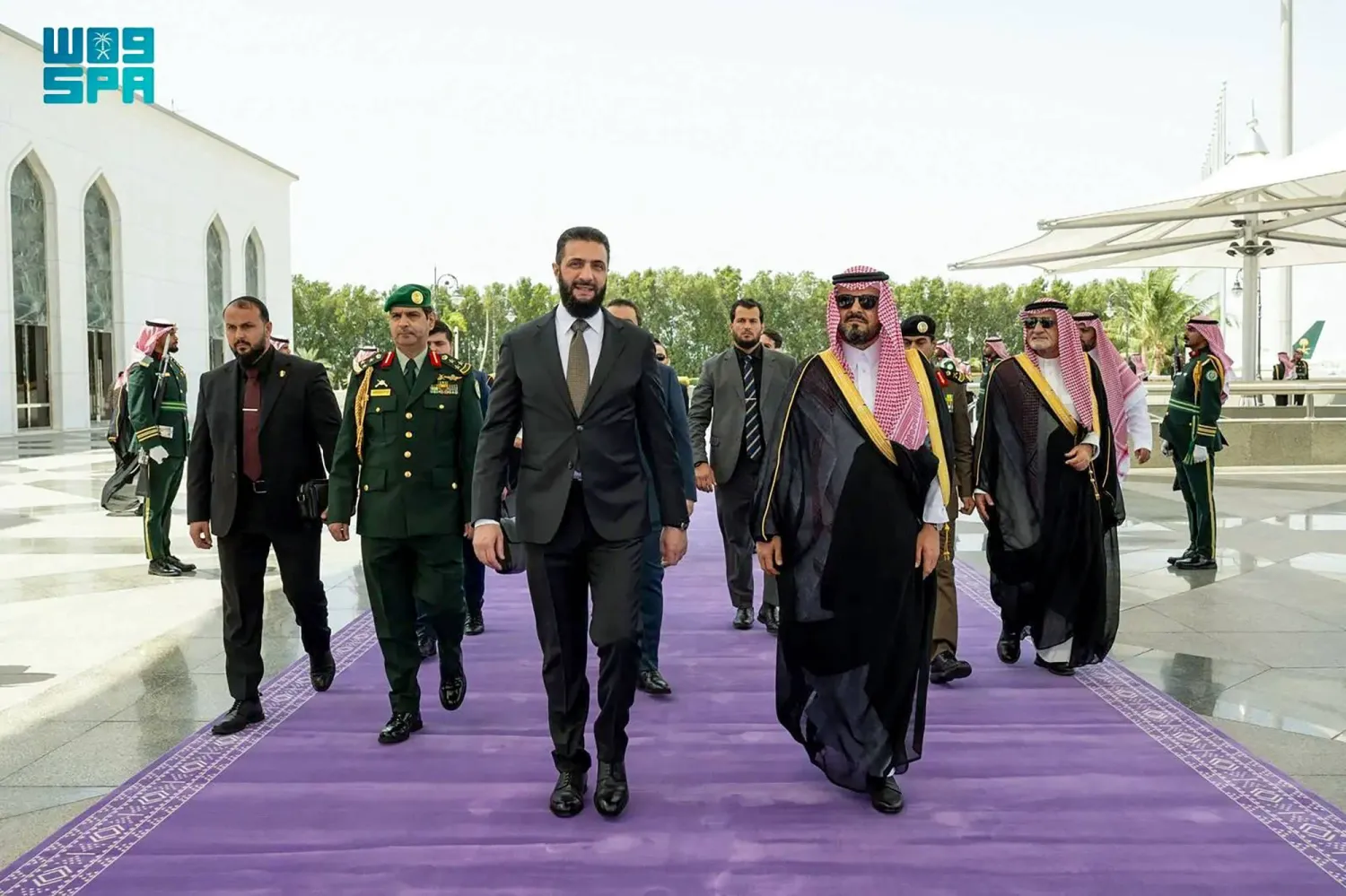
This handout picture provided by the Saudi Press Agency (SPA) shows the Deputy Governor of the Makkah Region Prince Saud bin Mishaal bin Abdulaziz, (C-R) welcoming Syrian President Ahmed al-Sharaa upon his arrival in Jeddah, on April 21, 2026. (SPA)
TT

Syrian President Arrives in Jeddah on Official Visit

This handout picture provided by the Saudi Press Agency (SPA) shows the Deputy Governor of the Makkah Region Prince Saud bin Mishaal bin Abdulaziz, (C-R) welcoming Syrian President Ahmed al-Sharaa upon his arrival in Jeddah, on April 21, 2026. (SPA)

Syrian President Ahmed al-Sharaa arrived in Saudi Arabia on an official visit.

He was welcomed at Jeddah’s King Abdulaziz International Airport by Deputy Governor of the Makkah Region Prince Saud bin Mishaal bin Abdulaziz.

He is expected to meet with Prince Mohammed bin Salman, Crown Prince and Prime Minister.

They are set to hold talks on efforts to bolster bilateral ties, as well as issues of common interest, said Syria’s state news agency SANA.

Sharaa is on a tour of the Gulf.


Gulf Underscores Support for Lebanon’s Security, Stability

Secretary-General of the Gulf Cooperation Council Jasem Mohamed Albudaiwi speaks at the symposium in Riyadh on Tuesday. (GCC)
TT

Gulf Underscores Support for Lebanon’s Security, Stability

Secretary-General of the Gulf Cooperation Council Jasem Mohamed Albudaiwi speaks at the symposium in Riyadh on Tuesday. (GCC)

Secretary-General of the Gulf Cooperation Council Jasem Mohamed Albudaiwi stressed on Tuesday the council’s firm support for Lebanon and everything that can bolster its security, stability and sovereignty.

Albudaiwi sponsored a symposium on GCC relations with Lebanon, “Challenges and Drivers”, organized by the Political Affairs and Negotiations Sector at the General Secretariat in Riyadh. The event was attended by a number of ambassadors to Saudi Arabia, as well as officials and experts.

Albudaiwi said GCC countries “view Lebanon as an integral part of its Arab surroundings and an important pillar of regional stability.”

“Relations between the GCC countries and Lebanon are historic and robust, built and consolidated on many foundations and bonds, foremost among them the bond of brotherhood, which has remained unchanged despite all developments and circumstances,” he stressed.

The leaders of GCC countries have repeatedly underlined the need for the full implementation of United Nations Security Council resolution 1701 in Lebanon. They have also repeatedly expressed their support for Lebanon’s state institutions, added Albudaiwi.

“The GCC welcomes the steps taken by the government to extend the state’s control over all Lebanese territory and ensure that arms are held exclusively by the state, as an indispensable foundation for restoring stability and building trust with the Arab and international communities,” he went on to say.

“During our visits to Beirut and our meetings with Lebanese leaders, we were keen to convey a clear message that the GCC countries will remain an active partner in supporting Lebanon and its recovery,” he remarked.

He acknowledged the complex challenges Lebanon is currently facing, which require concerted international efforts to support and assist it.

He noted that the recent war between Israel and Hezbollah, which resulted in the displacement of more than a million people and left more than 2,000 dead, places Lebanon before a major humanitarian and security challenge.

Albudaiwi stressed the importance of strengthening cooperation with the international community and regional organizations to support the capabilities of the Lebanese army, control borders, and combat smuggling and illicit activities, “to restore Lebanon’s position as a trusted partner within its Arab and international surroundings.”

“GCC countries will remain by Lebanon’s side,” he declared.

“Lebanon’s future begins from within, through the will of its people and their ability to build a strong and stable state,” he stressed.

He expressed confidence that Lebanon “is capable of overcoming its crises and returning to its natural role within its Arab surroundings, with the support of its brothers and friends, the determination of its people, and the wisdom of its leadership.”


Saudi, Italian Defense Ministers Discuss Partnership, Regional Developments

Saudi Minister of Defense Prince Khalid bin Salman bin Abdulaziz meets with his Italian counterpart Guido Crosetto in Jeddah on Tuesday. (SPA)
TT

Saudi, Italian Defense Ministers Discuss Partnership, Regional Developments

Saudi Minister of Defense Prince Khalid bin Salman bin Abdulaziz meets with his Italian counterpart Guido Crosetto in Jeddah on Tuesday. (SPA)

Saudi Minister of Defense Prince Khalid bin Salman bin Abdulaziz held talks in Jeddah on Tuesday with his Italian counterpart Guido Crosetto, reported the Saudi Press Agency.

They reviewed Saudi-Italian partnership relations and ways to further develop them in the military and defense fields.

They also discussed the latest regional and international developments, as well as coordination of joint efforts to boost regional security and stability.


Saudi Govt: Alternative Export Routes Have Bolstered Our Ability to Supply the World with Energy

Prince Mohammed bin Salman bin Abdulaziz Al Saud, Crown Prince and Prime Minister, chairs the Cabinet meeting in Jeddah. (SPA)
TT

Saudi Govt: Alternative Export Routes Have Bolstered Our Ability to Supply the World with Energy

Prince Mohammed bin Salman bin Abdulaziz Al Saud, Crown Prince and Prime Minister, chairs the Cabinet meeting in Jeddah. (SPA)

The Saudi government stressed on Tuesday that the Kingdom’s decades-long investments in energy security and alternative export routes have bolstered its ability to supply the world with energy during the most challenging circumstances despite geopolitical tensions in the region and their repercussions on global supply chains.

Prince Mohammed bin Salman bin Abdulaziz Al Saud, Crown Prince and Prime Minister, chaired the Cabinet session that was held in Jeddah.

The ministers reviewed developments related to maritime traffic in the Strait of Hormuz. Crown Prince Mohammed briefed them on his telephone call with China’s President Xi Jinping and meetings with Chairman of Sudan’s Transitional Sovereignty Council Abdel Fattah Al-Burhan, Prime Minister of Pakistan Muhammad Shehbaz Sharif, and President of the European Council Antonio Costa.

On behalf of Custodian of the Two Holy Mosques King Salman bin Abdulaziz Al Saud, the Crown Prince welcomed pilgrims arriving from around the world to Saudi Arabia to perform the Hajj, underlining the Kingdom’s pride in serving the Grand Mosque of Makkah and the Prophet's Mosque of Madinah.

Crown Prince Mohammed directed that all resources and capabilities be utilized to ensure the success of the organizational, security, and preventative plans adopted for this year's Hajj, and to continue providing the highest quality services and facilities to the pilgrims in Makkah, Madinah, the holy sites, and at air, land, and sea ports of entry.

The cabinet convened in Jeddah on Tuesday. (SPA)

The Cabinet discussed the outcomes of the Kingdom’s participation in recent international meetings. These engagements reflect Saudi Arabia’s ongoing support for multilateral action, which strengthens consultation and coordination regarding regional and global challenge, helping foster dialogue and diplomatic solutions while reinforcing international security and peace.

On the domestic level, the Cabinet welcomed the launch of the Public Investment Fund’s five-year strategy, which aligns with the third phase of Saudi Vision 2030. The strategy focuses on building highly competitive local economic systems that boost international leadership, support assets and sustainable returns, and increase the private sector's contribution to national development.

The Cabinet commended the historic performance of non-oil exports in 2025, which achieved an annual growth rate of 15% compared to 2024. The milestone reflects the success of national efforts aimed at developing exports, expanding the Kingdom's export base, and strengthening its position among the world's fastest-growing economies.

The Cabinet highlighted the Kingdom's achievement of first place globally in the digital readiness framework, issued by the International Telecommunication Union, saying it confirms Saudi Arabia's status as a leading international hub for the digital economy and artificial intelligence. It also confirms it as an attractive destination for investment and innovation supported by rapid strides toward a prosperous and sustainable future.