


Foreign Ministers of Arab, Islamic Countries Condemn Israeli Violations in Jerusalem

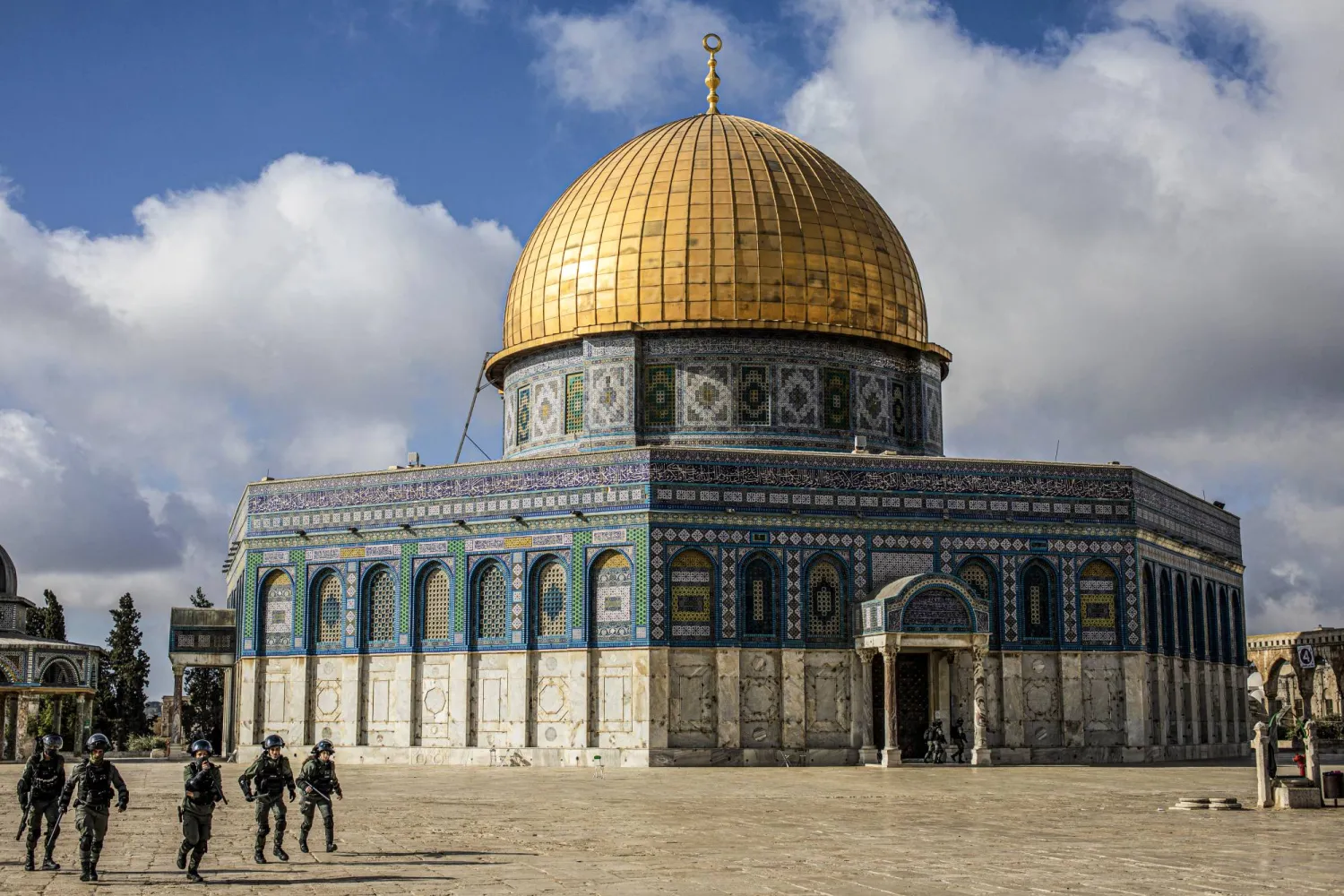
FILED - 05 May 2022, ---, Jerusalem: Israeli security officers patrol in front of the Dome of the Rock mosque at the Al-Aqsa mosque compound in the Old City of Jerusalem. Photo: Ilia Yefimovich/dpa
TT

Foreign Ministers of Arab, Islamic Countries Condemn Israeli Violations in Jerusalem

FILED - 05 May 2022, ---, Jerusalem: Israeli security officers patrol in front of the Dome of the Rock mosque at the Al-Aqsa mosque compound in the Old City of Jerusalem. Photo: Ilia Yefimovich/dpa

The foreign ministers of several Arab and Muslim countries have condemned the repeated Israeli violations of the historic and legal status quo in Jerusalem’s Islamic and Christian holy sites, particularly the continued incursions by settlers and extremist ministers into Al-Aqsa Mosque compound under Israeli police protection, as well as the raising of the Israeli flag within its courtyards.

The foreign ministers of Saudi Arabia, Jordan, the United Arab Emirates, Qatar, Indonesia, Pakistan, Egypt, and Türkiye reiterated that these provocative actions at Al-Aqsa Mosque constitute a flagrant violation of international law and international humanitarian law, and represent an unacceptable provocation to Muslims around the world, and a flagrant violation of the sanctity of the holy city.

They reaffirmed their categorical rejection of any attempts to alter the historic and legal status quo in Jerusalem and its Islamic and Christian holy sites, and stressed its preservation while recognizing the special role of the historic Hashemite custodianship in this regard.

The ministers reiterated that the entire area of Al-Aqsa Mosque, which amounts to 144 dunams, is a place of worship exclusively for Muslims, and that the Jerusalem Endowments and Al-Aqsa Mosque Affairs Department, affiliated with the Jordanian Ministry of Awqaf and Islamic Affairs, is the legal entity with exclusive jurisdiction to administer the affairs of the blessed Al-Aqsa Mosque and to regulate entry thereto.

The ministers further condemned the accelerating illegal settlement activity, including Israel’s decision to approve over 30 new settlements, which constitutes a flagrant violation of international law, including United Nations Security Council resolutions and the 2024 advisory opinion of the International Court of Justice.

They also condemned the continued and escalating settler violence against Palestinians in the occupied West Bank, including recent attacks on Palestinian schools and children, and called for those responsible to be held accountable.

They emphasized that Israel has no sovereignty over the Occupied Palestinian Territory.

The ministers stressed that such actions constitute a deliberate and direct attack on the viability of the Palestinian State and on the implementation of the two-state solution, increase tensions, undermine peace efforts, and hinder ongoing initiatives aimed at de-escalation and the restoration of stability.

They called on Israel to assume full responsibility, condemn these hostile acts, and hold perpetrators accountable.

The ministers reiterated their call for the international community to uphold its legal and moral responsibilities and compel Israel to halt its dangerous escalation in the occupied West Bank, and to put an end to its illegal practices.

They also called on the international community to intensify all efforts to advance a political solution that achieves a comprehensive peace based on the two-state solution.

The ministers reiterated their unwavering support for the legitimate rights of the Palestinian people, particularly their right to self-determination and to establish a state along the June 4, 1967 lines, with East Jerusalem as its capital.



Iraq Vows No Leniency with Parties Harming Ties with Saudi Arabia

Iraqi government spokesman Bassem al-Awadi. (INA)
TT

Iraq Vows No Leniency with Parties Harming Ties with Saudi Arabia

Iraqi government spokesman Bassem al-Awadi. (INA)

Iraq said it was ready to cooperate fully in verifying any information about an attack on Saudi Arabia that was launched from its territory, renewing its condemnation of the incident and vowing measures to prevent any breach of Iraqi sovereignty.

The Iraqi government’s latest condemnation came a day after the Foreign Ministry denounced the attacks on the Kingdom, in what observers said signaled Prime Minister Ali al-Zaidi’s new government was keen to protect ties with Saudi Arabia and other Gulf states.

Saudi Arabia’s Defense Ministry said on Sunday it had intercepted and destroyed three drones after they entered the Kingdom’s airspace from Iraq.

Iraqi government spokesman Bassem al-Awadi renewed Baghdad’s condemnation on Tuesday, saying Iraq “reaffirms its firm and historic position in support of distinguished and lasting relations with brotherly and friendly countries of the region, its commitment to the security of Arab states, the importance of supporting stability, all efforts to ease tensions, and preventing attacks, whatever their source.”

“The Iraqi government condemns the recent drone attacks that targeted Saudi Arabia and affirms its continued joint efforts to strengthen regional security and safeguard the security and sovereignty of countries in the region,” he said.

Awadi repeated that the military authorities did not detect or record any activity from the country’s airspace, stressing, however, that Iraqi institutions were fully ready “to cooperate in verifying any information related to the circumstances of the attack that targeted the Kingdom.”

He stressed Iraq’s “categorical rejection of the use of its territory, airspace or territorial waters to launch any attack on neighboring countries.”

Awadi said Iraqi security forces had taken “all necessary steps and measures to thwart and uncover any attempt in this context,” adding that there would be “no leniency toward anyone who tries to violate the sovereignty of the Iraqi state or damage relations with the Kingdom, neighboring countries or brotherly states.”

Observers are now raising questions over how Zaidi will deal with pro-Iran armed factions and confront their activities at home and abroad, particularly under continued US pressure.

In recent months, after the outbreak of the US-Israeli war against Iran, factions launched hundreds of attacks on targets inside Iraq, most of them in the northern Kurdistan region.

They also carried out attacks on more than one country in Iraq’s regional neighborhood. Those attacks stopped during the ceasefire, before resuming with three drones over Saudi territory.

Many believe the factions’ latest attacks pose a serious challenge to Zaidi’s authority. The prime minister, whose government was approved by parliament last week, has received clear US, domestic and Arab backing, a development that was not welcomed by the factions, which are seeking to embarrass him at the start of his tenure in Iraq’s top executive post.


Bahrain Suspends Entry of Foreign Travelers Arriving from Three Countries Amid Ebola Fears

A view of Bahrain's capital Manama. (Getty Images file)
TT

Bahrain Suspends Entry of Foreign Travelers Arriving from Three Countries Amid Ebola Fears

A view of Bahrain's capital Manama. (Getty Images file)

Bahrain said on Tuesday it was suspending the entry of foreign travelers arriving from South Sudan, ‌the Democratic ‌Republic of ‌Congo ⁠and Uganda due ⁠to the Ebola virus outbreak.

The suspension will be effective for ⁠30 days ‌starting Tuesday, ‌according to ‌the country's ‌state news agency.

The World Health Organization expressed deep ‌concern on Tuesday at the speed ⁠and ⁠scale of the Ebola outbreak, as the number of cases rises.


UAE Says Drones Targeting Nuclear Plant Came from Iraq

The United Arab Emirates flag flutters against the backdrop of the Abu Dhabi Skyline following a reported Iranian strike, March 1, 2026. (AFP)
TT

UAE Says Drones Targeting Nuclear Plant Came from Iraq

The United Arab Emirates flag flutters against the backdrop of the Abu Dhabi Skyline following a reported Iranian strike, March 1, 2026. (AFP)

The United Arab Emirates on Tuesday said drones that targeted its nuclear plant last week came from Iraq, from where Iranian-backed groups have launched several attacks since the Middle East war began.

On Sunday, an unclaimed drone struck an electrical generator near the Arab world's only nuclear power plant in Barakah in the emirate of Abu Dhabi, triggering a fire but causing no injuries or radiation leak. Two other drones had been intercepted.

"As part of the ongoing investigation into the blatant attack on the Barakah Nuclear Power Plant on May 17, 2026, technical tracking and monitoring confirmed that the three drones... all originated from Iraqi territory," the Emirati defense ministry said.

Authorities intercepted six drones that also came from Iraq and "attempted to target civilian and vital areas" in the past 48 hours, the ministry added.

Iraqi authorities had already condemned the attack on Barakah before Abu Dhabi announced where the drones came from.

Iran has attacked the UAE and other Gulf nations since the US and Israel launched strikes on the country on February 28, targeting US assets but also energy and civilian infrastructure.

Iran-backed groups in Iraq have not claimed any strikes since the truce came into place, though Gulf countries have reported attacks from Iraq.

On Sunday, Saudi Arabia had reported intercepting drones that came from Iraq, while Baghdad said its defense systems had not detected any drones launched from its territory toward the Kingdom.