

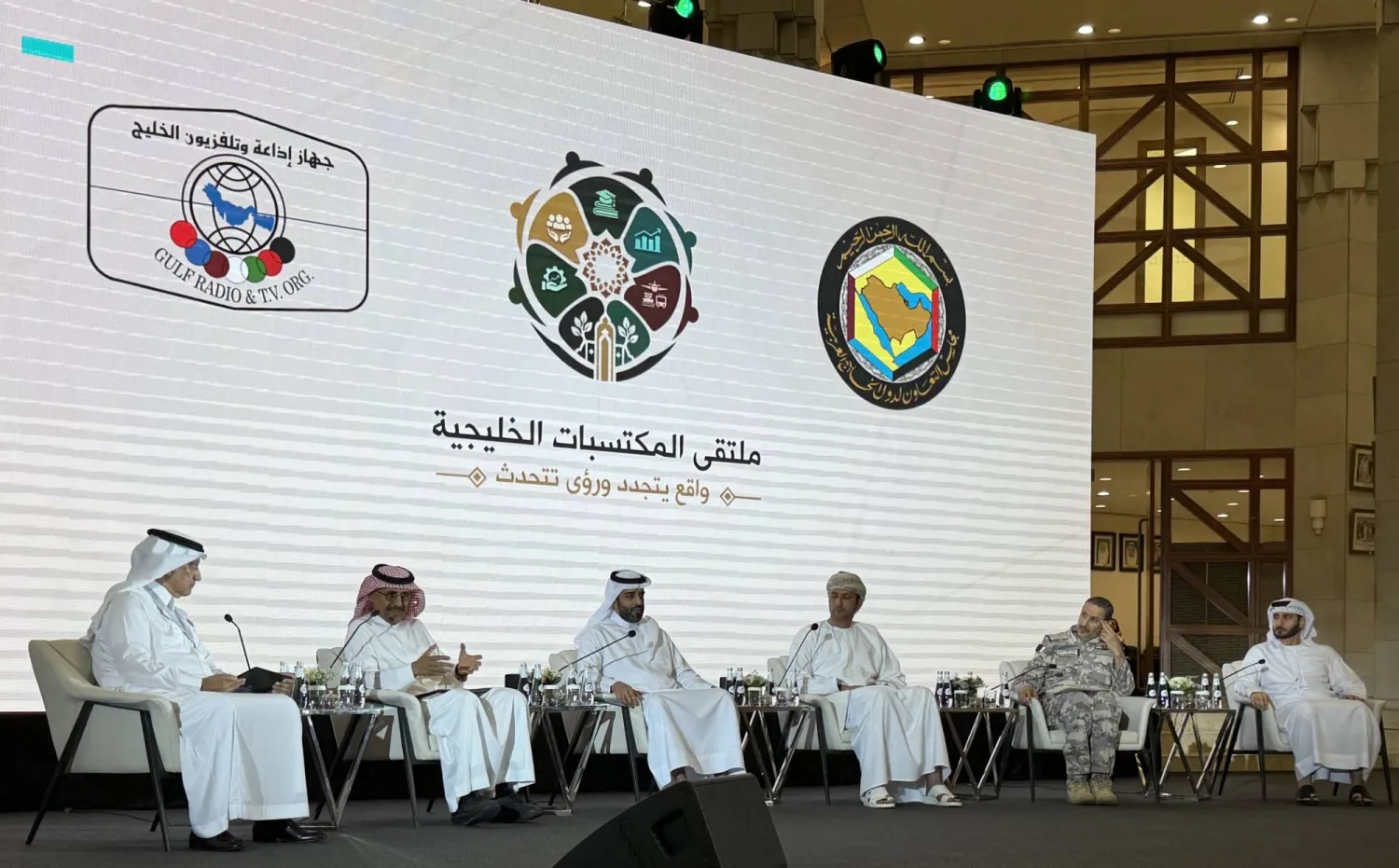

GGC Highlights its Achievements at Riyadh Forum

GCC officials speak at the Gulf Achievements Forum in Riyadh on Monday. (Asharq Al-Awsat)
TT

GGC Highlights its Achievements at Riyadh Forum

GCC officials speak at the Gulf Achievements Forum in Riyadh on Monday. (Asharq Al-Awsat)

Jasem Mohamed Albudaiwi, Secretary General of the Gulf Cooperation Council (GCC), said on Monday that during a 45-day period, GCC countries were the target of 7,000 attacks by Iran and its proxies.

Speaking at the Gulf Achievements Forum in Riyadh, he stressed that the GCC countries were no longer a merely a regional bloc united by geography and history, but they have become a global strategic power where opportunities are created and models of development, prosperity, security, and stability are built.

“The ultimate objective of holding the Gulf Achievements Forum is to enhance awareness of the achievements that were never merely temporary accomplishments or economic indicators, but rather the result of an integrated Gulf system through which the founding leaders of the GCC,” he added.

The leaders of the GCC countries, have sought over past and present decades, to transform challenges into opportunities through integration across all areas of joint Gulf action, he went on to say.

“This has directly contributed to improving the quality of life of GCC citizens, boosting their welfare and stability, and strengthening the standing of the GCC regionally and internationally,” remarked Albudaiwi.

He expressed pride in the achievements accomplished in the fields of political integration, military and security cooperation, economic integration, infrastructure, digital transformation, education, health, media, electricity interconnection, food security and other vital sectors that have helped in strengthening the competitiveness of the GCC countries and consolidating their position as an influential regional and international hub.

“One of the most distinctive features of the Gulf experience is that the GCC citizen has always been, and remains, the focus and ultimate objective of development,” he said. “These achievements have had a direct impact on their lives through freedom of movement, employment, ownership, investment, education and healthcare across the GCC countries.”

He revealed that 95% of traffic connectivity between the GCC countries has been achieved. The countries have adopted a dedicated strategy to combat money laundering, he added, noting that there is high-level coordination among the interior ministers of the GCC countries to unify the drug control strategy.

“The future of the GCC is not measured only by the scale of the achievements made, but by our ability to build upon them and transform them into sustainable gains that meet the aspirations of our peoples and future generations,” Albudaiwi told the audience.

“The next phase requires intensified joint Gulf efforts, strengthened integration across all fields, and the building of a Gulf economy capable of competing globally, thereby consolidating the position of the GCC countries as an influential global partner in shaping the economy of the future and sustainable development.”

Assistant Secretary-General for Economic Affairs, Gulf Cooperation Council Khaled Al-Senaidi stressed that the development aspect is present in all GCC systems, including a set of regulations that have been issued and have led to achievements in the field of human rights.

Figures show that joint Gulf cooperation is progressing rapidly, including the common market and the customs union, he said.

GCC Assistant Secretary-General for military Affairs Eisa Al-Mohannadi stressed that among the most important achievements are the activation of the unified military command in the Naval Command in Bahrain, the unified air command in Riyadh, and the Peninsula Shield Force in Hafr Al-Batin.

He also underscored the joint defense agreement that says that any threat or attack on a GCC country is a tantamount to an attack on all Gulf countries.

On military industrialization, he revealed coordination and integration in this field among the GCC countries, highlighting their ambitions to establish a joint air defense system. He also announced that an early warning system to counter threats will be launched soon.

On the security level, he highlighted achievements in combating money-laundering and terror financing.

The Gulf Achievements Forum was organized by the General Secretariat of the GCC in cooperation with the Gulf Radio and Television Organization (GRTO). It was attended by a number of senior media officials from the GCC countries, specialists, and GCC students studying at universities in Saudi Arabia.


Saudi Arabia, the UK to Support Vulnerable Groups in Yemen with $10 Million

Advisor at the Royal Court and Supervisor General of KSrelief Dr. Abdullah Al Rabeeah signs the agreement. SPA
TT

Saudi Arabia, the UK to Support Vulnerable Groups in Yemen with $10 Million

Advisor at the Royal Court and Supervisor General of KSrelief Dr. Abdullah Al Rabeeah signs the agreement. SPA

Advisor at the Royal Court and Supervisor General of the King Salman Humanitarian Aid and Relief Center (KSrelief) Dr. Abdullah Al Rabeeah and Acting Executive Director of the World Food Programme (WFP) Carl Skau have signed a cooperation agreement to support vulnerable groups in several Yemeni governorates.

The agreement forms part of Saudi Arabia's humanitarian and relief projects and programs delivered through its humanitarian arm, KSrelief, to assist people in need and those affected by crises around the world.

The agreement was signed on Tuesday via video conference in the presence of UK Deputy Ambassador to Saudi Arabia Dr. Alice Burt.

Under the agreement, KSrelief and the UK Foreign, Commonwealth and Development Office will each contribute half of a $10 million financial package to the WFP to support the project in Yemen's Al-Mahrah, Hadhramout, Aden, Al-Dhale, and Lahij governorates.

The agreement aims to address the food needs of the most vulnerable groups by providing asset-creation support activities for beneficiaries and improving their access to food through conditional cash transfers, enabling them to become less dependent on humanitarian assistance.

The project also includes rehabilitating productive infrastructure, helping targeted households transition from Phase 4 acute food insecurity to greater stability and self-reliance, implementing vocational training programs, developing beneficiaries' skills to enhance productivity, strengthening the capacities of local authorities, and activating governance systems to manage and sustain community assets.


Kuwait, Bahrain Say Intercepted Iran Attacks

Smoke rises after a drone was intercepted during early morning hours in Manama, Bahrain, July 14, 2026. REUTERS/Stringer
TT

Kuwait, Bahrain Say Intercepted Iran Attacks

Smoke rises after a drone was intercepted during early morning hours in Manama, Bahrain, July 14, 2026. REUTERS/Stringer

Kuwait and Bahrain on Wednesday confirmed they had intercepted fresh aerial salvos from Iran as Tehran and Washington exchanged fire over control of the Strait of Hormuz.

Kuwait's military said it was intercepting attack drones, and blamed "nefarious Iranian aggression,” with Bahrain's army later saying it "succeeded in intercepting and destroying a number of the treacherous Iranian aerial attacks.”

In the early hours of the morning, Bahrain's interior ministry said it had sounded warning sirens and urged citizens and residents to remain calm and head to the nearest safe place.

Iranian state media reported Wednesday that Iran carried out separate attacks on US targets in Kuwait and Bahrain after US forces struck Iran.


Arab, Islamic Countries Slam Terrorist Houthi Attack against Saudi Arabia

A view of Riyadh, Saudi Arabia. (SPA)
TT

Arab, Islamic Countries Slam Terrorist Houthi Attack against Saudi Arabia

A view of Riyadh, Saudi Arabia. (SPA)

The Iran-backed Houthi militias’ terrorist attack against Saudi Arabia on Monday sparked Arab and international outcry and condemnation of what was seen as a violation of international law and a direct threat to the security of the region.

The United States declared its solidarity with Saudi Arabia in confronting the latest Houthi attacks, saying the strategic relationship between Washington and Riyadh was stronger.

The State Department said the Houthi group remains designated as a foreign terrorist organization. It added that efforts to protect marine navigation in the Red Sea and combat terrorist groups in Yemen continue.

The Saudi Defense Ministry had said on Monday that its air defenses shot down ballistic missiles fired by the Houthis against the Kingdom.

Condemnations poured in from Bahrain, Kuwait, Qatar, Oman, Jordan, Egypt and Lebanon.

The statements warned that the attack was a dangerous escalation that undermines regional security and stability.

They expressed solidarity with the Kingdom and support for the measures it takes in defending its sovereignty and security.

Bahrain hailed the vigilance of the Saudi defenses in intercepting the attack and saving lives and its efforts in leading the Coalition to Support Legitimacy in Yemen.

Kuwait slammed the attack as a violation of the Kingdom’s sovereignty and of international law.

Oman called on all Yemeni parties to show restraint, commit to the truce and return to the negotiations table under the UN-sponsored process.

Lebanese President Joseph Aoun said the attacks against Saudi Arabia and Jordan were “systematic attempts to undermine the stability of the Arab Gulf and keep the region in a cycle of tensions in service of plots that harbor no goodwill towards the Arab people.”

He expressed Lebanon’s solidarity with Saudi Arabia, the Gulf and Jordan, saying their security and stability were an “integral part of national Arab security.”

Lebanese Prime Minister Nawaf Salam echoed Aoun’s remarks, adding that Beirut stands by Saudi Arabia and its legitimate right to take the suitable measures to defend its territories and people.

He warned that the “continuation of these attacks reveals a dangerous insistence on undermining efforts to achieve security and stability in the Arab Gulf region.”

The Muslim World League condemned the terrorist attack against Saudi Arabia that “violates religious values and international laws and norms.”

“The cowardly attack violates all humanitarian values,” added MWL Secretary-General Sheikh Dr. Mohammed Al-Issa.

Gulf Cooperation Council Secretary General Jasem Albudaiwi stressed that the “cowardly attack is a flagrant violation of international law and international humanitarian law.”

He called for a “firm and deterrent international stance to put an end to its hostile practices and ensure those responsible are held accountable.”
