


Saudi Interior Minister Meets Jordanian, Malaysian Counterparts

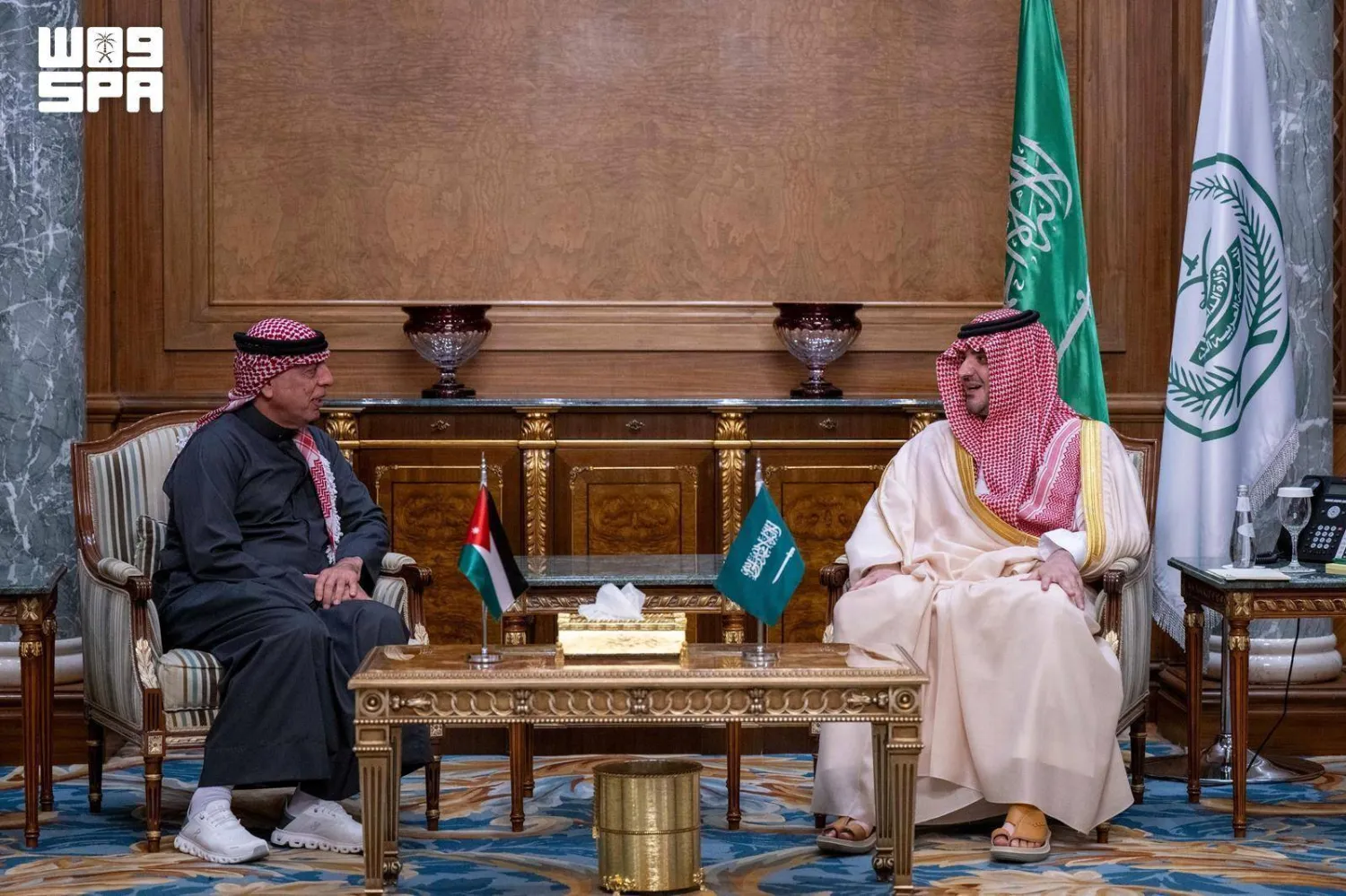
Saudi Minister of Interior and Chairman of the Supreme Hajj Committee Prince Abdulaziz bin Saud bin Naif bin Abdulaziz receives his Jordanian counterpart Mazen Al-Faraya  in Makkah on Thursday. (SPA)
Saudi Minister of Interior and Chairman of the Supreme Hajj Committee Prince Abdulaziz bin Saud bin Naif bin Abdulaziz receives his Jordanian counterpart Mazen Al-Faraya in Makkah on Thursday. (SPA)
TT

Saudi Interior Minister Meets Jordanian, Malaysian Counterparts

Saudi Minister of Interior and Chairman of the Supreme Hajj Committee Prince Abdulaziz bin Saud bin Naif bin Abdulaziz receives his Jordanian counterpart Mazen Al-Faraya  in Makkah on Thursday. (SPA)
Saudi Minister of Interior and Chairman of the Supreme Hajj Committee Prince Abdulaziz bin Saud bin Naif bin Abdulaziz receives his Jordanian counterpart Mazen Al-Faraya in Makkah on Thursday. (SPA)

Saudi Minister of Interior and Chairman of the Supreme Hajj Committee Prince Abdulaziz bin Saud bin Naif bin Abdulaziz received in Makkah on Thursday his Jordanian counterpart Mazen Al-Faraya and Minister of Home Affairs of Malaysia Datuk Seri Saifuddin Nasution bin Ismail.

The separate meetings discussed security cooperation and coordination between their countries. The ministers also reviewed several issues of mutual interest.

The Jordanian and Malaysian ministers praised the capabilities and integrated services provided by the Kingdom of Saudi Arabia to serve Hajj pilgrims. They commended the high level of organization and coordination within the Hajj system, which allowed pilgrims to perform their rituals with ease and tranquility.

Also on Thursday, Prince Abdulaziz bin Saud reviewed the workflow at several health facilities operated by the Ministry of Interior’s medical services at the holy sites.

He inspected the Ministry of Interior Medical Services Clinics Complex and reviewed its specialized medical, pharmaceutical, and laboratory clinics, in addition to critical-care units and support services operating within the healthcare system provided to pilgrims under the supervision of specialized medical, technical, and administrative personnel.

The minister viewed a visual presentation highlighting the efforts of the ministry’s medical services during the Hajj season, the healthcare-provider network, field and seasonal teams and clinics, as well as hospitals and medical centers operating in Makkah, Madinah, and the holy sites.

Prince Abdulaziz bin Saud further reviewed the Medical Services Command and Control Center during the Hajj and its real-time monitoring capabilities for health-facility readiness, case movement, deployment of field teams, and operational-performance indicators. The capabilities support rapid decision-making and boost the efficiency of field medical response.

The tour included the Ministry of Interior Medical Services Field Hospital in Arafat, where the minister reviewed the medical and treatment services provided, including emergency, intensive-care, and resuscitation departments, heat-exhaustion and heatstroke treatment units, as well as preventive, laboratory, and pharmaceutical services.

The minister reviewed efforts by the medical services in operating mobile clinics, medical vehicles, and field teams to provide first aid, health awareness, and preventive guidance and reduce health risks associated with heat exhaustion and infectious diseases.

The efforts included employing modern technologies to enhance field healthcare through the smart health bracelet, visual communication technologies supporting field teams medically, and the use of drones to deliver medical supplies when needed.


Saudi-Lebanese Security Cooperation Foils Smuggling of Nearly 4 Million Amphetamine Pills

Security cooperation between the Kingdom and Lebanon contributed to tracking and seizing the narcotic substances (Saudi Ministry of Interior).
TT

Saudi-Lebanese Security Cooperation Foils Smuggling of Nearly 4 Million Amphetamine Pills

Security cooperation between the Kingdom and Lebanon contributed to tracking and seizing the narcotic substances (Saudi Ministry of Interior).

Information provided by Saudi Arabia’s Ministry of Interior helped Lebanese authorities foil an attempt to smuggle nearly 3.9 million amphetamine pills, the ministry said on Friday.

The seizure was made following intelligence shared by the Saudi ministry’s General Directorate of Narcotics Control as part of efforts to monitor criminal networks involved in drug trafficking, the ministry's security spokesperson Brigadier General Talal bin Shalhoub said in a statement.

Bin Shalhoub said cooperation between Saudi and Lebanese authorities in tracking and intercepting narcotics reflected the level of security coordination between the two countries in combating cross-border criminal networks.

Saudi Arabia will continue to pursue drug-trafficking activities that threaten the kingdom’s security and youth, disrupt smuggling operations and arrest those involved, he added.


Riyadh to Host UNITAR’s First Cybersecurity Office

The office will help address global cybersecurity capacity gaps. (National Cybersecurity Authority) 
TT

Riyadh to Host UNITAR’s First Cybersecurity Office

The office will help address global cybersecurity capacity gaps. (National Cybersecurity Authority) 

The United Nations has selected Riyadh as the headquarters of the first cybersecurity-focused office of its training and research arm, the United Nations Institute for Training and Research (UNITAR).

The move reflects Saudi Arabia’s global leadership in the sector and the success of its cybersecurity model at the national, regional and international levels.

The office will spearhead initiatives and projects focused on capacity building, policy development, and joint research and development programs, helping to strengthen the skills of a broad range of beneficiaries and specialists while advancing cybersecurity globally.

Its objectives align with the Global Initiative for Building Cyber Capacities, launched by Saudi Arabia in partnership with the United Nations and its specialized agencies, particularly through research and development programs, training courses and workshops aimed at enhancing the capabilities of policymakers, law enforcement officials, diplomats and cybersecurity professionals worldwide.

Musaed Al Aiban, Minister of State, Member of the Council of Ministers, and Chairman of the NCA Board of Directors, praised the support the sector receives from Custodian of the Two Holy Mosques King Salman bin Abdulaziz and Crown Prince and Prime Minister Mohammed bin Salman.

He said the selection reflects the leadership’s continued commitment to promoting international cooperation and joint action in cybersecurity.

Al Aiban added that the decision underscores Saudi Arabia’s leading position in the strategic sector and the achievements of its cybersecurity model since the establishment of the NCA as the country’s competent authority and national reference body for cybersecurity. He also highlighted the creation of the Saudi Information Technology Company (SITE) as the authority’s strategic and technical partner in developing the sector.

Saudi Arabia has established a strong track record in supporting strategic cybersecurity initiatives, further cementing its standing as a preferred destination for international organizations and institutions, Al Aiban underlined. He added that the Kingdom has long championed international initiatives aimed at enhancing the stability of cyberspace, contributing to societal prosperity, economic growth and human well-being worldwide.

For his part, Majed Al Mazyed, Governor of the National Cybersecurity Authority, said the UN’s decision further reflects Saudi Arabia’s internationally recognized leadership in cybersecurity, as evidenced by a range of global benchmarks.

He noted that Saudi Arabia retained its position as the world’s top-ranked country in cybersecurity for a second consecutive year in the IMD World Competitiveness Yearbook 2025. He also pointed to the Kingdom’s designation by the International Telecommunication Union (ITU), the UN agency for information and communication technologies, as a “Role Model” in the highest tier of the Global Cybersecurity Index 2024.

Michelle McDonough, Executive Director of UNITAR, said the launch of the institute’s first cybersecurity office and the choice of Riyadh as its headquarters underscore Saudi Arabia’s leadership and its pivotal role in advancing international cybersecurity efforts.

She added that the office will work with partners to address cybersecurity capacity gaps globally and help transform shared risks into shared resilience by connecting institutions and organizations across regions.

Saudi Arabia already hosts several regional and international cybersecurity bodies, including the Arab Cybersecurity Ministers Council, the Global Cybersecurity Forum Foundation, and the Cyber Economics Center, established through a partnership between the foundation and the World Economic Forum.


UAE Categorically Denies Reports Alleging the Transfer of Funds to Iran

A view of the UAE capital, Abu Dhabi. (WAM)
TT

UAE Categorically Denies Reports Alleging the Transfer of Funds to Iran

A view of the UAE capital, Abu Dhabi. (WAM)

The United Arab Emirates categorically denied on Friday media reports alleging the transfer of funds from the UAE to Iran, including allegations concerning USD 3 billion.

In a statement, the Ministry of Foreign Affairs affirmed that these allegations are “entirely false and unfounded”, stressing that “no frozen Iranian funds have been released, transferred, or facilitated through the UAE.”

The Ministry called on media outlets “to exercise accuracy, rely on official sources, and refrain from publishing or circulating unverified information and unfounded allegations,” reported the UAE's state news agency WAM.
