

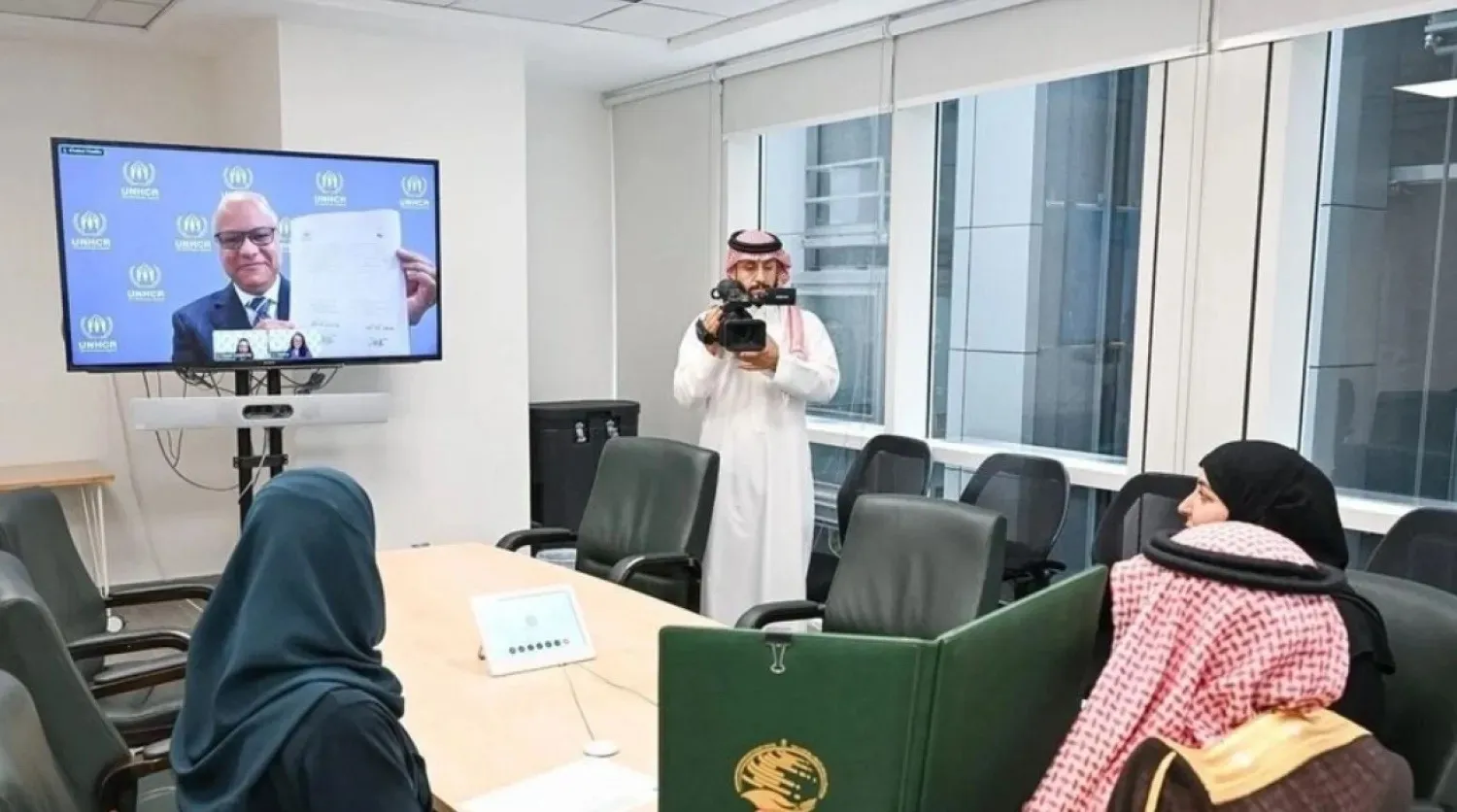

Saudi Arabia's KSrelief, UNHCR Sign Agreement to Boost Protection, Healthcare Services in Yemen

Officials at the virtual meeting between KSrelief and UNHCR. (UNHCR Office in Riyadh)
TT

Saudi Arabia's KSrelief, UNHCR Sign Agreement to Boost Protection, Healthcare Services in Yemen

Officials at the virtual meeting between KSrelief and UNHCR. (UNHCR Office in Riyadh)

The United Nations High Commissioner for Refugees (UNHCR) and the King Salman Humanitarian Aid and Relief Center (KSrelief) signed a $3.1 million agreement to strengthen protection and healthcare services for forcibly displaced people in Yemen.

The agreement will provide nearly 45,000 people with access to essential services, including civil documentation, legal aid, voluntary refugee return support, and primary healthcare, helping vulnerable families maintain stability and dignity amid Yemen’s deepening humanitarian crisis.

Under the agreement, UNHCR and its partners will support thousands of internally displaced people and refugees in obtaining identity and civil registration documents, enabling them to regain access to basic rights, protection mechanisms, and public services. The initiative will also offer legal assistance to address displacement-related challenges, including eviction threats, housing and property disputes, and personal status issues.

The effort is particularly critical as many displaced families lost identification documents while fleeing conflict, preventing them from enrolling children in school, accessing public services, or securing livelihoods.

The agreement will also support Somali refugees seeking voluntary return to Somalia through counseling services, documentation assistance, and safe sea and air transportation, helping reduce reliance on dangerous irregular migration routes.

Funding will further support services at three healthcare centers in Sana’a, Aden, and Kharaz Refugee Camp in the Lahij governorate, providing medical consultations and essential medicines to refugees and vulnerable host communities.

The agreement was signed during a virtual meeting between Eng. Ahmed bin Ali Al-Baiz, Assistant Supervisor General for Operations and Programs at KSrelief, and Dr. Khaled Khalifa, Senior Advisor to the UN High Commissioner for Refugees and UNHCR Representative to the Gulf Cooperation Council countries.

Al-Baiz reaffirmed KSrelief’s commitment to continuing its strategic partnership with UNHCR to strengthen protection services and expand access to essential assistance for displaced families, refugees, and host communities in Yemen.

He said the project reflects Saudi Arabia’s broader humanitarian efforts to alleviate suffering and build sustainable resilience among vulnerable populations.

Khalifa described the agreement as evidence of the deep strategic humanitarian partnership between UNHCR and Saudi Arabia, represented by KSrelief.

The contribution would help thousands of vulnerable people gain access to protection services, healthcare, and legal assistance, enabling them to live with greater dignity and security, he added.

Armen Yedigarian, Acting UNHCR Representative in Yemen, stressed that the support from KSrelief demonstrates a strong commitment to protecting Yemen’s most vulnerable communities and helping displaced families rebuild their lives with dignity.



GCC Secretary-General Condemns Iranian Attacks on Bahrain, Kuwait, and Jordan

Secretary-General of the Gulf Cooperation Council (GCC) Jasem Albudaiwi. SPA
TT

GCC Secretary-General Condemns Iranian Attacks on Bahrain, Kuwait, and Jordan

Secretary-General of the Gulf Cooperation Council (GCC) Jasem Albudaiwi. SPA

Gulf Cooperation Council (GCC) Secretary-General Jasem Albudaiwi expressed his strongest condemnation of the repeated hostile Iranian attacks targeting the Kingdom of Bahrain, the State of Kuwait, and the Hashemite Kingdom of Jordan.

Albudaiwi stated that Iran's continued targeting of civilian facilities and vital infrastructure undermines international and regional efforts aimed at promoting security and peace and resolving ongoing crises, SPA reported.

He also reaffirmed the GCC’s full support for all measures taken by Bahrain, Kuwait, and Jordan to strengthen their security and protect their territorial integrity.


Saudi Arabia Condemns Iranian Attacks, Calls for Diplomatic Engagement

Firefighters work to extinguish fire in the aftermath of Iranian drone attacks, according to Bahrain's Interior Ministry, at a location given as Bahrain, in this handout image released on June 11, 2026. Ministry of Interior of the Kingdom of Bahrain/Handout via REUTERS
TT

Saudi Arabia Condemns Iranian Attacks, Calls for Diplomatic Engagement

Firefighters work to extinguish fire in the aftermath of Iranian drone attacks, according to Bahrain's Interior Ministry, at a location given as Bahrain, in this handout image released on June 11, 2026. Ministry of Interior of the Kingdom of Bahrain/Handout via REUTERS

Saudi Arabia strongly condemned on Thursday the repeated Iranian attacks on Jordan, Bahrain and Kuwait, and the continued violations of their sovereignty which “escalate tensions in the region.”

A Foreign Ministry statement called for “de-escalation, the avoidance of any further escalation, and the exercise of wisdom by returning to diplomatic engagement and continuing the constructive negotiations” sponsored by Pakistan, along with the efforts exerted by Qatar.

Such a move “spares the region and its people the consequences of the return of war and contributes to the restoration of security and stability in the region and the world,” the statement added.


Saudi Arabia Stresses Centrality of Palestinian Cause for Arab World

The Saudi flag. Asharq Al-Awsat
TT

Saudi Arabia Stresses Centrality of Palestinian Cause for Arab World

The Saudi flag. Asharq Al-Awsat

Permanent Representative of Saudi Arabia to the United Nations Dr. Abdulaziz Alwasil affirmed the centrality of the Palestinian cause for the Arab world, saying achieving a just, comprehensive, and lasting peace in the Middle East requires ending the Israeli occupation and enabling the Palestinian people to exercise their inalienable right to self-determination.

In a statement delivered on behalf of the Arab Group during a high-level Security Council meeting on the Middle East, Alwasil also referred to recent Iranian attacks targeting several Gulf states and Jordan, describing them as violations of the principles of good neighborliness, international law, and the United Nations Charter.

He stressed the need to respect state sovereignty and avoid actions that threaten regional security and stability.

He further condemned the continued Israeli aggression against Lebanon, reaffirming rejection of any violation of Lebanon’s sovereignty or targeting of its army, and stressing the importance of complying with international resolutions and respecting states’ sovereignty and territorial integrity.

Alwasil also denounced repeated Israeli incursions and attacks on Syrian territory, stressing the Arab Group’s rejection of such violations, which undermine Syria’s sovereignty and threaten regional security and stability.

He emphasized the importance of political solutions, dialogue, and mediation as the most effective means of addressing regional crises and resolving conflicts peacefully, thereby contributing to security, stability, and development for the peoples of the Middle East.