


Saudi Arabia, Arab and Islamic Countries Condemn Israeli Settlers’ Incursions into Al-Aqsa Mosque

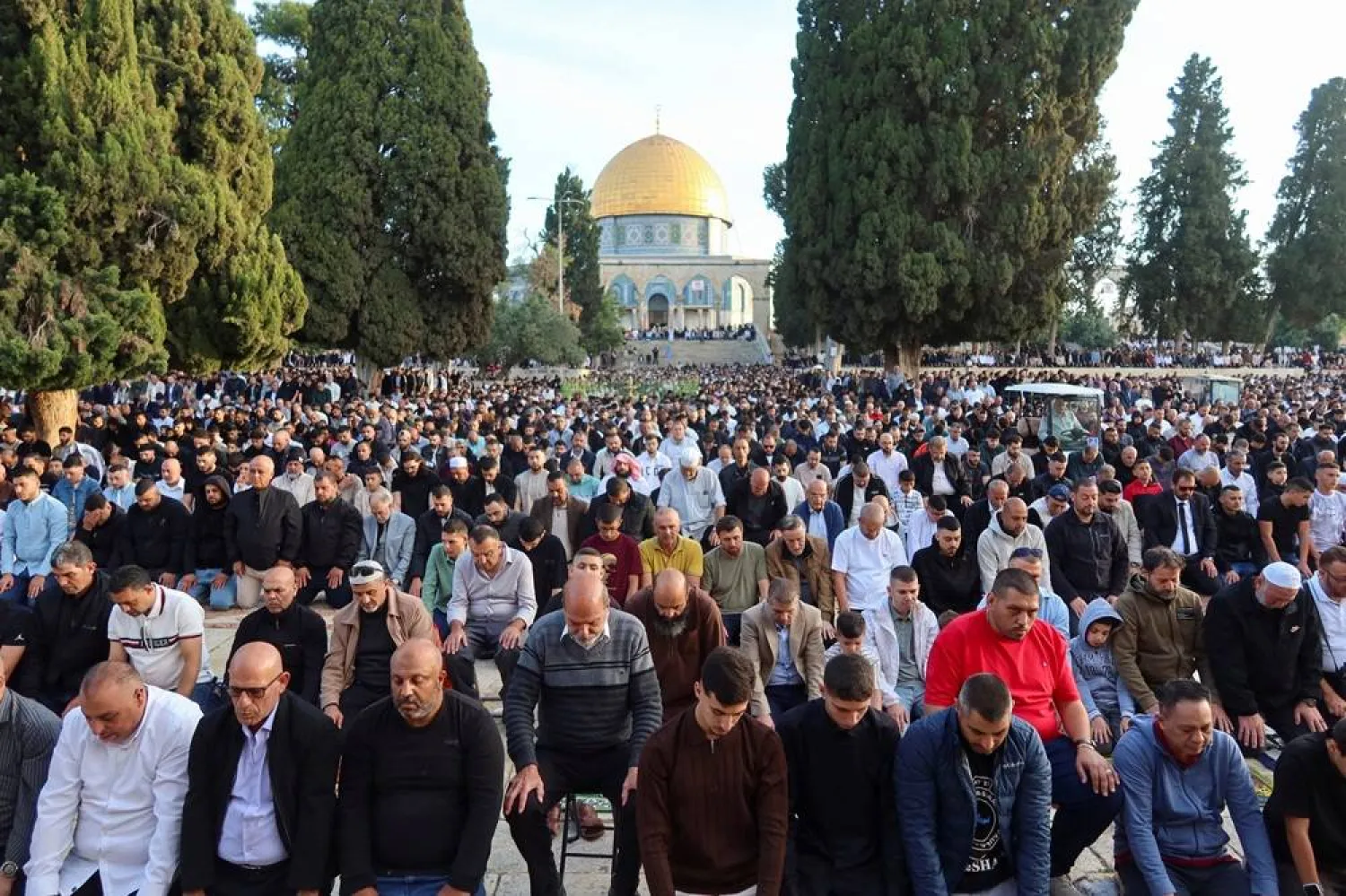
 Muslim worshippers attend Eid al-Adha prayer at Al-Aqsa Mosque in Jerusalem, May 27, 2026  (Reuters)
Muslim worshippers attend Eid al-Adha prayer at Al-Aqsa Mosque in Jerusalem, May 27, 2026 (Reuters)
TT

Saudi Arabia, Arab and Islamic Countries Condemn Israeli Settlers’ Incursions into Al-Aqsa Mosque

 Muslim worshippers attend Eid al-Adha prayer at Al-Aqsa Mosque in Jerusalem, May 27, 2026  (Reuters)
Muslim worshippers attend Eid al-Adha prayer at Al-Aqsa Mosque in Jerusalem, May 27, 2026 (Reuters)

The foreign ministers of Saudi Arabia, Jordan, the United Arab Emirates, Qatar, Indonesia, Pakistan, Egypt, and Türkiye strongly condemned on Tuesday the continued incursions by extremist Israeli settlers, into the Al-Aqsa Mosque under the protection of the Israeli forces.

In a statement, they also condemned the raising of the Israeli flag within its courtyards. They stressed that these provocative and unacceptable actions are “a flagrant violation of international law, the relevant United Nations resolutions, and the historical and legal status quo at the holy sites in occupied East Jerusalem.”

The foreign ministers slammed “the continued and systematic violations and measures carried out by Israel, the occupying power, aimed at altering the historical, legal, and demographic character of occupied East Jerusalem and undermining the sanctity and status of its Islamic and Christian holy sites.”

They reaffirmed their “categorical rejection of any attempts to alter the historical and legal status quo in Jerusalem and its Islamic and Christian holy sites, stressing its preservation while recognizing the special role of the historical Hashemite custodianship in this regard.”

The ministers reiterated that “the entire area of Al-Aqsa Mosque, which amounts to 144 dunams, is a place of worship exclusively for Muslims, and that the Jerusalem Endowments and Al-Aqsa Mosque Affairs Department, affiliated with the Jordanian Ministry of Awqaf and Islamic Affairs, is the legal entity with exclusive jurisdiction to administer its affairs.”

The foreign ministers held Israeli authorities responsible for halting these escalatory actions and warned that repeated Israeli violations deepen tensions, fuel instability and extremism, undermine international efforts to achieve peace and are a clear breach of Israel’s obligations under international law.

They called for an immediate cessation of all such Israeli illegal and provocative practices and reaffirmed the need to respect the historical and legal status quo at Al-Aqsa Mosque in its entirety.

The foreign ministers underlined “their unwavering solidarity with the Palestinian people and their steadfast support for the realization of their legitimate and inalienable national rights, foremost among them their right to self-determination and the realization of an independent and sovereign Palestinian State on the 1967 lines, with East Jerusalem as its capital.”

They further voiced their support “for all efforts aimed at ending the Israeli occupation and achieving a just, lasting, and comprehensive peace based on the two-State solution in accordance with international law, the relevant United Nations resolutions, and the Arab Peace Initiative.”



GCC and US Stress Commitment to Strategic Partnership, Regional Security

US Secretary of State Marco Rubio speaks during a meeting with Foreign Ministers of the Gulf Cooperation Council Member States at The Ritz-Carlton Bahrain, in Manama, Bahrain, June 25, 2026. REUTERS/Eric Lee/Pool
TT

GCC and US Stress Commitment to Strategic Partnership, Regional Security

US Secretary of State Marco Rubio speaks during a meeting with Foreign Ministers of the Gulf Cooperation Council Member States at The Ritz-Carlton Bahrain, in Manama, Bahrain, June 25, 2026. REUTERS/Eric Lee/Pool

Foreign Ministers of the Gulf Cooperation Council (GCC) countries, along with US Secretary of State Marco Rubio, stressed on Thursday their commitment to strengthening their strategic partnership and intensifying coordination on regional and international issues of mutual interest.

During a meeting in the Bahraini capital, Manama, the ministers discussed a number of regional and international issues, emphasizing the importance of enhancing coordination and joint consultation in a manner that supports regional security and stability and protects shared interests.

The meeting also explored opportunities to strengthen cooperation in investment, trade, energy, and advanced technologies, in addition to supporting initiatives aimed at achieving sustainable development and promoting economic prosperity.

Participants stressed the importance of collective action to confront common challenges and of adopting diplomatic solutions to resolve crises, in a way that enhances security and peace in the region and the world.

Bahrain's Foreign Minister Abdullatif Al Zayani, who chaired the gathering, said GCC countries stress the need to respect national sovereignty and protect maritime routes, including the Strait of Hormuz.

In his opening remarks, Al Zayani welcomed the efforts that led to the cessation of hostilities and the signing of a memorandum of understanding between the United States and Iran. He also welcomed the announcement by the Sultanate of Oman of a corridor for the safe passage of vessels through the strait.

As for Rubio, he said that any deal with Iran would take the interests of Gulf states into account.

"The reality of it is that no country on Earth has the right to charge for the use of international waterways. And that will never be an acceptable condition of any deal. The president's been fundamentally clear about that," said Rubio.


Rubio: Kuwait is an Indispensable Partner for Regional Security and Stability

Kuwait's Emir Sheikh Meshal al-Ahmad al-Sabah during his meeting with US Secretary of State Marco Rubio (KUNA)
TT

Rubio: Kuwait is an Indispensable Partner for Regional Security and Stability

Kuwait's Emir Sheikh Meshal al-Ahmad al-Sabah during his meeting with US Secretary of State Marco Rubio (KUNA)

US Secretary of State Marco Rubio has described Kuwait as “an indispensable partner for regional security and stability.”

Rubio held talks with Kuwait's Emir Sheikh Meshal al-Ahmad al-Sabah on efforts to bolster security and stability, Kuwait's state news agency KUNA said on Wednesday.

He also attended a flag-raising at the US Embassy, which resumed operations after Iran-linked attacks forced a suspension, the State Department said.

"The American flag: a symbol of liberty, unity and freedom now flies proudly once again over Kuwait City. Kuwait is an indispensable partner for regional security and stability," Rubio wrote on social media following the ceremony.

US Secretary of State Marco Rubio upon his arrival in Kuwait as part of his Gulf tour (US Secretary of State's account on social media)

Earlier, UAE President Sheikh Mohamed bin Zayed Al Nahyan discussed with Rubio strategic cooperation between the two countries and ways to further strengthen coordination across various fields in support of shared interests, Emirates News Agency (WAM) reported.

The meeting in Abu Dhabi also addressed regional and international issues of mutual concern, with a focus on developments in the Middle East. Sheikh Mohamed and Rubio underscored the importance of advancing the foundations of security, stability, and lasting peace across the region, WAM said.

On Monday, State Department spokesperson Tommy Pigott said Rubio will travel to the UAE, Kuwait, and Bahrain from June 23-25.

“The Secretary will discuss a range of regional priorities including the memorandum of understanding with Iran, efforts to secure full and free safe transit through the Strait of Hormuz, and the importance of peace and stability in the region. In Bahrain, the Secretary will also meet with the Gulf Cooperation Council to discuss shared priorities across the region,” Pigott said.


Faisal bin Farhan, Araghchi Discuss Latest Developments

Saudi Minister of Foreign Affairs Prince Faisal bin Farhan bin Abdullah
TT

Faisal bin Farhan, Araghchi Discuss Latest Developments

Saudi Minister of Foreign Affairs Prince Faisal bin Farhan bin Abdullah

Saudi Minister of Foreign Affairs Prince Faisal bin Farhan bin Abdullah held a phone call with his Iranian counterpart, Abbas Araghchi, the Saudi Press Agency reported on Wednesday.

During the call, the two ministers reviewed the latest developments in negotiations between Iran and the United States, as well as progress in implementing the agreed understandings, SPA said.

They also discussed regional developments and underscored the importance of continuing efforts to advance dialogue and diplomatic solutions in a manner that serves the shared interests of the countries and peoples of the region, the news agency added.