


Saudi Arabia Urges Rebuilding Trust before Any Economic Cooperation with Iran

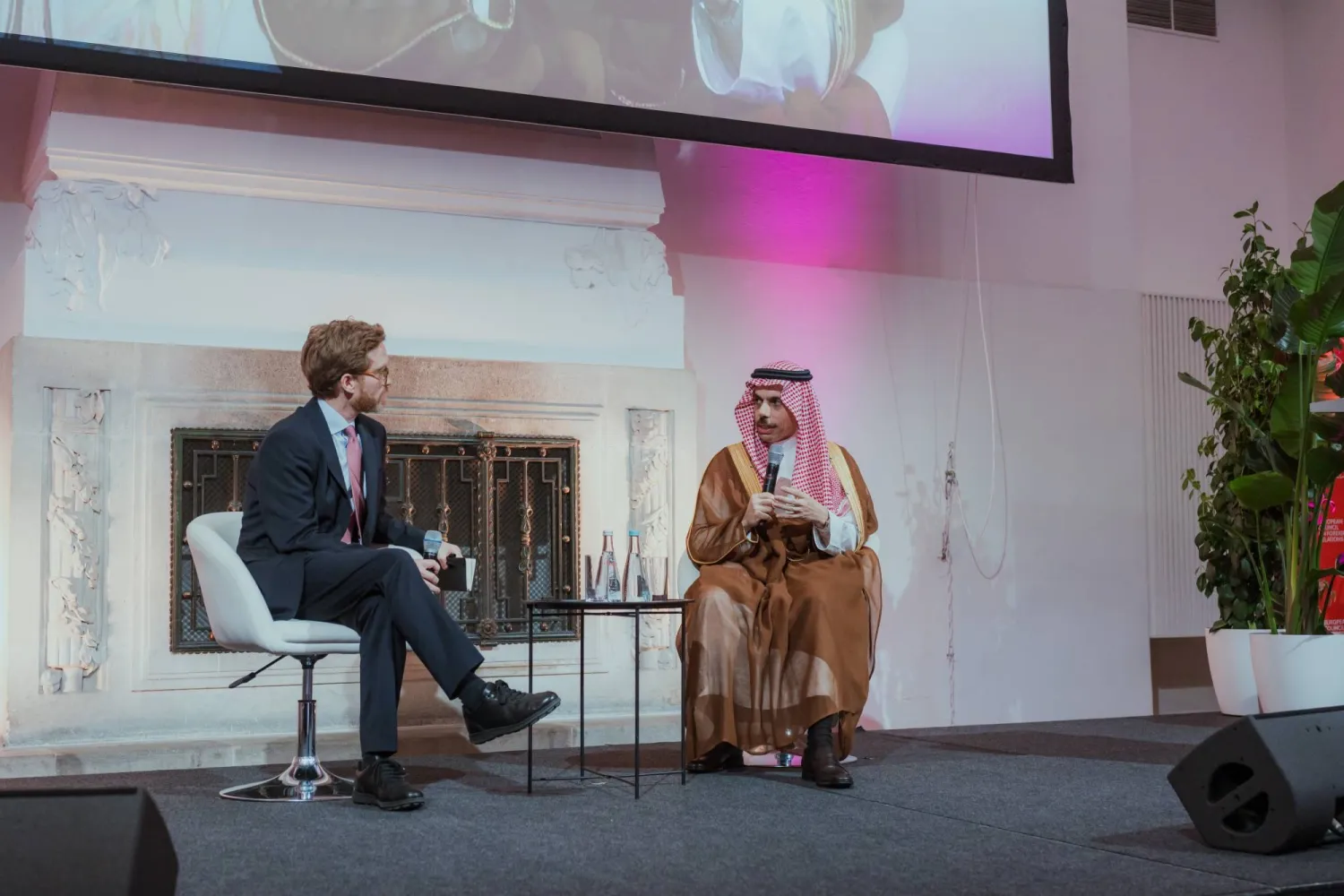
Saudi Foreign Minister Prince Faisal bin Farhan spoke on Wednesday as a keynote guest at a European Council on Foreign Relations panel in Vienna
TT

Saudi Arabia Urges Rebuilding Trust before Any Economic Cooperation with Iran

Saudi Foreign Minister Prince Faisal bin Farhan spoke on Wednesday as a keynote guest at a European Council on Foreign Relations panel in Vienna

Saudi Arabia said trust must be rebuilt with Iran before any discussion of economic cooperation or mutual investment can begin.

The Saudi position came in response to media reports that a memorandum of understanding between the United States and Iran, signed on Wednesday by US President Donald Trump and Iranian President Masoud Pezeshkian, includes a provision for companies from the region, other countries and US partners to take part in a fund supporting Iran’s reconstruction after a final agreement is reached.

Saudi Foreign Minister Prince Faisal bin Farhan, speaking on Wednesday as a keynote guest at a European Council on Foreign Relations panel in Vienna, said he had no information about the alleged fund to rebuild Iran.

But he said the latest conflict had seen Iran attack Saudi Arabia and all Gulf states, creating a major breach of trust.

The minister said this had happened while relations with Iran were being rebuilt under the “Beijing agreement,” a process that had gained real momentum to the point that the two sides were exploring potential areas for economic cooperation and the like on the sidelines.

Dialogue to rebuild trust

“That trust has regressed,” Prince Faisal said.

“We will have to hold a dialogue on how to rebuild that trust and rebuild the relationship before any concept of economic cooperation, mutual investment, or anything of that sort can be rationally addressed,” he added.

He said Saudi Arabia’s development priority now remains focused on the domestic front.

On the nuclear file, Prince Faisal said one lesson from the previous nuclear agreement, which also completely ignored the regional context, was that any deal that fails to address regional concerns risks becoming less secure.

Without tackling the issues that matter to the region, he said, a nuclear agreement could become a source of dispute and risk as much as a solution to the nuclear issue.

Support for diplomacy

Despite ambiguity over some provisions, Riyadh supported the Pakistani and Qatari efforts that led to the memorandum of understanding.

Prince Faisal said Saudi Arabia remains committed to diplomacy, which is why it backed the diplomatic efforts that helped produce the memorandum.

That commitment, he said, is also why Riyadh is “very actively engaged” in supporting the success of the upcoming negotiations, and why it will work with regional partners to launch a regional dialogue on rebuilding trust after the conflict.

He said such talks should focus on how to overcome the crisis of trust, look toward a better future and ensure that potential flashpoints are handled through diplomacy rather than confrontation.

But he said that diplomacy cannot be effective without strong deterrence and high resilience to address potential threats and challenges.

The Saudi Foreign Minister said Riyadh would pursue a dual-track approach, including building its defense capabilities to confront threats and strengthening its logistical and economic resilience.

‘Trust first, then cooperation’

Researchers say Riyadh’s approach toward Iran reflects both hedging and flexibility.

Political researcher Ahmed Alibrahim said Prince Faisal’s remarks on Wednesday set the stage for a new phase in dealing with Iran, based on the principle of “trust first, then cooperation.”

He said Riyadh does not reject economic openness or support for regional stability, but believes that any sustainable path requires addressing the fallout from the previous phase and establishing concrete guarantees to prevent threats from recurring.

That is especially important, he said, given the previous experience of the “Beijing agreement.”

Alibrahim told Asharq Al-Awsat that Saudi support for diplomacy does not conflict with its insistence on strengthening its defense capabilities and protecting its national interests.

Recent political contacts show Saudi Arabia was a key player in supporting the Pakistan-sponsored negotiations and the accompanying Qatari efforts.

Those contacts included 11 phone consultations between the two countries’ leaders and foreign ministers in the past month alone.

The latest was Monday’s visit to Riyadh by Qatari Minister of State at the Foreign Ministry Mohammed al-Khulaifi, who met Saudi Deputy Foreign Minister Waleed al-Khuraiji.

Dr. Khaled al-Habbas told Asharq Al-Awsat that Riyadh had used its active diplomacy to support a political solution and back mediation efforts led by Pakistan with Qatari support, leading to the announced peace agreement.

He said that role was reflected in praise for Saudi Arabia’s support for de-escalation and settlement efforts.

Saudi Arabia welcomed the agreement reached between the United States and Iran to end military operations and begin 60 days of detailed negotiations aimed at a permanent agreement.

It stressed the importance of restoring security and freedom of navigation in the Strait of Hormuz, calling it essential to regional stability and the smooth flow of global trade and energy.

Riyadh said it hoped the talks would lead to a lasting peace that strengthens security in the region and the world, through understandings that account for the security interests of regional states and uphold respect for state sovereignty and non-interference in internal affairs.

Saudi Foreign Minister Prince Faisal bin Farhan also received a phone call from his Iranian counterpart on Monday, hours after the agreement was announced.

During the call, Prince Faisal affirmed the Kingdom’s welcome of the US-Iran agreement to end military operations and begin detailed negotiations toward a permanent deal.

He expressed Riyadh’s hope that the agreement would help strengthen security and stability and achieve peace in the region and the world.

Habbas said the Gulf approach to the war, led by Saudi Arabia, was marked by wisdom.

He said the Kingdom avoided becoming a party to the war while seeking from the start to prevent it, contain its effects and support a political settlement that serves regional security and stability.

He said Riyadh was likely to continue its efforts in the next phase to prevent a return to confrontation, consolidate peace and stability, and ensure maritime security in the region.


Kuwait’s Military Says Air Defenses Are Responding to an Attack

A view of Kuwait City on June 2, 2026. (AFP)
TT

Kuwait’s Military Says Air Defenses Are Responding to an Attack

A view of Kuwait City on June 2, 2026. (AFP)

Kuwait’s military said on Tuesday its air defenses are responding to an attack.

The General Staff of the Kuwait Armed Forces said that explosions heard were a result of air defenses intercepting hostile attacks.

Iran has launched repeated attacks on Kuwait and other Gulf countries in recent days in response to US strikes.

The latest exchanges of fire have been triggered by Iran attacking commercial ships in the Strait of Hormuz.

There were no immediate details or reports of casualties or damage from Tuesday’s attack on Kuwait.


Arab Interior Ministers Council Condemns Houthi Terrorist Attack on Saudi Arabia's Southern Region

File photo of the Saudi flag/AAWSAT
TT

Arab Interior Ministers Council Condemns Houthi Terrorist Attack on Saudi Arabia's Southern Region

File photo of the Saudi flag/AAWSAT

The General Secretariat of the Arab Interior Ministers Council strongly condemned the terrorist attack carried out by the Houthi militia, which launched ballistic missiles toward the southern region of the Kingdom of Saudi Arabia yesterday evening.

In a statement, the secretariat condemned the deliberate criminal act, saying the Houthi militia sought to target civilians and civilian facilities, SPA reported.

The secretariat reiterated its call for firm action against such acts and for those responsible to be held accountable.

It also reaffirmed its full support for all measures taken by the Kingdom to confront these threats and safeguard its security, stability, and territorial integrity.


Saudi Arabia Affirms Its Complete Rejection of Iran's Destabilizing Behavior in the Region

Saudi Crown Prince Mohammed bin Salman bin Abdulaziz Al Saud - SPA
TT

Saudi Arabia Affirms Its Complete Rejection of Iran's Destabilizing Behavior in the Region

Saudi Crown Prince Mohammed bin Salman bin Abdulaziz Al Saud - SPA

Saudi Arabia strongly reaffirmed its categorical rejection of Iran's continued destabilizing conduct in the region and its violations of the principles of international law. This came during the Cabinet session chaired by Saudi Crown Prince and Prime Minister Prince Mohammed bin Salman, which was held on Tuesday in Jeddah.

The Crown Prince briefed the Cabinet on the contents of the phone call he received from US President Donald Trump, during which they reviewed areas of cooperation and discussed a number of regional and international issues, emphasizing their support for all efforts that contribute to achieving the region's security and stability.

He also informed the Cabinet of the results of his discussions with Prime Minister Mark Carney of Canada, which affirmed the commitment to strengthening and developing bilateral relations across all sectors, aiming for a future characterized by deeper cooperation. This cooperation is underpinned by mutual trust, close friendship, and the objectives stemming from Saudi Vision 2030 and Canada's growth agenda, which seek to build a stronger and more resilient economy for both countries, SPA reported.

The Cabinet praised the signing of memoranda of understanding during the official visit of the Canadian prime minister, which included the establishment of the Saudi-Canadian Coordination Council, cooperation in the energy sector, investment in artificial intelligence, and skills development.

It also commended the success of the Saudi Arabia-Canada Investment Forum, which resulted in the announcement of trade and investment agreements between government entities, companies, and institutions from both countries in the fields of mining, engineering, infrastructure, advanced industries, training and education, financial services, and information and communications technology.

In a statement to the Saudi Press Agency following the session, Minister of Human Resources and Social Development and Acting Minister of Media Ahmed Al-Rajhi said that after monitoring regional and international developments, the Cabinet strongly condemned Iran's repeated attacks on commercial vessels in the Strait of Hormuz, as well as on Kuwait, Bahrain, Qatar, the United Arab Emirates, Oman, and Jordan.

The Cabinet affirmed its complete rejection of Iran's continued destabilizing behavior in the region and its violations of international law, the charters of the United Nations and the Organization of Islamic Cooperation, and the principles of good neighborliness.

The Cabinet welcomed the outcomes of the meeting held in Riyadh between the Saudi and Iraqi sides, including Iraq's reaffirmation of its commitment not to allow its territory and airspace to be used as a launching pad for any acts or attacks targeting Saudi Arabia, the Gulf Cooperation Council countries, and other countries in the region. The Cabinet also commended the agreement to continue bilateral coordination in a manner that serves common interests.

The Cabinet welcomed the United States' announcement that it has begun procedures to remove the Syrian Arab Republic from the list of state sponsors of terrorism, a designation imposed in 1979, reiterating Saudi Arabia's support for the positive steps taken by the Syrian government to enhance security and stability, build state institutions, and fulfill the aspirations of its people.
