

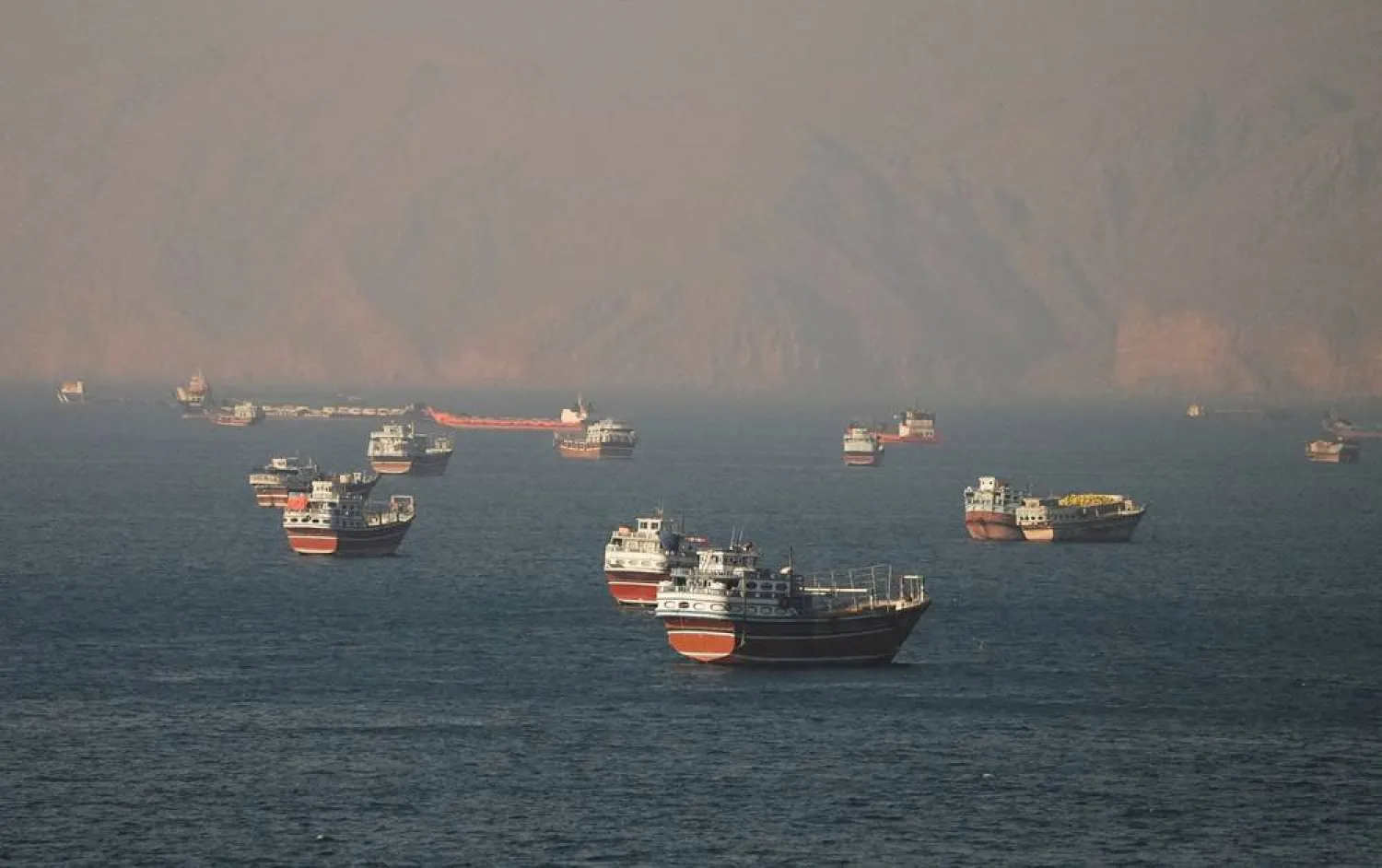

Oman Opens Temporary Strait of Hormuz Shipping Routes, Says No Tolls Will Be Charged

Vessels at the Strait of Hormuz, as seen from Musandam, Oman, June 15, 2026. (Reuters)
TT

Oman Opens Temporary Strait of Hormuz Shipping Routes, Says No Tolls Will Be Charged

Vessels at the Strait of Hormuz, as seen from Musandam, Oman, June 15, 2026. (Reuters)

Oman said it would keep the Strait of Hormuz open to shipping without imposing any tolls and had designated two temporary routes north and south of the existing shipping lane to facilitate the safe passage of vessels departing the region.

In coordination with the International Maritime Organization, Oman established temporary maritime corridors to help ships leave the area safely amid heightened security risks.

The Strait of Hormuz, a vital route for ‌roughly a fifth ‌of global oil and liquefied natural gas supplies before the ‌war, has ⁠been heavily disrupted ⁠since the United States and Israel launched a war against Iran on February 28, curbing commercial shipping and rattling global energy markets.

In a notice to mariners, Oman said the existing Traffic Separation Scheme in the strategic waterway was currently unsafe for use and that vessels departing through the strait could instead use temporary routes located to the north and south of the existing shipping lanes.

The scheme, adopted by the United Nations’ shipping agency ⁠in 1968, established routing lanes through Iranian and Omani waters in ‌the strait.

Oman said the measures ‌reflected its responsibilities towards the strait, its importance to the global economy and its commitment to ‌international law and freedom of navigation, citing understandings reached between the United States and ‌Iran.

Oman said navigational safety remained the overriding priority and that a gradual, controlled movement of vessel traffic was required because of an elevated risk of collisions.

Under a phased plan developed by the IMO in coordination with Omani authorities, vessels will be grouped and contacted individually with instructions on ‌when they may depart and which route they should follow.

Ships will be directed to a designated waiting area in international ⁠waters before being ⁠cleared to proceed.

Vessels using Oman's eastbound route will be required to maintain communications with coastal authorities and comply with all navigational instructions.

Oman said shipowners and masters remained responsible for conducting independent risk assessments before voyages.

Vessels were instructed to keep their Automatic Identification System activated during transit and to report any navigational hazards to the Oman Maritime Security Centre.

Oman's statement said that no tolls would be imposed on vessels transiting the Strait of Hormuz, in line with the outcome of recent talks between the United States and Iran.

Iran and Oman began discussions on the future administration of navigation and maritime services in the waterway on Tuesday.

While the interim US-Iran agreement provides for commercial vessels to transit without charge for 60 days, the talks are expected to address longer-term arrangements, including any costs associated with maritime services after that period ends.



Kuwait Court Orders Imprisonment of Former MPs, Including Musallam Al-Barrak

The defendants were charged with "contesting the rights and authorities of the Emir of the country and spreading malicious news". (Asharq Al-Awsat)
TT

Kuwait Court Orders Imprisonment of Former MPs, Including Musallam Al-Barrak

The defendants were charged with "contesting the rights and authorities of the Emir of the country and spreading malicious news". (Asharq Al-Awsat)

The Kuwaiti Court of Cassation sentenced on Sunday a number of former MPs to prison, overturning the acquittals of 15 defendants, most of whom were former lawmakers in the dissolved National Assembly. The defendants were charged with "contesting the rights and authorities of the Emir of the country and spreading malicious news detrimental to the internal interests and stability of the nation."

The First Circuit of the Court of Cassation reversed the Court of Appeals' ruling that had suspended the sentence of former MP Muhannad Talal Al-Sayer, sentencing him again to three years in prison on charges related to contesting the rights of the Emir, interfering with his authorities, and spreading malicious news harmful to Kuwait's internal interests and stability.

The court also overturned the appellate ruling that suspended the sentence of former MP Saleh Mohammed Al-Mulla, ordering him to serve two years in prison for contesting the authorities and rights of the Emir.

It overturned the acquittal of former MPs Musallam Al-Barrak and Salem Al-Namlan, convicting them as repeat offenders and sentencing them to three years in prison for spreading malicious news detrimental to the country's interests.

It sentenced former MP Bader Al-Dahoum to one year of hard labor on charges of offending judges of the Constitutional Court.

The court also overturned the acquittals issued in favor of 15 defendants, finding them guilty while abstaining from pronouncing punishment on charges of spreading malicious news detrimental to the state's interests.

The rulings included former MPs Adel Al-Damkhi, Mohammed Mosaed Al-Dosari, Osama Al-Zaid, Shuaib Ali Shaban, Mohammed Abbas Jawhar Hayat, Madi Al-Hajri, Falah Al-Hajri, Hamad Al-Mudlej, Ali Radan Al-Otaibi, Mohammed Haif, Saoud Al-Hajri, Khaled Mounis Al-Otaibi, Nasser Mohammed Al-Mutairi, and Nami Harab Mohammed Awad Obeid.


MWL Condemns Israeli Statements on Displacement of Palestinian People

The Muslim World League (MWL) logo
TT

MWL Condemns Israeli Statements on Displacement of Palestinian People

The Muslim World League (MWL) logo

The Muslim World League (MWL) strongly condemned statements by Israeli National Security Minister Itamar Ben-Gvir and Israeli Defense Minister Israel Katz concerning the displacement of the Palestinian people from the Gaza Strip, including proposed plans and mechanisms aimed at forcibly removing Palestinians from their land.

In a statement issued by the MWL General Secretariat, MWL Secretary-General and Chairman of the Organization of Muslim Scholars Sheikh Dr. Mohammed Al-Issa denounced the Israeli statements as unacceptable. He stressed that they come amid Israel's violations of international and humanitarian laws and norms in the occupied Palestinian territory and its undermining of peace efforts, the Saudi Press Agency said.

Al-Issa stressed the urgent need for the international community to fulfill its legal and moral responsibilities to bring an immediate end to all Israeli violations and attempts to impose a new demographic or geographic reality in the occupied Palestinian territory.

He also expressed strong support for the statement issued in this regard by the foreign ministers of Saudi Arabia, Jordan, the United Arab Emirates, Indonesia, Pakistan, Türkiye, Qatar, and Egypt.

He reaffirmed their unwavering solidarity with the Palestinian people and steadfast support for their legitimate rights, including the right to establish an independent Palestinian state in accordance with the two-state solution and relevant international resolutions, as the only path to achieving a just and lasting peace in the region.

Ben-Gvir and Katz on Thursday outlined a seven-year plan for removing Palestinians from the Gaza Strip through what Ben-Gvir described as "voluntary emigration."


Saudi FM Signs Strategic Dialogue MoU with Germany, Holds Calls with UK and Bahrain Counterparts

Saudi Foreign Minister Prince Faisal bin Farhan met German Federal Foreign Minister Johann Wadephul in Berlin. (SPA)
TT

Saudi FM Signs Strategic Dialogue MoU with Germany, Holds Calls with UK and Bahrain Counterparts

Saudi Foreign Minister Prince Faisal bin Farhan met German Federal Foreign Minister Johann Wadephul in Berlin. (SPA)

Saudi Foreign Minister met with his German counterpart in Berlin to sign a memorandum of understanding on strategic dialogue, while also holding separate phone talks with the UK foreign secretary and his Bahraini counterpart, the Saudi Press Agency said on Monday.

During his meeting with Federal Minister for Foreign Affairs of Germany Johann Wadephul, the two officials reviewed the bilateral and historical relations between the two friendly countries and discussed ways to further develop and strengthen them across various fields.

They also discussed the current situation in the region, stressing the importance of the security and safety of international waterways, ensuring freedom of maritime navigation, and restoring normal conditions in the Strait of Hormuz. They also reaffirmed their support for all efforts to find peaceful and diplomatic solutions to regional and international crises.

The two ministers also discussed economic and trade relations, including bilateral trade volumes and ways to boost them, reflecting the depth of their ties while creating new opportunities to expand cooperation and investment across various sectors.

During the meeting, Prince Faisal and Wadephul signed a memorandum of understanding between the governments of Saudi Arabia and Germany to establish a strategic dialogue at the foreign-minister level, strengthen consultation and coordination, and further advance bilateral relations across various fields.

The meeting was attended by a number of officials.

Earlier, Prince Faisal received a phone call from Secretary of State for Foreign and Commonwealth Affairs of the United Kingdom Edward Miliband where they reviewed bilateral relations and ways to strengthen cooperation and coordination.

They also discussed regional and international developments, particularly the situation in the region and its implications for security and stability.

The two ministers stressed the importance of intensifying diplomatic efforts to de-escalate tensions, enhance the security of international waterways, and ensure freedom of navigation to help safeguard supply chains and international trade.

Prince Faisal also held a phone call with his Bahraini counterpart, Dr. Abdullatif bin Rashid Al Zayani, during which they discussed regional developments and efforts to maintain security and stability.