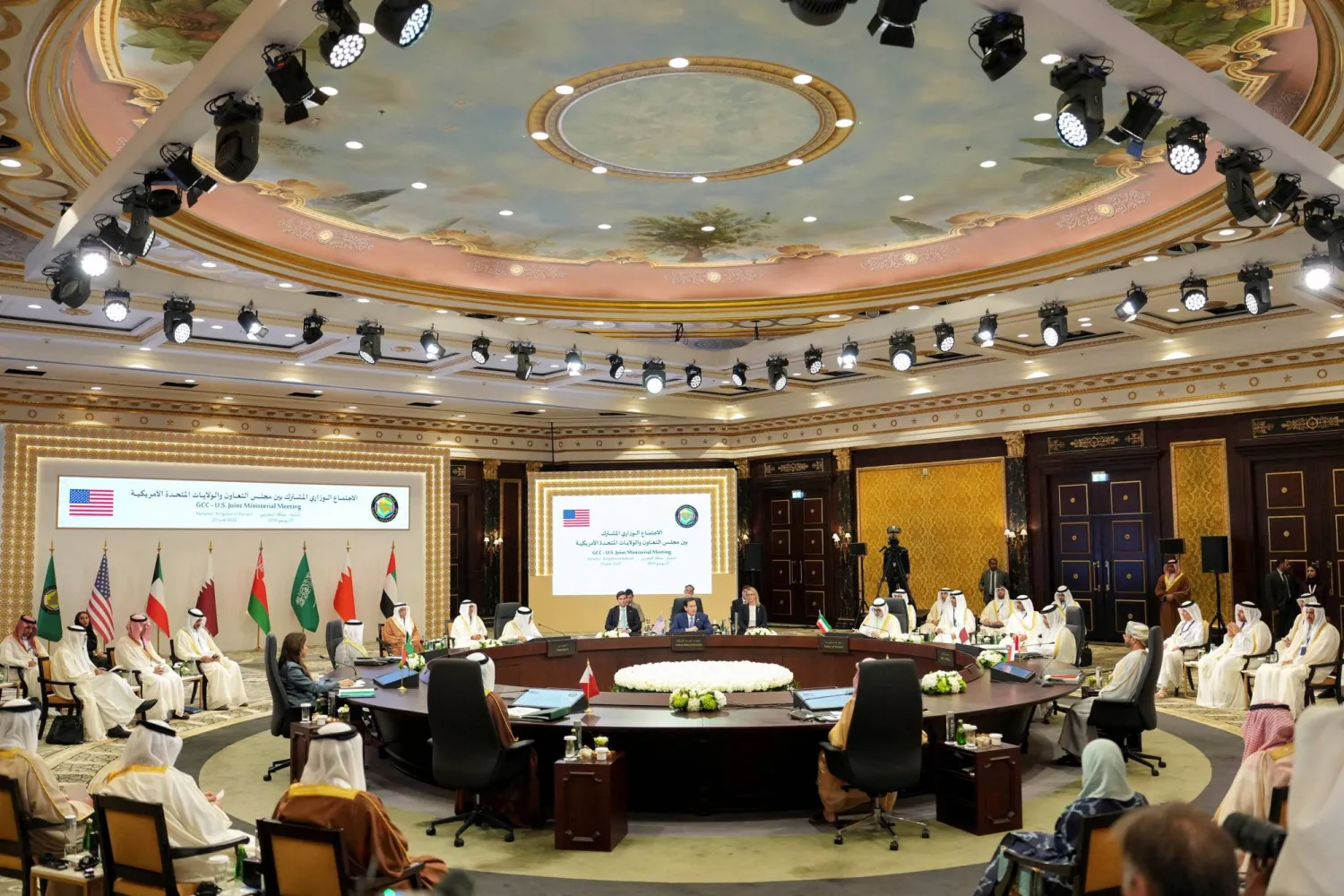
GCC and US Stress Commitment to Strategic Partnership, Regional Security

US Secretary of State Marco Rubio speaks during a meeting with Foreign Ministers of the Gulf Cooperation Council Member States at The Ritz-Carlton Bahrain, in Manama, Bahrain, June 25, 2026. REUTERS/Eric Lee/Pool
TT

GCC and US Stress Commitment to Strategic Partnership, Regional Security

US Secretary of State Marco Rubio speaks during a meeting with Foreign Ministers of the Gulf Cooperation Council Member States at The Ritz-Carlton Bahrain, in Manama, Bahrain, June 25, 2026. REUTERS/Eric Lee/Pool

Foreign Ministers of the Gulf Cooperation Council (GCC) countries, along with US Secretary of State Marco Rubio, stressed on Thursday their commitment to strengthening their strategic partnership and intensifying coordination on regional and international issues of mutual interest.

During a meeting in the Bahraini capital, Manama, the ministers discussed a number of regional and international issues, emphasizing the importance of enhancing coordination and joint consultation in a manner that supports regional security and stability and protects shared interests.

The meeting also explored opportunities to strengthen cooperation in investment, trade, energy, and advanced technologies, in addition to supporting initiatives aimed at achieving sustainable development and promoting economic prosperity.

Participants stressed the importance of collective action to confront common challenges and of adopting diplomatic solutions to resolve crises, in a way that enhances security and peace in the region and the world.

Bahrain's Foreign Minister Abdullatif Al Zayani, who chaired the gathering, said GCC countries stress the need to respect national sovereignty and protect maritime routes, including the Strait of Hormuz.

In his opening remarks, Al Zayani welcomed the efforts that led to the cessation of hostilities and the signing of a memorandum of understanding between the United States and Iran. He also welcomed the announcement by the Sultanate of Oman of a corridor for the safe passage of vessels through the strait.

As for Rubio, he said that any deal with Iran would take the interests of Gulf states into account.

"The reality of it is that no country on Earth has the right to charge for the use of international waterways. And that will never be an acceptable condition of any deal. The president's been fundamentally clear about that," said Rubio.


Qatar Denies Interference in Israeli Elections

A view of Doha, the capital of Qatar (Qatar News Agency)
TT

Qatar Denies Interference in Israeli Elections

A view of Doha, the capital of Qatar (Qatar News Agency)

Qatar has categorically denied allegations that it interfered in Israel's elections or financed activities aimed at influencing their outcome, rejecting accusations promoted by some Israeli politicians and affiliated media outlets as part of a new disinformation campaign seeking to drag Doha into Israel's domestic political disputes following this week's elections.

Qatari Foreign Ministry spokesperson Majed Al-Ansari highlighted the contradictory nature of the allegations, which range from claims that Qatar bought Benjamin Netanyahu's loyalty to accusations that it financed the Israeli left and influenced Arab voters, as though Doha, according to these claims, controlled the entire Israeli political landscape.

Al-Ansari stressed that the baseless accusations were both absurd and dangerous, saying the persistent attempts to inject Qatar's name into Israel's election discourse reflected an "excessive obsession" that defied logic in certain Israeli political and media circles.

He emphasized that Qatar refused to be made "a scapegoat for the political failures of certain Israeli politicians," adding that rather than trying to divert attention toward Doha, those politicians would be better served by responding to their voters' aspirations and addressing the consequences of their disastrous policies in the region.

The spokesperson reiterated that Qatar has no interest in Israel's political and electoral competition, describing it as an internal matter in which Doha does not interfere and refusing to allow the country to be drawn into its disputes.

He also stressed that any government emerging from the elections must comply with international law and relevant international resolutions, engage seriously and sincerely with the Palestinian issue, and respect the inalienable rights of the Palestinian people, foremost among them their right to self-determination and the establishment of an independent state along the 1967 borders, with East Jerusalem as its capital.

Al-Ansari added that such campaigns would not deter Qatar from continuing its mediation role, diplomatic and humanitarian efforts, support for the Palestinian people, and commitment to achieving a just and comprehensive peace that strengthens regional security and stability.

He affirmed that Doha would continue working closely with its regional and international partners to resolve conflicts through diplomatic means, stressing that remaining silent would not be Qatar's response to attempts to exploit its name for electoral agendas or narrow political gains.


Saudi Leadership Extends Condolences to Spain over Victims of Train Crash

Saudi King Salman bin Abdulaziz and Crown Prince and Prime Minister Mohammed bin Salman
TT

Saudi Leadership Extends Condolences to Spain over Victims of Train Crash

Saudi King Salman bin Abdulaziz and Crown Prince and Prime Minister Mohammed bin Salman

Saudi King Salman bin Abdulaziz and Crown Prince and Prime Minister Mohammed bin Salman sent separate cables of condolences to Spanish King Felipe VI following a train collision in central Spain that left dozens dead and scores injured, the Saudi Press Agency said on Wednesday.

Both leaders expressed their deepest sympathies to the Spanish monarch, the families of the victims and the Spanish people, and wished those injured a speedy recovery.

On Wednesday, a high-speed train slammed into another that had stopped on the tracks in Spain, killing at least 68 people and injuring dozens.


Saudi, Kuwaiti Defense Ministers Pledge Solidarity Against All Threats in Phone Call

Saudi Minister of Defense Prince Khalid bin Salman bin Abdulaziz
TT

Saudi, Kuwaiti Defense Ministers Pledge Solidarity Against All Threats in Phone Call

Saudi Minister of Defense Prince Khalid bin Salman bin Abdulaziz

Saudi Minister of Defense Prince Khalid bin Salman bin Abdulaziz held a phone call on Wednesday with Kuwaiti Minister of Defense Abdullah Ali Abdullah Al-Salem Al-Sabah, the Saudi Press Agency said.

The two officials reviewed defense relations between the two countries, discussed the latest regional developments, and affirmed their solidarity against all challenges and threats to safeguard their security and stability.