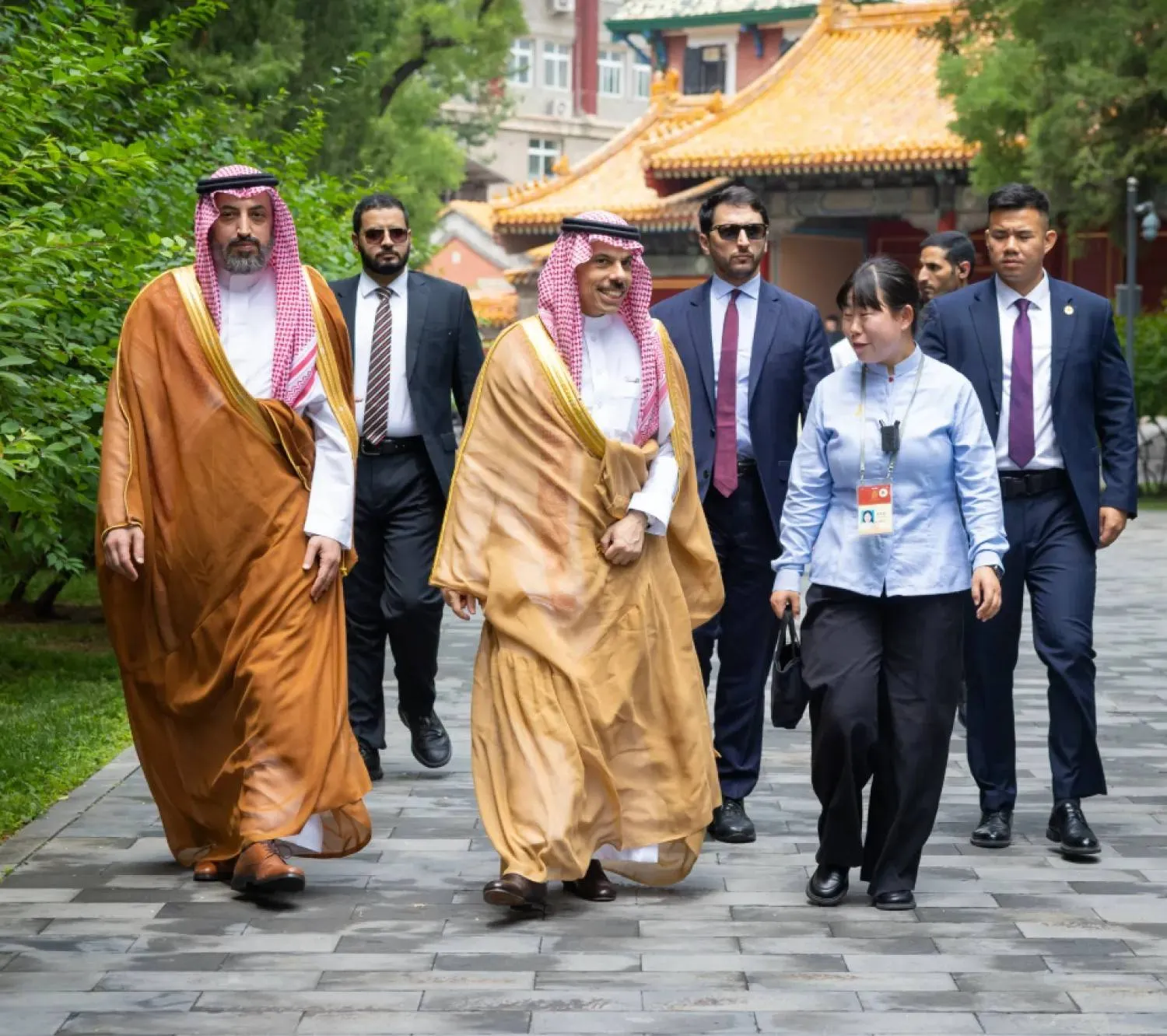
Saudi FM Visits Imperial Palace Museum in Beijing

Saudi Foreign Minister Prince Faisal bin Farhan during his visit to the Imperial Palace Museum in Beijing. Photo: Foreign Ministry
TT

Saudi FM Visits Imperial Palace Museum in Beijing

Saudi Foreign Minister Prince Faisal bin Farhan during his visit to the Imperial Palace Museum in Beijing. Photo: Foreign Ministry

Saudi Foreign Minister Prince Faisal bin Farhan has visited the Imperial Palace Museum in Beijing on the sidelines of his trip to China.

During Wednesday’s tour, Prince Faisal explored the museum's cultural and historical landmarks, including artifacts and exhibits that reflect key aspects of China's rich history and civilization.

Prince Faisal’s visit to China aims to strengthen bilateral relations and expand cooperation between the two countries across various fields, including cultural and civilizational exchange.


Interior Ministry: Drug Smuggling and Trafficking Network Arrested in Riyadh

The Saudi Ministry of Interior affirmed that security agencies are vigilant against all criminal schemes (SPA)
TT

Interior Ministry: Drug Smuggling and Trafficking Network Arrested in Riyadh

The Saudi Ministry of Interior affirmed that security agencies are vigilant against all criminal schemes (SPA)

An official source at the Saudi Ministry of Interior has announced the arrest of a criminal network involved in drug smuggling and trafficking in the Riyadh region.

The source said Wednesday that 22 suspects were arrested, including 19 Saudi citizens, one of whom is an employee of the Ministry of Municipalities and Housing, as well as an Ethiopian national in violation of the Border Security Law, a Moroccan female resident, and a Yemeni male resident.

Legal procedures have been taken against them, and they have been referred to the Public Prosecution.

The Ministry of Interior said the announcement reaffirms the vigilance of the security authorities in confronting all criminal plots aimed at targeting the Kingdom and its youth through narcotics.

It stressed that the security agencies will continue to confront anyone who attempts to undermine the Kingdom's security or the safety of its citizens and residents, regardless of who they may be.


Saudi Arabia, Pakistan Sign MoU to Boost Scientific and Training Cooperation

Saudi Minister of Interior Prince Abdulaziz bin Saud bin Naif bin Abdulaziz met on Wednesday with Pakistan’s Federal Minister of Interior and Narcotics Control Mohsin Raza Naqvi in Riyadh. SPA
TT

Saudi Arabia, Pakistan Sign MoU to Boost Scientific and Training Cooperation

Saudi Minister of Interior Prince Abdulaziz bin Saud bin Naif bin Abdulaziz met on Wednesday with Pakistan’s Federal Minister of Interior and Narcotics Control Mohsin Raza Naqvi in Riyadh. SPA

Saudi Minister of Interior Prince Abdulaziz bin Saud bin Naif bin Abdulaziz has met with Pakistan’s Federal Minister of Interior and Narcotics Control Mohsin Raza Naqvi in Riyadh to review relations between the two countries and discuss ways to strengthen security cooperation and coordination between their respective ministries.

Following Wednesday’s meeting, the two ministers signed a memorandum of understanding (MoU) to enhance scientific, training, and research cooperation between the Saudi and Pakistani interior ministries.

The agreement aims to support the exchange of expertise and capacity building in areas of mutual interest.

The meeting and signing ceremony were attended by Saudi Acting Vice Minister of Interior Prince Dr. Abdulaziz bin Mohammed bin Ayyaf, Director of Public Security Lt. Gen. Mohammed Al-Bassami, the Pakistani Ambassador to Riyadh, Ahmad Farooq, and several senior officials.


GCC Military Chiefs Discuss Stronger Defense Cooperation, Iranian Attacks

Officials are seen at Tuesday's meeting in Manama. (BNA)
TT

GCC Military Chiefs Discuss Stronger Defense Cooperation, Iranian Attacks

Officials are seen at Tuesday's meeting in Manama. (BNA)

The chiefs of staff of the armed forces of the Gulf Cooperation Council (GCC) member states met during a session of the Supreme Military Committee in Manama on Tuesday to discuss ways to strengthen joint military cooperation.

According to the Bahrain News Agency, the meeting was chaired by Bahrain’s Chief of Staff, Lt. Gen. Dhiab Al Nuaimi, and attended by the chiefs of staff of the GCC armed forces, Assistant Secretary-General for Military Affairs at the GCC Secretariat Maj. Gen. Isa Al Muhannadi, and Commander of the GCC Unified Military Command Maj. Gen. Abdulaziz Al Balawi.

In his opening remarks, Al Nuaimi said the GCC countries were facing “systematic and painful Iranian aggression” targeting their states.

He accused Iran of deliberately attacking civilians and jeopardizing maritime security in the Strait of Hormuz, saying the actions had harmed the interests of GCC countries and the wider region while endangering innocent lives in violation of international treaties, conventions, and law.

The developments required stronger Gulf solidarity and a united response to confront the hostile attacks, he urged.

Al Nuaimi also called for establishing a comprehensive practical framework for joint military cooperation, built on the Gulf states’ shared ties, common objectives, and existing agreements.

He hoped that the meeting would serve as a launching point for stronger collective action, including coordinated measures, faster response mechanisms, and greater cooperation to safeguard the security and stability of GCC countries and the region.

Islamic Military Counter Terrorism Coalition

Separately, the Islamic Military Counter Terrorism Coalition (IMCTC), led by its Secretary-General, Maj. Gen. Mohammed bin Saeed Al-Moghedi, participated in the Fourth United Nations High-Level Conference on Counter-Terrorism, which opened at UN headquarters in New York under the theme: “A Future Free from Terrorism: Consolidating the Global Commitment to Multi-Stakeholder Approaches to Counter Terrorism, notably through Member States’ Leadership and Action.”

The conference brought together senior officials, policymakers, and representatives of governments, international and regional organizations, and counterterrorism experts.

According to the Saudi Press Agency, the coalition’s participation reflects its ongoing efforts to strengthen international cooperation, unify global counterterrorism initiatives, and deepen strategic partnerships with member states and international organizations.

These efforts aim to advance effective policies and practices for combating terrorism and extremism while enhancing regional and international security.

The opening session featured remarks by UN Secretary-General Antonio Guterres and other senior international officials, focusing on strengthening global commitment to counterterrorism through a comprehensive, multilateral approach involving governments, international organizations, civil society, and the private sector.

Al-Moghedi said the coalition’s participation underscores its role as an active international partner in global counterterrorism efforts.

Evolving international security challenges require closer coordination among countries and regional and international organizations, stronger mechanisms for joint action, and greater efforts to prevent the spread of terrorism while addressing its root causes, he stressed.