


Saudi Arabia Leads International Initiative to Establish ‘Maritime Defense Coalition’

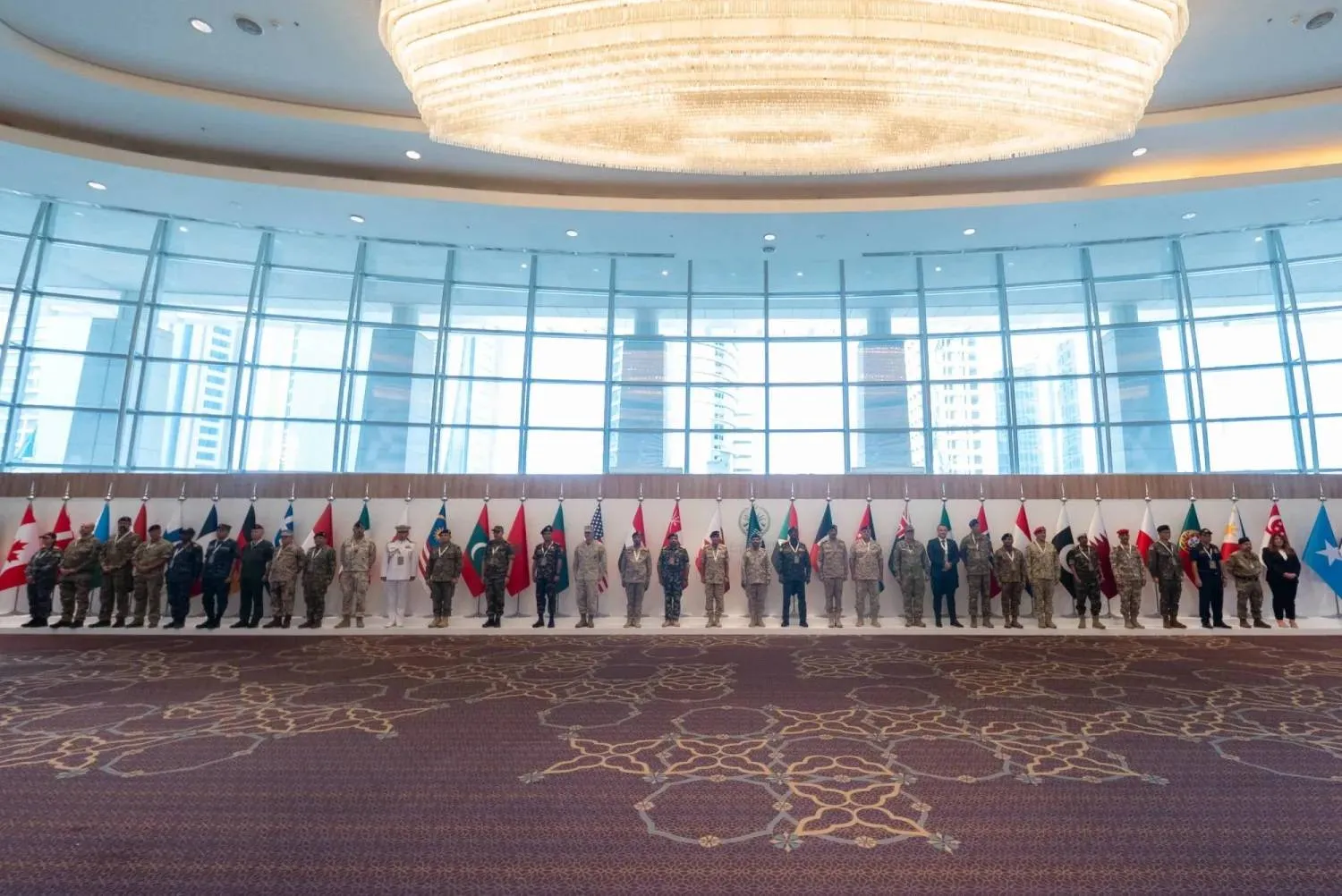
Officials pose for a family photo during the meeting in Saudi Arabia. (Saudi Defense Ministry)
TT

Saudi Arabia Leads International Initiative to Establish ‘Maritime Defense Coalition’

Officials pose for a family photo during the meeting in Saudi Arabia. (Saudi Defense Ministry)

Saudi Arabia hosted on Thursday an international meeting to discuss its initiative to establish a multinational “Maritime Defense Coalition”, as part of its efforts to enhance maritime security, protect international sea lanes, and counter threats targeting maritime navigation and global trade.

The meeting witnessed broad participation from chiefs of staff and their representatives from 43 countries, as well as the European Delegation to Saudi Arabia. This reflects growing international interest in boosting maritime defense cooperation and underscoring the importance of unifying efforts to confront shared threats targeting the security of international sea lanes within the defense coalition's designated scope of responsibility.

Participants discussed growing threats to maritime security, including attacks on commercial ships, energy tankers, and maritime infrastructure, and the risks they pose to the safety of navigation, the stability of global supply chains, and the international economy.

They underscored the importance of enhancing multilateral defense cooperation to confront and deter these threats, and to maintain the security of international sea lanes.

The meeting addressed the draft charter of the multinational Maritime Defense Coalition, its reference documents, organizational structure, command and control arrangements, operational mechanisms, and future steps.

This aims to ensure the establishment of an effective institutional framework that bolsters maritime defense cooperation among participating nations and confronts shared maritime threats in the Bab al-Mandab Strait, Red Sea, and Gulf of Aden.

The participants discussed the foundational arrangements for the coalition, primarily that Saudi Arabia will serve as its founding and leading nation and host its headquarters, reflecting international confidence in its leadership role in strengthening collective maritime security.
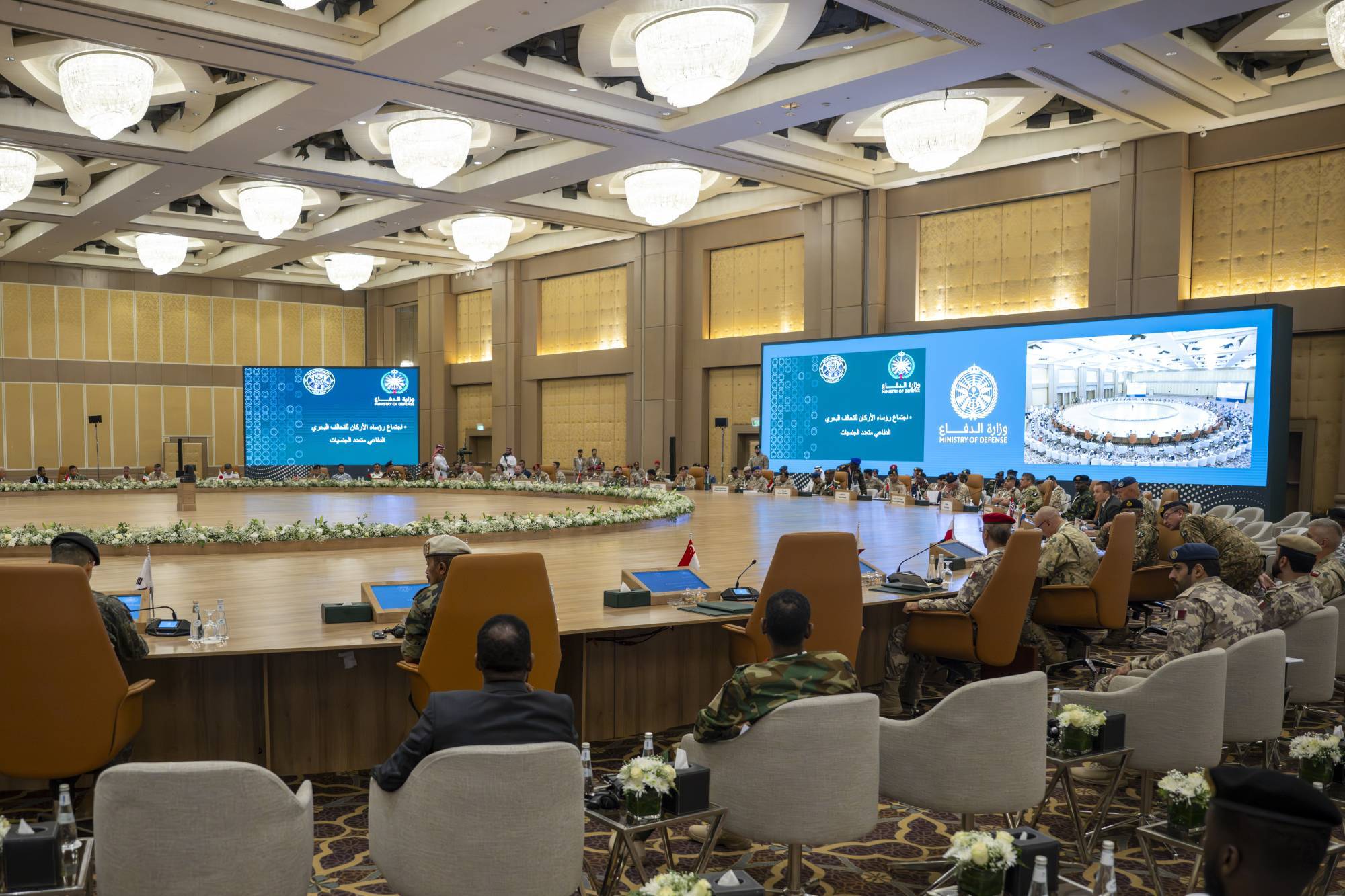
Gatherers are seen at the meeting on Thursday. (Saudi Defense Ministry)

The gatherers agreed to continue the work of military planners from nations wishing to join the coalition during the upcoming phase to complete foundational procedures. This includes finalizing the coalition's charter, reference documents, organizational structure, command and control arrangements, operational mechanisms, and forming the necessary frameworks and technical teams, along with completing national procedures for countries wishing to join, in preparation for signing the charter, launching the coalition, and kicking off its duties.

For its part, Saudi Arabia stressed that the coalition represents an open international defense initiative that accommodates all countries sharing its goals and principles, welcoming their accession and participation in its efforts, in accordance with their national procedures. This aims to deepen collective maritime security, safeguard the freedom of navigation and global trade, and embody the principle of shared international responsibility in confronting common threats, stemming from a firm conviction that the security of international sea lanes is a collective responsibility requiring an effective and sustainable international partnership.

Furthermore, 14 countries issued a joint statement affirming their support for the coalition project and welcoming the consensus achieved regarding its foundational arrangements. They are: Saudi Arabia, Kuwait, Bahrain, Qatar, Pakistan, Türkiye, Egypt, Jordan, Yemen, Bangladesh, Nigeria, Sudan, Djibouti, and Somalia.

Other countries expressed their support for the initiative and are in the process of completing their necessary domestic national procedures and approvals to join the joint statement.

The meeting concluded by underscoring the shared determination to move forward with completing the foundational procedures to establish the coalition, thereby bolstering collective capability to confront and deter threats targeting maritime security, protecting international sea lanes, safeguarding freedom of navigation and global trade, and promoting regional and international security and stability.


Saudi Arabia and France Seek New Routes for Security and Energy

Prince Mohammed bin Salman, Saudi Crown Prince and Prime Minister, and French President Emmanuel Macron during his visit to the Kingdom in December 2024. (Reuters)
TT

Saudi Arabia and France Seek New Routes for Security and Energy

Prince Mohammed bin Salman, Saudi Crown Prince and Prime Minister, and French President Emmanuel Macron during his visit to the Kingdom in December 2024. (Reuters)

The visit by Prince Mohammed bin Salman, Saudi Crown Prince and Prime Minister, to Paris is not taking place under ordinary regional circumstances. The region is experiencing a phase where wars and maritime security are redefining the concept of economic security, while European countries are facing growing questions about the stability of energy supplies and the resilience of trade routes.

In this environment, the Saudi-French partnership gains a dimension that transcends the boundaries of bilateral relations.

Riyadh and Paris view regional security from two complementary angles: Saudi Arabia from its position at the heart of the Middle East's energy and trade systems, and France from its European and international position, making their coordination of particular importance when it comes to protecting supply lines and opening safer, more resilient alternatives.

The visit is taking place as the two countries seek to discuss the diversification of energy transport routes and logistics, including maritime routes, regional railway projects, and pipelines, in an effort to build a network that does not rely on a single route in a region where geography has become an influential factor in the global economy.

Security is no longer just military

Recent years have shown that energy security neither begins at a production facility nor ends at a receiving station in Europe. The maritime corridor, port, pipeline, power grid, and storage centers have all become links in a single concept of security, and it is here that Saudi and French interests intersect.

Saudi Arabia is in a pivotal position between the Gulf and the Red Sea, while France possesses a military and naval presence in the region, in addition to its position within the European system. This provides both parties with room for coordination in maritime security, the protection of trade routes, and the development of infrastructure linking Asian and European markets.

Energy is changing

The issue is not limited to oil; the Saudi-French relationship is moving toward hydrogen, renewable energy, electricity storage, smart grids, and carbon capture, reflecting the transformation in the nature of the energy market itself.

Saudi Arabia possesses the advantage of resources, vast areas, and investment capabilities, while France has a broad industrial and technological base in energy, engineering, and transport.

If both parties succeed in integrating these advantages, cooperation could shift from merely purchasing energy or developing a facility to building production, transport, and technology systems.

Economy at the heart of calculations

Meanwhile, the volume of Saudi-French trade rose to around $11.79 billion (44.2 billion riyals) in 2025, while the balance of French investments in the Kingdom jumped in less than a decade from around $7.49 billion (28.1 billion riyals) to $18.53 billion (69.5 billion riyals).

However, the figures, despite their importance, do not alone reveal the future direction of the relationship. The greater bet lies in investing in the sectors that will drive the economy over the next decade: artificial intelligence, advanced industries, health, tourism, transport, logistics, and new energy.

Here, Saudi Vision 2030 converges with France 2030 in the pursuit of an economy more reliant on technology and innovation.

Beyond bilateral relations

Paris also holds political value for Riyadh. France is not only a European nation with an advanced economy, but also a permanent member of the UN Security Council and a power with a historical presence in the Middle East.

Conversely, Paris views Saudi Arabia as an actor whose role cannot be bypassed in any broad regional arrangements. The scope of consultation between the two countries has expanded to encompass the Palestinian cause, Lebanon, Syria, and Red Sea security, alongside broader regional developments.

Therefore, the Saudi-French Strategic Partnership Council, which will hold its first meeting during the Crown Prince’s visit, arrives at an opportune time to transform this communication into a more regular mechanism, linking economic files with political and strategic ones.

Common interests

What Riyadh and Paris are discussing for the upcoming phase does not merely concern a new energy corridor or a new transport project; at its core, it is an attempt to build a network of interests capable of withstanding crises.

The more diversified energy sources and transport routes become, and the more trade paths multiply and technologies and industries are localized, the less vulnerable nations become to sudden shocks.

From this perspective, the Saudi visit to Paris can be read as part of a broader discussion on the shape of the region and the relationship between the Gulf and Europe in the coming years.

Riyadh aims to become a global economic and logistical hub, while Paris wants to maintain an influential European presence in a region reshaping its balances and it is precisely within this space that the interests of the two countries converge.


Mohammed bin Salman Heads to Paris to Deepen Ties, Advance Strategic Partnership

An expanded meeting between the Saudi crown prince and the French president in Riyadh on Dec. 2, 2024 (SPA) 
TT

Mohammed bin Salman Heads to Paris to Deepen Ties, Advance Strategic Partnership

An expanded meeting between the Saudi crown prince and the French president in Riyadh on Dec. 2, 2024 (SPA) 

Saudi Crown Prince and Prime Minister Mohammed bin Salman is making an official visit to France on Sunday and Monday at the invitation of President Emmanuel Macron, whose state visit to Saudi Arabia in December 2024 resulted in a broad range of agreements and understandings and the launch of the Saudi-French Strategic Partnership Council.

The visit will be Mohammed bin Salman’s third to Paris, following trips in July 2022 and June 2023.

The crown prince left Saudi Arabia for France on Friday. The Saudi Royal Court said the visit was being made at the direction of Custodian of the Two Holy Mosques King Salman bin Abdulaziz and in response to Macron’s invitation.

First Strategic Partnership Council meeting

The visit comes in the wake of a major expansion in bilateral relations after the two countries signed a strategic partnership agreement, followed by a memorandum serving as a roadmap for cooperation across political, economic, cultural, artistic and sports fields.

In a statement issued late on Thursday into Friday, the Élysée Palace described the visit as “reflecting the vitality of the dialogue between France and the Kingdom of Saudi Arabia” and saying it would help strengthen the strategic partnership between the two countries. It added that Macron and Mohammed bin Salman would, for the first time, convene the French-Saudi Strategic Partnership Council.

Their first meeting will take place Sunday evening, Aug. 23, at the Grand Palais near the Champs-Élysées, where they will attend the closing ceremony of the Esports World Cup, hosted in France for the first time at Saudi Arabia’s request.

The French presidency noted that hosting the major international tournament reflected France’s renewed appeal as a venue for major sporting events following the success of the Paris 2024 Olympic and Paralympic Games.

It is the first time the competition has been held outside the Saudi capital. Sunday evening’s ceremony will include the presentation of prizes after seven weeks of competition involving 2,000 players from 100 countries and 200 clubs, including prominent Saudi teams. Organizers say total prize money amounts to $75 million.

Monday will include an official welcome for Mohammed bin Salman at the Élysée Palace, followed by bilateral talks in the afternoon. Macron and the crown prince will then co-chair the Strategic Partnership Council, which is expected to conclude with the signing of several agreements.

The two leaders will subsequently attend the closing session of a Saudi-French business forum being held in Paris to coincide with the official visit. The day will conclude with an official dinner at the Élysée Palace in honor of Mohammed bin Salman and his accompanying delegation.

According to the French presidency, talks will focus on the major economic and strategic issues underpinning the French-Saudi partnership. The two leaders will also exchange views on key regional challenges amid a situation that requires close coordination between France and its Gulf partners to support stability and peace in the Near and Middle East.

Regional crises on the agenda

French presidential sources said the visit comes amid “a regional crisis that erupted several months ago and whose outcome no one can foresee,” adding that Paris considers the crown prince’s decision to travel to France an “important signal.”

Macron and Mohammed bin Salman are expected to discuss the closure of the Strait of Hormuz, its repercussions and ways of ending the situation, with particular attention to efforts to diversify energy supply routes and improve links between the Middle East and Europe.

Élysée sources stressed that progress had been made on several projects but declined to provide details.

Lebanon will also figure prominently. Paris has called what French sources described as a “preparatory and technical” meeting involving the chiefs of staff of 15 countries, with the United States expected to attend.

France says it is working “closely” with Saudi Arabia on Lebanon and that both countries share a commitment to Lebanese sovereignty and support for the country’s authorities.

Élysée sources also referred to other projects being pursued away from public attention. Indications suggest these concern the expiry of the mandate of the UN Interim Force in Lebanon, UNIFIL, with France and Italy working on a formula aimed at preventing a vacuum. The United Nations has proposed several options.

Syria will also be on the agenda. Paris says it is working with Riyadh on the issue and noted that Macron recently paid an official visit to Syria.

Asked about the defense agreement signed in Makkah on Aug. 8 between Saudi Arabia, Pakistan and Türkiye, Élysée sources described it as “an illustration of the new regional architecture” and said it would be “extremely important to hear the Saudi view” of the development.

Searching for a way out of the war

Observers in Paris generally describe Saudi-French relations as “close and productive,” with regular communication between Mohammed bin Salman and Macron and ongoing coordination on Middle East issues, from the US-Iran war to Lebanon, Gaza, Yemen and maritime security in the Strait of Hormuz, Bab el-Mandeb and the Red Sea.

Bertrand Besancenot, a former French ambassador to Saudi Arabia, said the crown prince’s visit should be viewed in three contexts.

The first is the evolving regional situation, as Gulf leaders consider the best way out of the crisis gripping the region. While they recognize the central role of the United States, they also believe they must explore additional ways to safeguard their security and interests.

The second is Europe’s presence in the region, where European countries have political, economic and strategic interests and a role to play. Coordination with Riyadh, Besancenot said, can help them do so.

He pointed in particular to France’s importance as one of the European countries playing a leading role in the Middle East. Consultation and coordination with Paris could therefore help identify ways out of the current impasse, while also engaging other influential actors, including Pakistan and Türkiye.

Besancenot expects the tripartite Saudi-Pakistani-Turkish security agreement to feature in the Élysée talks.

The third context is the broad strategic partnership between France and Saudi Arabia and the economic, cultural, educational and sports projects they have launched together.

Besancenot also expects other major issues to be discussed, above all the Palestinian file in Gaza and the West Bank.

France and Saudi Arabia last year launched an initiative to revive the two-state solution, which won broad support at the United Nations and prompted major countries, led by France and Britain, to recognize the Palestinian state.

Lebanon and Syria are also expected to feature in the talks, particularly as Paris plans to host a preparatory meeting on Sept. 17 dedicated to supporting the Lebanese Armed Forces and Internal Security Forces.

Maritime security is another issue likely to feature. Riyadh convened a conference attended by 43 delegations that led to the launch of a maritime defense coalition to safeguard the Red Sea, Bab el-Mandeb and the Gulf of Aden, with 14 countries committing to participate.

On Aug. 14, Saudi Arabia formally announced the establishment of the Red Sea Maritime Defense Coalition.

A key question now is whether coordination can be established between the European Union’s Aspides naval mission in the Red Sea, launched in February 2024, and the Saudi-led coalition, particularly as both pursue the same objective. That issue could also feature in Monday’s Élysée talks.


Muslim World League Condemns Israel’s ‘E1’ Settlement Plan

The Muslim World League (MWL) logo
TT

Muslim World League Condemns Israel’s ‘E1’ Settlement Plan

The Muslim World League (MWL) logo

The Muslim World League (MWL) strongly condemned Israel's settlement policies in Palestinian territories ‌and said ‌they categorically ‌rejected ⁠the residential property project ⁠called 'E1' in the occupied West Bank, the Saudi Press Agency reported Saturday.

In a statement, MWL Secretary-General and Chairman of the Organization of Muslim Scholars Sheikh Dr. Mohammed Al-Issa condemned the dangerous plan, warning that it threatens the establishment of an independent Palestinian state. He also denounced Israeli settlement policies in the occupied Palestinian territories and Israel’s support for and protection of settler violence against Palestinians and their property.

He said these actions form part of Israel’s continued approach of violating relevant international laws and resolutions and undermining all peace efforts.

He stressed the urgent need for the international community to assume its legal and moral responsibilities to immediately halt Israel’s acts of violence, violations, settlement policies, and other measures aimed at altering the geographic and demographic character of the occupied Palestinian territories.

He also commended the statement issued by the foreign ministers of Saudi Arabia, Jordan, Qatar, Egypt, Pakistan, Türkiye, the United Arab Emirates, and Indonesia on the matter, praising their steadfast support for the Palestinian people and their legitimate right to an independent, sovereign state based on the two-state solution and relevant international resolutions as the only path to lasting peace in the region.