‘Makkah Agreement’ Moves Toward Establishing Strategic, Political and Military Mechanisms

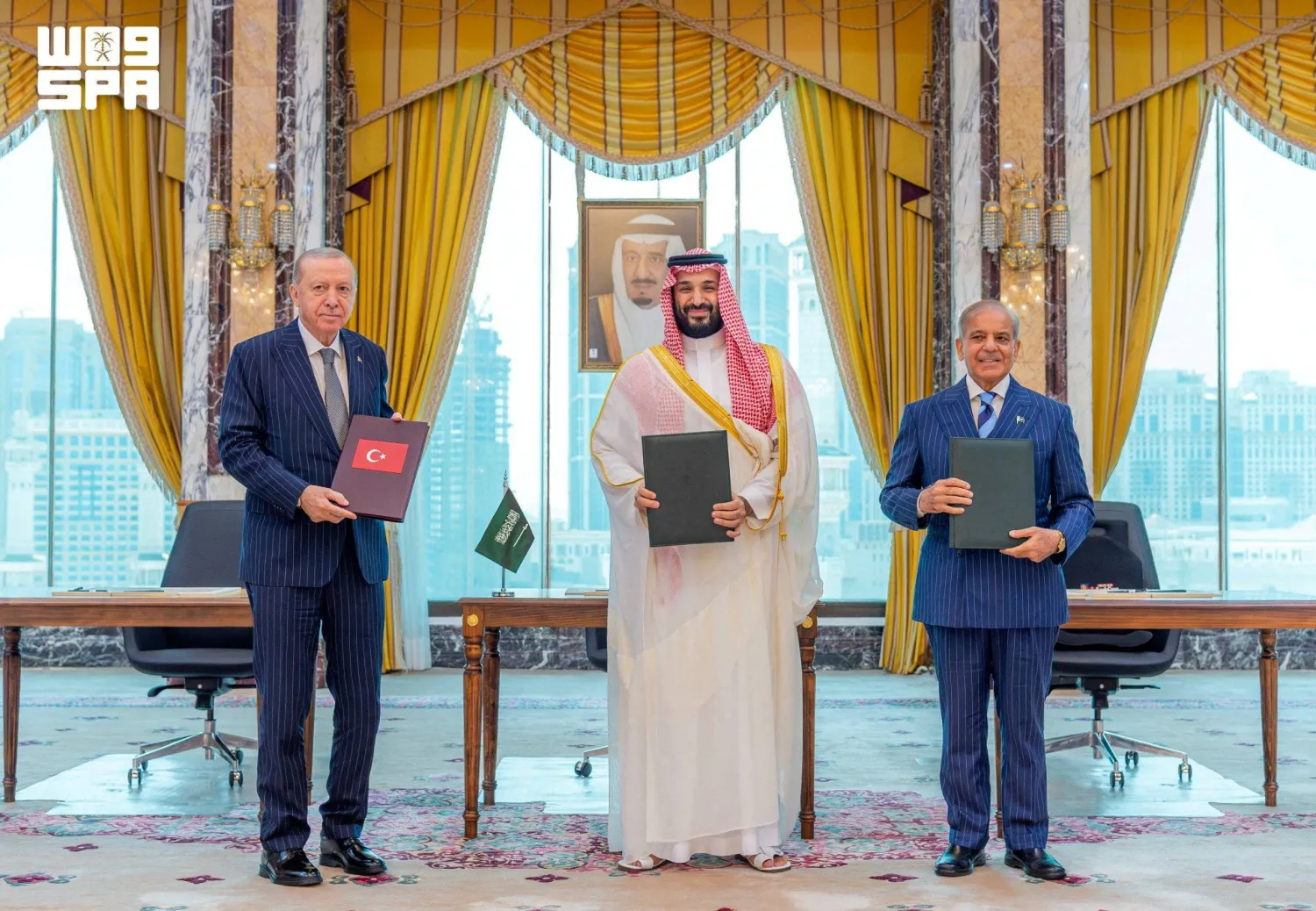
Turkish President Recep Tayyip Erdogan, Prince Mohammed bin Salman, Saudi Crown Prince and Prime Minister, and Pakistani Prime Minister Shehbaz Sharif pose after signing the joint defense agreement in Makkah, Saudi Arabia, August 7, 2026. (SPA)
TT

‘Makkah Agreement’ Moves Toward Establishing Strategic, Political and Military Mechanisms

Turkish President Recep Tayyip Erdogan, Prince Mohammed bin Salman, Saudi Crown Prince and Prime Minister, and Pakistani Prime Minister Shehbaz Sharif pose after signing the joint defense agreement in Makkah, Saudi Arabia, August 7, 2026. (SPA)

Türkiye, Saudi Arabia and Pakistan will group senior ministers, hold joint exercises and deepen defense industry cooperation under a military pact signed between the regional powers last week, Türkiye’s defense ministry said on Thursday.

At a weekly briefing in Ankara, the defense ministry said the pact's fundamental goal was to ensure defense and military ties were put on a "more institutional ⁠and sustainable" footing.

"Under the accord, strategic political ‌and military mechanisms plan to be ‌established involving the Defense Ministers, Foreign Ministers, and Chiefs of ‌General Staff/Armed Forces Commanders, and that coordination among the three countries ‌will be conducted at the highest level," it said.

The Turkish statements open the door for the Makkah Agreement to move from a political commitment toward establishing practical structures and mechanisms for defense coordination, including military, industrial and technological cooperation, while keeping the agreement open to the accession of other countries.

An agreement for deterrence and coordination

On August 7, Saudi Arabia, Türkiye and Pakistan signed the Makkah Agreement for Joint Defense in Makkah during a summit attended by Saudi Crown Prince and Prime Minister Mohammed bin Salman, Turkish President Recep Tayyip Erdogan and Pakistani Prime Minister Shehbaz Sharif.

The agreement is aimed at strengthening joint deterrence, as well as defense coordination and integration among the three countries. It stipulates that an armed attack against any one of the parties will be considered an attack against all three, reinforcing the principle of collective defense against threats to their security.

The agreement was signed under the umbrella of the Makkah Summit for Joint Defense, with the aim of strengthening the security of the three countries and contributing to regional and international security, peace and stability.

Saudi Defense Minister Prince Khalid bin Salman said after the agreement was signed that it establishes a framework for a long-term defense partnership and strengthens deterrence, coordination and integration, contributing to regional and global security and stability.

An open-ended defense partnership

Since the agreement was announced, the three parties have signaled that it is not intended to form a closed alliance. Turkish President Recep Tayyip Erdogan said the agreement is open to the participation of all brotherly countries seeking to achieve peace, prosperity and stability in our region.

Türkiye signaled that expanding the agreement to other countries would depend on first establishing the necessary institutional and regulatory mechanisms. A Saudi official stressed that the pact is not intended as a military or sectarian bloc, nor is it tied to nuclear ambitions or an arms race, but to building sustainable defense capabilities.

The official stressed that the agreement does not come at the expense of Saudi Arabia’s strategic ties with Gulf and Arab states or international partners, and is not directed against any country or intended to escalate tensions in the region.

Joint drills and defense production

The agreement could expand beyond military coordination to include joint exercises, defense production, technology transfer and the development of local capabilities. The three countries aim to build a shared defense-industrial base, with Saudi Arabia seeking greater localization and Türkiye and Pakistan bringing growing expertise in drones and other military systems.

The Makkah Agreement unites three regional powers with shared security interests. Türkiye’s plans to establish strategic, political and military mechanisms could institutionalize the pact and potentially turn it into a broader regional defense framework, depending on its structure and future membership.


Saudi Arabia and Kuwait Support Efforts to De-escalate Regional Tensions

Saudi Foreign Minister Prince Faisal bin Farhan and his Kuwaiti counterpart Sheikh Jarrah Al-Sabah (Asharq Al Awsat)
TT

Saudi Arabia and Kuwait Support Efforts to De-escalate Regional Tensions

Saudi Foreign Minister Prince Faisal bin Farhan and his Kuwaiti counterpart Sheikh Jarrah Al-Sabah (Asharq Al Awsat)

Saudi Foreign Minister Prince Faisal bin Farhan discussed the latest regional developments and efforts to address them during a phone call on Wednesday with his Kuwaiti counterpart, Sheikh Jarrah Al-Sabah.

Saudi Arabia and Kuwait stressed the importance of maintaining coordination and consultations between the two countries and supporting joint diplomatic efforts to de-escalate tensions and strengthen regional security and stability.


Saudi Air Defenses Destroy Three Cruise Missiles and Two Drones

Yemeni army fighters on the Jabal Han front near the city of Taiz. (AFP)
TT

Saudi Air Defenses Destroy Three Cruise Missiles and Two Drones

Yemeni army fighters on the Jabal Han front near the city of Taiz. (AFP)

Saudi air defenses intercepted and destroyed on Wednesday three cruise missiles fired by Houthi militias towards Riyadh, as well as two drones over the Makkah and Southern Region.

Yemeni government forces expanded their military operations against the Houthis under the “Yemen Dawn” operation, across the fronts of Marib, Al-Jawf, Taiz, Lahj, Al-Dhale and Hajjah.

The Yemeni army said it had carried out 874 strikes over a 24-hour period, killing or wounding about 190 Houthi militants and destroying or disabling 130 military vehicles and combat assets.

In western Lahj, the Giants Brigades and Nation’s Shield forces repelled Houthi attacks, as families fled front-line areas towards Aden and other safer locations.

Government forces also foiled an attempt to detonate two improvised explosive devices disguised as sandstone rocks and planted on either side of the international road linking Marib with the Al-Abr area, which leads to the border crossing with Saudi Arabia.

Military sources said engineering teams dismantled the devices between the Al-Ruwaik and Al-Dhuwaybi areas and secured the road without any casualties.


Bahrain Crown Prince Receives Saudi and GCC Interior Ministers

Bahrain’s Crown Prince, Deputy Supreme Commander of the Armed Forces and Prime Minister Prince Salman bin Hamad Al Khalifa receives the Gulf ministers in Manama on Wednesday. (SPA)
TT

Bahrain Crown Prince Receives Saudi and GCC Interior Ministers

Bahrain’s Crown Prince, Deputy Supreme Commander of the Armed Forces and Prime Minister Prince Salman bin Hamad Al Khalifa receives the Gulf ministers in Manama on Wednesday. (SPA)

Bahrain’s Crown Prince, Deputy Supreme Commander of the Armed Forces and Prime Minister Prince Salman bin Hamad Al Khalifa received in Manama on Wednesday Saudi Minister of Interior Prince Abdulaziz bin Saud bin Naif bin Abdulaziz and the interior ministers of the Gulf Cooperation Council (GCC) member states.

Prince Abdulaziz bin Saud conveyed the greetings of Prince Mohammed bin Salman bin Abdulaziz Al Saud, Crown Prince and Prime Minister, to Prince Salman bin Hamad, along with his wishes for continued progress and prosperity for Bahrain and its people.

Prince Salman bin Hamad commended the efforts of the interior ministers during their meeting and the outcomes achieved in strengthening the security and stability of GCC member states.

The meeting also addressed security cooperation among GCC countries and ongoing efforts to boost coordination and integration in security-related fields.

GCC Secretary-General Jasem Albudaiwi attended the talks.