



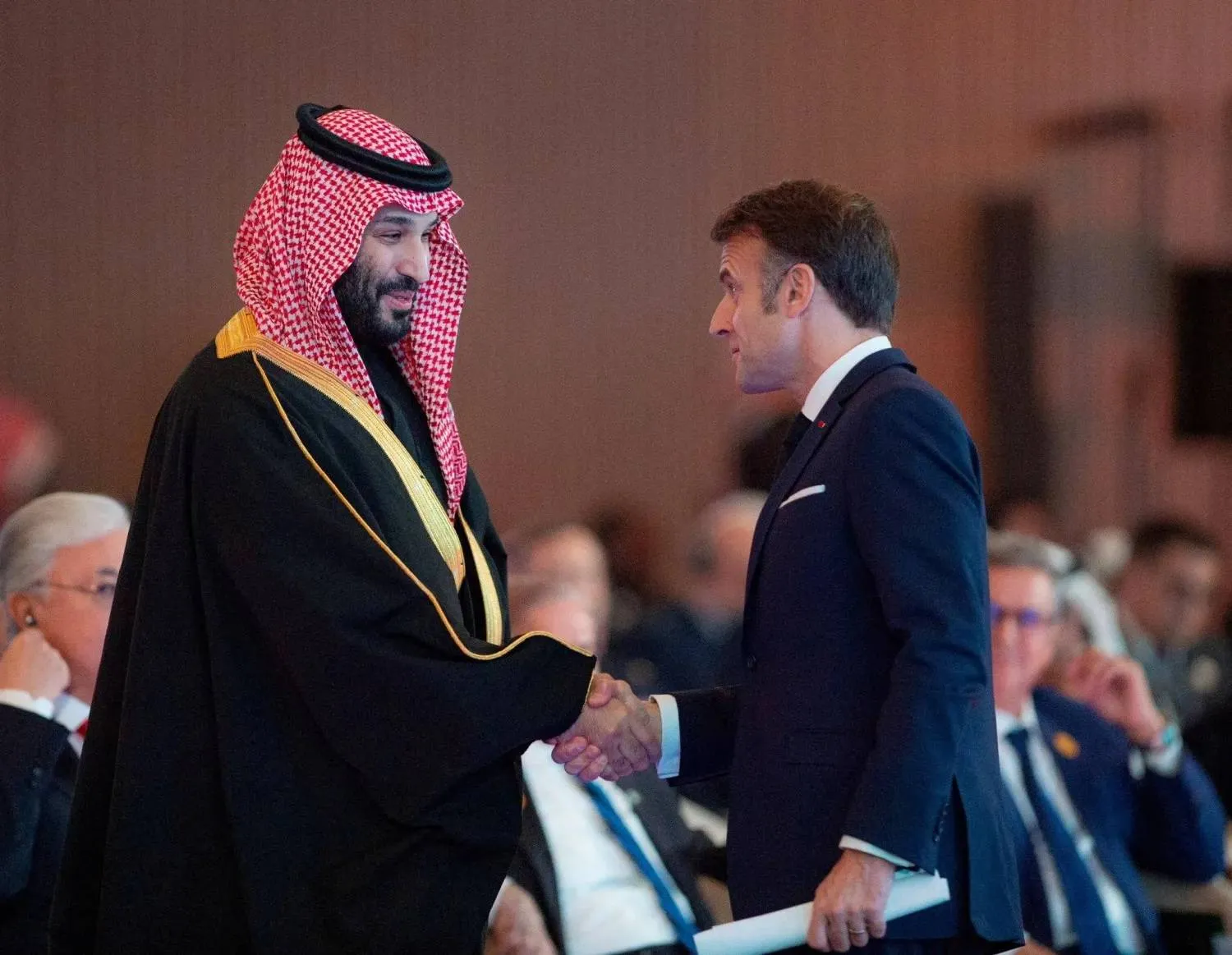

The visit by Prince Mohammed bin Salman, Saudi Crown Prince and Prime Minister, to Paris is not taking place under ordinary regional circumstances. The region is experiencing a phase where wars and maritime security are redefining the concept of economic security, while European countries are facing growing questions about the stability of energy supplies and the resilience of trade routes.
In this environment, the Saudi-French partnership gains a dimension that transcends the boundaries of bilateral relations.
Riyadh and Paris view regional security from two complementary angles: Saudi Arabia from its position at the heart of the Middle East's energy and trade systems, and France from its European and international position, making their coordination of particular importance when it comes to protecting supply lines and opening safer, more resilient alternatives.
The visit is taking place as the two countries seek to discuss the diversification of energy transport routes and logistics, including maritime routes, regional railway projects, and pipelines, in an effort to build a network that does not rely on a single route in a region where geography has become an influential factor in the global economy.
Security is no longer just military
Recent years have shown that energy security neither begins at a production facility nor ends at a receiving station in Europe. The maritime corridor, port, pipeline, power grid, and storage centers have all become links in a single concept of security, and it is here that Saudi and French interests intersect.
Saudi Arabia is in a pivotal position between the Gulf and the Red Sea, while France possesses a military and naval presence in the region, in addition to its position within the European system. This provides both parties with room for coordination in maritime security, the protection of trade routes, and the development of infrastructure linking Asian and European markets.
Energy is changing
The issue is not limited to oil; the Saudi-French relationship is moving toward hydrogen, renewable energy, electricity storage, smart grids, and carbon capture, reflecting the transformation in the nature of the energy market itself.
Saudi Arabia possesses the advantage of resources, vast areas, and investment capabilities, while France has a broad industrial and technological base in energy, engineering, and transport.
If both parties succeed in integrating these advantages, cooperation could shift from merely purchasing energy or developing a facility to building production, transport, and technology systems.
Economy at the heart of calculations
Meanwhile, the volume of Saudi-French trade rose to around $11.79 billion (44.2 billion riyals) in 2025, while the balance of French investments in the Kingdom jumped in less than a decade from around $7.49 billion (28.1 billion riyals) to $18.53 billion (69.5 billion riyals).
However, the figures, despite their importance, do not alone reveal the future direction of the relationship. The greater bet lies in investing in the sectors that will drive the economy over the next decade: artificial intelligence, advanced industries, health, tourism, transport, logistics, and new energy.
Here, Saudi Vision 2030 converges with France 2030 in the pursuit of an economy more reliant on technology and innovation.
Beyond bilateral relations
Paris also holds political value for Riyadh. France is not only a European nation with an advanced economy, but also a permanent member of the UN Security Council and a power with a historical presence in the Middle East.
Conversely, Paris views Saudi Arabia as an actor whose role cannot be bypassed in any broad regional arrangements. The scope of consultation between the two countries has expanded to encompass the Palestinian cause, Lebanon, Syria, and Red Sea security, alongside broader regional developments.
Therefore, the Saudi-French Strategic Partnership Council, which will hold its first meeting during the Crown Prince’s visit, arrives at an opportune time to transform this communication into a more regular mechanism, linking economic files with political and strategic ones.
Common interests
What Riyadh and Paris are discussing for the upcoming phase does not merely concern a new energy corridor or a new transport project; at its core, it is an attempt to build a network of interests capable of withstanding crises.
The more diversified energy sources and transport routes become, and the more trade paths multiply and technologies and industries are localized, the less vulnerable nations become to sudden shocks.
From this perspective, the Saudi visit to Paris can be read as part of a broader discussion on the shape of the region and the relationship between the Gulf and Europe in the coming years.
Riyadh aims to become a global economic and logistical hub, while Paris wants to maintain an influential European presence in a region reshaping its balances and it is precisely within this space that the interests of the two countries converge.


