
Qatar PM Pursues Mediation in Tehran as US Ramps up ‘Economic War’

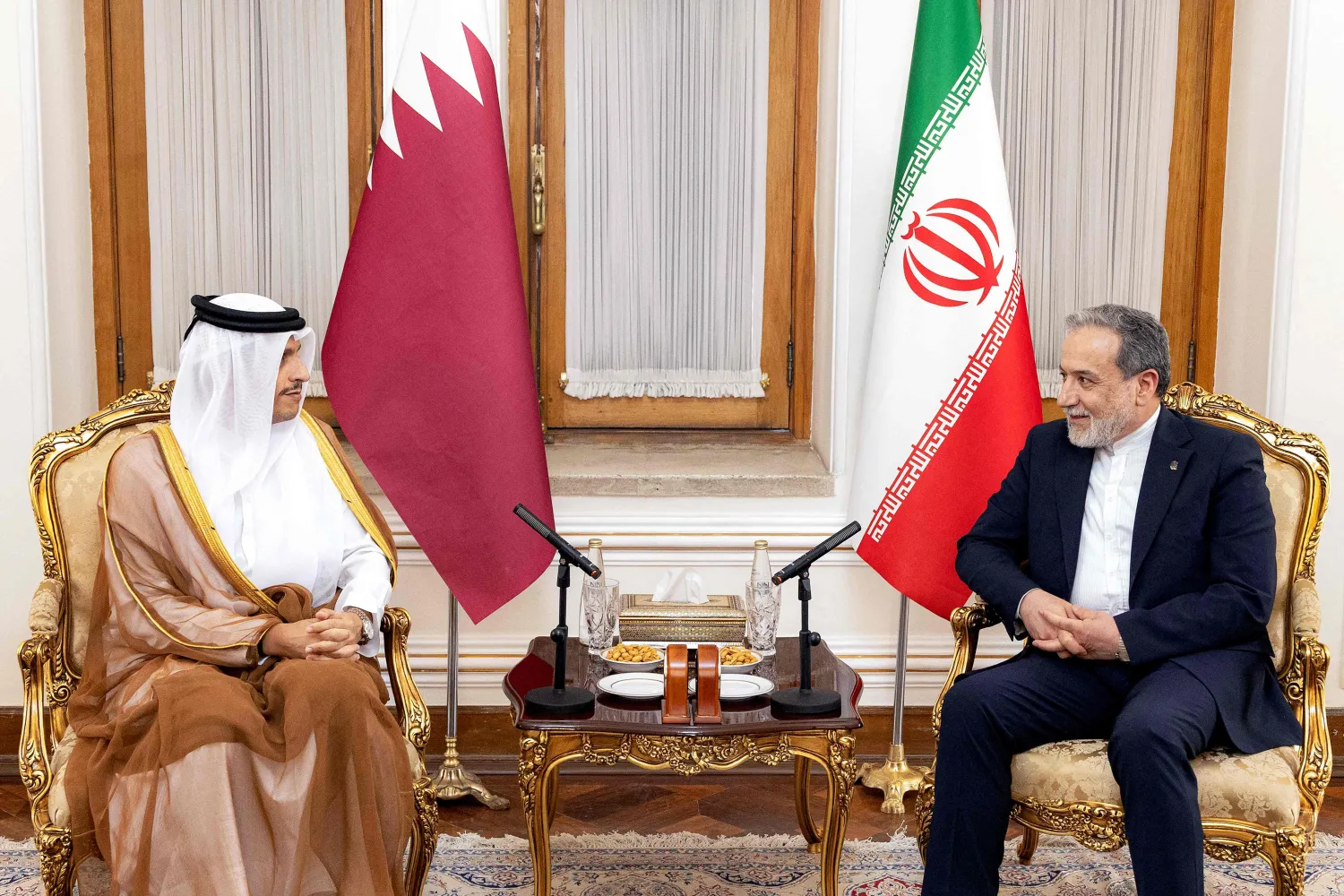
This handout picture released by the Qatari Ministry of Foreign Affairs shows Qatar's Prime Minister and Foreign Minister Sheikh Mohammed bin Abdulrahman Al Thani, (L) meeting with Iran's Foreign Minister Abbas Araghchi (R) in Tehran on August 27, 2026. (Qatari Ministry of Foreign Affairs / AFP)
TT

Qatar PM Pursues Mediation in Tehran as US Ramps up ‘Economic War’

This handout picture released by the Qatari Ministry of Foreign Affairs shows Qatar's Prime Minister and Foreign Minister Sheikh Mohammed bin Abdulrahman Al Thani, (L) meeting with Iran's Foreign Minister Abbas Araghchi (R) in Tehran on August 27, 2026. (Qatari Ministry of Foreign Affairs / AFP)

The prime minister Qatar visited Tehran on Thursday in a bid to revive diplomacy as the US and Iran traded recriminations over Washington's latest sanctions drive, described by one Iranian official as "all-out economic war". 

Qatar has played a direct role in securing a June ceasefire that briefly led to a cessation of hostilities. 

The visit comes as the war nears its sixth month with fighting largely paused but no diplomatic breakthrough in sight. Both sides are at odds over control of the Strait of Hormuz, a chokepoint for global oil supplies that Tehran has used as leverage.  

The White House said there were currently no negotiations happening between the United States and Iran as Tehran had not yet "come to the table in a meaningful way".  

Iran ‌has repeatedly said it ‌has never left the negotiating table. 

UNBLOCKING HORMUZ 

Qatar's Prime Minister Sheikh Mohammed bin Abdulrahman Al Thani, ‌who is ⁠also his country's ⁠foreign minister, held talks in Tehran with Iranian Foreign Minister Abbas Araghchi, according to Iran's foreign ministry channel on Telegram. 

The two discussed a proposed phased framework that includes establishing a temporary joint Iranian-Omani shipping corridor through the strait and carrying out a joint project to clear mines from the waterway, Qatar's foreign ministry said. 

A memorandum of understanding reached between the US and Iran in June to end the conflict broke down in part because of differences over the strait between Iran and Oman, where one-fifth of the world's oil supplies passed before the war began on February 28. 

Tehran has said the strait will remain shut unless the US meets Iranian conditions agreed under the June interim ceasefire. Those conditions include ⁠an end to the US blockade on Iranian ports, compensation and removal of sanctions. 

The two ‌officials also reviewed the latest developments in the region and efforts to de-escalate tensions ‌and create conditions for dialogue, the Qatari ministry said. 

'NO NEGOTIATIONS HAPPENING'  

White House press secretary Karoline Leavitt said on Thursday that President Donald Trump "continues to retain ‌all options on the table" with regard to Iran. 

"We've had Operation Epic Fury to destroy their military. Now we have Operation ‌Economic Outcast to destroy their economy," Leavitt said in an interview with Fox News.  

"No negotiations are happening right now, and this will continue until the president feels that maybe they come to the table in a meaningful way," she said. "We have not seen that yet." 

While direct military strikes on Iran have halted, Washington this week piled on the economic pressure by announcing plans to cut Iran off from its trading partners with increased sanctions. 

Iranian Parliament ‌Speaker Mohammad Baqer Qalibaf called on Thursday for national unity in the face of what he described as "all-out economic war", warning that internal division was "exactly what the enemy wants". 

Ebrahim Azizi, ⁠the head of the Iranian ⁠parliament's national security committee, said the sanctions were an "inhumane and hostile act" which nonetheless had lost their effectiveness. 

Tehran has lived under various forms of US sanctions since the revolution in 1979. 

OMAN-IRAN HORMUZ DEAL  

Iran's Revolutionary Guards said on Wednesday that Iran and Oman had agreed on how to share the Strait of Hormuz and its revenues, but a senior Iranian source later said the two countries were still working on the details of an agreement. 

The Strait of Hormuz was open to free navigation before the war, but Iran has since clung to its control of the waterway as leverage and a revenue source, seeking to charge ships a commission, which the US has opposed. 

Despite an aerial bombardment earlier in the war that severely diminished Iran's conventional forces, Tehran has maintained enough missile and drone capability to attack Gulf neighbors and disrupt oil tankers in the strait. 

The International Maritime Organization has reported 70 incidents in the Strait of Hormuz since February 28 that have killed 19 seafarers. 

Thousands of others have died, mostly in Iran and Lebanon, since the US and Israel attacked Iran with the stated goals of denying Iran a nuclear weapon, helping Iranians topple their government, and destroying Tehran's missile program. 


GCC Secretary-General Highlights Gulf’s Leading Global Position in Cybersecurity

GCC Secretary-General Jasem Albudaiwi. SPA
TT

GCC Secretary-General Highlights Gulf’s Leading Global Position in Cybersecurity

GCC Secretary-General Jasem Albudaiwi. SPA

Secretary-General of the Gulf Cooperation Council (GCC) Jasem Albudaiwi said that GCC member countries occupy a leading global position in cybersecurity, driven by strengthened national capabilities, data protection, and enhanced cyber threat response, SPA reported.

These remarks were made during the fifth meeting of the GCC Ministerial Committee for Cybersecurity, held in Manama.

He also pointed to recent developments in the region and the accompanying escalation of cyber risks and threats, noting that the GCC cybersecurity ecosystem demonstrated a high level of readiness and efficiency.

He highlighted key achievements in joint Gulf action, including the Executive Plan for the GCC Cybersecurity Strategy (2024–2028), the GCC International Cooperation Framework in the Field of Cybersecurity, the governance mechanism for information sharing on the Cyber Threat Intelligence Platform, and the annual organization of joint Gulf cyber drills.


Ismail Ould Cheikh Ahmed Elected Secretary-General of the Organization of Islamic Cooperation

The new Secretary-General, Ismail Ould Cheikh Ahmed (Organization of Islamic Cooperation)
TT

Ismail Ould Cheikh Ahmed Elected Secretary-General of the Organization of Islamic Cooperation

The new Secretary-General, Ismail Ould Cheikh Ahmed (Organization of Islamic Cooperation)

Foreign ministers of the member states of the Organization of Islamic Cooperation elected Mauritanian diplomat Ismail Ould Cheikh Ahmed as the organization's new secretary-general on Thursday. The organization comprises 57 countries.

Ould Cheikh Ahmed succeeds Chadian Hussein Ibrahim Taha, who took office as secretary-general in November 2021 and whose term officially ends in November 2026.

The Mauritanian diplomat arrives in Jeddah, in western Saudi Arabia, where the organization's General Secretariat is based, bringing more than three decades of extensive experience between UN work and crisis hotspots.

The organization's charter sets the secretary-general's term at five years, renewable only once. The secretary-general is elected by the Council of Foreign Ministers of the member states according to the principles of fair geographical distribution, rotation, and equal opportunity, while taking competence, integrity, and experience into account.

The charter does not provide for a fixed sequence for the transfer of the position among the Arab, African, and Asian groups. Instead, it makes rotation and fair geographical distribution the basis for the selection.

In February, the African Union formally endorsed Ould Cheikh Ahmed's candidacy for the position for the 2027-2032 term, listing Mauritania within the Northern Africa region.


Kuwait Foils Biggest Drug Operation in Its History

Sheikh Fahad Yousef Saud Al-Sabah, Kuwait's First Deputy Prime Minister and Minister of Interior. (KUNA)
TT

Kuwait Foils Biggest Drug Operation in Its History

Sheikh Fahad Yousef Saud Al-Sabah, Kuwait's First Deputy Prime Minister and Minister of Interior. (KUNA)

Sheikh Fahad Yousef Saud Al-Sabah, Kuwait's First Deputy Prime Minister and Minister of Interior, announced on Wednesday the foiling of the largest drug bust in Kuwait's history, consisting of approximately 5 tons of raw "Lyrica" powder and nearly 4 million capsules ready for sale, worth around 150 million Kuwaiti dinars, or around $486.8 million US dollars.

Speaking as part of a national drug prevention campaign, he said that Tuesday's bust also included an integrated factory for producing the psychotropic substance Lyrica, alongside equipment for filling and distributing capsules.

The bust reflects the magnitude of the danger of drugs to society, he added.

"The quantity seized was ready to be sold, but the suspect did not act to distribute it out of fear of falling under the jurisdiction of the new law."

Al-Yousef stressed that the new drug law "has contributed to boosting deterrence, making drug dealers think twice before attempting to harm any citizen or resident on Kuwaiti soil."

"Combating drugs is at the forefront of the Ministry of Interior's priorities, which continues to crack down on smugglers and distributors, tighten surveillance and seizure measures, and dry up the sources of this scourge," he said.