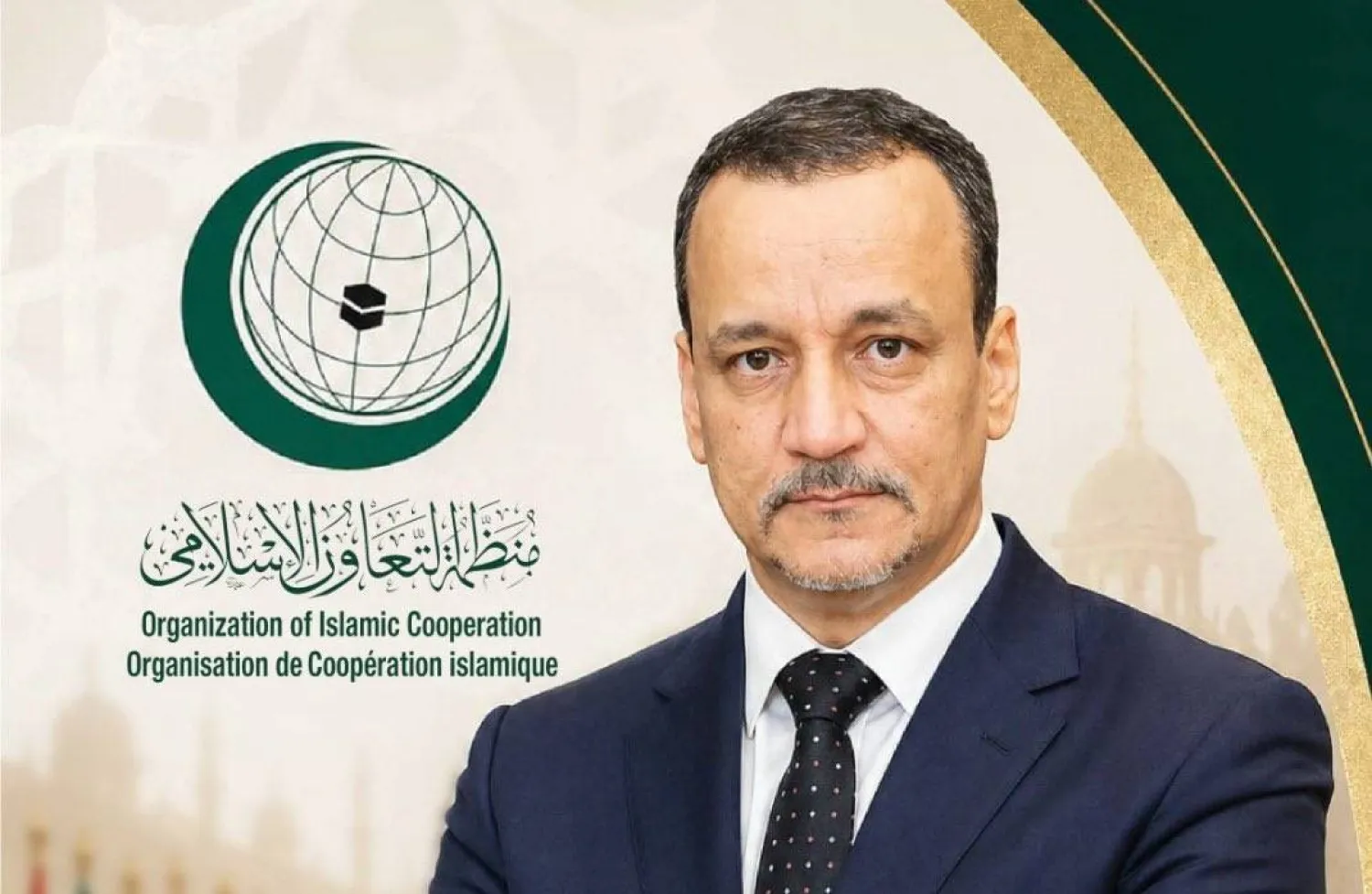
Ismail Ould Cheikh Ahmed Elected Secretary-General of the Organization of Islamic Cooperation

The new Secretary-General, Ismail Ould Cheikh Ahmed (Organization of Islamic Cooperation)
TT

Ismail Ould Cheikh Ahmed Elected Secretary-General of the Organization of Islamic Cooperation

The new Secretary-General, Ismail Ould Cheikh Ahmed (Organization of Islamic Cooperation)

Foreign ministers of the member states of the Organization of Islamic Cooperation elected Mauritanian diplomat Ismail Ould Cheikh Ahmed as the organization's new secretary-general on Thursday. The organization comprises 57 countries.

Ould Cheikh Ahmed succeeds Chadian Hussein Ibrahim Taha, who took office as secretary-general in November 2021 and whose term officially ends in November 2026.

The Mauritanian diplomat arrives in Jeddah, in western Saudi Arabia, where the organization's General Secretariat is based, bringing more than three decades of extensive experience between UN work and crisis hotspots.

The organization's charter sets the secretary-general's term at five years, renewable only once. The secretary-general is elected by the Council of Foreign Ministers of the member states according to the principles of fair geographical distribution, rotation, and equal opportunity, while taking competence, integrity, and experience into account.

The charter does not provide for a fixed sequence for the transfer of the position among the Arab, African, and Asian groups. Instead, it makes rotation and fair geographical distribution the basis for the selection.

In February, the African Union formally endorsed Ould Cheikh Ahmed's candidacy for the position for the 2027-2032 term, listing Mauritania within the Northern Africa region.


Saudi Arabia and Kuwait Support Efforts to De-escalate Regional Tensions

Saudi Foreign Minister Prince Faisal bin Farhan and his Kuwaiti counterpart Sheikh Jarrah Al-Sabah (Asharq Al Awsat)
TT

Saudi Arabia and Kuwait Support Efforts to De-escalate Regional Tensions

Saudi Foreign Minister Prince Faisal bin Farhan and his Kuwaiti counterpart Sheikh Jarrah Al-Sabah (Asharq Al Awsat)

Saudi Foreign Minister Prince Faisal bin Farhan discussed the latest regional developments and efforts to address them during a phone call on Wednesday with his Kuwaiti counterpart, Sheikh Jarrah Al-Sabah.

Saudi Arabia and Kuwait stressed the importance of maintaining coordination and consultations between the two countries and supporting joint diplomatic efforts to de-escalate tensions and strengthen regional security and stability.


Saudi Air Defenses Destroy Three Cruise Missiles and Two Drones

Yemeni army fighters on the Jabal Han front near the city of Taiz. (AFP)
TT

Saudi Air Defenses Destroy Three Cruise Missiles and Two Drones

Yemeni army fighters on the Jabal Han front near the city of Taiz. (AFP)

Saudi air defenses intercepted and destroyed on Wednesday three cruise missiles fired by Houthi militias towards Riyadh, as well as two drones over the Makkah and Southern Region.

Yemeni government forces expanded their military operations against the Houthis under the “Yemen Dawn” operation, across the fronts of Marib, Al-Jawf, Taiz, Lahj, Al-Dhale and Hajjah.

The Yemeni army said it had carried out 874 strikes over a 24-hour period, killing or wounding about 190 Houthi militants and destroying or disabling 130 military vehicles and combat assets.

In western Lahj, the Giants Brigades and Nation’s Shield forces repelled Houthi attacks, as families fled front-line areas towards Aden and other safer locations.

Government forces also foiled an attempt to detonate two improvised explosive devices disguised as sandstone rocks and planted on either side of the international road linking Marib with the Al-Abr area, which leads to the border crossing with Saudi Arabia.

Military sources said engineering teams dismantled the devices between the Al-Ruwaik and Al-Dhuwaybi areas and secured the road without any casualties.


Bahrain Crown Prince Receives Saudi and GCC Interior Ministers

Bahrain’s Crown Prince, Deputy Supreme Commander of the Armed Forces and Prime Minister Prince Salman bin Hamad Al Khalifa receives the Gulf ministers in Manama on Wednesday. (SPA)
TT

Bahrain Crown Prince Receives Saudi and GCC Interior Ministers

Bahrain’s Crown Prince, Deputy Supreme Commander of the Armed Forces and Prime Minister Prince Salman bin Hamad Al Khalifa receives the Gulf ministers in Manama on Wednesday. (SPA)

Bahrain’s Crown Prince, Deputy Supreme Commander of the Armed Forces and Prime Minister Prince Salman bin Hamad Al Khalifa received in Manama on Wednesday Saudi Minister of Interior Prince Abdulaziz bin Saud bin Naif bin Abdulaziz and the interior ministers of the Gulf Cooperation Council (GCC) member states.

Prince Abdulaziz bin Saud conveyed the greetings of Prince Mohammed bin Salman bin Abdulaziz Al Saud, Crown Prince and Prime Minister, to Prince Salman bin Hamad, along with his wishes for continued progress and prosperity for Bahrain and its people.

Prince Salman bin Hamad commended the efforts of the interior ministers during their meeting and the outcomes achieved in strengthening the security and stability of GCC member states.

The meeting also addressed security cooperation among GCC countries and ongoing efforts to boost coordination and integration in security-related fields.

GCC Secretary-General Jasem Albudaiwi attended the talks.