


Qatar Expands Political, Economic Outreach in Libya, Engages Benghazi

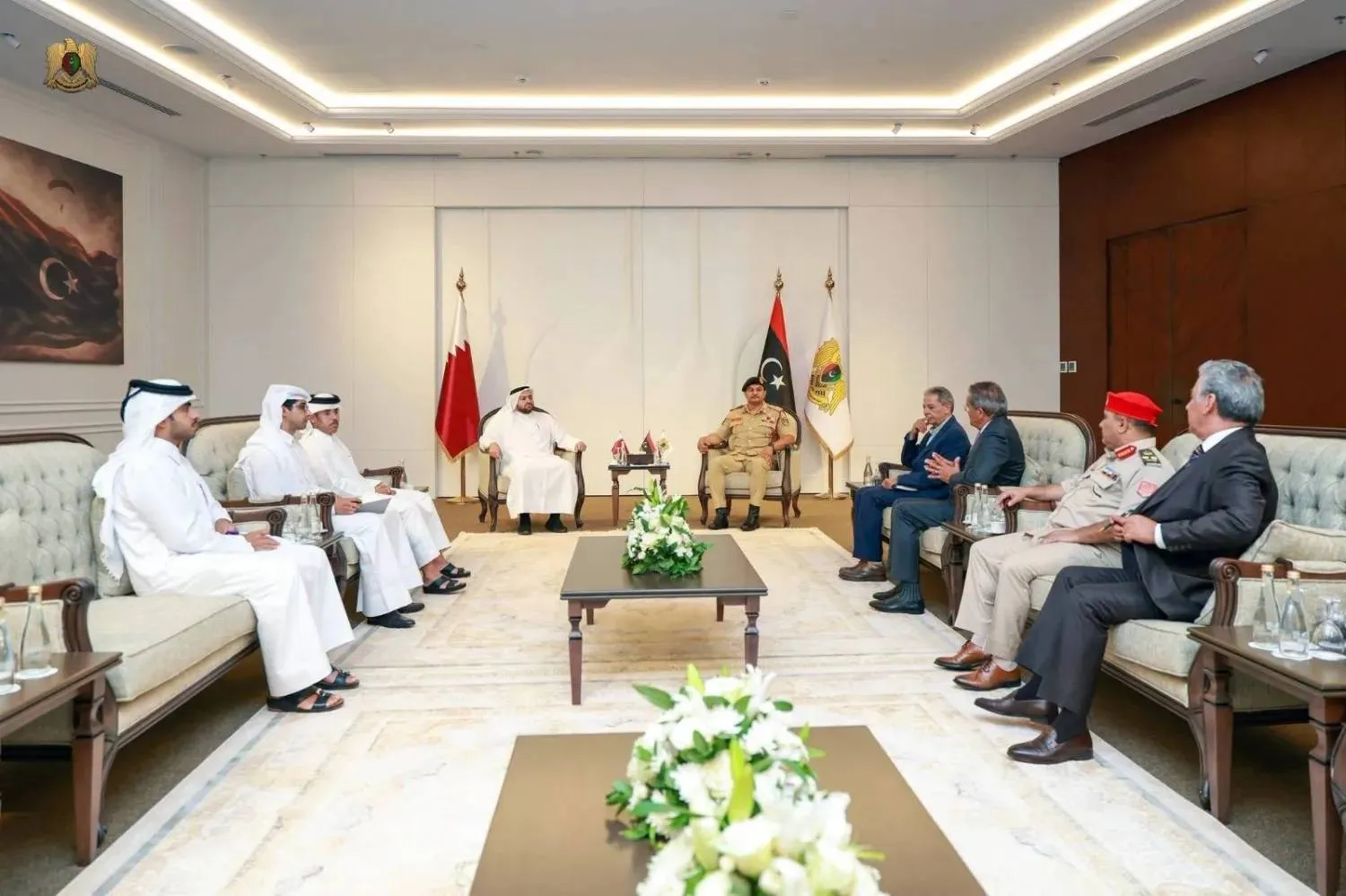
Saddam Haftar, acting commander-in-chief of the Libyan National Army, receives Qatari Minister of State for Foreign Affairs Mohammed bin Abdulaziz Al-Khulaifi. (General Command)
TT

Qatar Expands Political, Economic Outreach in Libya, Engages Benghazi

Saddam Haftar, acting commander-in-chief of the Libyan National Army, receives Qatari Minister of State for Foreign Affairs Mohammed bin Abdulaziz Al-Khulaifi. (General Command)

Qatar has significantly expanded its diplomatic and political presence in Libya, appearing poised to deepen cooperation and partnerships with political factions in both the east and west and forge future ties after years of strained relations, particularly with Benghazi.

During visits to the capital Tripoli and Benghazi, Qatari Minister of State for Foreign Affairs Mohammed bin Abdulaziz Al-Khulaifi held a series of meetings focused on political, economic and military cooperation. He also held talks with UN envoy to Libya Hanna Tetteh.

Al-Khulaifi concluded his two-day tour of Libya with a visit to Benghazi, where he met Lieutenant General Saddam Haftar, the acting commander-in-chief of the Libyan National Army, at the Libyan National Army's general command headquarters.

The two discussed the latest political developments in Libya and abroad, as well as ways to develop bilateral relations and strengthen cooperation across various fields in a manner that serves the two countries’ mutual interests.

Qatar has close ties and extensive cooperation with the authorities in Tripoli in western Libya, but this was the first visit by a senior Qatari official to Benghazi in the east since a political split engulfed the country 14 years ago.

Qatari Ambassador Khalid Al-Dosari has also conducted diplomatic outreach in Libya aimed at strengthening cooperation, advancing mutual interests and supporting stability in the country.

Saddam Haftar welcomed the Qatari delegation led by Al-Khulaifi, stressing the depth of the fraternal relations between the two countries and praising Qatar’s efforts to support Libya’s stability and unity.

The general command said on Thursday evening that Al-Khulaifi expressed his pleasure at visiting Benghazi and praised the stability and urban development the city was experiencing. He also formally invited Saddam Haftar to visit Qatar to continue consultations and coordination between the two sides.

Saddam Haftar visited Doha on July 16 to offer condolences to Qatar’s Emir Sheikh Tamim bin Hamad Al Thani over the death of his father, Sheikh Hamad bin Khalifa Al Thani.

Before meeting Saddam Haftar, Al-Khulaifi met his brother, Belqasim Haftar, director-general of the Libya Development and Reconstruction Fund, who was accompanied by Qatar’s ambassador to Libya, Khalid Al-Dosari.

Their talks focused on the importance of cooperation in development and reconstruction, economic partnerships and the participation of Qatari institutions and companies in development projects carried out by the fund.

The fund’s media office said on Thursday evening that the two sides discussed expanding cooperation in areas of mutual interest and maintaining communication and coordination in the coming period to translate bilateral relations into practical cooperation and partnerships in development and reconstruction.

Before traveling to Benghazi, Al-Khulaifi held several meetings at various levels in Tripoli late last week, beginning with talks with Abdulhamid al-Dbeibah, prime minister of the interim Government of National Unity, and his deputy Salem al-Zadma. He also met Salah al-Namroush, chief of the general staff in western Libya.

Talks between Dbeibah and Al-Khulaifi focused on developments in bilateral relations and ways to enhance Qatar’s role in supporting stability and Libya’s political and economic tracks.

Dbeibah welcomed the Qatari minister’s visits to Tripoli and Benghazi and stressed the importance of maintaining contact with Libya’s various factions.

He said his government hoped Qatar would play a greater role in the coming period to support stability and consensus and strengthen regional and international coordination on Libya.

The meeting also addressed the development of bilateral cooperation in several sectors, particularly energy and healthcare, and the expansion of economic cooperation between the two countries into broader programs and practical projects, according to Dbeibah’s office.

The two sides also discussed developments in a four-way cooperation mechanism involving Libya, Qatar, Türkiye, and Italy to address irregular migration.

They reviewed ways to build on the launch of a pilot operations room and to strengthen joint programs for capacity building, combating migration, and supporting voluntary returns.

Southern Libya also featured in Al-Khulaifi’s meeting with Dbeibah’s deputy, al-Zadma, who said he briefed the Qatari minister on conditions in the southern Fezzan region and the main challenges and obstacles it faced across various sectors.

They also discussed prospects for economic and development cooperation, developments related to irregular migration, and ways to strengthen coordination between the two countries.

Al-Zadma spoke of Qatar’s importance as an active partner in supporting cooperation with Libya, and the need to broaden communication and partnership to advance stability and development.

He also stressed the importance of continued communication and coordination to open wider prospects for cooperation on issues of mutual interest.

Al-Khulaifi and the Qatari delegation also met al-Namroush at the general staff headquarters in Tripoli to discuss strengthening and developing bilateral relations in various fields.

They also discussed support for efforts to unify Libya’s military establishment and ways to enhance cooperation that could bolster security and consolidate stability in the country.

Tetteh and Al-Khulaifi exchanged views on the latest political and security developments in Libya.

The UN mission said on Thursday evening that Tetteh briefed Al-Khulaifi on recommendations emerging from the “Structured Dialogue,” which the mission sponsored in an effort to break the political deadlock, and on ways to build on them.

She also briefed him on the outcome of a smaller meeting known as the “4+4 Committee” and the next steps, highlighting the role of regional and international actors in supporting UN efforts to pave the way for elections.

Al-Khulaifi expressed support for the efforts of the UN secretary-general’s special representative and the United Nations Support Mission in Libya. He stressed the need to integrate all initiatives aimed at resolving Libya’s political deadlock and leading the country toward elections.

The period following the overthrow of the late Libyan leader Muammar Gaddafi in 2011 was marked by political differences among regional states. Some chose to support Tripoli for ideological reasons, while others backed Field Marshal Khalifa Haftar, commander-in-chief of the Benghazi-based Libyan National Army.



Saudi Arabia Condemns Israeli Official, Settlers’ Storming of Al-Aqsa Courtyards

Logo of the Saudi Ministry of Foreign Affairs
TT

Saudi Arabia Condemns Israeli Official, Settlers’ Storming of Al-Aqsa Courtyards

Logo of the Saudi Ministry of Foreign Affairs

The Saudi Ministry of Foreign Affairs strongly condemned the storming of Al-Aqsa Mosque’s courtyards by an Israeli occupation official and a group of extremist settlers, under the protection of occupation forces, describing the incursion as a flagrant violation and a provocation to Muslims worldwide, the Saudi Press Agency said Monday.

In a statement, the ministry said: "Saudi Arabia reiterates its categorical rejection of the provocative practices and illegal and extremist acts of incitement and violence committed by Israeli occupation officials against Palestinians and the holy lands in occupied Palestine."

The ministry further stressed the urgent need for the international community to fulfill its responsibility to stop all such attacks, which violate international law and international humanitarian law.


Türkiye: The Makkah Agreement Will Be a Pivotal Platform That Changes the Rules of the Game in the Region

Saudi Crown Prince Mohammed bin Salman, Turkish President Recep Tayyip Erdogan and Pakistani Prime Minister Shehbaz Sharif signed the Makkah Joint Defense Agreement on August 7 (Turkish Presidency).
TT

Türkiye: The Makkah Agreement Will Be a Pivotal Platform That Changes the Rules of the Game in the Region

Saudi Crown Prince Mohammed bin Salman, Turkish President Recep Tayyip Erdogan and Pakistani Prime Minister Shehbaz Sharif signed the Makkah Joint Defense Agreement on August 7 (Turkish Presidency).

Türkiye said the Makkah Agreement on mutual defense will become a pivotal platform that will change the rules of the game in the region.

Turkish Foreign Minister Hakan Fidan said the Makkah Agreement is progressing well and represents a very strong expression of political will, with intensive efforts under way to translate that will into practical steps.

He added that steps are currently being taken to institutionalize the agreement, and that work to establish the secretariat and associated military command stipulated in the agreement is nearing completion. An understanding has been reached, he said, leaving the deployment of personnel and activation of the command as the remaining steps, adding that Türkiye is satisfied with the progress being made in this regard.

In a televised interview late Saturday, Fidan said the Makkah Agreement is open to the countries of the region and that, once the steps of the foundational phase are completed, the necessary consultations can be held with Saudi Arabia and Pakistan regarding the admission of new allies.

He explained that there is an initial decision to that effect, noting that President Recep Tayyip Erdogan had said from the outset that if the framework did not expand, it would not constitute an alliance but rather a bloc. He added that Türkiye's regional vision is based on bringing together the largest possible group of countries in the region to establish a common defense framework.

Fidan stressed that this defense framework is not directed against outside parties. Rather, its aim is to enable the region to address its internal problems more effectively through the concept of regional ownership, and to prevent new crises from emerging by creating an environment of trust that did not previously exist. He said the fundamental starting point for all of this is the pursuit of regional solutions to regional problems.

Regarding the concerns expressed by some countries, and comments from Israel, Iran, India and Greece describing the Makkah Agreement as merely a piece of paper, Fidan said that the fact that these countries are concerned demonstrates the agreement's impact and importance.

He added that attempts to discredit the agreement and such forms of misinformation through the media are in fact a reflection of that impact and the concerns it has generated. He said Türkiye simply smiles and moves on because such claims have no basis.

Fidan pointed out that Türkiye has been a member of NATO since 1952 and that NATO has activated Article 5 only twice in its history, yet no one described the alliance as merely a piece of paper. He said that describing an agreement signed only three months ago in such terms, despite the rapid progress it is making, amounts to an attempt to end something before it has even begun. He added that, in reality, such an approach indirectly reflects the perception of the threat held by those making these comments, and said the Makkah Agreement will become a pivotal platform that changes the rules of the game.

Asked about the Houthis' recent attacks targeting Saudi Arabia and whether the principle of mutual defense under the Makkah Agreement would be activated, Fidan said Saudi Arabia had come under serious attacks targeting its territorial integrity, sovereignty and infrastructure. He said Türkiye stands in solidarity with Saudi Arabia on this matter, is assessing and analyzing the situation, and is conducting consultations that cannot be made public. These discussions, he added, could identify specific military needs in certain technical areas, and Türkiye would have no difficulty meeting them.

He noted that the Turkish Foreign Ministry had condemned the attacks against Saudi Arabia, particularly those targeting Makkah and oil infrastructure. He stressed that it is unacceptable to turn this matter into part of the ongoing conflict between Iran and the United States, and that Saudi Arabia must be kept outside this equation because it is also not seeking to join it.


Saudi FM Highlights Saudi Arabia’s Commitment to International Peace and Security

Saudi Minister of Foreign Affairs Prince Faisal bin Farhan bin Abdullah in Moscow on July 4, 2025. (Reuters)
TT

Saudi FM Highlights Saudi Arabia’s Commitment to International Peace and Security

Saudi Minister of Foreign Affairs Prince Faisal bin Farhan bin Abdullah in Moscow on July 4, 2025. (Reuters)

Saudi Minister of Foreign Affairs Prince Faisal bin Farhan bin Abdullah said that Saudi Arabia’s participation in the high-level week of the 81st session of the United Nations General Assembly this year reflects its approach of engaging with the international community, continuing its role in supporting international peace and security, promoting dialogue and mediation, and contributing to efforts to address shared challenges.

In a statement to SPA, Prince Faisal said that the Kingdom views the proceedings of this session, held under the theme "Restoring Trust, Managing Transformation: A United Nations That Delivers for All," as an opportunity to reaffirm the principles on which international institutions, foremost among them the United Nations, were established.

These principles include fulfilling their role in promoting security and peace, upholding international law and norms, and strengthening international cooperation in addressing crises.

He added that, in light of current developments in the region, the Kingdom affirms the need to uphold the principles of international law, which underscore respect for the sovereignty of states, the peaceful resolution of disputes, and the safety and freedom of navigation in international waterways, thereby safeguarding the security of all nations and advancing the aspirations of their peoples.

Prince Faisal also noted that, in its participation this year, the Kingdom places great importance on sustainable development, particularly artificial intelligence technologies and their responsible use to develop various sectors, enhance their efficiency, and support innovation, thus delivering tangible benefits to the people, coinciding with the Kingdom’s designation of 2026 as the Year of Artificial Intelligence.