


Gulf, UN Condemnation of Houthi Attacks on Saudi Arabia

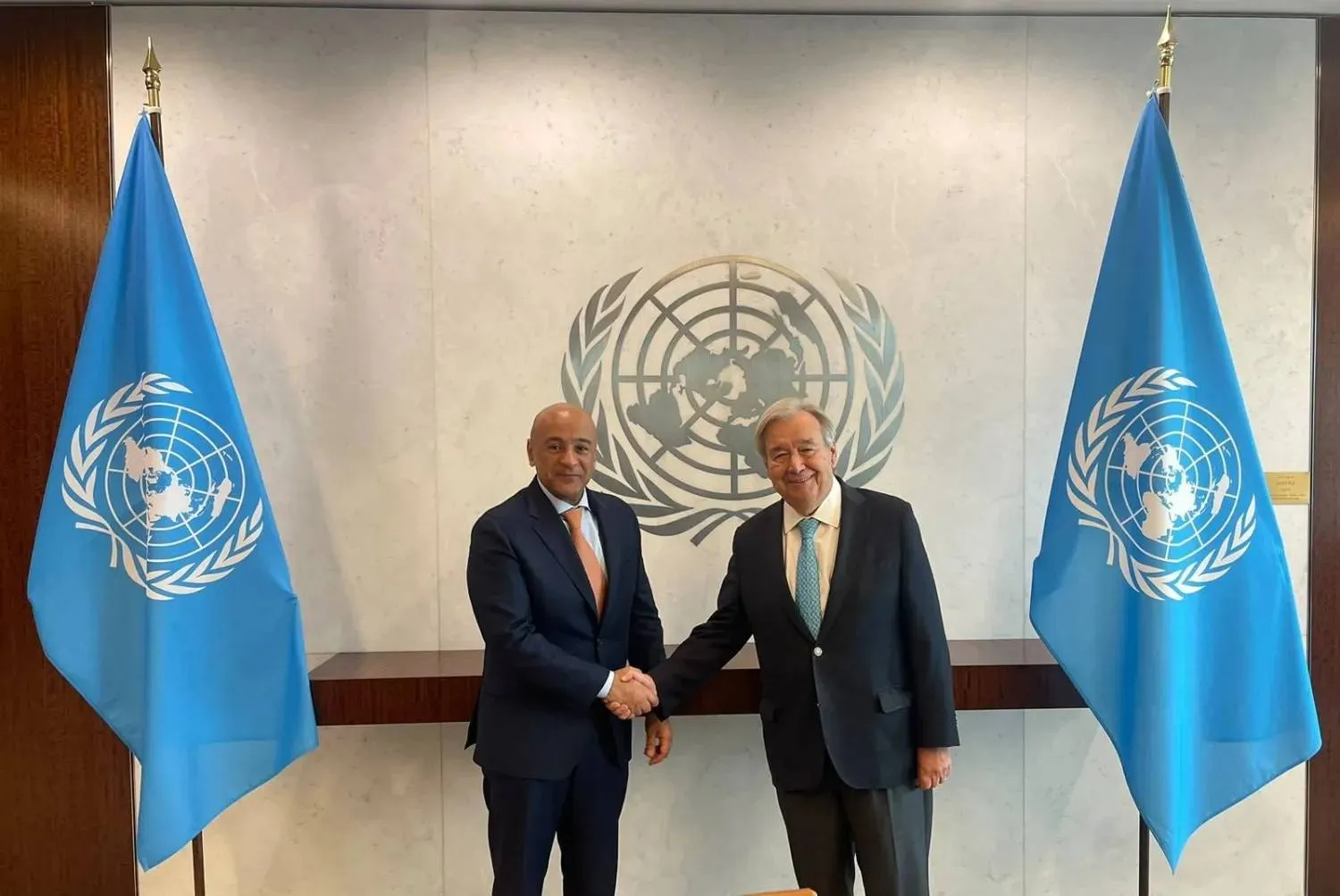
UN Secretary-General Antonio Guterres and GCC Secretary-General Jasem AlBudaiwi meet in New York. (GCC)
TT

Gulf, UN Condemnation of Houthi Attacks on Saudi Arabia

UN Secretary-General Antonio Guterres and GCC Secretary-General Jasem AlBudaiwi meet in New York. (GCC)

The United Nations and the Gulf Cooperation Council (GCC) condemned on Saturday the terrorist Houthi militia's attacks on Saudi Arabia, its targeting of civilian objects, and their dangerous impact on regional security and stability.

UN Secretary-General Antonio Guterres and GCC Secretary-General Jasem AlBudaiwi exchanged views on the latest regional developments during their meeting on Saturday on the sidelines of the 81st session of the UN General Assembly in New York.

The two sides discussed several regional issues and the efforts exerted toward them. Guterres praised the development, progress, and prosperity achieved by the Gulf states, as well as their regional and international efforts to promote security and stability.

Guterres and AlBudaiwi reviewed issues of mutual interest, as well as cooperation relations between the GCC and the UN, and ways to boost and consolidate them to serve shared interests.

The UN Security Council had warned of the consequences of the Houthi attacks on Saudi Arabia and the threats posed to international navigation in the Red Sea and the Bab al-Mandeb Strait, considering that the militia's military actions in Yemen, alongside its targeting of Saudi territory and commercial shipping, threaten to expand the regional conflict, undermine maritime security and international trade, and hinder regional and international efforts aimed at achieving peace in Yemen.

In a statement on Friday night, the Council members strongly condemned in the strongest terms the ongoing attacks launched by the Houthis on Saudi Arabia, including those that caused damage to civilians and energy infrastructure, and resulted in civilian casualties, including women and children.

The Council stressed the importance of maintaining the safety of commercial vessels and their crews, the necessity of adhering to international law, particularly the UN Convention on the Law of the Sea, and respecting navigational rights and freedoms, at a time when military developments in Yemen raise concerns regarding the security of sea lanes and the movement of international trade.

The Council expressed its solidarity with Saudi Arabia in confronting attacks that affect civilians and civilian objects on its territory, affirming its inherent right to self-defense in accordance with international law.

The Council members demanded that the Houthis immediately cease their attacks affecting civilians and civilian objects, expressing their grave concern over reports regarding the killing and injuring of civilians, as well as the destruction of civilian objects and infrastructure resulting from these attacks

Coalition Destroys Ballistic Missile Fired by Houthis at Riyadh

Coalition spokesman Major General Turki Al-Malki. (Asharq Al-Awsat)
TT

Coalition Destroys Ballistic Missile Fired by Houthis at Riyadh

Coalition spokesman Major General Turki Al-Malki. (Asharq Al-Awsat)

The Arab Coalition to Restore Legitimacy in Yemen announced that Saudi air defenses successfully intercepted and destroyed a ballistic missile fired by the terrorist Houthi militia towards Riyadh on Saturday morning.

Coalition spokesman Major General Turki Al-Malki said the Houthi escalation and their continued attempts to target civilians and civilian areas in the Saudi capital, Riyadh, home to over 8 million citizens and residents, underscore the militia’s intransigence and its persistence in deliberately and systematically targeting civilians and civilian objects in a hostile and terrorist manner.

Al-Malki added that the Houthis attempted to target civilians in the cities of Taif, Baysh, Yanbu and Farasan, saying the air defenses thwarted all the hostile attempts.

In a statement on Saturday, Al-Malki underlined the Coalition command’s inherent right to take whatever measures it deems appropriate, and in accordance with international humanitarian law and its customary rules, to deter the behavior of the terrorist Houthi militia.

The Jordanian Ministry of Foreign Affairs condemned the Houthi attacks on Saudi Arabia as a flagrant violation of its sovereignty, a threat to its security, stability, and territorial integrity, and a blatant breach of international law and the United Nations Charter.

It stressed Amman's absolute solidarity with Riyadh and its support for all measures it takes to protect its security, stability, assets, and the safety of its citizens and residents.

The Lebanese Ministry of Foreign Affairs also strongly condemned the missile attack that targeted Riyadh, considering the assault on Saudi Arabia's security a grave violation of international law and a threat to regional security and stability.

In a statement, the ministry expressed Lebanon's full solidarity with Saudi Arabia and its support for the Kingdom in confronting any attack targeting its security and territorial integrity, reiterating its categorical rejection of any targeting of cities and civilian facilities or placing the lives of civilians in danger.


Saudi Arabia Lifts Early Warning Alerts Issued in Ten Cities

Saudi Civil Defense (Asharq Al-Awsat)
TT

Saudi Arabia Lifts Early Warning Alerts Issued in Ten Cities

Saudi Civil Defense (Asharq Al-Awsat)

The Saudi Civil Defense sent an all clear on Saturday after issuing alerts for potential ⁠danger in several cities of the kingdom as part of emergency procedures to alert residents.

The alerts included Riyadh, al-Kharj, Khamis Mushait, Jeddah, Taif, Yanbu, AlUla, Jazan, Farasan and Abha.

The sirens had been activated in those cities and governorates as part of the emergency early warning system before the Civil Defense later declared that the danger had passed.

The Civil Defense stressed the importance of refraining from circulating rumors and videos from unknown sources, emphasizing that information related to emergency situations should be obtained from official sources. Residents should comply with instructions and guidance issued by the relevant authorities, it added.


Saudi Electronic University Renamed after Prince Musaid bin Abdulrahman

Prince Musaid bin Abdulrahman (King Abdulaziz Foundation)
TT

Saudi Electronic University Renamed after Prince Musaid bin Abdulrahman

Prince Musaid bin Abdulrahman (King Abdulaziz Foundation)

Saudi Arabia’s King Salman has ordered the Saudi Electronic University in Riyadh renamed after Prince Musaid bin Abdulrahman, following a recommendation by Crown Prince and Prime Minister Mohammed bin Salman.

The directive honors Prince Musaid bin Abdulrahman for his distinguished service and contributions as one of the Kingdom’s prominent statesmen.

Prince Musaid, a brother of Saudi Arabia’s founder King Abdulaziz bin Abdulrahman, was born at Al-Hukm Palace in Riyadh in 1918. He studied at one of the capital’s leading traditional Quranic schools before attending lessons in Islamic studies and Arabic under several prominent scholars.

He held a series of senior government positions, serving as an adviser to King Saud bin Abdulaziz, president of the Board of Grievances in 1954, state auditor before the establishment of the General Auditing Bureau, royal adviser and Cabinet member in 1957, interior minister in 1960, and minister of finance and national economy in 1962. He died in Riyadh on Dec. 9, 1986.

Commitment to knowledge

Prince Musaid was known from an early age for his interest in education, knowledge and culture. In 1944, he established Riyadh’s first public library inside his palace, assembling a collection of valuable books and manuscripts and opening it to students and visitors.

Renaming the university, established in Riyadh in 2011, is intended to carry forward that intellectual legacy and preserve the memory of a national figure closely associated with education and public service.

Crown Prince Mohammed bin Salman referred to Prince Musaid’s forward-looking ideas in a 2021 television interview, recalling a real estate development proposal he had put forward more than five decades earlier.

The Crown Prince said the proposal, raised during the reign of King Faisal and the beginning of King Khalid’s reign, faced opposition from ministers and officials who resisted allowing greater private-sector involvement.

He said the rejection contributed to poor urban planning and services in Saudi housing developments, adding that had the proposal been implemented at the time, Saudi Arabia could have developed some of the world’s largest real estate companies. He cited ROSHN as a company now seeking to help meet housing demand in the Kingdom.

Honoring his legacy

Prince Musaid’s public service has previously been commemorated. In 2017, the General Auditing Bureau named the main hall at its new Riyadh headquarters after him, honoring his role as the bureau’s first president and his contribution to establishing its administrative and professional foundations.

At the hall’s inauguration in early 2018, Riyadh Governor Prince Faisal bin Bandar bin Abdulaziz paid tribute to Prince Musaid’s work and his role in laying the foundations for the institution’s approach.

Dr. Mohammed bin Yahya Mardi, president of the newly renamed university, said the name carries national and academic significance and reflects the leadership’s recognition of Prince Musaid’s contributions to the Kingdom.

Mardi noted that the prince’s longstanding interest in education, culture, and knowledge aligns with the university’s mission to build capabilities and expand access to learning.

He said the university would continue pursuing excellence and innovation while strengthening its national impact, drawing inspiration from the intellectual and national legacy associated with Prince Musaid’s name.

Mardi added that continued government support has helped drive significant advances in Saudi higher education, enabling universities to develop human capital, advance knowledge, serve society and contribute to the goals of Saudi Vision 2030.
