

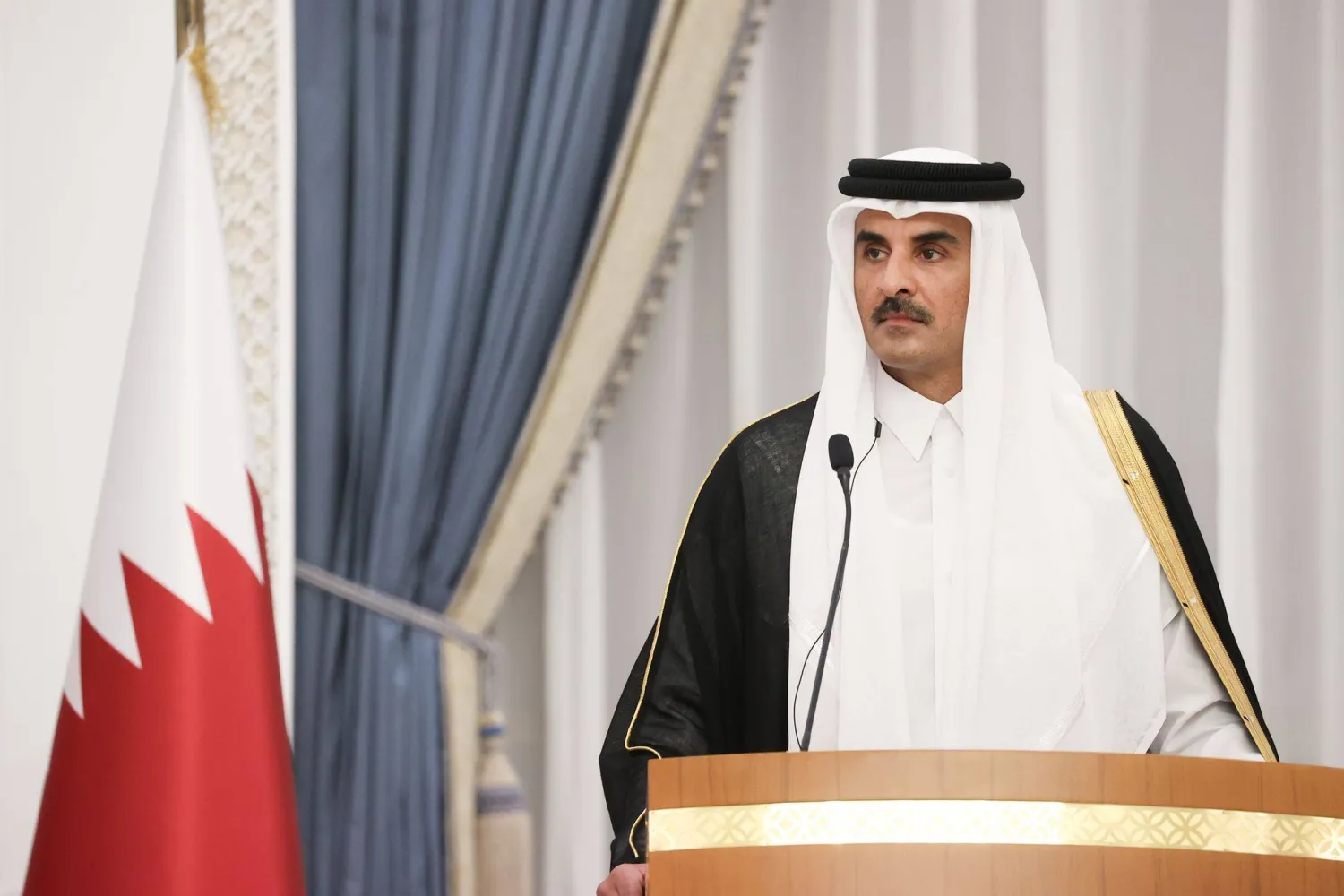

Qatar’s Emir: Protecting the Stability of GCC Countries is a Shared Responsibility

FILED - 02 October 2024, Qatar, Doha: FILE PHOTO - Qatari Emir Sheikh Tamim bin Hamad Al Thani speaks during a press conference in Doha. Photo: -/Iranian Presidency/dpa
TT

Qatar’s Emir: Protecting the Stability of GCC Countries is a Shared Responsibility

FILED - 02 October 2024, Qatar, Doha: FILE PHOTO - Qatari Emir Sheikh Tamim bin Hamad Al Thani speaks during a press conference in Doha. Photo: -/Iranian Presidency/dpa

Qatar’s Emir Sheikh Tamim bin Hamad Al Thani on Tuesday called for closer security coordination among Gulf countries. He also called for stepped-up efforts to secure maritime routes in the Gulf and the Strait of Hormuz and energy infrastructure.

Speaking to the Shura Council, the Emir said that his country had been “attacked on its territory by Iran, in a blatant violation of its sovereignty, the provisions of international law, and the principles of good-neighborly relations,” stressing that the armed forces and security agencies had carried out their duty to defend the country.

He emphasized that Qatar would not abandon its approach based on dialogue and negotiation, but would not hesitate to protect its sovereignty, saying: “Our commitment to dialogue and peaceful solutions does not mean compromising the defense of our country, just as our right to defend our sovereignty does not conflict with our determination to prevent the war from expanding.”

He said recent events had demonstrated the interconnected nature of regional and global security and the impossibility of isolating the repercussions of conflicts from the global economy and international stability.

He stressed the need for continued cooperation and coordination among the Gulf Cooperation Council states, noting that protecting the sovereignty and stability of GCC countries is a shared responsibility. He added that Qatar would continue working with its regional and international partners to preserve security in the region.

He explained that Qatar had confronted the crisis through a four-track strategy: defending the country without being drawn into war; ensuring the continuity of services, supply chains, and economic activity; contributing to efforts to achieve a ceasefire and reopen waterways; and pushing for the resumption of negotiations and the achievement of peaceful settlements.

On the economy, the Emir revealed that a significant portion of the country’s exports had been disrupted as a result of the closure of the Strait of Hormuz and the direct damage sustained by some energy facilities in Ras Laffan Industrial City.

He noted that Qatar supplies around one-fifth of global liquefied natural gas (LNG), meaning that any disruption to its exports has a direct impact on energy markets and consumers worldwide.

He explained that the repercussions of the crisis were concentrated primarily in the energy sector, while non-hydrocarbon sectors continued to grow, accounting for around 80 percent of real gross domestic product, according to figures presented in his speech.

He also revealed that total public revenues fell by 42 percent during the first half of the year, while expenditures declined by 14 percent, stressing that the government had decided not to reduce essential services or alter its development priorities despite the financial pressures.

He said the state had confronted the crisis by relying on earlier policies that included strengthening financial reserves, reducing public debt, and developing non-oil revenues. At the same time, he called for continued fiscal discipline and greater efficiency in public spending.

The Emir announced projects and investment opportunities valued at approximately 221 billion Qatari riyals (about $60.7 billion) over the next five years. These include infrastructure projects and public-private partnerships, as well as investments in real estate and hospitality.

He noted that the Qatari economy recorded real growth of 2.9 percent in 2025, while average inflation remained stable at 0.5 percent. The country also posted a current account surplus and maintained its high sovereign credit ratings.

The Qatari Emir also accused Israel of committing crimes in the Gaza Strip that constitute “genocide.” He called for holding Israeli officials accountable.



Hajj Conference Marks Major Leap, More Than Fivefold Growth

Saudi Minister of Hajj and Umrah meets with journalists on the sidelines of the conference (Asharq Al-Awsat)
TT

Hajj Conference Marks Major Leap, More Than Fivefold Growth

Saudi Minister of Hajj and Umrah meets with journalists on the sidelines of the conference (Asharq Al-Awsat)

The sixth Hajj Conference and Exhibition wrapped up in the Saudi city of Jeddah on Wednesday, drawing more than 200,000 attendees and participants from over 150 countries, a sharp rise from around 14,000 at its 2022 debut.

The four-day gathering brought together officials, experts and service providers for talks and agreements aimed at improving pilgrim services and accelerating preparations for future Hajj seasons.

Saudi Minister of Hajj and Umrah Tawfiq Al-Rabiah hailed the event as a "major qualitative leap," citing soaring attendance, wider international participation and a growing number of contracts to improve services for pilgrims.

Speaking to reporters at the close of the conference, Al-Rabiah said the event had expanded significantly since its launch in 2022 with just 84 participating companies.

The minister said the gathering attracted representatives from more than 150 countries, including ministers, religious leaders, muftis and government officials, reflecting its growing role in shaping pilgrim services.

He said the conference had grown more than fivefold, praising the organizers and expressing hope for further improvements in services.

Held under the theme "From Makkah to the World" at Jeddah Superdome, the conference was organized by the Ministry of Hajj and Umrah in cooperation with the Pilgrim Experience Program.

It brought together government planning and operations agencies, Hajj affairs offices, service providers and technology companies to tackle challenges facing pilgrims and finalize preparations for the 1448 AH Hajj season.

The program focused on three areas: infrastructure and operational services; empowerment and integration; and development and sustainability.

Discussions covered transportation, accommodation, catering, crowd management, healthcare, security and safety, digital transformation and workforce training.

A key focus was the shift toward all-inclusive service packages for pilgrims, alongside tighter contracting procedures, stronger oversight and better ways to measure service quality.

Artificial intelligence and data analytics also featured prominently in discussions on streamlining operations and improving the pilgrimage experience.

Conference sessions revealed that the Nusuk app had surpassed 65 million users worldwide and offered more than 100 services.

The electronic Hajj platform, meanwhile, connects more than 70 entities inside and outside Saudi Arabia, helping coordinate pilgrim reception, transportation, accommodation, group movements and departures.

Participants also examined advances in housing, transportation and healthcare, including the growing use of smart technologies, sensors and communications systems.

Discussions highlighted stronger governance and oversight, and a shift from measuring operational readiness to assessing how services actually affect pilgrims.

On the final day, attention turned to preparations for the next Hajj season, with sessions exploring artificial intelligence, the future of digital services, smart infrastructure, medical readiness and the role of regulations in improving hospitality standards.

The contributions of Saudi Scouts to pilgrim services were also highlighted.

Specialized workshops on the fourth day addressed emergency response coordination, the shift from prevention to healthcare, food safety, catering and services linked to the Nusuk Card.

Other sessions focused on crowd management at the holy sites, early warning systems and improving the skills of Hajj sector workers.

Beyond the formal conference sessions, the program featured the Hajj Council, showcasing personal and professional experiences in serving pilgrims, alongside the Innovation Council, the Awareness and Training Diwaniya and the Hajj Affairs Offices Forum.

Dedicated spaces also allowed participating organizations to exchange expertise and explore cooperation.

The accompanying exhibition showcased technological and operational solutions for the pilgrimage journey, with specialized areas covering healthcare, aviation, technology, innovation and media.

A business center and partner platform provided opportunities for meetings, contract negotiations and partnerships ahead of future Hajj seasons.

The conference's previous five editions generated more than 1,850 agreements related to pilgrim services and hosted over 310 discussion sessions, underscoring the event's expansion over the years.

With the sixth edition concluded, the focus now shifts from discussions and agreements to implementation, as Saudi Arabia seeks to turn new partnerships and technological solutions into practical improvements for the 1448 AH Hajj season.

The effort reflects a broader push to strengthen coordination among service providers, improve efficiency and deliver a better experience for pilgrims at every stage of their journey.


Saudi Arabia, Kenya Sign Technical Annex to Regulate Domestic Worker Recruitment

Saudi Arabia, Kenya Sign Technical Annex to Regulate Domestic Worker Recruitment
TT

Saudi Arabia, Kenya Sign Technical Annex to Regulate Domestic Worker Recruitment

Saudi Arabia, Kenya Sign Technical Annex to Regulate Domestic Worker Recruitment

Saudi Vice Minister of Human Resources and Social Development for Labor Abdullah Nasser Abuthnain met with Kenya’s Cabinet Secretary for Labor and Social Protection Alfred Nganga Mutua on Thursday at the ministry’s headquarters in Riyadh, in the presence of the accompanying Kenyan delegation and several senior ministry officials.

The meeting discussed ways to strengthen cooperation between Saudi Arabia and Kenya in areas of mutual interest in the labor sector, particularly by developing cooperation mechanisms for the recruitment of domestic workers, improving the effectiveness of pre-departure training and qualification programs, and raising awareness of contractual rights and obligations, SPA reported.

These efforts aim to enhance the readiness of domestic workers, improve the quality of recruitment services, promote stability in contractual relations, and protect the rights of all parties.

The two sides also discussed mechanisms for strengthening technical coordination, exchanging expertise and best practices in training and qualification, and improving procedures related to the recruitment of domestic workers. These measures aim to enhance the efficiency of recruitment processes, improve their outcomes, and serve the mutual interests of both countries.

According to SPA, following the meeting, the Saudi vice minister and Kenya’s cabinet secretary signed a technical annex to the agreement on the recruitment of domestic workers between Saudi Arabia and Kenya, signed on July 5, 2026.

The annex is part of efforts to strengthen cooperation and develop the technical and regulatory mechanisms governing the recruitment of domestic workers.

The technical annex aims to streamline procedures and reduce the costs of recruiting domestic workers from Kenya to Saudi Arabia. It also seeks to improve the efficiency of recruitment mechanisms, ensure compliance with approved regulations, protect the rights of employers and domestic workers, and regulate the contractual relationship between the two parties.

The signing of the annex builds on the longstanding relations and ongoing cooperation between Saudi Arabia and Kenya, reflecting both sides’ commitment to developing their partnership in labor-related fields, improving the efficiency of the recruitment system, and promoting sustainable cooperation that serves the mutual interests of both countries.


Saudi Arabia and Kuwait Support Efforts to De-escalate Regional Tensions

Saudi Foreign Minister Prince Faisal bin Farhan and his Kuwaiti counterpart Sheikh Jarrah Al-Sabah (Asharq Al Awsat)
TT

Saudi Arabia and Kuwait Support Efforts to De-escalate Regional Tensions

Saudi Foreign Minister Prince Faisal bin Farhan and his Kuwaiti counterpart Sheikh Jarrah Al-Sabah (Asharq Al Awsat)

Saudi Foreign Minister Prince Faisal bin Farhan discussed the latest regional developments and efforts to address them during a phone call on Wednesday with his Kuwaiti counterpart, Sheikh Jarrah Al-Sabah.

Saudi Arabia and Kuwait stressed the importance of maintaining coordination and consultations between the two countries and supporting joint diplomatic efforts to de-escalate tensions and strengthen regional security and stability.