


Saudi Cabinet: Kingdom Remains a Bastion of Security and Stability, Will Not Tolerate Threats to Its Security

Prince Mohammed bin Salman bin Abdulaziz Al Saud, Crown Prince and Prime Minister, chaired the Cabinet session held on Tuesday in Riyadh - SPA
TT

Saudi Cabinet: Kingdom Remains a Bastion of Security and Stability, Will Not Tolerate Threats to Its Security

Prince Mohammed bin Salman bin Abdulaziz Al Saud, Crown Prince and Prime Minister, chaired the Cabinet session held on Tuesday in Riyadh - SPA

The Saudi Cabinet commended the decisive role of the Armed Forces in defending the homeland, safeguarding its gains and resources, and effectively deterring any aggression or threat against its sovereignty and the safety of its citizens and residents.

This came in Tuesday's session, which was chaired by Prince Mohammed bin Salman bin Abdulaziz Al Saud, Crown Prince and Prime Minister.

The Cabinet affirmed that these efforts ensure the Kingdom of Saudi Arabia remains a bastion of security and stability as it advances toward further progress and prosperity, while maintaining its steadfast commitment to achieving regional and global peace.

The Cabinet stressed that the terrorist Houthi militia will bear the consequences of its crimes and recurrent, heinous attacks targeting Saudi Arabia's airports, Makkah, Madinah, visitors to the Two Holy Mosques, and civilian and economic facilities.

The Cabinet extended its deepest condolences to the families of the victims of these criminal assaults and wished the wounded a speedy recovery.

Furthermore, the Cabinet praised the military operations conducted by the Coalition to Restore Legitimacy in Yemen to neutralize the threats posed by the terrorist Houthi militia against the Yemeni people, international peace and security, global trade, and maritime supply chains.

The Cabinet reiterated the Kingdom's firm position that it will not tolerate threats to its security or to maritime navigation in the Red Sea and the Bab al-Mandab Strait, expressing appreciation for brotherly and friendly nations and international organizations that condemned the crimes of the rebel coup militia.

The Cabinet also commended the successful restoration of crude oil flows through the East-West pipeline by national cadres.

It underscored that this rapid restoration highlights the operational agility of the Kingdom's energy sector, its emergency response capabilities, and its technical proficiency, which reinforce the reliability and continuity of supplies to global markets and support the world economy.

In a statement to the Saudi Press Agency following the session, Minister of Media Salman Al-Dossary said that the Cabinet reviewed the outcomes of recent discussions and meetings held between the Kingdom and brotherly and friendly nations. These engagements focused on strengthening bilateral and multilateral cooperation to enhance integration and coordinate responses to shared challenges across various sectors.

The Cabinet also reviewed the outcomes of the fifth meeting of the Security Coordination Committee of the Saudi-Bahraini Coordination Council, emphasizing the continuation of joint efforts to implement agreed-upon initiatives to serve the shared interests of both peoples, given their deep-rooted fraternal ties.

Additionally, the Cabinet welcomed participants attending the 25th WPC Energy Congress as well as concurrent Arab and international ministerial meetings held in Riyadh this week, emphasizing that hosting these events underscores the Kingdom's role as a global platform for energy dialogue, innovation, partnership-building, and international cooperation.

On domestic affairs, the Cabinet expressed appreciation for the widespread public participation in the 2026 national blood donation campaign, launched by the Crown Prince to promote humanitarian values and achieve self-sufficiency in blood units and components for patients across all regions of the Kingdom.



Saudi Crown Prince Receives Calls from Turkish, Lebanese and German Leaders Condemning Houthi Attacks

Saudi Crown Prince Mohammed bin Salman and Turkish President Recep Tayyip Erdogan (SPA)
TT

Saudi Crown Prince Receives Calls from Turkish, Lebanese and German Leaders Condemning Houthi Attacks

Saudi Crown Prince Mohammed bin Salman and Turkish President Recep Tayyip Erdogan (SPA)

Saudi Crown Prince and Prime Minister Mohammed bin Salman received phone calls Tuesday from Federal Chancellor of Germany Friedrich Merz, Lebanese President Joseph Aoun and Turkish President Recep Tayyip Erdogan, during which the leaders condemned the Houthi attacks targeting the Kingdom and affirmed their solidarity with Saudi Arabia in the face of threats to its security and stability.

During the call, Merz expressed Germany's condemnation of the terrorist Houthi attacks on Saudi Arabia, which threaten the Kingdom's security and stability, reaffirming his country's support and solidarity with the Kingdom.

The two leaders also discussed bilateral cooperation and ways to strengthen it across several fields.

For his part, the Lebanese president condemned the attacks targeting Saudi Arabia and its vital facilities and threatening its security and stability. He reaffirmed Lebanon's full solidarity with the Kingdom and its support in confronting anything that could undermine its security, sovereignty and territorial integrity.

The Turkish president, meanwhile, strongly condemned the Houthi attacks targeting Saudi territory, expressing his sorrow and condolences over the victims of the attacks. He reaffirmed Türkiye's support for the Kingdom in the period ahead and expressed confidence in its ability to overcome these challenges.


Coalition Urges Civilians to Evacuate Yemen Petroleum Company Station in Sanaa

Coalition Urges Civilians to Evacuate Yemen Petroleum Company Station in Sanaa
TT

Coalition Urges Civilians to Evacuate Yemen Petroleum Company Station in Sanaa

Coalition Urges Civilians to Evacuate Yemen Petroleum Company Station in Sanaa

Official Spokesman of the Coalition to Restore Legitimacy in Yemen Major General Turki Al-Malki stated that the Joint Coalition Forces Command called on civilians, for their own safety, to evacuate the Yemen Petroleum Company's Al-Sabaha Central Station in Sanaa.

The Coalition announced earlier on Tuesday that it would issue the warning ahead of a targeted operation, adding that details of the warning would be announced later.

The announcement comes as the coalition intercepted and destroyed three unmanned aerial vehicles (UAVs) north of Riyadh, SPA reported.

The warning is expected to identify the targeted site and call on civilians to evacuate and stay away from the area for their safety.


Qatar’s Emir: Protecting the Stability of GCC Countries is a Shared Responsibility

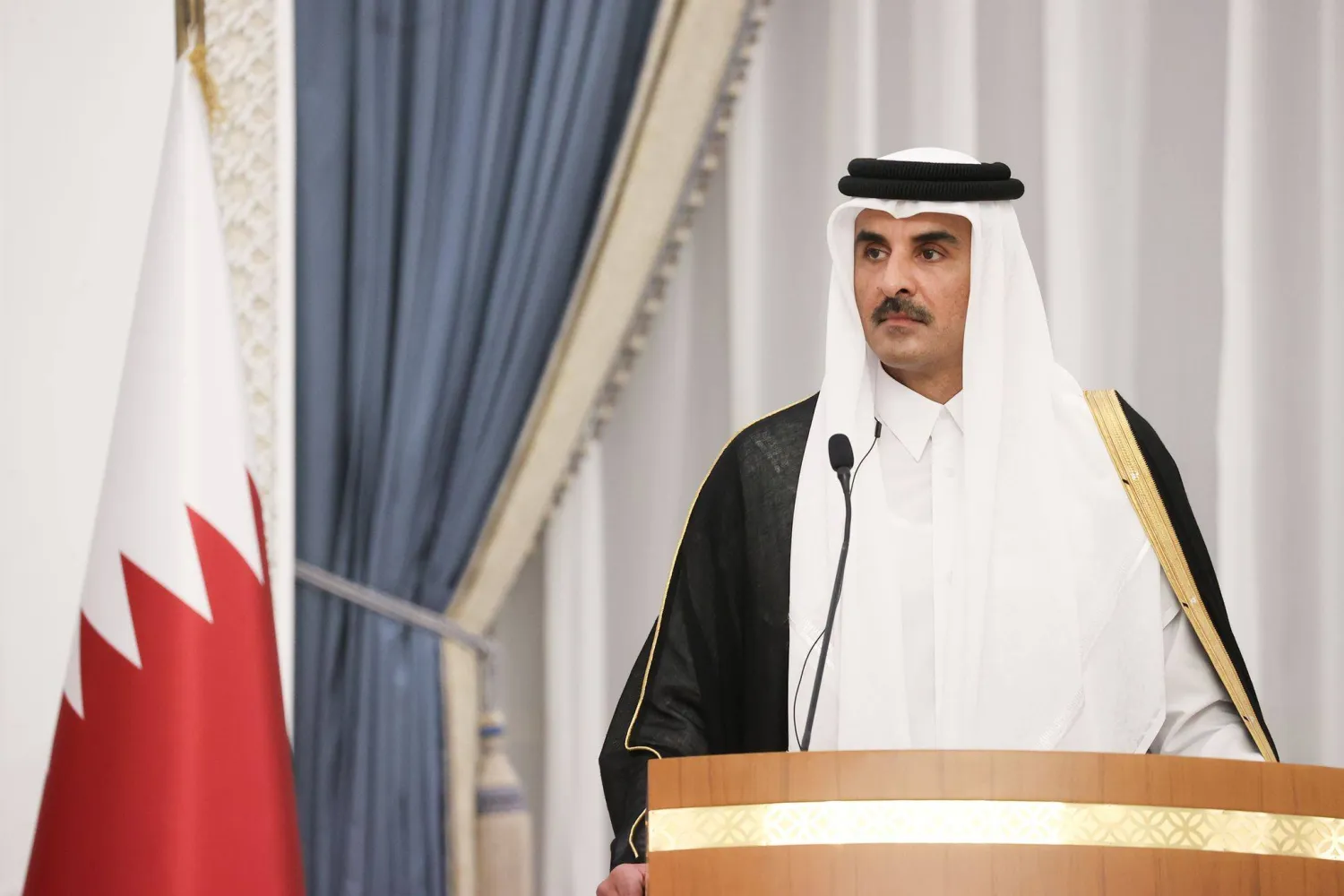
FILED - 02 October 2024, Qatar, Doha: FILE PHOTO - Qatari Emir Sheikh Tamim bin Hamad Al Thani speaks during a press conference in Doha. Photo: -/Iranian Presidency/dpa
TT

Qatar’s Emir: Protecting the Stability of GCC Countries is a Shared Responsibility

FILED - 02 October 2024, Qatar, Doha: FILE PHOTO - Qatari Emir Sheikh Tamim bin Hamad Al Thani speaks during a press conference in Doha. Photo: -/Iranian Presidency/dpa

Qatar’s Emir Sheikh Tamim bin Hamad Al Thani on Tuesday called for closer security coordination among Gulf countries. He also called for stepped-up efforts to secure maritime routes in the Gulf and the Strait of Hormuz and energy infrastructure.

Speaking to the Shura Council, the Emir said that his country had been “attacked on its territory by Iran, in a blatant violation of its sovereignty, the provisions of international law, and the principles of good-neighborly relations,” stressing that the armed forces and security agencies had carried out their duty to defend the country.

He emphasized that Qatar would not abandon its approach based on dialogue and negotiation, but would not hesitate to protect its sovereignty, saying: “Our commitment to dialogue and peaceful solutions does not mean compromising the defense of our country, just as our right to defend our sovereignty does not conflict with our determination to prevent the war from expanding.”

He said recent events had demonstrated the interconnected nature of regional and global security and the impossibility of isolating the repercussions of conflicts from the global economy and international stability.

He stressed the need for continued cooperation and coordination among the Gulf Cooperation Council states, noting that protecting the sovereignty and stability of GCC countries is a shared responsibility. He added that Qatar would continue working with its regional and international partners to preserve security in the region.

He explained that Qatar had confronted the crisis through a four-track strategy: defending the country without being drawn into war; ensuring the continuity of services, supply chains, and economic activity; contributing to efforts to achieve a ceasefire and reopen waterways; and pushing for the resumption of negotiations and the achievement of peaceful settlements.

On the economy, the Emir revealed that a significant portion of the country’s exports had been disrupted as a result of the closure of the Strait of Hormuz and the direct damage sustained by some energy facilities in Ras Laffan Industrial City.

He noted that Qatar supplies around one-fifth of global liquefied natural gas (LNG), meaning that any disruption to its exports has a direct impact on energy markets and consumers worldwide.

He explained that the repercussions of the crisis were concentrated primarily in the energy sector, while non-hydrocarbon sectors continued to grow, accounting for around 80 percent of real gross domestic product, according to figures presented in his speech.

He also revealed that total public revenues fell by 42 percent during the first half of the year, while expenditures declined by 14 percent, stressing that the government had decided not to reduce essential services or alter its development priorities despite the financial pressures.

He said the state had confronted the crisis by relying on earlier policies that included strengthening financial reserves, reducing public debt, and developing non-oil revenues. At the same time, he called for continued fiscal discipline and greater efficiency in public spending.

The Emir announced projects and investment opportunities valued at approximately 221 billion Qatari riyals (about $60.7 billion) over the next five years. These include infrastructure projects and public-private partnerships, as well as investments in real estate and hospitality.

He noted that the Qatari economy recorded real growth of 2.9 percent in 2025, while average inflation remained stable at 0.5 percent. The country also posted a current account surplus and maintained its high sovereign credit ratings.

The Qatari Emir also accused Israel of committing crimes in the Gaza Strip that constitute “genocide.” He called for holding Israeli officials accountable.