

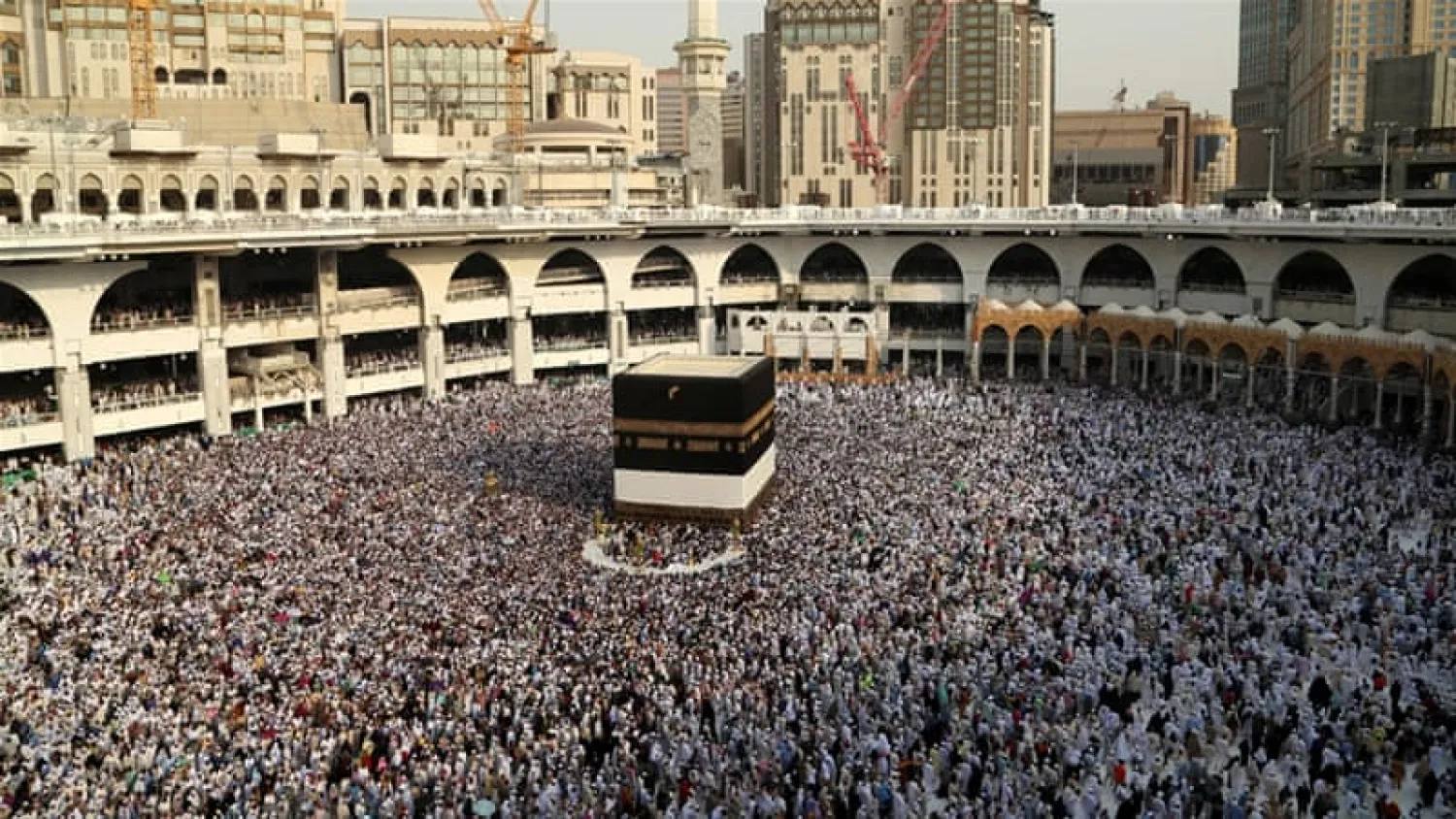

1,400 Qatari Pilgrims Arrive in Saudi Arabia

Muslims from around the world gather in Mecca to perform the annual Hajj. Reuters photo
TT

1,400 Qatari Pilgrims Arrive in Saudi Arabia

Muslims from around the world gather in Mecca to perform the annual Hajj. Reuters photo

Over 1,400 Qatari pilgrims have arrived in Saudi Arabia through Salwa crossing to attend the pilgrimage, after Custodian of the Two Holy Mosques King Salman bin Abdulaziz ordered the opening of the crossing at his personal expense.

King Salman’s orders were issued after the mediation of Sheikh Abdullah Bin Ali Al Thani.

Dammam and al-Ihsa airport have also been equipped to receive the pilgrims where government committees have been deployed to facilitate their religious duties.

Salwa crossing is still accessible for anyone wanting to enter the Kingdom for humanitarian issues or who have relatives from Saudi or Qatari families inside the country.

Earlier, Qatari authorities refused to allow seven Saudi airplanes to enter to transfer of Qatari pilgrims to Makkah through King Abdulaziz airport in Jeddah and Taif airport.

Salwa Customs’Acting Director Abdulrahman Abo al-Kheil explained that the land crossing continues to receive pilgrims and humanitarian cases. He added that they are still serving all the families arriving and leaving Saudi Arabia.

The crossing continues to receive pilgrims until 8th of Dhu al-Hejja as more are expected to arrive.

He told Asharq Al-Awsat newspaper that the land crossing is functioning around the clock to serve the pilgrims and has provided them with electronic registration given that they are excluded from Hajj permits. He added that it only takes a pilgrim a record time of five minutes to register.

Salwa is the only land crossing that links Qatar with the world with more than 1,000 trucks passing everyday loaded with supplies and an annual average of 4,000 per day.

Import and export at the land crossing almost stopped after Saudi Arabia, Bahrain, UAE, and Egypt boycotted Qatar for its hostile policies and support for terrorism threatening the security of the quartet, the region, and the world.



Custodian of the Two Holy Mosques Arrives in Jeddah

Custodian of the Two Holy Mosques King Salman bin Abdulaziz Al Saud. (SPA file)
TT

Custodian of the Two Holy Mosques Arrives in Jeddah

Custodian of the Two Holy Mosques King Salman bin Abdulaziz Al Saud. (SPA file)

Custodian of the Two Holy Mosques King Salman bin Abdulaziz Al Saud arrived in Jeddah on Tuesday coming from Riyadh.

At King Abdulaziz International Airport, he was received by Deputy Governor of Makkah Region Prince Saud bin Mishaal bin Abdulaziz.

King Salman was accompanied by several princes and senior officials.

At King Khalid International Airport in Riyadh, King Salman was seen off by Governor of Riyadh Region Prince Faisal bin Bandar bin Abdulaziz and Deputy Governor of Riyadh Region Prince Mohammed bin Abdulrahman bin Abdulaziz.


Saudi Arabia Declares Wednesday First Day of Ramadan

 Saudi Arabia declares Wednesday the first day of the holy fasting month of Ramadan. (Majmaah University)
Saudi Arabia declares Wednesday the first day of the holy fasting month of Ramadan. (Majmaah University)
TT

Saudi Arabia Declares Wednesday First Day of Ramadan

 Saudi Arabia declares Wednesday the first day of the holy fasting month of Ramadan. (Majmaah University)
Saudi Arabia declares Wednesday the first day of the holy fasting month of Ramadan. (Majmaah University)

Saudi Arabia declared on Tuesday that the holy fasting month of Ramadan will begin on Wednesday.

Qatar and the United Arab Emirates also declared that Ramadan will begin on Wednesday.

Saudi Arabia’s Supreme Court had on Sunday urged Muslims across the Kingdom to sight the crescent moon that signals the advent of Ramadan on Tuesday evening.


Saudi Arabia, Arab and Islamic Countries Condemn Israel’s 'State Land' Decision in West Bank 

The West Bank village of al-Ram is pictured behind Israel's controversial separation barrier from the outskirts of Jerusalem on February 16, 2026. (AFP)
TT

Saudi Arabia, Arab and Islamic Countries Condemn Israel’s 'State Land' Decision in West Bank 

The West Bank village of al-Ram is pictured behind Israel's controversial separation barrier from the outskirts of Jerusalem on February 16, 2026. (AFP)

The foreign ministers of Saudi Arabia, Jordan, the United Arab Emirates, Qatar, Indonesia, Pakistan, Egypt, and Türkiye strongly condemned on Tuesday Israel's decision to designate lands in the occupied West Bank as so-called "state land".

They also slammed it for approving procedures for the registration and settlement of land ownership across extensive areas of the occupied West Bank for the first time since 1967.

They condemned the moves as “a grave escalation aimed at accelerating illegal settlement activity, land confiscation, entrenching Israeli control, and applying unlawful Israeli sovereignty over the Occupied Palestinian Territory and undermining the legitimate rights of the Palestinian people.”

These measures are “a flagrant violation of international law and international humanitarian law, particularly the Fourth Geneva Convention, as well as a violation of relevant United Nations Security Council resolutions, foremost among them Resolution 2334,” the FMs said in a statement.

“The decision also contradicts the advisory opinion issued by the International Court of Justice concerning the legal consequences arising from Israeli policies and practices in the Occupied Palestinian Territory, which underscored the illegality of measures intended to alter the legal, historical, and demographic status of the Occupied Palestinian Territory, the obligation to end the occupation, and the prohibition of the acquisition of territory by force,” they added.

“This step reflects an attempt to impose a new legal and administrative reality designed to consolidate control over the occupied land, thereby undermining the two-state solution, eroding the prospects for the establishment of an independent and viable Palestinian State, and jeopardizing the attainment of a just and comprehensive peace in the region,” they warned.

The foreign ministers reiterated their “categorical rejection of all unilateral measures aimed at altering the legal, demographic, and historical status of the Occupied Palestinian Territory.”

They stressed that such policies are “a dangerous escalation that will further heighten tensions and instability in the Occupied Palestinian Territory and the region as a whole.”

They called on the international community “to assume its responsibilities and take clear and decisive steps to halt these violations, ensure respect for international law, and safeguard the inalienable rights of the Palestinian people, foremost among them their right to self-determination, ending the occupation, and establishing their independent and sovereign State based on 1967 borders with East Jerusalem as its capital.”