


Germany’s Stand on ‘Despicable’ Fans Puts Silent England to Shame

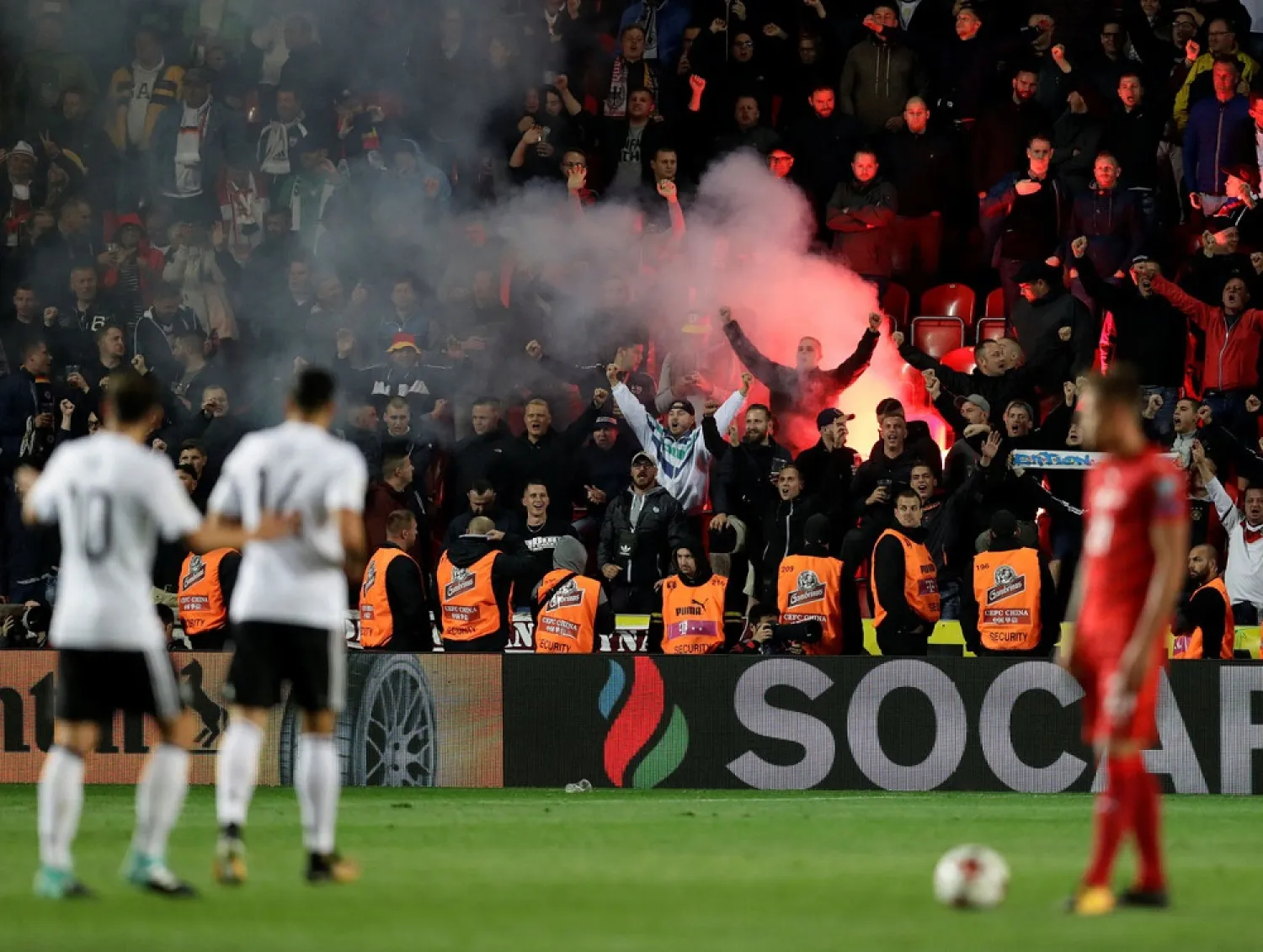
German supporters light flares during the FIFA World Cup 2018 qualifying match between Germany and the Czech Republic in Prague on September 1, 2017. (Reuters)
TT

Germany’s Stand on ‘Despicable’ Fans Puts Silent England to Shame

German supporters light flares during the FIFA World Cup 2018 qualifying match between Germany and the Czech Republic in Prague on September 1, 2017. (Reuters)

That was some performance from Joachim Löw, the Germany national manager, after the jarring evidence during the international break that there are still a few troglodytes among his team’s support who seem hell-bent on providing living proof of Einstein’s theory that there is no limit to human stupidity.

Löw had just seen his team win 2-1 against the Czech Republic in Prague, maintaining an immaculate record in their World Cup qualifying group, but when he arrived for his press conference, face like thunder, the questions about his team’s performance had to wait. “I am neither upset nor sad,” he began. “I am full of rage, that explains my feelings better. I am really, really angry about this – that some so-called fans have used the stage of an international football match, and the stage of football, to bring shame on our country with their embarrassing behavior and appearance. We don’t want these anarchists. We are not their national team and they are not our fans. Their behavior was the lowest of the low and utterly despicable.”

It isn’t usual to hear a manager speak this way but, then again, these weren’t usual circumstances. A section of Germany’s support had disrupted a minute’s silence, abused one of their own players, Timo Werner, and followed up the traditional chants of “Sieg” (victory) towards the end of the game with an echoed “Heil”. It was an abomination and, at the final whistle, something happened that the people who follow die Mannschaft tell me they have never seen before. Germany’s players refused to go to the away end. They didn’t wave, there was no clapping, zero appreciation. It was a choreographed protest, a public disavowal and a clear, defiant message that they didn’t want any association.

For that, the players deserve our applause and Mats Hummels, in particular, as the captain who directed his team-mates off the pitch and made it absolutely clear it was a time to make a stand. “The chants were a catastrophe,” Hummels said later. “They started during the minute’s silence, which shows you the kind of people we’re dealing with. Timo Werner was insulted and ridiculed. Then the fans started shouting their insults. We distance ourselves completely from it and want nothing to do with it. And that’s why we didn’t go [to them].”

Bravo, that man, and what a pity England’s players did not have it in them to do the same in response to that abysmal night in Dortmund six months ago and the absence of respect for their hosts from the corner of the Westfalenstadion decorated in St. George’s flags.

That occasion needed a strong voice, too, when virtually the entire soundtrack was about the second world war and the only real choreography came in the form of the outstretched arms, creating a fleet of pretend fighter planes, during the various renditions of Ten German Bombers, one lasting fully 15 minutes, and how “the RAF from England shot them down”.

Unfortunately, it did not get one. Gareth Southgate’s comments were, frankly, not nearly enough and let’s not kid ourselves: it won’t even have crossed the players’ minds that they might be in a position to affect change and try to stop it happening again. The modern‑day England footballer just isn’t made that way. You will never find one speaking in the way that Hummels did. And more’s the pity.

The only counter-argument is that the 21,000-capacity Eden Arena in Prague is a much smaller stadium than the Westfalenstadion, making what happened feel even more intrusive and lamentable, and the behavior was on a different, more sinister level than the backdrop to the Germany-England encounter.

Maybe that’s true. Reports in Germany say the 100 or so troublemakers were associated with Dynamo Dresden and a number of other clubs from the former East Germany, where right‑wing extremism is said to be more prominent than other parts of the country. They mostly wore black and targeted their own football association with chants of “scheisse, DFB” during what was supposed to be a minute’s silence. Rudolf Kocek, president of the Czechoslovak FA when they won 1976 European Championship, was one of the people the host nation wanted to remember. Rudolf Bat’a, the organization's former general secretary, was another; and so was Lenka Civinova, who was on holiday in Egypt during the summer when a terrorist went on the rampage in two beachfront hotels. Civinova, 36, the Czech FA’s accountant, was among the seven tourists stabbed. Two of the dead were actually from Germany.

It isn’t easy to understand why anybody would want to shout that down, but don’t forget what happened when England arranged a minute’s silence against Brazil in 2013 to honor the people who died in the Munich air tragedy, the 20th anniversary of Bobby Moore’s death and the 238 victims of a nightclub fire in Santa Maria. Perhaps you might remember the England-Wales match in 2004 and what happened after a request by the authorities for a minute’s silence for Ken Bigley, the news of whose murder by terrorists in Iraq had broken the previous day.

The difference on those occasions is that it is very rare for anyone involved with England – the manager, the captain, any of the players – ever to dare criticize their own supporters, even when criticism would be deserved, and it is a shame they have never found their voice when Löw, Hummels and their various colleagues have shown that it is possible to make a stand and in the process, change the narrative.

The FA did hold a media briefing three months after the Dortmund game to go over what had happened but nobody from the England setup itself was prepared to go on record even though it was clear by that point it was more than just a few beery, offensive chants. The footage of England’s end showed people making Nazi salutes and slit-throat gestures. One member of the choir could be seen holding a finger above his lip to imitate Hitler, in between gesturing that he would stab the German fans. All of which brought to mind the verdict of one Philadelphia Inquirer columnist after the United States had been awarded the 1994 World Cup. “What’s the first word to come into your head when I say: ‘British soccer fan’?” he asked. “It was ‘sub-human’, wasn’t it? I rest my case.”

It’s a nice line but, in reality, there are plenty of people who go abroad to watch England and enjoy their adventures without restoring to time‑warp chanting, 90-minute xenophobia or pretend patriotism about conflicts from another phase of history.

Yet it was still easy enough to find lads going through “No Surrender” in the queues on Wembley Way after England’s last game and, when it comes to next year’s World Cup, it has been interesting to hear from the relevant authorities about some of the supporters who will be making that trip to Russia and why those people had better wise up bearing in mind what could be waiting for them.

England’s troublemakers still tend to wear the same uniform that was fashionable on the terraces a quarter of a century ago – Stone Island, Burberry, Adidas trainers (more Gazelles than the Maasai Mara) – but it is a different form of trouble these days. The old category-C hooligans have gone, for the most part, and in their place it is a new breed of younger supporters, largely 19 to 25, who are not so dangerous but make up for that by adopting an anything-goes, stag-weekend mentality, whereby they take pride in behaving badly and regard England trips as a bit of escapism. When the FA’s travel club emailed its members after the Germany game a number of replies came back telling the FA to stop being spoilsports, arguing the behavior was exactly how they liked it.

The difficult part is breaking that kind of mentality and perhaps Southgate and his players missed a trick when the alternative, as their equivalents in Germany have shown, would have been to turn their backs and disown the people who still confuse international football matches with old medieval tournaments.

It doesn’t automatically mean that when Germany go on future excursions the demagogues and dunderheads will stay away or come with a new songbook. But at least the manager and players of the world champions have realized this kind of behavior affects them, too, and that it would be better to confront it rather than sitting on their hands and deciding it is somebody else’s problem. That has to count for something and, for that alone, it is tempting to think their English counterparts could learn a thing or two.

The Guardian Sport


Perfect Start for Pereira as Forest Enjoy Record Win at Fenerbahce

Nottingham Forest's Portuguese head coach Vitor Pereira (CR) gestures from the techincal area during the UEFA Europa League - knockout round play-off first leg - football match between Fenerbahce SK and Nottingham Forest FC at the Sukru Saracoglu Stadium in Istanbul on February 19, 2026. (Photo by Yasin AKGUL / AFP)
TT

Perfect Start for Pereira as Forest Enjoy Record Win at Fenerbahce

Nottingham Forest's Portuguese head coach Vitor Pereira (CR) gestures from the techincal area during the UEFA Europa League - knockout round play-off first leg - football match between Fenerbahce SK and Nottingham Forest FC at the Sukru Saracoglu Stadium in Istanbul on February 19, 2026. (Photo by Yasin AKGUL / AFP)

Nottingham Forest's new head ‌coach Vitor Pereira said he had encouraged his players to express themselves at Fenerbahce on Thursday and they responded in style with a 3-0 victory that marked their biggest away win in European competition.

The comfortable win in the first leg of their Europa League knockout round playoff tie in Turkey was the perfect start for Pereira, who took the ‌helm last ‌weekend following the departure of ‌Sean ⁠Dyche.

Goals from Murillo, ⁠Igor Jesus and Morgan Gibbs-White secured the win but the scoreline could have been even more emphatic.

"We had chance to score two more goals. It was a very good result," Portuguese Pereira told TNT Sports, according to Reuters. "It is only ⁠halftime, we need to be consistent, ‌the schedule is ‌tight and difficult."

Pereira is Forest's fourth managerial appointment this ‌season after Nuno Espirito Santo, Ange Postecoglou ‌and Dyche, and the 57-year-old arrives with the side just three points above the Premier League relegation zone.

"Everyone must be ready to help the ‌team. This is what I ask them," said Pereira. "I realized before I ⁠came that ⁠the players have a lot of quality. They need results but they need to enjoy the game.

"If they enjoy the way they are playing they can have a high level. They need organization and confidence. I asked them to express themselves on the pitch. They did it."

Forest host Liverpool in the league on Sunday before Fenerbahce arrive for the second leg of their Europa League tie on February 26.


FIFA President: All 104 World Cup Matches Will be 'Sold Out'

FIFA President Gianni Infantino speaks during a Board of Peace meeting at the US Institute of Peace, Thursday, Feb. 19, 2026, in Washington. (AP Photo/Mark Schiefelbein)
TT

FIFA President: All 104 World Cup Matches Will be 'Sold Out'

FIFA President Gianni Infantino speaks during a Board of Peace meeting at the US Institute of Peace, Thursday, Feb. 19, 2026, in Washington. (AP Photo/Mark Schiefelbein)

FIFA president Gianni Infantino said all 104 matches of ‌the 2026 World Cup will be "sold out" despite tickets available for the tournament running from June 11 to July 19.

"The demand is there. Every match is sold out," Infantino told CNBC in an interview Wednesday from US President Donald Trump's Mar-a-Lago resort in Palm Beach, Fla.

Infantino said there had been 508 million ticket requests in four weeks from more than 200 countries for about seven million available tickets.

"(We've) never see anything like that -- incredible," he said.

The 48-team World Cup is taking place across 16 host cities in the United States, Mexico and Canada, with MetLife Stadium in East Rutherford, N.J., as the site ‌of the ‌World Cup final.

The head of the sport's governing ‌body ⁠said that tournament ⁠locations contribute to what soccer supporters' associations have complained are exorbitant ticket prices.

"I think it is because it's in America, Canada and Mexico," he said. "Everybody wants to be part of something special."

Also affecting prices are resale websites, which take the official ticket that has a fixed price and use "dynamic pricing" leading to the cost to fluctuate.

"You are able as well to resell your tickets ⁠on official platforms, secondary markets, so the prices as ‌well will go up," Reuters quoted Infantino as saying. "That's part ‌of the market we are in."

A report in the Straits Times said that a ‌Category 3 seat -- the highest section in the stadium -- for Mexico's match ‌against South Africa in the tournament opener on June 11 in Mexico City was listed at $5,324 in the secondary market. The original price was $895.

The same seat category for the World Cup final on July 19, originally priced at $3,450, was advertised for $143,750 on ‌Feb. 11, per the report.

In December, FIFA designated "supporter entry tier" tickets with a $60 price to be allocated to ⁠the national federations ⁠whose teams are playing. Those federations are expected to make those tickets available "to loyal fans who are closely connected to their national teams," FIFA said in a press release.

The last time the US served as a World Cup host in 1994, tickets ranged from $25 to $475. At the 2022 World Cup in Qatar, prices ranged from $70 to $1,600 after the matches were announced.

Infantino in his comments this week estimated that the 2026 World Cup will raise $11 billion in revenue for FIFA, with "every dollar" to be reinvested in the sport in the 211 member countries.

He said the economic impact for the United States would be around $30 billion "in terms of tourism, catering, security investments and so on." Infantino also estimated the tournament will attract 20 million to 30 million tourists and


Sports Investment Forum Allocates Third Day to Women's Empowerment to Promote Sustainable Investment in Women’s Sports

Sports Investment Forum Allocates Third Day to Women's Empowerment to Promote Sustainable Investment in Women’s Sports
TT

Sports Investment Forum Allocates Third Day to Women's Empowerment to Promote Sustainable Investment in Women’s Sports

Sports Investment Forum Allocates Third Day to Women's Empowerment to Promote Sustainable Investment in Women’s Sports

The Sports Investment Forum announced that the third day of its 2026 edition will be dedicated to empowering women in the sports sector, in partnership with Princess Nourah bint Abdulrahman University. The move reflects the forum’s commitment to supporting the objectives of Saudi Vision 2030 and enhancing the role of women in the sports industry and sports investment.

This allocation comes as part of the forum’s program, scheduled to take place from April 20 to 22, at The Ritz-Carlton, Riyadh. The third day will feature a series of strategic sessions and specialized workshops focused on sustainable investment in women’s sports, the empowerment of female leadership, the development of inclusive sports cities, and support for research and studies in women’s sports, SPA reported.

Forum organizers emphasized that the partnership with Princess Nourah bint Abdulrahman University, recognized as the largest women’s university in the world, represents a model of integration between the academic and investment sectors. The partnership contributes to building a sustainable knowledge base that supports the growth of women’s sports and enhances investment opportunities at both local and international levels.

The dedicated day will address several strategic themes, including sustainable investment in women’s leagues and events, boosting scalable business models, empowering female leaders within federations, clubs, and sports institutions, and developing inclusive sports cities that ensure women’s participation in line with the highest international standards. It will also include the launch of research initiatives and academic partnerships to support future policies and strategies for the sector.

This approach aims to transform women’s empowerment in sports from a social framework into a sustainable investment and development pathway that enhances women’s contributions to the sports economy and reinforces Saudi Arabia’s position as a leading regional hub for advancing women’s sports.

The day is expected to attract prominent female leaders, decision-makers, investors, and local and international experts, in addition to the signing of several memoranda of understanding and joint initiatives supporting women’s empowerment in the sports sector.

The Sports Investment Forum reiterated that empowering women is a strategic pillar in developing the national sports ecosystem, contributing to economic growth objectives, enhancing quality of life, and building a more inclusive and sustainable sports community.
