


Suu Kyi Condemns Rakhine Unrest as Rights Groups Slam ‘Purge’ against Rohingya

Myanmar leader Aung San Suu Kyi delivers a national address in Naypyidaw on September 19, 2017. (AFP)
TT

Suu Kyi Condemns Rakhine Unrest as Rights Groups Slam ‘Purge’ against Rohingya

Myanmar leader Aung San Suu Kyi delivers a national address in Naypyidaw on September 19, 2017. (AFP)

In her first public remarks on the violence against Rohingya Muslims, Myanmar leader Aung San Suu Kyi condemned on Tuesday any human rights violations in the turbulent Rakhine state as rights groups said a systematic purge was being committed against the minority ethnic group.

Suu Kyi added that anyone responsible for violations would face the law and that she felt deeply for the suffering of everyone caught up in the conflict there.

More than 410,000 Rohingya have been forced out of Myanmar in Bangladesh as government forces cracked down on insurgents, whose attack on a military post on August 25 sparked the unrest.

Western diplomats and aid officials attending the Suu Kyi’s national address welcomed her message, though some doubted if she had said enough to end the barrage of global criticism Myanmar has faced.

Human rights groups were dismissive. Amnesty International said Suu Kyi and her government were “burying their heads in the sand” for ignoring the role of the army in the violence.

"This is the worst crisis in Rohingya history," said Chris Lewa, founder of the Arakan Project, which works to improve conditions for the ethnic minority, citing the monumental size and speed of the exodus. "Security forces have been burning villages one by one, in a very systematic way. And it's still ongoing."

Using a network of monitors, Lewa and her agency are meticulously documenting tracts of villages that have been partially or completely burned down in three townships in northern Rakhine state, where the vast majority of Myanmar's 1.1 million Rohingya once lived.

It's a painstaking task because there are hundreds of them, and information is almost impossible to verify because the army has blocked access to the area. Satellite imagery released by Human Rights Watch on Tuesday shows massive swaths of scorched landscape and the near total destruction of 214 villages.

The United Nations has branded the military operation in the western state ethnic cleansing. Suu Kyi did not address that but said her government was committed to the rule of law.

“We condemn all human rights violations and unlawful violence. We are committed to the restoration of peace and stability and rule of law throughout the state,” Suu Kyi said in her address in the capital, Naypyitaw.

Long feted in the West for her role as champion of democracy in the Buddhist-majority country during years of military rule and house arrest, Suu Kyi has faced growing criticism for saying little about the abuses faced by the Rohingya.

“Action will be taken against all people regardless of their religion, race and political position, who go against the law of the land and violate human rights,” she said.

“We feel deeply for the suffering of all the people caught up in the conflict.”

The United States urged Myanmar on Monday to end military operations, grant humanitarian access, and commit to aiding the safe return of civilians to their homes.

Myanmar’s generals remain in full charge of security and Suu Kyi did not comment on the military operation, except to say that there had been “no armed clashes and there have been no clearance operations” since September 5.

“Nevertheless, we are concerned to hear that numbers of Muslims are fleeing across the border,” she said.

“We want to find out why.”

Rights monitors and fleeing Rohingya say the army and Rakhine Buddhist vigilantes have mounted a campaign of arson aimed at driving out the Muslim population.

Referring to Suu Kyi’s assertion that army clearance operations had ceased, Phil Robertson of Human Rights Watch asked: “If that is true, then who is burning all the villages we’ve seen in the past two weeks?”

He said it was time that Suu Kyi, the government and military faced the fact that the security forces “don’t follow a code of conduct and shoot and kill who they want” and burn villages.

Amnesty International said there was “overwhelming evidence” the security forces were engaged in ethnic cleansing.

“While it was positive to hear Aung San Suu Kyi condemn human rights violations in Rakhine state, she is still silent about the role of the security forces,” the group said.

While foreign critics raised doubts, thousands of Suu Kyi’s cheering supporters gathered in the main city of Yangon and other towns to watch her speech broadcast on big screens.

The ambassador of China, which vies with the United States for influence in Myanmar, welcomed Suu Kyi’s speech saying it would improve understanding. Russia’s ambassador said there was no evidence of ethnic cleaning.



Police Search Royal Mansion as Probe Into King's Brother Goes On

British newspapers, featuring coverage of the arrest of Andrew Mountbatten-Windsor, younger brother of Britain's King Charles, on suspicion of misconduct in public office, sit on display in a newsagent in London, Britain, February 20, 2026. REUTERS/Jack Taylor
TT

Police Search Royal Mansion as Probe Into King's Brother Goes On

British newspapers, featuring coverage of the arrest of Andrew Mountbatten-Windsor, younger brother of Britain's King Charles, on suspicion of misconduct in public office, sit on display in a newsagent in London, Britain, February 20, 2026. REUTERS/Jack Taylor

British police were searching the former mansion of King Charles' younger brother Andrew Mountbatten-Windsor on Friday after a photograph of the royal emerging from a police station was splashed on newspapers around the world.

Mountbatten-Windsor was arrested on Thursday, his 66th birthday, on suspicion of misconduct in public office over allegations he sent confidential government documents to disgraced financier Jeffrey Epstein when he was a trade envoy.

The former prince was released under investigation after being held by police for more than 10 hours. He has not been charged with any offence but looked haunted in a Reuters photograph after his release, slumped in the back of ‌a Range Rover, eyes ‌red and with a look of disbelief on his face.

The photograph ‌of ⁠a man who ⁠was once a dashing naval officer and reputed favorite son of the late Queen Elizabeth was carried on the front page of newspapers in Britain and around the world, accompanied by headlines such as "Downfall".

Mountbatten-Windsor has always denied any wrongdoing in relation to Epstein, a convicted sex offender who took his own life in 2019, and said he regrets their friendship. But the release of millions of documents by the US government showed he had remained friends with Epstein long after the financier was convicted of soliciting prostitution from ⁠a minor in 2008.

Those files suggested Mountbatten-Windsor had forwarded to Epstein British ‌government reports about investment opportunities in Afghanistan and assessments of Vietnam, Singapore ‌and other places he had visited as the government's Special Representative for Trade and Investment.

The arrest of the senior royal, eighth in line to the throne, ‌is unprecedented in modern times. The last member of the royal family to be arrested in Britain was Charles I, who was beheaded in 1649 after being found guilty of treason.

King Charles, who stripped his brother of his title of prince and forced him out of his Windsor home last year, said on Thursday he ‌had learned about the arrest with "deepest concern".

"Let me state clearly: the law must take its course," the king said. "What now follows is the ⁠full, fair and proper process ⁠by which this issue is investigated in the appropriate manner and by the appropriate authorities."

The news broke early on Thursday morning that six unmarked police cars and around eight plain-clothed officers had arrived at Wood Farm on the king's Sandringham estate in Norfolk, eastern England, where Mountbatten-Windsor now resides.

Thames Valley Police officers also searched the mansion on the king's Windsor estate west of London where Mountbatten-Windsor had lived before being forced out amid anger at the Epstein revelations.

Officers said late on Thursday that the royal had been released under investigation. They said the searches at Sandringham had concluded but the searches in Windsor were continuing.

While being arrested means that police have reasonable suspicion that a crime has been committed and that the royal is suspected of involvement in an offence, it does not imply guilt.

A conviction for misconduct in a public office carries a maximum sentence of life imprisonment, and cases must be dealt with in a Crown Court, which handles the most serious criminal offences.


Florida Airport to be Renamed after US President Donald Trump

President Donald Trump gets ready to exit the stage after speaking at a rally at Coosa Steel Corporation in Rome, Ga., Thursday, Feb. 19, 2026. (AP Photo/Mark Schiefelbein)
TT

Florida Airport to be Renamed after US President Donald Trump

President Donald Trump gets ready to exit the stage after speaking at a rally at Coosa Steel Corporation in Rome, Ga., Thursday, Feb. 19, 2026. (AP Photo/Mark Schiefelbein)

An airport in Florida will soon be renamed after US President Donald Trump, after a bill proposing the change was approved by the state's legislature on Thursday.

Trump, a real estate mogul who has plastered his name on buildings around the world, has sought to leave his mark on the country in an unprecedented image and building campaign.

Florida's Republican-led legislature approved a bill to rename the Palm Beach International Airport as the "President Donald J. Trump International Airport," state records show. Governor Ron DeSantis, once a Trump opponent, is expected to sign the measure into law.

The airport in Palm Beach, a town known for its sandy beaches and luxurious estates, is just minutes away from Trump's Mar-a-Lago residence.

The airport renaming will also require the approval of the Federal Aviation Administration, AFP reported.

It would then become the latest institution to be renamed after Trump.

The president's handpicked board of the Kennedy Center, an arts complex and memorial to late president John F. Kennedy in Washington, voted in December to rename itself the "Trump-Kennedy Center."

Trump has also sought to rename New York's Penn Station and Washington's Dulles International Airport after himself, according to US media reports, although those efforts were rebuffed.

The Treasury Department has also confirmed reports that drafts have been drawn up for a commemorative $1 coin featuring Trump's image, even though there are laws against displaying the image of a sitting or living president on money.


Venezuela: Amnesty Law Excludes those who Promoted Military Action

National Assembly President Jorge Rodriguez, center, presides over a session debating an amnesty bill in Caracas, Venezuela, Thursday, Feb. 19, 2026. (AP Photo/Crisitian Hernandez)
TT

Venezuela: Amnesty Law Excludes those who Promoted Military Action

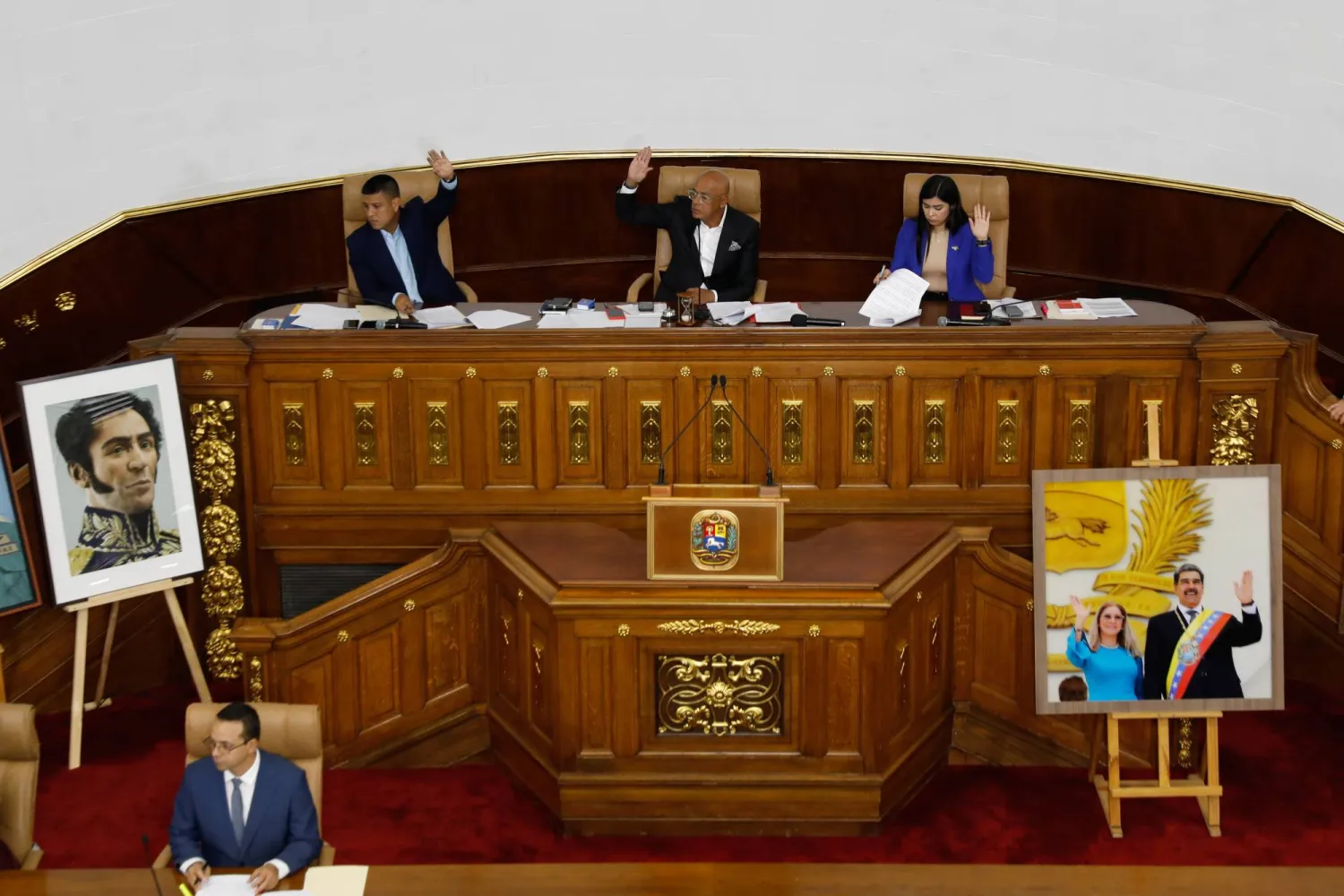
National Assembly President Jorge Rodriguez, center, presides over a session debating an amnesty bill in Caracas, Venezuela, Thursday, Feb. 19, 2026. (AP Photo/Crisitian Hernandez)

Venezuela's parliament unanimously approved an amnesty law on Thursday that could free political prisoners, almost two months after President Nicolas Maduro was captured by US forces.

“The law on democratic coexistence has been approved. It has been forwarded to acting president Delcy Rodriguez for announcement,” said National Assembly President, Jorge Rodriguez, before parliament.

Acting president Delcy Rodriguez signed the legislation after it was handed to her by Jorge Rodrigez, her brother.

The passage of the law led to the end of a hunger strike by relatives of political prisoners.

Ten women have participated in a hunger strike outside the Zona 7 police facility in the capital Caracas last Saturday, setting up camps outside the prison and demanding the release of their relatives, according to AFP.

Because they experienced health problems, nine of them stopped the protest on Wednesday evening. Only one woman continued until Thursday, ending “136 hours,” or more than five days, of strike.

But the amnesty law excludes those who have been prosecuted or convicted of promoting military action against the country – which could include opposition leaders like Nobel Peace Prize winner Maria Corina Machado, who has been accused by the ruling party of calling for international intervention like the one that ousted Maduro.

Article 9 of the bill lists those excluded from amnesty as “persons who are being prosecuted or may be convicted for promoting, instigating, soliciting, invoking, favoring, facilitating, financing or participating in armed actions or the use of force against the people, sovereignty, and territorial integrity” of Venezuela “by foreign states, corporations or individuals.”