Bloomberg Al-Arabiya: A Cooperation between SRMG and Bloomberg

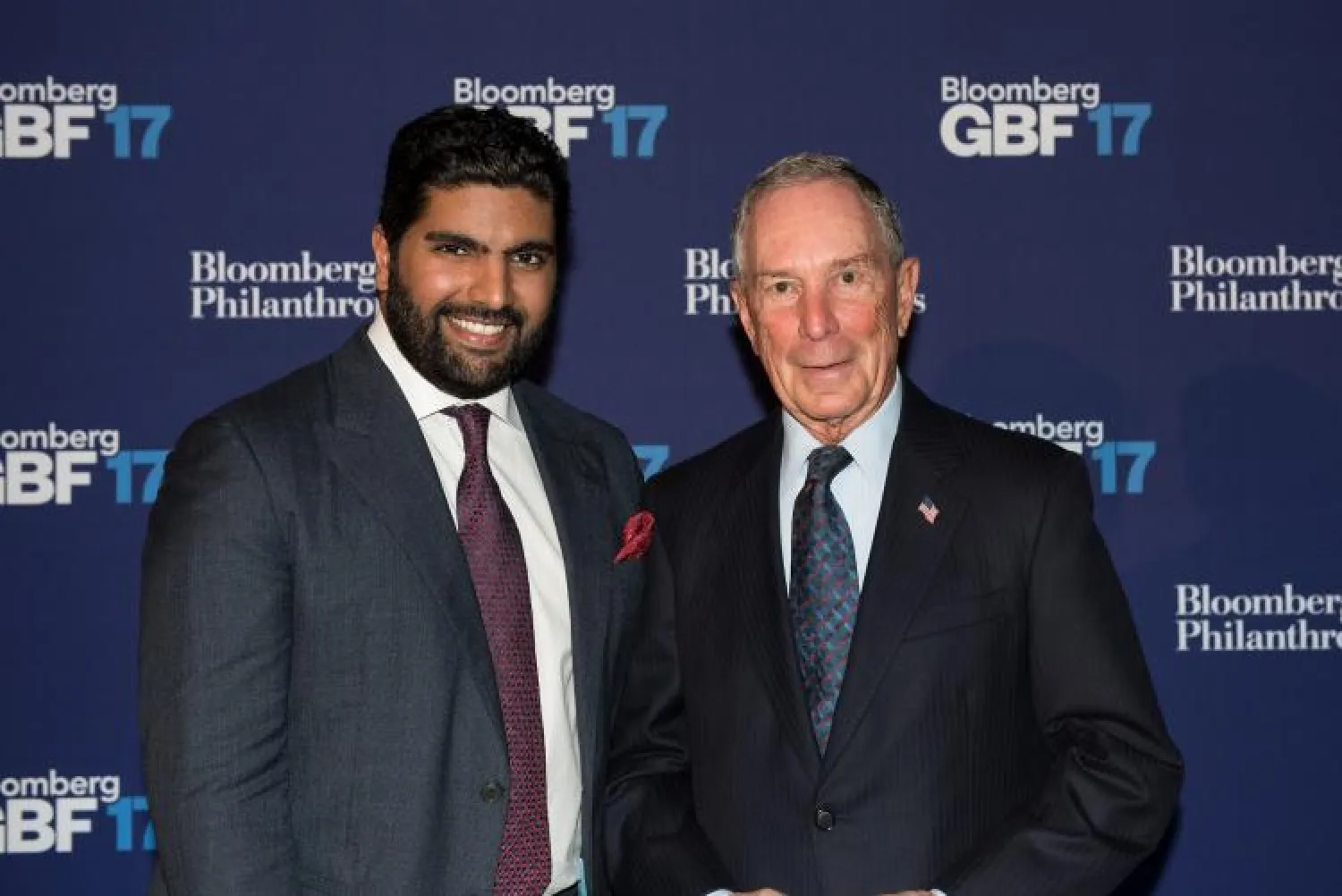
Chairman of SRMG Prince Bader bin Abdullah al-Saud and founder of Bloomberg Michael Bloomberg (SRMG)
TT

Bloomberg Al-Arabiya: A Cooperation between SRMG and Bloomberg

Chairman of SRMG Prince Bader bin Abdullah al-Saud and founder of Bloomberg Michael Bloomberg (SRMG)

US-headquartered Bloomberg L.P., world renowned financial software, data, and media firm entered a long-term agreement with Saudi Research and Marketing Group (SRMG) to launch an Arabic multi-platform for business and financial news service.

According to this agreement, SRMG, publisher of Asharq Al-Awsat, Arab News and al-Eqtisadiah, will launch a 24-hour television and radio network, an integrated digital portal and a dedicated digital platform under the “Bloomberg al-Arabiya” brand.

It will also publish “Bloomberg Businessweek” magazine in Arabic and launch a new conference and live events series.

Bloomberg al-Arabiya platforms will provide Arabic-speaking audiences around the world with news and analysis on the companies, markets, economies and politics shaping the Middle East.

Bloomberg founder and former mayor of New York City Michael Bloomberg said that the Middle East is an important, economically diverse region, and the agreement with SRMG permits the delivery of the sharpest global business and financial insights to a critical audience of business decision makers.

Following the signing of the deal, chairman of SRMG Prince Bader bin Abdullah said the deal would give a boost to the regional media industry.

“We are very pleased with this promising partnership with Bloomberg. In addition to the many business opportunities this collaboration brings, we believe the partnership will greatly enhance the media landscape in our region,” he stated.

Prince Badr described the deal as an exciting development for SRMG and a strong progression in the quest to offer the highest quality financial and business journalism from and about the Middle East.

Bloomberg al-Arabiya team will be managed by SRMG with support from Bloomberg, and will draw on Bloomberg’s financial and economic content and data as well as its 2,700 reporters and analysts globally.

CEO of Bloomberg Media Group Justin Smith stated that the partnership with SRMG is a significant milestone in the regional growth story.

“This agreement is an integral part of our strategy of forming partnerships with leading news providers in markets that have a compelling economic growth story, as we look to further expand our localized international presence,” Smith added.

Managing director and CEO of SRMG Ghassan al-Shibl declared that the partnership between SRMG and Bloomberg will expand into the international television business.

With the new era of business and economic transformation in Saudi Arabia, such a significant agreement between two leading brands will pave the way for a multi-platform ecosystem of specialized business and financial content of international standards, according to Shibl.

“This is the beginning of a new chapter in the history of media and publishing in the region,” he confirmed.

Bloomberg editor in chief John Micklethwait declared that Bloomberg al-Arabiya will enable both associations to build on more than 20 years of news gathering across the Arab world to deliver the best of Bloomberg’s news, insight and analysis.


HUMAIN Secures $667 Million Infra Financing to Advance Saudi Arabia’s AI Infrastructure

A photo taken during the signing ceremony of the two agreements in Riyadh (SPA) 
TT

HUMAIN Secures $667 Million Infra Financing to Advance Saudi Arabia’s AI Infrastructure

A photo taken during the signing ceremony of the two agreements in Riyadh (SPA) 

The National Infrastructure Fund (Infra) and HUMAIN, a PIF company delivering full-stack artificial intelligence capabilities globally, signed on Monday two financing agreements totaling up to SAR 2.5 billion ($667 million) to support AI computing deployment and the development of critical power infrastructure in Saudi Arabia.

The agreements were signed in Riyadh in the presence of Governor of the Public Investment Fund, Yasir Al-Rumayyan, Minister of Economy and Planning and Chairman of Infra’s Board of Directors, Faisal bin Fadhil Alibrahim and Governor of the National Development Fund, Abdulaziz Alarifi.

The facilities are the first transactions announced under Infra’s AI Data Center Financing Program. They build on the strategic financing framework announced by Infra and HUMAIN at Davos in January 2026, which outlined non-binding financing terms of up to SAR 4.5 billion ($1.2 billion) to support AI and digital infrastructure projects in the Kingdom.

The GPU financing facility, of up to SAR 1.1 billion ($293.3 million), will support the procurement and deployment of graphics processing units (GPUs), representing approximately 25 MW of IT load.

A second facility of up to SAR 1.4 billion ($373.3 million), will finance the development of substations, transmission infrastructure and grid connections to support HUMAIN’s AI data centers in Saudi Arabia.

The planned power infrastructure is designed to support future data center development with up to 1 GW of IT capacity, helping create the conditions for investment by developers, hyperscalers and institutional investors.

“Through these agreements, we aim to unlock investment well beyond Infra’s own commitment,” said Chief Executive Officer of Infra, Engineer Esmail bin Mohammed Alsallom.

He noted that supporting HUMAIN’s computing deployment alongside essential power infrastructure helps prepare a broader pipeline of data center projects for investment.

“Our role is to strengthen project readiness and bankability, with commercial viability and economic value guiding how we deploy our capital,” Alsallom said, adding that this partnership connects Infra’s priorities with commercial discipline, helping build a financing market that can attract a broader pool of private and institutional capital and sustain the local AI infrastructure growth.

For his part, Chief Executive Officer of HUMAIN, Tareq Amin, said that AI infrastructure is becoming foundational to the next generation of computing, and scaling it requires both significant investment and the infrastructure to support it.

“These facilities with Infra will help accelerate the deployment of advanced computing capacity and the power infrastructure required to support it. At HUMAIN, we are focused on building and operating AI infrastructure at scale, while developing the technologies and platforms that enable organizations and customers globally to put AI to work,” he added.


Lucid Gets Crucial $1.75 Billion Liquidity Boost From PIF

A Lucid Air Grand Touring electric car is displayed during the New York International Auto Show in New York City, US, April 1, 2026. REUTERS/Jeenah Moon/File Photo 
TT

Lucid Gets Crucial $1.75 Billion Liquidity Boost From PIF

A Lucid Air Grand Touring electric car is displayed during the New York International Auto Show in New York City, US, April 1, 2026. REUTERS/Jeenah Moon/File Photo 

Lucid Group, an American electric vehicle (EV) manufacturer, said on Monday a $1.75 billion increase in a loan facility from Saudi Arabia's Public Investment Fund (PIF), its largest investor, would help fund the ‌electric-vehicle maker into the fourth quarter of 2027, according to Reuters.

The larger delayed-draw term loan lifts the company’s pro forma liquidity to $3.75 billion, strengthening new CEO Silvio Napoli's hand as he seeks to turn around the company facing an industry-wide demand weakness following the expiry of a federal ⁠tax credit last year.

Lucid said it expects its liquidity to fund operations until production of its midsize vehicle begins in the second half of 2027.

The company’s shares were down about 5% in extended trading.

Lucid cut its third-quarter cash outflow to $1.04 billion from $1.48 billion in the previous quarter by cutting production, including eliminating a second shift at its Arizona factory and reducing inventory and operating costs.

“These actions are already showing through in Q3, ‌with ⁠free cash flow consumption 30% lower sequentially,” CFO Alexander De Bock said.

Lucid said it would provide 2027 guidance and a mid-term plan with its year-end results. It had withdrawn its annual production forecast earlier this year amid a sweeping operational ⁠review by its newly appointed CEO.

The company said headcount fell about 28% between the first and third quarters. It said it had achieved $800 million of a targeted $1.4 ⁠billion cash flow improvement this year through lower inventory, operating costs and capital spending.

New chief technology, finance, customer and transformation officers joined early in ⁠the third quarter, the company said. Lucid is also cutting management layers and tying incentives to four priority projects.


Saudi Real Estate Market Maintains Investment Momentum Despite War Fallout

Residential developments in Saudi Arabia (Ministry of Municipalities and Housing)
TT

Saudi Real Estate Market Maintains Investment Momentum Despite War Fallout

Residential developments in Saudi Arabia (Ministry of Municipalities and Housing)

Saudi Arabia's real estate market continues to attract investment despite geopolitical challenges weighing on economic activity worldwide, supported by new housing developments and efforts to expand residential supply.

The Ministry of Municipalities and Housing announced that more than 15,000 residential land plots had been made available through the Sakani platform across the Kingdom between the beginning of 2026 and the end of October, alongside additional projects launched by private-sector developers.

The developments underscore the sector's continued momentum and its importance to the Saudi economy.

Government initiatives and private-sector projects aim to expand housing supply and meet growing demand, reinforcing real estate's position as a key driver of economic growth and diversification.

Strong domestic demand and ongoing urban development projects continue to underpin the market's appeal, attracting investment from both Saudi and international investors.

Against a backdrop of geopolitical uncertainty and war-related disruptions to trade, supply chains, financing costs and construction expenses, the real estate sector has gained importance as an industry driven largely by domestic demand and capable of sustaining economic activity.

Private-Sector Investment

Despite mounting global economic volatility and geopolitical tensions, Saudi Arabia's real estate market continues to attract international investment, supported by clear economic policies, expanding development opportunities and strong housing demand.

Real estate developer Arada recently announced its entry into the Saudi market through a partnership with local company XTOPIA, backed by a SAR 50 billion ($13.3 billion) portfolio of land and development opportunities.

The partnership's first project is a SAR 14 billion residential development in Riyadh's Al Rimal district.

Riyadh Region Municipality, the Ministry of Municipalities and Housing, and the National Center for Privatization & PPP also recently announced the launch of the expression of interest, prequalification and proposal submission stages for a joint land investment project.

The initiative involves developing a municipal land plot in northern Riyadh through a 50-year partnership with the private sector, marking the municipality's first project under the joint investment model.

Real estate specialists described the initiative as an important step toward enabling private investors to develop property assets into sustainable projects with significant economic value.

They said the extended investment period would encourage developers to improve construction quality and services, strengthen project feasibility, diversify real estate offerings and increase supply in one of the capital's most expensive neighborhoods.

Balancing the Real Estate Market

The importance of releasing more residential land lies in achieving greater balance in the property market, a government objective outlined by Crown Prince and Prime Minister Mohammed bin Salman.

The strategy seeks to increase housing supply by making more land available, broadening the options accessible to Saudi citizens and enabling more households to move from searching for a home to building and owning one.

Increasing the availability of residential land, particularly in cities and governorates experiencing rising demand, could ease pressure on land prices over the medium term, provided that plot locations and sizes correspond to actual market needs.

The release of additional land also creates opportunities for real estate developers, contractors, engineering firms and building materials suppliers to benefit from anticipated demand for construction projects.

As a result, businesses across the real estate and construction supply chain could see stronger activity despite the impact of the geopolitical crisis on other economic sectors in the region.

The initiative also expands housing choices, supports efforts to increase homeownership rates and improve quality of life, and encourages urban development beyond major metropolitan centers.

Lowering Prices

Real estate developer Ahmed Omar Basoudan believes the main challenge facing Saudi Arabia's property market in the coming period will not simply be increasing the number of land plots and housing units available.

Rather, he said, the priority must be ensuring that homes reach buyers at prices they can afford, while providing adequate infrastructure and services and keeping development and construction costs under control.

Speaking to Asharq Al-Awsat, Basoudan explained that genuine balance in the real estate market depends on the availability of housing that meets buyers' needs in terms of price, location and quality, rather than simply increasing overall supply.

He said the release of more than 15,000 residential land plots during the first 10 months of the year, together with recently announced private-sector projects, reflected the government's continued commitment to expanding housing supply and providing more residential options.

Basoudan stressed that the latest real estate developments represent an important step toward addressing one of the market's most pressing challenges: achieving a sustainable balance between supply and demand, particularly amid the Kingdom's population growth and continued urban expansion.