


Former Hostage Held by Qaeda Describes 6-Year Ordeal in the Sahara

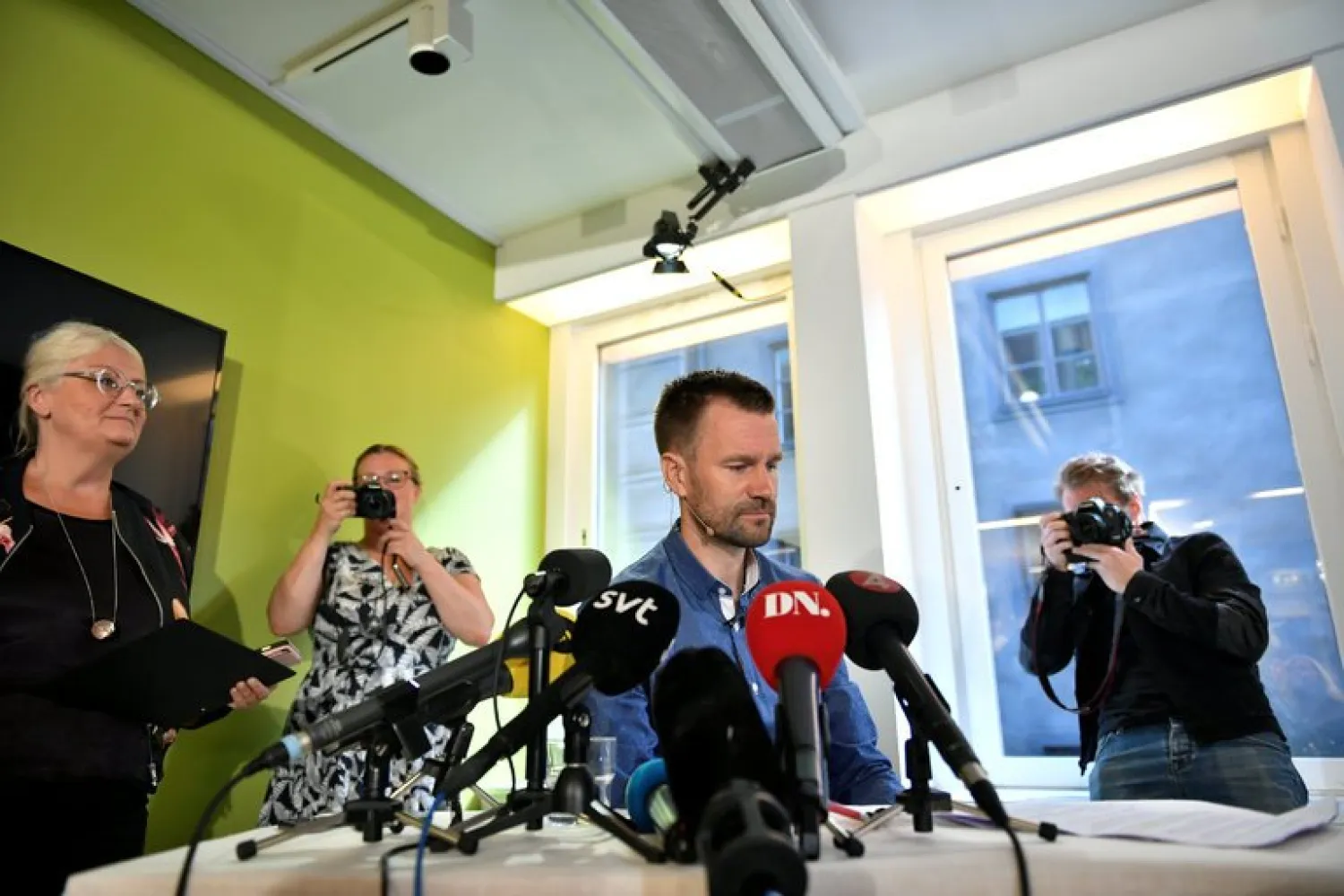
Johan Gustafsson was freed this year after being held hostage in the Sahara by Al Qaeda in the Islamic Maghreb since 2011. Credit Pool photo by Vilhem Stockstad
TT

Former Hostage Held by Qaeda Describes 6-Year Ordeal in the Sahara

Johan Gustafsson was freed this year after being held hostage in the Sahara by Al Qaeda in the Islamic Maghreb since 2011. Credit Pool photo by Vilhem Stockstad

It was supposed to be an adventurous motorcycle journey through Africa. Johan Gustafsson, then a 36-year-old engineer, set off with a friend to see the continent, “not just read about it in books,” he later said. His biggest concern was traffic accidents.

Twenty-four hours after he arrived in Timbuktu, Mali, Mr. Gustafsson was taken hostage from his hotel at gunpoint. He and two other tourists were herded into the back of a pickup truck. A fourth man, a German tourist, resisted and was shot dead on the spot.

That was Nov. 25, 2011, the beginning of an almost six-year ordeal for Mr. Gustafsson, who was held for ransom in the Sahara by Al Qaeda in the Islamic Maghreb, or AQIM, the North African branch of Al Qaeda, until he was freed this year.

On June 26, Mr. Gustafsson, now 42, returned to Sweden, the second of the “Timbuktu Three” to be freed. French Special Forces rescued one hostage, Sjaak Rijke, a Dutch citizen, in April 2015. The other, Stephen McGown, a South African, was released in August.

More than two months after Mr. Gustafsson was driven out of the desert, he shared his story of captivity for the first time at a museum in Stockholm.

During the first harrowing months in the desert, he and the others were blindfolded, bound and moved countless times. The threat of execution hung over them. In one of the many ransom videos they were forced to make, they had to wear orange “Guantánamo” suits, like those worn by the detainees at the United States military prison in Cuba, and to plead for their lives.

“I tried to explain that I am Swedish,” he recalled. “That we also think Guantánamo is unlawful and counterproductive.”

When he tried to get a sense of his kidnappers’ motives, they made only vague reference to the invasion of Iraq, the war in Afghanistan and satirical cartoons of the Prophet Muhammad that set off protests when they were published by a Danish newspaper in 2005.

Four months into captivity, the hostages made a strategic decision to convert to Islam. “It was to save my life,” he said. After the conversion they were no longer isolated, shackled or forced to plead for their lives in the many ransom videos that were made.

“I see that as the most clear evidence that it actually helped change my situation,” he said.

Mr. Gustafsson told his captors that his government would never pay. When he was released, Sweden’s foreign minister said it was the result of years of diplomatic efforts, not ransom.

But Magnus Ranstorp, a counterterrorism and security expert with the Swedish Defense University, said it was unlikely that some form of exchange did not take place.

“The only thing we know for sure is that not a single hostage has been released without payment,” he said. “It’s not a charitable organization.”

A retired European intelligence official, who spoke on the condition of anonymity, said that 3.5 million euros, or about $4.2 million, had been paid and negotiated through the South African charity Gift of the Givers Foundation for the release of Mr. McGown.

While the United States and Britain adhere to strict no-ransom policies, countries like France and Germany have taken bags full of cash disguised as humanitarian aid to the desert.

From his view inside their camps, Mr. Gustafsson said it was evident his captors had resources.

“They’re well financed nowadays,” he said. “They say they didn’t used to be, but now they are, and it’s not difficult to figure out that that is actually the money that has been paid by European governments.”

A 2014 New York Times tally of ransoms collected by Al Qaeda’s affiliates found that the group had taken in at least $125 million since 2008.

Al Qaeda in the Islamic Maghreb rose to prominence more than a decade ago largely because of extraordinary ransom payments, which started in 2003 with the abduction of 32 European tourists who were freed after governments paid an estimated €5 million, or about $6 million.

After their conversion to Islam, the hostages prayed, ate and sat with their kidnappers. There was no need for prison walls when the Sahara stretched for hundreds of miles in every direction.

For the next five years, they moved hundreds of times, living outdoors and being guarded by about a dozen rotating men and boys.

Mr. Gustafsson said life in the desert was a cross between “a prison sentence and Robinson Crusoe.”

“We are a group of young guys hanging out in a sandbox, living through the same things — sand storms, problems with the car. If we don’t have water, it’s the same for all of us.”

Between prayers, he occupied himself with exercising and learning the languages of his captors — local languages, Arabic, French.

Mali, a former French colony, has seen decades of tension between the south, where the economic and political power is concentrated, and the minority populations in the north. In the beginning of 2012, a Tuareg separatist movement calling for a new state, “Azawad,” swept down from the north.

In the same year, the military in Mali, displeased with the government’s handling of the rebellion, ousted the president. The north came under rebel control while Al Qaeda in the Islamic Maghreb capitalized on the subsequent power vacuum and took over Timbuktu for a time.

In January 2013, French forces moved into the north. There were fighter planes in the air, and the kidnappers were constantly on the run, decamping at the first hint of a surveillance plane or anything suspicious, said Mr. Gustafsson. The hostages stopped counting the moves after they got to 100.

Mr. Gustafsson saw the flights above as an opportunity to escape, and he tried it once, walking into the desert, thinking that they might not dare follow him.

But after he wandered in the desert for two nights, his captors tracked him down. “I think actually I would have walked to my death,” he said.

Although Mr. Gustafsson was freed in June, it was only recently that he stopped saying “In the name of God” before every meal. Other habits acquired in the desert will take longer to change. He still sleeps with his head under the covers to “keep out the sand,” and he doesn’t bury his hands under the pillow where scorpions might burrow.

“Of course it changes you,” he said. “In the end, it’s difficult to put your finger on. But I’m getting out of it. I’m learning to switch.”

Will he ever go back to the Sahara? He said he would, if it were safe.

“I’m not going to miss those guys, but I’m going to miss the desert, the vastness, the night skies,” he said. “When you live there, you learn the landscape. You know where the wind comes from at different times of the year. You know how the storms move. All of this is just so majestic.”

The New York Times


Thailand and Cambodia Sign New Ceasefire Agreement to End Border Fighting

A handout photo made available by the Defense Ministry of Thailand shows Cambodian Defense Minister Tea Seiha (L) and Thai Defense Minister Natthaphon Narkphanit attending a General Border Committee Meeting in Ban Pak Kard, Chanthaburi Province, Thailand, 27 December 2025. (EPA/Defense Ministry of Thailand/Handout)
TT

Thailand and Cambodia Sign New Ceasefire Agreement to End Border Fighting

A handout photo made available by the Defense Ministry of Thailand shows Cambodian Defense Minister Tea Seiha (L) and Thai Defense Minister Natthaphon Narkphanit attending a General Border Committee Meeting in Ban Pak Kard, Chanthaburi Province, Thailand, 27 December 2025. (EPA/Defense Ministry of Thailand/Handout)

Thailand and Cambodia on Saturday signed a ceasefire agreement to end weeks of armed combat along their border over competing claims to territory. It took effect at noon local time.

In addition to ending fighting, the agreement calls for no further military movements by either side and no violations of either side’s airspace for military purposes.

Only Thailand employed airstrikes in the fighting, hitting sites in Cambodia as recently as Saturday morning, according to the Cambodian defense ministry.

The deal also calls for Thailand, after the ceasefire has held for 72 hours, to repatriate 18 Cambodian soldiers it has held as prisoners since earlier fighting in July. Their release has been a major demand of the Cambodian side.

The agreement was signed by the two countries’ defense ministers, Cambodia’s Tea Seiha and Thailand’s Nattaphon Narkphanit, at a checkpoint on their border after lower-level talks by military officials met for three days as part of the already-established General Border Committee.

The agreement declares that the two sides are committed to an earlier ceasefire that ended five days of fighting in July and follow-up agreements and includes commitments to 16 de-escalation measures.

The original July ceasefire was brokered by Malaysia and pushed through by pressure from US President Donald Trump, who threatened to withhold trade privileges unless Thailand and Cambodia agreed. It was formalized in more detail in October at a regional meeting in Malaysia that Trump attended.

Despite those deals, the two countries carried on a bitter propaganda war and minor cross-border violence continued, escalating in early December to widespread heavy fighting.

Thailand has lost 26 soldiers and one civilian as a direct result of the combat since Dec. 7, according to officials. Thailand has also reported 44 civilian deaths from collateral effects of the situation.

Cambodia hasn’t issued an official figure on military casualties, but says that 30 civilians have been killed and 90 injured. Hundreds of thousands of people have been evacuated from affected areas on both sides of the border.

Each side blamed the other for initiating the fighting and claimed to be acting in self-defense.

The agreement also calls on both sides to adhere to international agreements against deploying land mines, a major concern of Thailand. Thai soldiers along the border have been wounded in at least nine incidents this year by what they said were newly planted Cambodian mines. Cambodia says the mines were left over from decades of civil war that ended in the late 1990s.

Another clause says the two sides “agree to refrain from disseminating false information or fake news.”

The agreement also says previously established measures to demarcate the border will be resumed and the two sides also agree to cooperate on an effort to suppress transnational crimes.

That is primarily a reference to online scams perpetrated by organized crime that have bilked victims around the world of billions of dollars each year. Cambodia is a center for such criminal enterprises.


Russia Attacks Kyiv with Missiles and Drones, Wounding 11 ahead of Ukraine-US Meeting

Firefighters work at the site of a private home that went up in flames after it was hit by a Russian drone during a night of attacks on Kyiv, amid Russia's attack on Ukraine, November 29, 2025. REUTERS/Thomas Peter
TT

Russia Attacks Kyiv with Missiles and Drones, Wounding 11 ahead of Ukraine-US Meeting

Firefighters work at the site of a private home that went up in flames after it was hit by a Russian drone during a night of attacks on Kyiv, amid Russia's attack on Ukraine, November 29, 2025. REUTERS/Thomas Peter

Russia attacked Ukraine's capital with missiles and drones early Saturday morning, wounding at least 11 people a day before talks between Ukraine and the US, local authorities said.

Explosions boomed across the capital for hours as ballistic missiles and drones hit the city. The attack began in the early morning hours Saturday and was continuing as day broke.

The attack came as Ukrainian President Volodymyr Zelenskyy prepares to meet with US President Donald Trump on Sunday for further talks in an effort to end the nearly four-year-old war. Zelenskyy said they plan to discuss issues including security guarantees and territorial issues in the Donetsk and Zaporizhzhia regions.

Two children were among those injured in the attack, which affected seven locations across the city of Kyiv said the head of Kyiv's City Military Administration Tymur Tkachenko in a statement on Telegram, The Associated Press said.

A fire broke out in an 18-story residential building in the Dnipro district of the city, and emergency crews rushed to the scene to contain the flames.

A 24-story residential building in the Darnytsia district was also hit, Tkachenko said, and more fires broke out in the Obolonskyi and Holosiivsky districts.

In the wider Kyiv region, the strikes hit industrial and residential buildings, according to Ukraine's Emergency Service. In the Vyshhorod area, emergency crews rescued one person found under the rubble of a destroyed house.


Russia Lashes Out at Zelensky ahead of New Trump Talks on Ukraine Plan

Trump is trying to broker an agreement between the warring sides to end Europe's worst conflict since World War II. Jim WATSON, Tetiana DZHAFAROVA / AFP/File
TT

Russia Lashes Out at Zelensky ahead of New Trump Talks on Ukraine Plan

Trump is trying to broker an agreement between the warring sides to end Europe's worst conflict since World War II. Jim WATSON, Tetiana DZHAFAROVA / AFP/File

Volodymyr Zelensky is due to meet President Donald Trump in Florida this weekend, but Russia accused the Ukrainian president and his EU backers Friday of seeking to "torpedo" a US-brokered plan to stop the fighting.

Sunday's meeting to discuss new peace proposals comes as Trump intensifies efforts to end Europe's worst conflict since World War II, one that has killed tens of thousands since February 2022, AFP said.

The 20-point plan would freeze the war on its current front line but open the door for Ukraine to pull back troops from the east, where demilitarized buffer zones could be created, according to details revealed by Zelensky this week.

Ahead of the talks, AFP journalists reported several powerful explosions in Kyiv on Saturday, and authorities warned of a possible missile attack.

“Explosions in the capital. Air defense forces are operating. Stay in shelters!" Kyiv's mayor Vitali Klitschko said on Telegram.

Ukraine's air force announced a countrywide air alert and said drones and missiles were moving over several regions including Kyiv.

Zelensky's office said earlier that a meeting with Trump is planned for Sunday in Florida, where the US leader has a home.

Trump, speaking to news outlet Politico, said about Zelensky's plan that "he doesn't have anything until I approve it", adding: "So we'll see what he's got."

Zelensky meanwhile said he held telephone talks on Friday with NATO Secretary General Mark Rutte, Germany's Chancellor Friedrich Merz and a host of other European leaders.

A spokesperson for Britain's Prime Minister Keir Starmer said the leaders "reiterated their unshakeable commitment for a just and lasting peace for Ukraine and the importance that talks continue to progress towards this in the coming days".

Security guarantees

The new plan formulated with Ukraine's input is Kyiv's most explicit acknowledgement yet of possible territorial concessions and is very different from an initial 28-point proposal tabled by Washington last month that adhered to many of Russia's core demands.

Part of the plan includes separate US-Ukraine bilateral agreements on security guarantees, reconstruction and the economy. Zelensky said those were changing on a daily basis.

"We will discuss these documents, security guarantees," he said of Sunday's meeting.

"As for sensitive issues, we will discuss (the eastern region of) Donbas and the Zaporizhzhia nuclear power plant, and we will certainly discuss other issues," he added.

Russia signaled its opposition to the plan ahead of the Florida talks.

The Kremlin said Friday that foreign policy aide Yuri Ushakov had held telephone talks with US officials, and deputy foreign minister Sergei Ryabkov criticized Zelensky's stance.

Russia accuses EU

"Our ability to make the final push and reach an agreement will depend on our own work and the political will of the other party," Ryabkov said on Russian television.

"Especially in a context where Kyiv and its sponsors -- notably within the European Union, who are not in favor of an agreement -- have stepped up efforts to torpedo it."

He said the proposal drawn up with Zelensky input "differs radically" from points initially drawn up by US and Russian officials in contacts this month.

He said any deal had to "remain within the limits" fixed by Trump and Russia's President Vladimir Putin when they met in Alaska in August, or else "no accord can be reached".

Zelensky said this week there were still disagreements between Kyiv and Washington over the two core issues of territory and the status of the Zaporizhzhia plant.

Washington has pushed Ukraine to withdraw from the 20 percent of the eastern Donetsk region that it still controls -- Russia's main territorial demand.

It has also proposed joint US-Ukrainian-Russian control of Zaporizhzhia, Europe's largest nuclear plant, which Russia seized during the invasion.

Zelensky said he could only give up more land if the Ukrainian people agree to it in a referendum, and he does not want Russian participation in the nuclear plant.

But Moscow has shown little inclination to abandon its hardline territorial demands that Ukraine fully withdraw from Donbas and end efforts to join NATO.

Zelensky said Ukrainian negotiators were not directly in touch with Moscow, but that the United States acted as intermediary and was awaiting Russia's response to the latest proposal.

"I think we will know their official response in the coming days," Zelensky said.

"Russia is always looking for reasons not to agree," he added.
