Italian Minister of Interior Affairs Receives MWL Sec-Gen

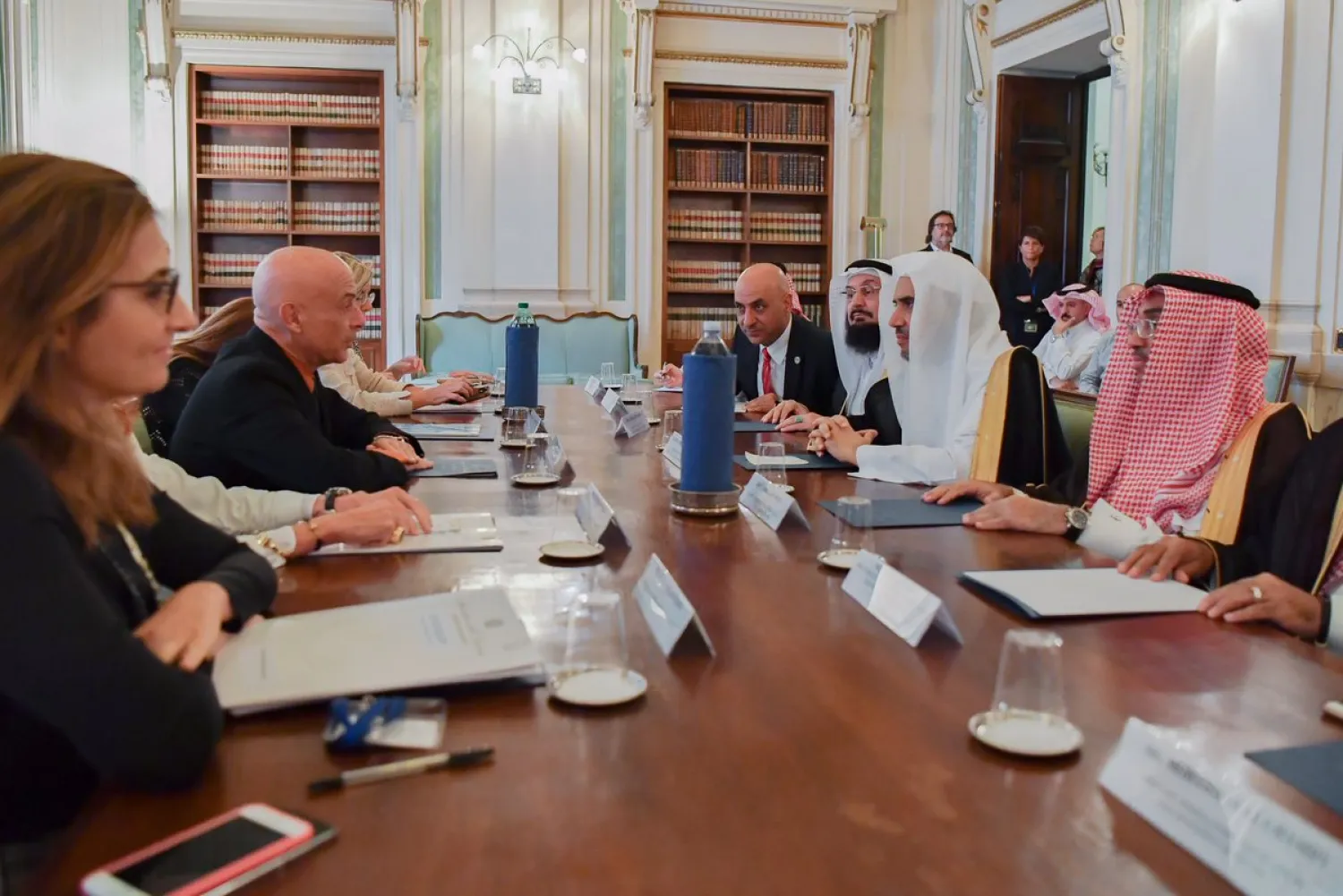
During the meeting between Italian Interior Minister Marco Minniti received Secretary-General Sheikh Mohammed Issa (MWL Website)
TT

Italian Minister of Interior Affairs Receives MWL Sec-Gen

During the meeting between Italian Interior Minister Marco Minniti received Secretary-General Sheikh Mohammed Issa (MWL Website)

Rome– Muslim World League (MWL) aims to pursue positive integration of Muslim communities into their societies and the citizenship they have recognized and committed to, according to MWL Sec-Gen Sheikh Mohammed al-Issa.

Italian Interior Minister Marco Minniti received Secretary-General Issa and his accompanying delegation in Rome on Tuesday.

The two officials discussed a number of topics of common interest including citizenship and positive integration with the promotion of the right of religious freedom guaranteed by law. They also addressed the issue of official recognition of Islam as a religion.

The Italian minister welcomed MWL chief and expressed appreciation for the role undertaken by the MWL in fighting extremism, unifying Muslim communities, and promoting moderation.

Minniti expressed hope that the visit of the MWL chief to Italy will achieve goals that serve humanity, especially after his historic meeting with Pope Francis in the Vatican City.

For his part, Issa thanked the Italian minister for his concern over MWL’s role and stressed that the League is keen to spread the values of peace, tolerance, and coexistence.

Later, Sec-Gen Issa held a meeting with Director of Religious Affairs in the Italian Government Maria Yurato where the two discussed several issues of mutual concern.

The two sides also discussed the legal status of several Islamic activities in Italy, and the cooperation between the association and the ministry to unify the Muslim community and improve its representation in the Italian government and civil institutions.

The secretary-general thanked Italian officials for providing the required facilities for a dialogue, hospitality and appreciation, especially in the light of the association’s renewed vision.


Israeli Settlers Attack Palestinians During Olive Harvest

Firefighters douse a burnt car with water after Israeli militant settlers attacked a group of Palestinians harvesting olives near Turmus Ayya in the Israeli-occupied West Bank, October 16, 2026. REUTERS/Ammar Awad
TT

Israeli Settlers Attack Palestinians During Olive Harvest

Firefighters douse a burnt car with water after Israeli militant settlers attacked a group of Palestinians harvesting olives near Turmus Ayya in the Israeli-occupied West Bank, October 16, 2026. REUTERS/Ammar Awad

Israeli settlers attacked Palestinians in multiple villages across the occupied West Bank on Friday and trees and cars were set on fire, according to local officials and emergency responders with the Palestinian Red Crescent Society.

The Palestinian Red Crescent Society said six people were injured in two attacks it responded to in the town of Abu Falah outside Ramallah. A 63-year-old woman and a 40-year-old man were taken to a hospital after being beaten by settlers, The Associated Press quoted the Red Crescent as saying.

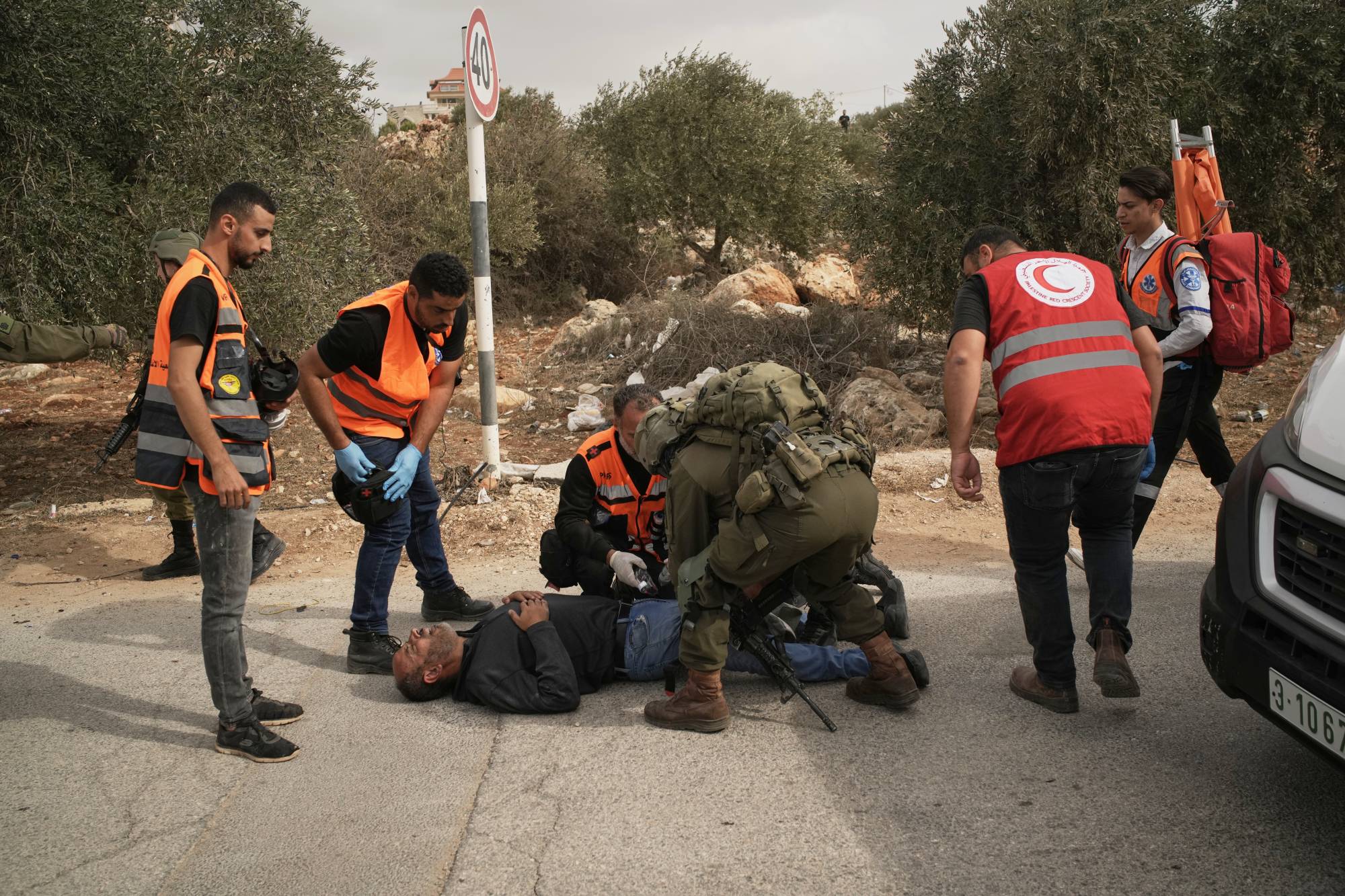
Palestinian medics and an Israeli soldier attend to a Palestinian man shot by Israeli soldiers following a settler attack on Palestinians harvesting olives in the West Bank village of Abu Falah, Friday, Oct. 16, 2026. (AP Photo/Leo Correa)

"The settlers want to attack us and force us from our homes," said Moutaz Abdelhadi, ⁠42, a farmer ⁠who witnessed the attack in Abu Falah.

Partway through the attack, at least two Israeli military jeeps sped through the area, kicking up dust as villagers ran out of their way.

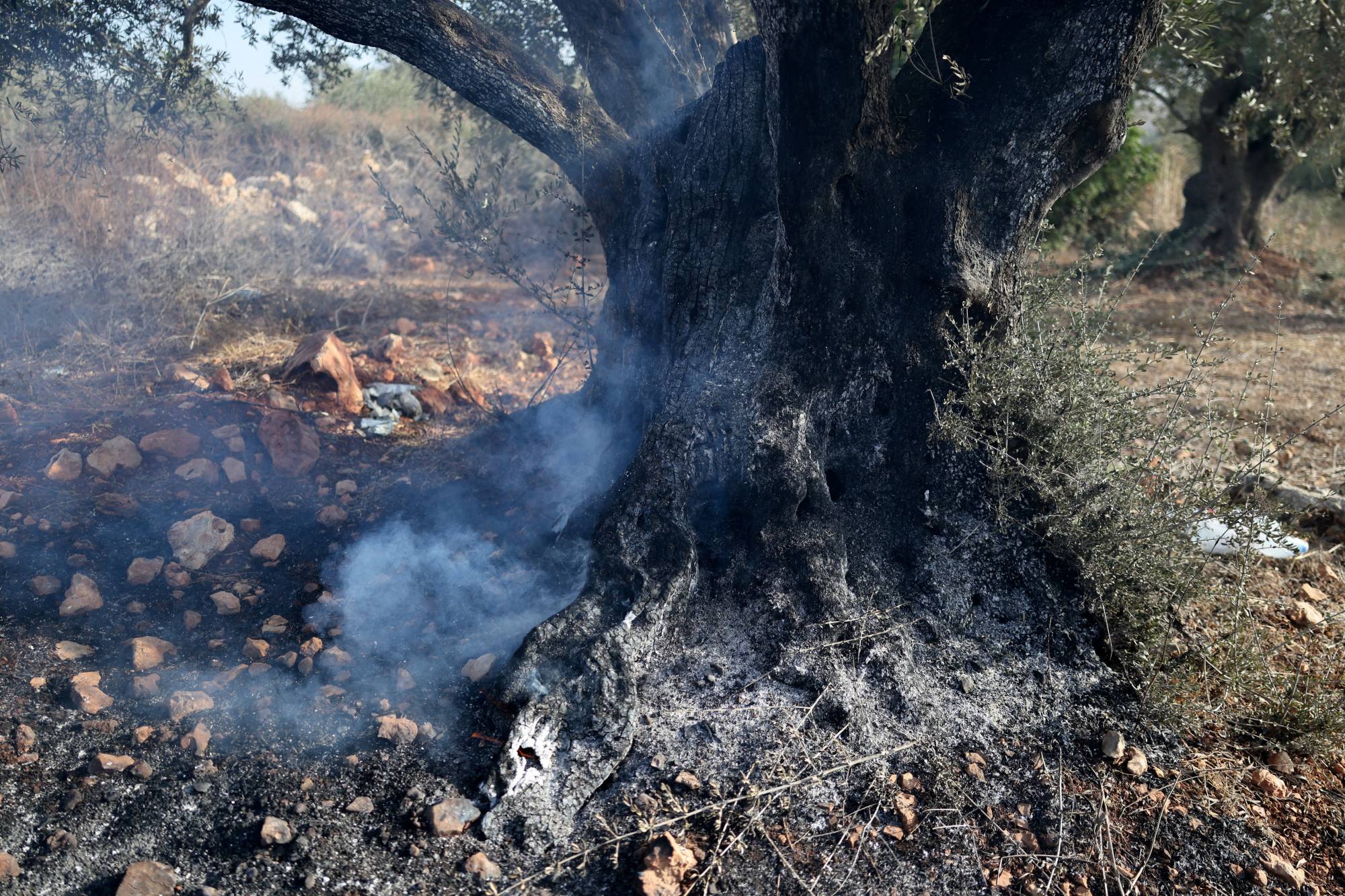
A burnt olive tree after Israeli militant settlers attacked a group of Palestinians while they were harvesting olives near Turmus Ayya in the Israeli-occupied West Bank, October 16, 2026. REUTERS/Ammar Awad

The attack continued after the military's arrival, with Israeli soldiers firing tear gas in the direction of the Palestinians who had dodged the jeeps. The sound of live gunfire could be heard in the area, and a Reuters photographer saw at least one armed settler fire ⁠a gun.
Among the injured was Heidi Levine, a photojournalist with the Washington Post. The newspaper did not immediately respond to a request for comment.

Israel has imposed new rules on the olive harvest this year, prohibiting Palestinians from working in what’s known as Area C, which is under Israeli security control and encompasses the majority of the territory’s agricultural land.

At least four Palestinians have been killed and more than 100 injured since the harvest season began earlier this month, according to Palestinian officials.

They say thousands of trees have been damaged, costing farmers hundreds of thousands of dollars.

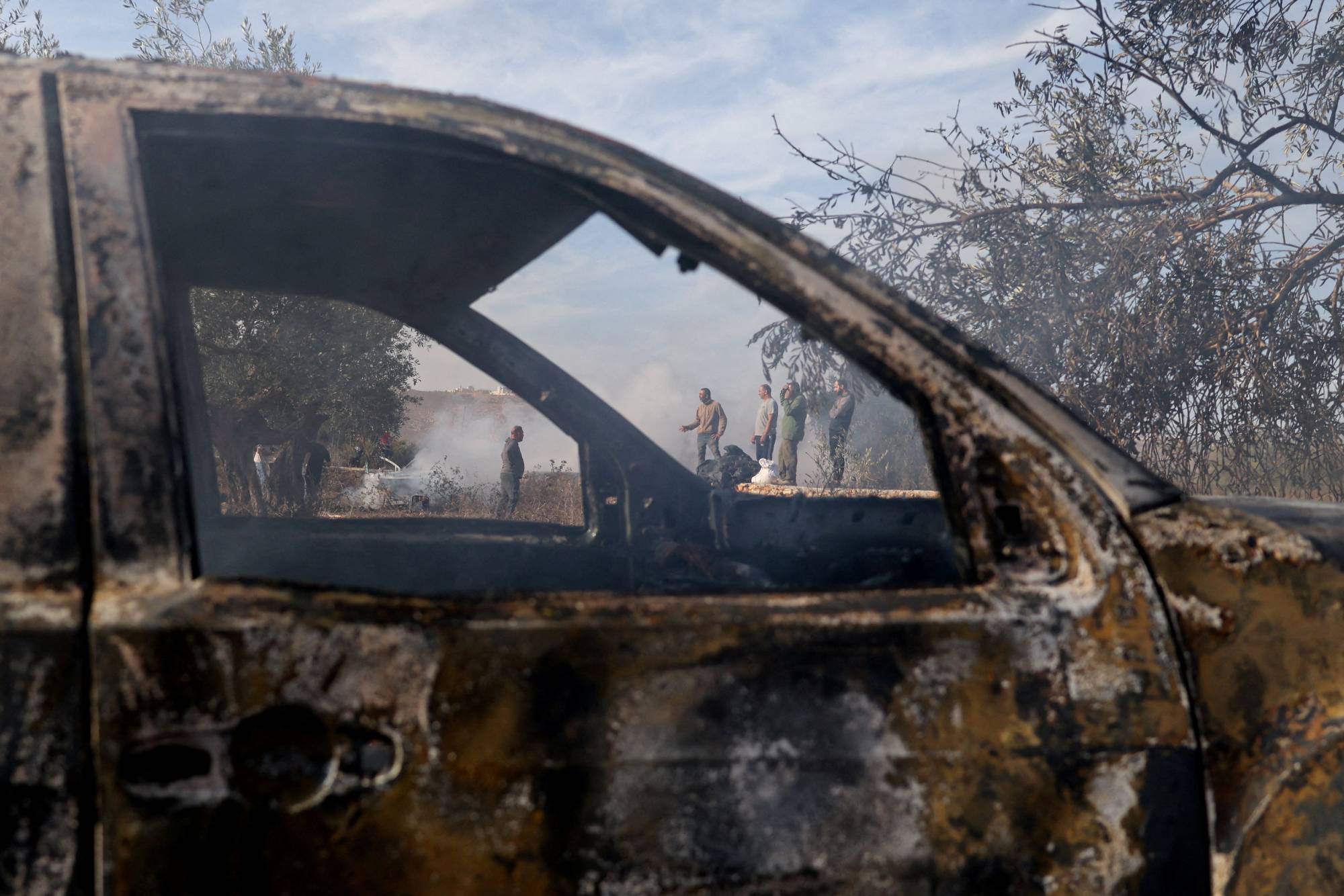
Palestinians stand near a burnt-out car after Israeli militant settlers attacked a group of Palestinians while they were harvesting olives near Turmus Ayya in the Israeli-occupied West Bank, October 16, 2026. REUTERS/Ammar Awad

Israel’s police and army did not immediately respond to questions about the attacks.

The Abu Falah attack followed a similar attack on Friday morning in the area of Turmus Ayya village, where settlers burned three cars after attacking a group of farmers harvesting olives.

Salah Abu Niswa, who witnessed the attack in Turmus Ayya, said the settlers "snuck up like thieves, they caught someone by himself and began to beat him."


Policing of France's School Protests Clouds Macron's Final Months and Sparks Uproar

France's President Emmanuel Macron delivers a speech during the "Bpifrance Inno Generation (BIG)" event, in Paris, France, October 8, 2026.  Julien De Rosa/Pool via REUTERS
France's President Emmanuel Macron delivers a speech during the "Bpifrance Inno Generation (BIG)" event, in Paris, France, October 8, 2026. Julien De Rosa/Pool via REUTERS
TT

Policing of France's School Protests Clouds Macron's Final Months and Sparks Uproar

France's President Emmanuel Macron delivers a speech during the "Bpifrance Inno Generation (BIG)" event, in Paris, France, October 8, 2026.  Julien De Rosa/Pool via REUTERS
France's President Emmanuel Macron delivers a speech during the "Bpifrance Inno Generation (BIG)" event, in Paris, France, October 8, 2026. Julien De Rosa/Pool via REUTERS

On one side, legions of determined teenagers protesting for their future by blockading schools and taking part in marches that have sometimes spiraled into violence.

On the other, one of the largest internal security forces in Europe, deployed by the government of an unpopular and outgoing president, The Associated Press said.

The result, playing out almost daily outside high schools and on the streets of France, is a nationwide storm of unrest. The mayhem of recent weeks — with mass arrests and hundreds of injured — has sparked an uproar in a country steeped in a centuries-old culture of protest. Even some police have turned on the government's handling of the demonstrations.

Discontent shrouds Macron's final months

For President Emmanuel Macron, who leaves office in May, it’s hardly the dream ending to his decade in power. He has faced a succession of protest movements that sapped his popularity and fueled broad criticism of how his ministers use police against demonstrators.

With the high schoolers, the outcry has grown particularly loud. That's partly because the vast majority of the 8,000 people arrested in recent weeks are under 18 and because police riot-control weapons are blamed for life-changing injuries suffered by some young teens.

The protesters' push for better-resourced schools, particularly in poorer Paris suburbs and other cities and towns, also has a sympathetic audience as France hurts from record poverty and record public debt.

But police complain that they're facing violent rioters who are latching onto the protests and using the crowds as cover to attack officers, pelting them with rocks, fireworks and other projectiles and wreaking havoc with fires, vandalism and other destruction. By the government's count, more than 900 officers and more than 150 teachers and other school staffers have been injured. More demonstrations, by a variety of groups with broader complaints beyond schools, are planned Saturday.

French history partly explains why protests are veering into confrontations between riot police and some demonstrators who come ready to fight in masks and black clothes, says Walid Hrar, a police officer and union representative in the northern suburbs of Paris.

“This is the country of the French Revolution. Everyone boasts about it, in fact. Some political parties don’t hesitate to say that we need to disobey the law. That’s what Robespierre and other revolutionaries taught us in 1789,” he said.

“France always tends to react rather than anticipate,” he added. "In other words, we’re always going to extremes.”

Attention focusing on police weaponry

The police have drawn sharp scrutiny for their efforts to control crowds using a variety of so-called non-lethal weaponry, particularly grenades and other projectiles, but also tear gas, water cannons and riot shields equipped with powerful strobe lights.

"We’re sending poorly equipped, untrained public security police officers to violent demonstrations who are likely to become agitated very quickly out of anger and fear,” said Jean-Marie Godard, an author who specializes in French policing.

Hrar said some of his police colleagues “aren’t specialized in crowd control and aren’t equipped for it. We send them in because we need the manpower, so we have officers wearing uniforms that aren’t flame-resistant. And if you’re hit by a firework mortar and your uniform isn’t flame-resistant, you can catch fire. We also have officers with worn-out helmets. We have shields that aren’t suitable."

He said officers who haven't been given permission to use riot-control projectiles and grenades sometimes struggle to keep attackers at a safe distance.

“So unfortunately we make do,” he said. “You’ll inevitably end up in direct physical confrontation. When that happens, there are injuries on both sides.”

His Alliance police union announced this week that it is filing a legal complaint against the state, accusing it of endangering lives. It alleged that officers are being issued with vague and contradictory orders, leaving them “isolated, betrayed, abandoned, exposed to violence."

Probes of alleged misconduct grow French Interior Minister Laurent Nunez said this week that security forces have used crowd-control weapons at least 18,000 times during the protests — mostly smoke and tear gas but also projectiles and grenades.

They include a deafening launcher-fired grenade that Nunez said was used “about 40 times” before he suspended its deployment against high schoolers, after a 15-year-old lost a hand.

“All this equipment, all these forces, all these intermediate weapons, are used whenever necessary, with proportionality, to mark an escalation of the response, to keep people at a distance or sometimes to put them out of action,” he said.

The minister said rules governing the use of riot-control projectiles are “very clear, very strict.”

“We avoid everything above the neck,” he said.

Still, an officer suspected of firing a round that partially blinded a 16-year-old was this week charged with aggravated violence.

That case is among a growing number of investigations — totaling 36 as of Tuesday — into alleged police misconduct.

Four involve “mutilating injuries,” another six involve “significant injuries” and others are for “blows, insults and suspected sexual assaults” and include the case of an officer accused of attempting to drown a protester, Nunez said.

Expert says different groups get different policing France has more than 250,000 police and gendarmes.

Sebastian Roché, a policing specialist at France's National Center for Scientific Research, said their use can depend on the political needs of the government, which commands them. Officers have been less forgiving with the teenagers than they previously were with farmers, a powerful lobby in France, who doused government buildings with manure, blocked roads and set fires.

“It’s the political definition of the movement that defines the police response,” Roché said.

Public perceptions of the police also change and are influenced by what people see on social media, said Hrar, who noted that officers were applauded for their bravery during terror attacks in 2015.

"When you bombard people every single day with images of police intervening with batons, shields and tear gas, you’re inevitably going to create a negative impression.”



Chelsea Captain Reece James Undergoes Knee Surgery

FILE PHOTO: Soccer Football - Premier League - Arsenal v Chelsea - Emirates Stadium, London, Britain - September 6, 2026 Chelsea's Reece James applauds fans after the match Action Images via Reuters/Paul Childs
TT

Chelsea Captain Reece James Undergoes Knee Surgery

FILE PHOTO: Soccer Football - Premier League - Arsenal v Chelsea - Emirates Stadium, London, Britain - September 6, 2026 Chelsea's Reece James applauds fans after the match Action Images via Reuters/Paul Childs

Chelsea captain Reece James has undergone knee surgery, the Premier League club said Friday.

Chelsea described the procedure as minor, but did not confirm the precise nature of the injury, which was sustained during a training session.

England defender James has endured a slew of injuries involving his knee and hamstring. A hamstring problem ruled him out of part of the 2026 World Cup.

Chelsea did not say how long it would take before the 26-year-old James would be back in action, The Associated Press reported.

“Reece has already begun his road to recovery and will be supported by the club’s medical department at Cobham during this rehabilitation phase,” it said in a statement. “Everyone at Chelsea wishes Reece a speedy recovery and will support him on his road to return.”

Chelsea, which is sixth in the league, travels to Everton on Saturday.