

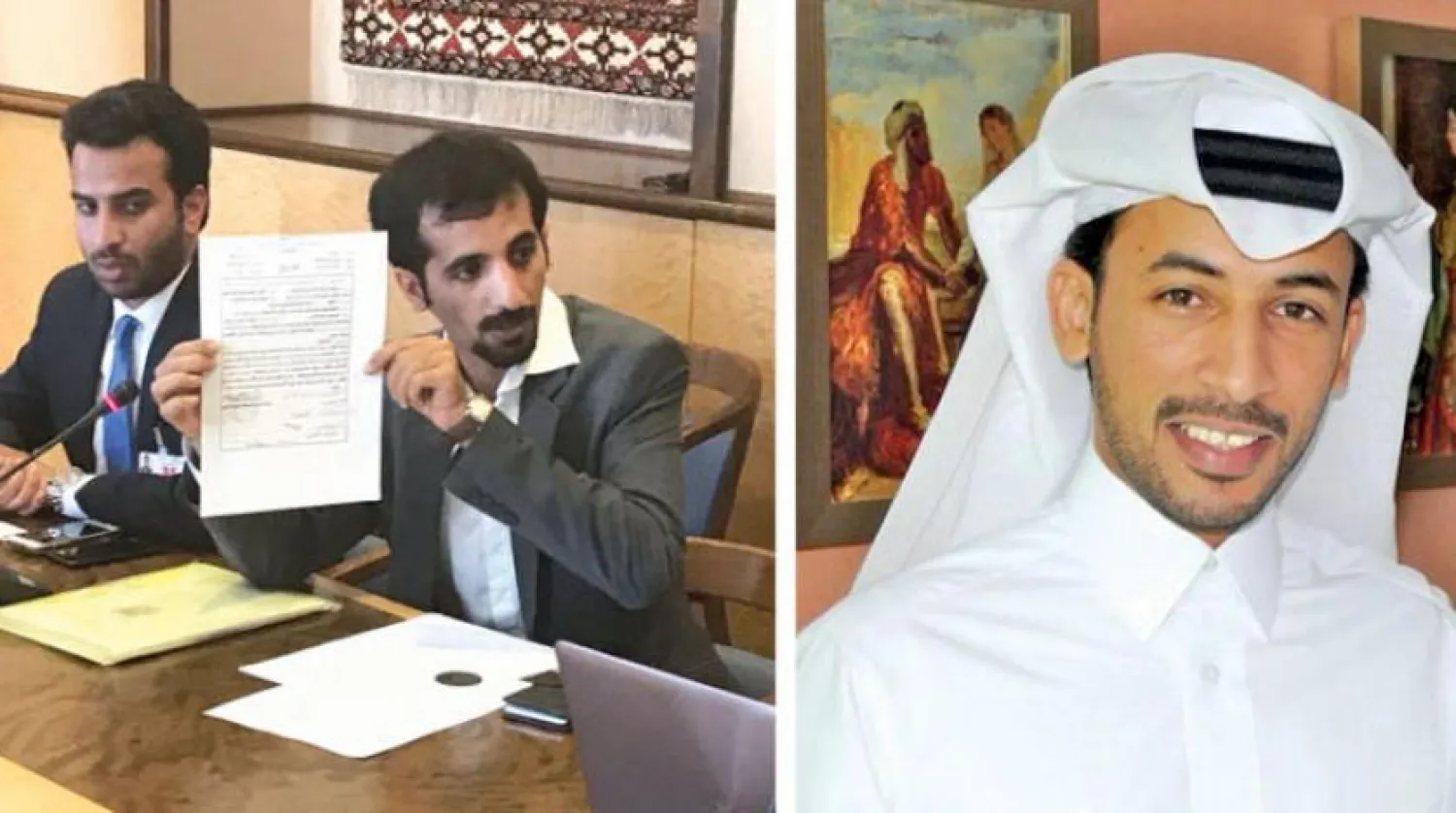

AFHR Condemns Qatar for Revoking Citizenship

Poet Mohammed bin Fattis al-Marri (right) and Saleh al-Marri (left), whose nationalities had been revoked, during a human rights convention in Geneva. (Asharq Al-Awsat)
TT

AFHR Condemns Qatar for Revoking Citizenship

Poet Mohammed bin Fattis al-Marri (right) and Saleh al-Marri (left), whose nationalities had been revoked, during a human rights convention in Geneva. (Asharq Al-Awsat)

Human Rights organizations condemned Qatar's steps in revoking the nationality of civilians who expressed their opinion on the Gulf crisis.

Chairman of Arab Federation for Human Rights Ahmed al-Hamli said the procedures taken were unacceptable, describing the rights of citizenship and nationality as inalienable, especially when it comes to freedom of speech.

Speaking to Asharq Al-Awsat, Hamli confirmed that the UN is concerned with the revocation of the citizenship, adding that all international organizations are worried that this would hurl citizens into political issues.

The chairman also wondered how can Qatar condemn Rohingya crisis and displacement, while the authorities in Doha are using the same method with Arab tribes especially tribes of Murrah and al-Hawajer.

Hamli expressed the readiness of the Federation to assist the Office of the UN High Commissioner for Human Rights with all the possible means for resolving this case that is of concern to Arabs.

Meanwhile, the Arab Federation strongly condemned Doha’s decision to revoke the citizenship and nationality of poet Mohammed bin Fattis al-Marri.

The federation denounced repressive practices of Doha authorities against poets, intellectuals and tribal leaders.

AFHR reiterated that nationality is a human right recognized under international law and cannot be contested or denied by anyone except through legal restrictions; not based on political differences.

The act against poet Mohamed on the grounds of differences in political opinions is a flagrant violation, according to the Federation.

Marri’s nationality was revoked after he expressed his personal views on the Qatari crisis and Qatar’s relations with the neighboring Gulf States and other Arab countries.

The Federation stated that this decision is an infringement of the inherent human rights of the poet. He did not carry out any terrorist or illegal acts, and no judicial decisions were issued against him.

It called upon the Qatari authorities to respect the freedom of opinion and expression guaranteed by the Universal Declaration of Human Rights and all relevant international institutions.

AFHR considered that the punishment to rescind the nationality contests the Qatari constitution against one of its citizens and is evidently a breach of the principles of human rights. The Federation considered the Qatari government’s decision was not based on any legal grounds or fair trial.

International human rights law recognizes the right of states to decide who their citizens are, however, the international law has stressed that such a right is not absolute and that such measures must be subject to legal considerations, according to AFHR.

International law stresses that those who have been subjected to the withdrawal of nationality, have the right to appeal before the courts for fair trials.

The Arab Federation for Human Rights called upon Qatari authorities to annul the arbitrary decision and to return Marri's nationality. It also appealed to local and foreign human rights organizations to exert pressure on the authorities and support those affected to regain their rights.

Mohammed bin Fattis Al Marri rejected Qatari authorities revoking the nationality of tribal sheikhs and wished the crisis would be resolved as soon as possible.

After 127 days of silence, the poet expressed his views on the crisis and voiced his concerns about the security and cohesion of the Gulf States, Qatar's involvement in other countries’ internal affairs, and his rejection of the politicization of Hajj.

“If assault against countries is a red line, the assault on sanctities, Custodian of the Two Holy Mosques and the scholars is a line of fire that we do not allow to violate," he stated.

Mohammed bin al-Dhib is another poet who had been persecuted by the authorities when he was imprisoned on false charges of incitement of violence against the regime in Qatar.

In 2005, Qatari authorities revoked the citizenship of about 12,000 members of Murrah and al-Ghofran tribes. Twelve years later, the government resorted to same measures and rescinded the nationality of Sheikh Taleb bin Shreim al-Marri and 50 members of his family.



Saudi Crown Prince Receives Message on Bilateral Ties from President of Kazakhstan

Prince Mohammed bin Salman bin Abdulaziz Al Saud, Saudi Crown Prince and Prime Minister. (SPA file)
TT

Saudi Crown Prince Receives Message on Bilateral Ties from President of Kazakhstan

Prince Mohammed bin Salman bin Abdulaziz Al Saud, Saudi Crown Prince and Prime Minister. (SPA file)

Prince Mohammed bin Salman bin Abdulaziz Al Saud, Saudi Crown Prince and Prime Minister, received on Tuesday a written message from President of Kazakhstan Kassym-Jomart Tokayev on bilateral relations between their two countries.

The message was received by Minister of Foreign Affairs Prince Faisal bin Farhan bin Abdullah during a meeting with his Kazakh counterpart Yermek Kosherbayev in Riyadh.


Princes and Officials Take Oath Before Custodian of the Two Holy Mosques

Custodian of the Two Holy Mosques King Salman bin Abdulaziz Al Saud and other officials are seen during the ceremony in Riyadh on Tuesday. (SPA)
TT

Princes and Officials Take Oath Before Custodian of the Two Holy Mosques

Custodian of the Two Holy Mosques King Salman bin Abdulaziz Al Saud and other officials are seen during the ceremony in Riyadh on Tuesday. (SPA)

Princes and officials appointed by royal orders to their new positions took the oath of office before Custodian of the Two Holy Mosques King Salman bin Abdulaziz Al Saud in Riyadh on Tuesday.

They included Deputy Governor of Al-Baha Region Prince Fahd bin Saad bin Abdullah bin Abdulaziz bin Turki; Member of the Shura Council Prince Dr. Saad bin Saud bin Mohammed bin Abdulaziz; Deputy Governor of Madinah Region Prince Saud bin Nahar bin Saud; Deputy Governor of Northern Borders Region Prince Mohammed bin Abdullah bin Abdulaziz; and Minister of Investment Fahd Al-Saif.

They swore to be faithful to their religion, then their King and country, not to reveal any of the state’s secrets, to preserve its interests and regulations, and to perform their duties with honesty, trustworthiness, and sincerity.


Saudi Arabia Reiterates Its Categorical Rejection of Israel’s ‘State Land’ Decision in West Bank

Custodian of the Two Holy Mosques King Salman bin Abdulaziz Al Saud chairs the Cabinet meeting in Riyadh. (SPA)
TT

Saudi Arabia Reiterates Its Categorical Rejection of Israel’s ‘State Land’ Decision in West Bank

Custodian of the Two Holy Mosques King Salman bin Abdulaziz Al Saud chairs the Cabinet meeting in Riyadh. (SPA)

The Saudi government condemned on Tuesday Israel’s decision to West Bank lands as "state lands."

Reiterating its absolute rejection of these illegal measures, the Cabinet warned that they undermine peace efforts and violate the Palestinian people's inherent right to establish an independent, sovereign state within the 1967 borders, with East Jerusalem as its capital.

Custodian of the Two Holy Mosques King Salman bin Abdulaziz Al Saud chaired the Cabinet session that was held in Riyadh.

The Cabinet congratulated citizens and Muslims on the advent of the holy month of Ramadan, expressing gratitude for the Kingdom's honor in caring for the two holy mosques and their visitors.

The Cabinet highlighted the success of the Hajj and Umrah seasons, noting that the Kingdom welcomed 19.5 million international pilgrims and Umrah performers in 2025, setting new records that reflect rapid progress toward the goals of Vision 2030 and the Pilgrim Experience Program.

The Cabinet described the Kingdom's Founding Day celebration on February 22 as an expression of pride in the Saudi state's nearly three-century history, underscoring the foundations of justice, unity, and development established by leaders and citizens throughout history to ensure the nation remains a global leader in all fields.

The Cabinet was briefed on recent talks between Saudi Arabia and various nations, which focused on strengthening bilateral and multilateral cooperation and boosting coordination to foster regional and international security, stability, and prosperity.

The session further reviewed the Kingdom's economic, cultural, and social activities, stressing the state's commitment to social solidarity and giving. This includes continued support for the sixth National Campaign for Charitable Work, set to begin on Friday.

The Cabinet commended the success of the third World Defense Show held in Riyadh under the Custodian of the Two Holy Mosques' patronage, during which strategic partnerships, agreements, and memoranda of understanding were signed to localize military technologies and strengthen local supply chains in alignment with Vision 2030 objectives.