The Making of Gabriel Jesus: How the Humble Kid from São Paulo Became a Superstar

 Jesus acrobatically controls the ball during Manchester City’s 4-0 Champions League win over Feyenoord. Photograph: Olaf Kraak/EPA
Jesus acrobatically controls the ball during Manchester City’s 4-0 Champions League win over Feyenoord. Photograph: Olaf Kraak/EPA
TT

The Making of Gabriel Jesus: How the Humble Kid from São Paulo Became a Superstar

 Jesus acrobatically controls the ball during Manchester City’s 4-0 Champions League win over Feyenoord. Photograph: Olaf Kraak/EPA
Jesus acrobatically controls the ball during Manchester City’s 4-0 Champions League win over Feyenoord. Photograph: Olaf Kraak/EPA

Gabriel Jesus’s childhood football coach, José Francisco Mamede, was the least surprised of anyone when the boy‑faced wonder exploded on to the Premier League scene with Manchester City in February against West Ham United.

“I always knew he would turn out to be a top professional. When we had him as a boy I predicted he would turn pro, play for Brazil and get a big overseas transfer. It all happened exactly as I knew it would. Well, it looks like I need to make another prediction now: Gabriel Jesus will win the Ballon d’Or within three years.”

Jesus has barely stopped scoring or impressing in the matches he has played since that February night, although a foot injury last season did sideline him for two and a half months, and if City have the look of serious title contenders that is in no small part down to the 20‑year‑old forward.

Whereas last season Jesus’s impact forced Sergio Agüero on to the bench, this term they are forming a formidable strike partnership. Jesus has five goals from his last five games, including one on his Champions League debut against Feyenoord. His tally of 11 goals from 13 Premier League starts points to an extraordinarily smooth transition since his arrival from Palmeiras in January for what now looks a bargain initial £27m. Little wonder City are preparing to reward Jesus with a new contract.

A journey back to where it all began for Jesus reinforces the scope of his talent and the speed of his rise. Through a combination of dedication and the right guidance, Jesus went from playing on dirt pitches with no referee at 15 to being Brazil’s first‑choice centre‑forward four years later.

Mamede, the director of sports and one of the founders of Pequeninos do Meio Ambiente, the junior club where Jesus played his first competitive games, almost wells up with emotion when he tells the Guardian about his former charge. “The boy is a superstar,” he says. “It seems as though the ball looks for him when it’s in the area. He is always in the right place at the right time. And he’s always been like that.”

About as far north as it is possible to go within the sprawling city limits of Brazil’s biggest metropolis, São Paulo, in the grounds of a military prison, lies the pitch used by the youth football club.

Saturday morning training is a romantic scene. By the time we arrive, the sun is forcing parents and spectators to take refuge in the shade of the tall pine trees that surround the dry, uneven dirt pitch. As the young boys and girls aged between seven and 14 turn, skip and kick away, the baked-earth clouds that billow up are highlighted by shafts of light piercing through the foliage.

This is where Jesus’s football education started; dodging defenders double his size in the dust. To play on these pitches you need to develop a great first touch and speed of thought, as the bounce is unpredictable.

“It’s on dirt pitches like this that boys will learn how to control the ball,” Mamede says. “Football is simple. You don’t need to complicate it. I train the boys a lot like this: control and pass, control and pass. These bare-earth pitches develop a boy to become quick-thinking; he needs to be able to predict where the ball is going to arrive and where it’s going after he makes the pass. So he’s going to develop much better control than if he just plays on artificial turf. I think this is very important.”

By all accounts the young Jesus did not need much coaching, only a little love and support. Thankfully, he has always been guided by people with his best interests at heart.

Mamede wistfully recalls the first time he saw Jesus in action: “He arrived here, in flip-flops, about eight years old, and in the first game of the first training that he attended he scored a goal by dribbling around three much bigger boys and slotted the ball home with ease. I said to myself: ‘This kid is something special.’”

The coaches voluntarily give up their weekends to coach dozens of youngsters from the surrounding area. Mamede says he used to drive the boys to away games in his knackered old Beetle, often fitting up to 11 little footballers in the back. Inside the car he kept boots and kit to lend to players who would otherwise play barefoot.

It is not an affluent part of the city, with the surrounding area full of favelas, and many of the kids come as much for the free ham sandwich and juice as for the chance of playing in the team. Jesus, among others, used to receive a box of basic food provisions from the club to take home to his family. Mamede is rightfully proud of the work he and his small team do here.

“This club exists to take children off the street,” he says. “That’s why we love playing at the military base. We often arrive at away games to find there’s also samba and alcohol. This is never going to end well. I even get angry when I see dads smoking on the touchline. If you smoke and use bad language, the kid is going to do the same.”

With a heavy heart, he recalls attending the funerals of boys caught up with robberies and drug dealing. Jesus was never involved in this side of life, though, and Mamede remembers him as a singularly focused individual.

“Gabriel used to say that he never missed training, never missed a game. He was always first in line for exercises and drills – he wasn’t one of those who loitered at the back pretending to do the drill, like so many are … I’ve had at least 10 young players here who were as good, if not better than him, but they didn’t make it because they were lazy. Something that Gabriel never was.”

This application is combined with a quiet self-confidence that earned Jesus the nickname Tetinha, slang for “easy-peasy”. Any time the team spoke of the opposition, or needed another goal, he would smile and say “Tetinha!”

By all accounts he was like this on and off the pitch and everyone in the neighborhood where he grew up knows him by that word. The only thing that seemed to visibly trouble the young Jesus was losing a game of football.

“He would cry a lot,” recalls Mamede. “He hates losing even half a game. Imagine when we lost the final of the local championship. It was his last year playing with us, we arrived in the semi-finals to play a team who were four years unbeaten. They had a great team. We won 4-1, with all four goals scored by Gabriel. We then played Portuguesa [a professional football club] in the final, and we lost 3-1. Gabriel scored for us but we lost because they were so much better prepared, they had proper football boots, whereas our boys were slipping on the grass; we didn’t even have studs.”

This particular defeat stuck in the young player’s head. Toward the end of his final season at Palmeiras, under his own steam, Jesus returned to Pequeninos to deliver 250 pairs of new boots. “I’m the same as them,” he told O Globo Sport last October. “I’ve also had my problems. I think it’s really important for them to hold on to the dream they may one day realize.”

Jesus had a tough start in life. He grew up in very humble surroundings, in Jardim Peri, at the northern edge of São Paulo. He was the youngest of four children in a single-parent family. His father, who left his mother for another woman when Jesus was in the womb, died in a motorbike accident and had no part in the boy’s upbringing.

Despite or perhaps because of these hardships, Jesus never wavered in his pursuit of becoming a professional athlete. His neighbor in the community where his family lived, Maria Rosimar da Silva, recalls a “quiet, smiley kid, only interested in football”.

“His mum used to scream and shout for him to come in at night but he wouldn’t respond,” she says. “He just stayed in the street with his ball. He’d run out of the house with both hands clutching it, snot running down his nose.” She giggles. “I’d call him over to wipe it for him – he never let go of that ball.”

Jesus’s mum, Vera Lucia, is without doubt the single most important figure in his life and he has two tattoos to commemorate this. Maria describes her as a “warrior woman, who was always very persistent in achieving her goals”.

Those goals were to raise four children to be hard-working and respectful. “If you are black and poor, you need to study hard,” she would tell her kids and she made sure their school work was done on time.

Jesus has joked in interviews that his mum is the “toughest center-back he’s ever had to face” and that she was a mum and a dad for him, putting a loving arm around him or chastising him as needed. Vera put her first three children to work from the age of 12 to augment the income she received as a cleaner in the city but she recognized Jesus’s talent and desire from an early age and spared him to concentrate on his football.

She lived with her son in Manchester as he settled in, controlling his press commitments and making sure he is careful with money and girls. The Guardian had lined up a meeting with Jesus’s cousin but was told that “Auntie Vera has forbidden it”. She still calls the shots and is not to be messed with. It is this kind of treatment that will keep the new darling of Brazilian football’s feet firmly on terra firma, as more and more people clamor for a piece of the action.

Jesus is adored by the people who knew him growing up and he retains a strong connection to the area, where there is a mural with his image. “I can leave Peri,” it reads, “but Peri will never leave me.”

Even after becoming a local hero at Palmeiras, Jesus would often return to see friends after games and have a kickabout in the street. He also spent a lot of time there during the summer break this year, seeing old friends and playing football with the youngsters who now see him as a role model.

Another neighbor, José Cesaro Neto, showed us his “Jesus” Palmeiras shirt and describes him as “the same guy today as he was as a kid. Quiet, simple, normal”.

Jesus’s profile is in stark contrast to that of his good friend and Brazil strike partner Neymar. The two young forwards have the same tattoo, which they got before winning gold for Brazil at Rio 2016, depicting a young boy with a ball, looking up at the favela he calls home.

In Brazil, however, Neymar is generally viewed as a bit too obsessed with the showbiz side of his life. Jesus is understood to be the opposite: humble, honest and focused on nothing but his game. Whether Mamede’s prediction comes true will depend on many variables working in Jesus’s favor: team-mates’ form, staying free of injury, and not least being able to get free of defenders who will now be doubling up on him.

Should the stars align, there will not be too many surprised faces in the north of São Paulo if Brazil’s next Ballon d’Or winner turns out not to be the big-money man playing in Paris after all. Jesus has the Premier League, Champions League and World Cup in his sights over the next 10 months and no one who witnessed his rise would doubt his potential to be the oustanding player in all three.

For Jesus, though, it has always been one step at a time. Albeit a succession of very quick steps. Thanks to his dedication and two important “salt of the earth” guiding lights, Jesus has made his journey from the street kickabouts of Jardim Peri to the pressure cooker of the Premier League title race look easy.

Brazil’s No9 is the perfect combination of nature and nurture. The sky is the limit but critically, behind the scenes, he has a dedicated group of family and friends making sure his feet stay firmly on the ground.

(The Guardian)


Ukraine's Officials to Boycott Paralympics over Russian Flag Decision

Milano Cortina 2026 Winter Olympics - Skeleton - Interview with Ukraine Youth and Sports minister Matvii Bidnyi - N H Hotel, Milan, Italy - February 12, 2026 Ukraine Youth and Sports Minister Matvii Bidnyi speaks after the disqualification of Ukrainian skeleton racer Vladyslav Heraskevych from the Winter Games. REUTERS/Kevin Coombs
TT

Ukraine's Officials to Boycott Paralympics over Russian Flag Decision

Milano Cortina 2026 Winter Olympics - Skeleton - Interview with Ukraine Youth and Sports minister Matvii Bidnyi - N H Hotel, Milan, Italy - February 12, 2026 Ukraine Youth and Sports Minister Matvii Bidnyi speaks after the disqualification of Ukrainian skeleton racer Vladyslav Heraskevych from the Winter Games. REUTERS/Kevin Coombs

Ukrainian officials will boycott the Paralympic Winter Games, Kyiv said Wednesday, after the International Paralympic Committee allowed Russian athletes to compete under their national flag.

Ukraine also urged other countries to shun next month's Opening Ceremony in Verona on March 6, in part of a growing standoff between Kyiv and international sporting federations four years after Russia invaded.

Six Russians and four Belarusians will be allowed to take part under their own flags at the Milan-Cortina Paralympics rather than as neutral athletes, the Games' governing body confirmed to AFP on Tuesday.

Russia has been mostly banned from international sport since Moscow invaded Ukraine. The IPC's decision triggered fury in Ukraine.

Ukraine's sports minister Matviy Bidny called the decision "outrageous", and accused Russia and Belarus of turning "sport into a tool of war, lies, and contempt."

"Ukrainian public officials will not attend the Paralympic Games. We will not be present at the opening ceremony," he said on social media.

"We will not take part in any other official Paralympic events," he added.

Ukrainian Foreign Minister Andriy Sybiga said he had instructed Kyiv's ambassadors to urge other countries to also shun the opening ceremony.

"Allowing the flags of aggressor states to be raised at the Paralympic Games while Russia's war against Ukraine rages on is wrong -- morally and politically," Sybiga said on social media.

The EU's sports commissioner Glenn Micallef said he would also skip the opening ceremony.

- Kyiv demands apology -

The IPC's decision comes amid already heightened tensions between Ukraine and the International Olympic Committee, overseeing the Winter Olympics currently underway.

The IOC banned Ukrainian skeleton racer Vladyslav Heraskevych for refusing to ditch a helmet depicting victims of the war with Russia.

Ukraine was further angered that the woman chosen to carry the "Ukraine" name card and lead its team out during the Opening Ceremony of the Games was revealed to be Russian.

Media reports called the woman an anti-Kremlin Russian woman living in Milan for years.

"Picking a Russian person to carry the nameplate is despicable," Kyiv's foreign ministry spokesman Georgiy Tykhy said at a briefing in response to a question by AFP.

He called it a "severe violation of the Olympic Charter" and demanded an apology.

And Kyiv also riled earlier this month at FIFA boss Gianni Infantino saying he believed it was time to reinstate Russia in international football.

- 'War, lies and contempt' -

Valeriy Sushkevych, president of the Ukrainian Paralympic Committee told AFP on Tuesday that Kyiv's athletes would not boycott the Paralympics.

Ukraine traditionally performs strongly at the Winter Paralympics, coming second in the medals table four years ago in Beijing.

"If we do not go, it would mean allowing Putin to claim a victory over Ukrainian Paralympians and over Ukraine by excluding us from the Games," said the 71-year-old in an interview.

"That will not happen!"

Russia was awarded two slots in alpine skiing, two in cross-country skiing and two in snowboarding. The four Belarusian slots are all in cross-country skiing.

The International Paralympic Committee (IPC) said earlier those athletes would be "treated like (those from) any other country".

The IPC unexpectedly lifted its suspension on Russian and Belarusian athletes at the organisation's general assembly in September.


'Not Here for Medals', Nakai Says after Leading Japanese Charge at Olympics

Ami Nakai of Japan competes during the women's short program figure skating at the 2026 Winter Olympics, in Milan, Italy, Tuesday, Feb. 17, 2026. (AP Photo/Ashley Landis)
TT

'Not Here for Medals', Nakai Says after Leading Japanese Charge at Olympics

Ami Nakai of Japan competes during the women's short program figure skating at the 2026 Winter Olympics, in Milan, Italy, Tuesday, Feb. 17, 2026. (AP Photo/Ashley Landis)

Ami Nakai entered her first Olympics insisting she was not here for medals — but after the short program at the Milano Cortina Games, the 17-year-old figure skater found herself at the top, ahead of national icon Kaori Sakamoto and rising star Mone Chiba.

Japan finished first, second, and fourth on Tuesday, cementing a formidable presence heading into the free skate on Thursday. American Alysa Liu finished third.

Nakai's clean, confident skate was anchored by a soaring triple Axel. She approached the moment with an ease unusual for an Olympic debut.

"I'm not here at this Olympics with the goal of achieving a high result, I'm really looking forward to enjoying this Olympics as much as I can, till the very last moment," she said.

"Since this is my first Olympics, I had nothing to lose, and that mindset definitely translated into my results," she said.

Her carefree confidence has unexpectedly put her in medal contention, though she cannot imagine herself surpassing Sakamoto, the three-time world champion who is skating the final chapter of her competitive career. Nakai scored 78.71 points in the short program, ahead of Sakamoto's 77.23.

"There's no way I stand a chance against Kaori right now," Nakai said. "I'm just enjoying these Olympics and trying my best."

Sakamoto, 25, who has said she will retire after these Games, is chasing the one accolade missing from her resume: Olympic gold.

Having already secured a bronze in Beijing in 2022 and team silvers in both Beijing and Milan, she now aims to cap her career with an individual title.

She delivered a polished short program to "Time to Say Goodbye," earning a standing ovation.

Sakamoto later said she managed her nerves well and felt satisfied, adding that having three Japanese skaters in the top four spots "really proves that Japan is getting stronger". She did not feel unnerved about finishing behind Nakai, who also bested her at the Grand Prix de France in October.

"I expected to be surpassed after she landed a triple Axel ... but the most important thing is how much I can concentrate on my own performance, do my best, stay focused for the free skate," she said.

Chiba placed fourth and said she felt energised heading into the free skate, especially after choosing to perform to music from the soundtrack of "Romeo and Juliet" in Italy.

"The rankings are really decided in the free program, so I'll just try to stay calm and focused in the free program and perform my own style without any mistakes," said the 20-year-old, widely regarded as the rising all-rounder whose steady ascent has made her one of Japan's most promising skaters.

All three skaters mentioned how seeing Japanese pair Riku Miura and Ryuichi Kihara deliver a stunning comeback, storming from fifth place after a shaky short program to capture Japan's first Olympic figure skating pairs gold medal, inspired them.

"I was really moved by Riku and Ryuichi last night," Chiba said. "The three of us girls talked about trying to live up to that standard."


PSG’s Mental Strength Hailed as they Come from Behind to Win at Monaco

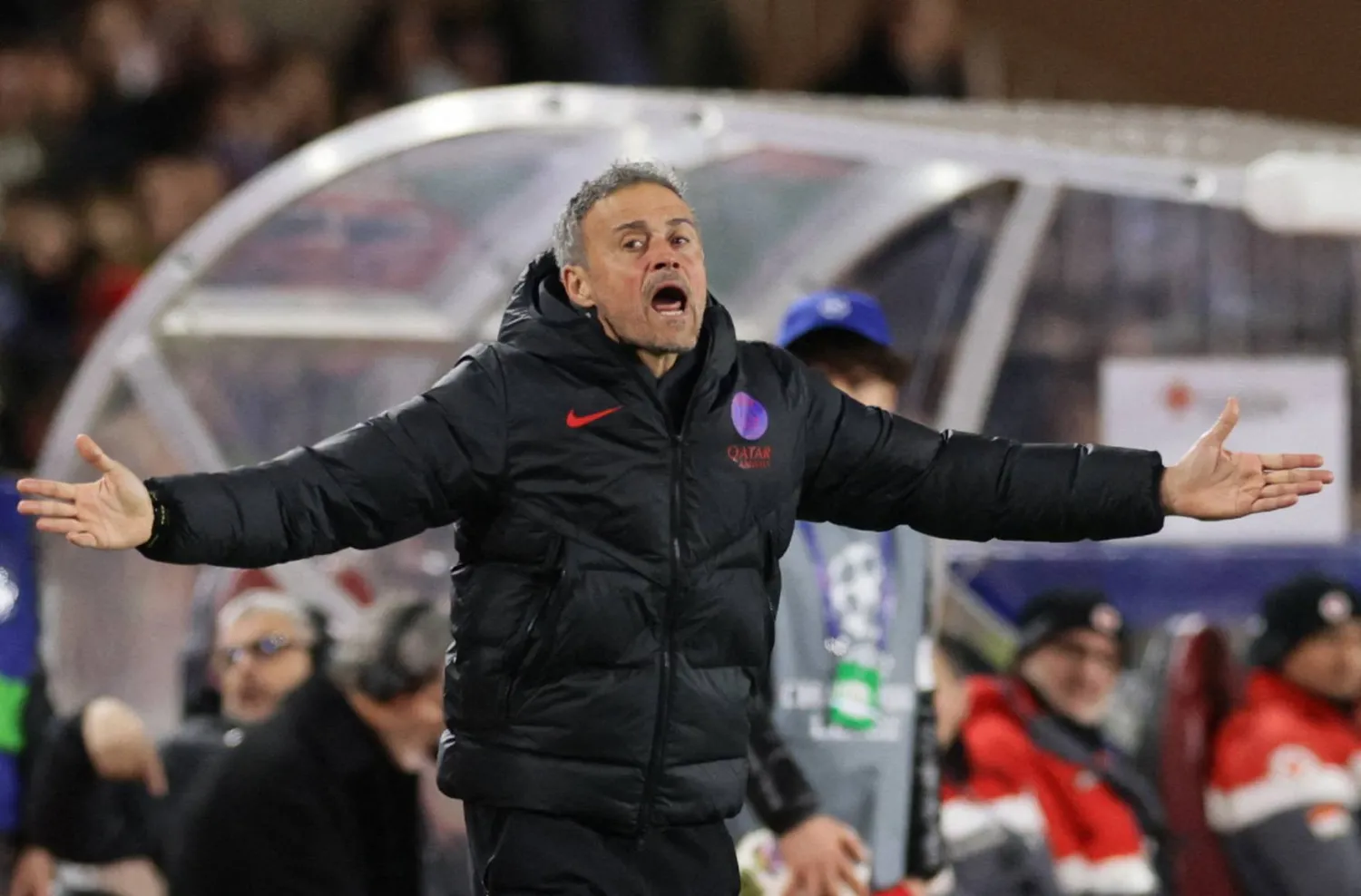
Soccer Football - UEFA Champions League - Play Off - First Leg - AS Monaco v Paris St Germain - Stade Louis II, Monaco - February 17, 2026 Paris St Germain coach Luis Enrique reacts REUTERS/Manon Cruz
TT

PSG’s Mental Strength Hailed as they Come from Behind to Win at Monaco

Soccer Football - UEFA Champions League - Play Off - First Leg - AS Monaco v Paris St Germain - Stade Louis II, Monaco - February 17, 2026 Paris St Germain coach Luis Enrique reacts REUTERS/Manon Cruz

Paris Saint-Germain coach Luis ‌Enrique hailed the mental strength of his side in coming from two goals down to win 3-2 away at Monaco in the Champions League on Tuesday, but warned the knockout round tie was far from finished.

The first leg clash between the two Ligue 1 clubs saw Folarin Balogun score twice for the hosts in the opening 18 minutes before Vitinha had his penalty saved to compound matters.

But after Desire Doue came on for injured Ousmane Dembele, the ‌match turned ‌and defending champions PSG went on to ‌secure ⁠a one-goal advantage ⁠for the return leg.

"Normally, when a team starts a match like that, the most likely outcome is a loss,” Reuters quoted Luis Enrique as saying.

“It was catastrophic. It's impossible to start a match like that. The first two times they overcame our pressure and entered our half, they scored. They ⁠made some very good plays.

“After that, it's difficult ‌to have confidence, but we ‌showed our mental strength. Plus, we missed a penalty, so ‌it was a chance to regain confidence. In the ‌last six times we've played here, this is only the second time we've won, which shows how difficult it is.”

The 20-year-old Doue scored twice and provided a third for Achraf Hakimi, just ‌days after he had turned in a poor performance against Stade Rennais last Friday ⁠and was ⁠dropped for the Monaco clash.

“I'm happy for him because this past week, everyone criticized and tore Doue apart, but he was sensational, he showed his character. He helped the team at the best possible time.”

Dembele’s injury would be assessed, the coach added. “He took a knock in the first 15 minutes, then he couldn't run.”

The return leg at the Parc des Princes will be next Wednesday. “Considering how the match started, I'm happy with the result. But the match in Paris will be difficult, it will be a different story,” Luis Enrique warned.