
Keep Politics out of Sport? Don’t Make me Laugh

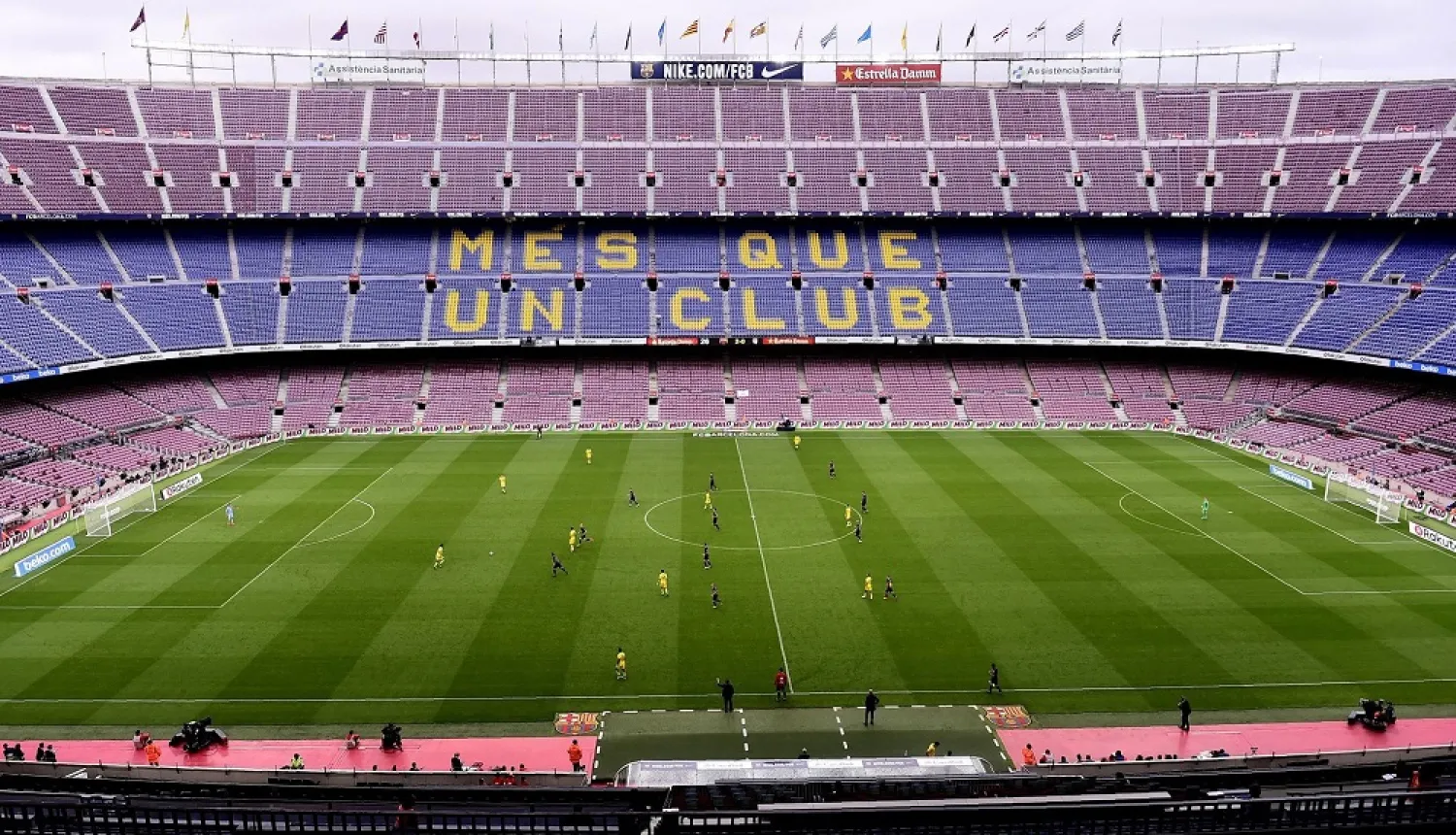
Spectator tribunes remain empty as the Spanish league football match FC Barcelona vs UD Las Palmas is played behind closed doors at the Camp Nou stadium in Barcelona on October 1, 2017. (AFP)
TT

Keep Politics out of Sport? Don’t Make me Laugh

Spectator tribunes remain empty as the Spanish league football match FC Barcelona vs UD Las Palmas is played behind closed doors at the Camp Nou stadium in Barcelona on October 1, 2017. (AFP)

Barcelona’s decision to play the October 1 match against Las Palmas in an empty stadium smacked of choosing points over principles, and overlooks the fact that sport has always found room for protest.

When it came down to it, FC Barcelona – mes que un club, remember – could not bring themselves to go all in. The threatened loss of six points – three for the defaulted match, three more as a penalty – was enough to persuade them to stage their match against Las Palmas behind locked doors in a deserted Camp Nou, while outside the streets of the city rang with the echoes of violent confrontations between police and voters in an independence referendum ruled illegal by the national government.

The club’s decision was an important one. Barça is a powerful international symbol of Catalan identity. A refusal to play Sunday’s match would have added tinder to the fire of the independence movement. But they compete in a league where their final standing against Real Madrid has been measured in the last three seasons by two points, one point and three points. So they took the safer option, leaving Gerard Piqué who has never made a secret of his Catalan pride, to join up with the Spain squad and face uncomfortable questions about divided loyalties.

Meanwhile, fans who had voted for independence pointed to the example of Welsh clubs competing in the English league as evidence that independence from Spain would not have to mean ejection from La Liga. Few would want an entirely autonomous Catalonia to incorporate a future of Barça competing in a domestic mini-league made up by FC Girona, Gimnàstic de Tarragona and Lleida Esportiu.

Keep politics out of sport? Don’t make me laugh. Politics infiltrates sport at all levels. Think about the decision to start next year’s Giro d’Italia in Israel. For one partner in the deal, that’s obviously a matter of money – €17m, apparently. For the other, it represents valuable image-polishing. This is not quite the same as launching the Tour de France in Yorkshire, which was not, the last time I looked, surrounded by walls aimed at keeping out people from Lancashire or County Durham. Or there’s Qatar, whose appalling treatment of migrant workers on the 2022 World Cup stadiums was exposed – not for the first time - by Human Rights Watch this week. Do we really think the Qataris are investing so heavily in football, at home and abroad, out of a sheer love of the game?

The coming days might tell us whether FC Barcelona has a further role to play in the dramatic reawakening of old regional tensions and whether the events of October 1 will join the line of football matches that played a part in shaping history, a phenomenon that could be said to have begun in 1969 with a conflict between El Salvador and Honduras that became known as the Football War.

Tensions between the two countries had been heightened by the migration to Honduras of hundreds of thousands of Salvadorans, leaving a country one-fifth the size of its neighbor but with a population 40 percent greater, prompting the Honduran government to enact reforms intended to keep land out of the hands of immigrant farmers while expelling Salvadoran laborers. The fuse for open conflict was lit when the two countries met in the qualifying tournament for the 1970 World Cup.

The first match was held in the Honduran capital, Tegucigalpa, where the visiting players were kept awake by crowds letting off firecrackers and breaking windows in their hotel. The home team won by a single goal, prompting an 18-year-old girl watching at home in El Salvador to take her father’s pistol from his desk and shoot herself dead. Amelia Bolianos was given a state funeral, her coffin accompanied by the president of the republic and the players of the football team.

When Honduras arrived in San Salvador for the return leg a week later, the welcome included rotten eggs and dead rats thrown through their hotel windows. They made their way to the Flor Blanca stadium in armored cars, passing through angry crowds holding portraits of the dead girl. El Salvador won this one 3-0, which meant that the tie progressed to a play-off on neutral ground in Mexico City. El Salvador won 3-2 with an extra-time goal from their right-winger, “Pipo” Rodríguez, a qualified civil engineer, a few hours after their government had dissolved diplomatic relationships with Honduras in protest against further mass expulsions.

Two weeks later the Salvadoran army and air force launched an invasion which drew a swift response. The war lasted 100 hours and killed 3,000 people, the majority of them civilians, before both sides obeyed a ceasefire call from the Organization of American States. Three months later El Salvador beat Haiti in a play-off to reach the 1970 finals in Mexico, where they lost all three of their group matches.

Twenty years later Red Star Belgrade traveled to meet Dinamo Zagreb in a Yugoslavian league fixture in the midst of rising fervor among Serb and Croat nationalists. Rioting between the home fans and 3,000 visiting supporters continued during the match itself and the game was on the verge of being abandoned, with several players having made it to the safety of the dressing rooms, when Zvonimir Boban, the Dinamo playmaker, kicked a police officer. Although criminal charges were brought and a suspension cost Boban his place in Yugoslavia’s team at the 1990 World Cup finals, his gesture made him a folk hero to his fellow Croats during the bloody war that raged from 1991 to 1995, by which time he was starring for Milan and sending part of his salary back home to help the fight against Serbia.

Back in Mexico City, the black-gloved fists of Tommie Smith and John Carlos in 1968 and the raised hand of Diego Maradona in 1986 were political statements, the first an explicit protest against racial injustice in the United States and the second an implicit response to England’s victory in the Falklands War. Two years ago the flag of a notional “Greater Albania” was flown from a drone into the Belgrade stadium where Serbia and Albania were playing in a Euro 2016 qualifying match, provoking fights among players and fans that led to the match being abandoned.

Like those examples, last weekend’s Barcelona affair and Donald Trump’s continuing assault on the take-a-knee movement in the NFL show that sport cannot seal itself off from the stresses and strains of the real world. From the anti-apartheid boycotts of the 1960s to the demonstrations against holding a grand prix in Bahrain, it offers a useful theater for protest. And those who complain about the temporary inconvenience are seldom on the side of the angels.

The Guardian Sport


Chelsea Injuries up 44% After Club World Cup but Report Says Event Has Had ‘Minimal’ Impact

Chelsea's Reece James, center, lifts the trophy following the Club World Cup final soccer match between Chelsea and PSG at MetLife Stadium in East Rutherford, N.J., Sunday, July 13, 2025. (AP)
TT

Chelsea Injuries up 44% After Club World Cup but Report Says Event Has Had ‘Minimal’ Impact

Chelsea's Reece James, center, lifts the trophy following the Club World Cup final soccer match between Chelsea and PSG at MetLife Stadium in East Rutherford, N.J., Sunday, July 13, 2025. (AP)

Chelsea suffered a 44% spike in injuries after competing in the supersized Club World Cup this year, according to findings published on Tuesday.

But the newly expanded tournament has so far had a “minimal impact” on injuries overall, the latest edition of the Men’s European Football Injury Index found.

There was fierce opposition to FIFA's new flagship club event when it was confirmed in 2023 that it would increase from seven to 32 teams, with players' unions warning of physical and mental burnout of players due to an ever expanding match schedule. But FIFA pressed ahead and staged the tournament in the United States in June-July.

Chelsea went on to win the inaugural competition, receiving the trophy from US President Donald Trump at MetLife Stadium and taking home prize money of around $125 million. But, according to the Index, from June-October, Chelsea picked up more injuries — 23 — than any of the nine clubs from Europe's top leagues that participated in the Club World Cup.

They included star player Cole Palmer, and was a 44% increase on the same period last year.

While Chelsea, which played 64 games over the entire 2024-25 season, saw an increase in injuries, the Index, produced by global insurance firm Howden, found that overall there was a decrease.

“In principle you would expect this increased workload to lead to an increase in the number of injuries sustained, as a possible rise in overall injury severity,” the Index report said, but added: “The data would suggest a minimal impact on overall injury figures.”

Despite the figures, the authors of the report accept it was too early to assess the full impact of the Club World Cup, with the findings only going up to October.

“We would expect to see the impact to spike in that sort of November to February period,” said James Burrows, Head of Sport at Howden. “What we’ve seen previously is that’s where the impact is seen from summer tournaments."

Manchester City has sustained 22 since the tournament, which is the highest among the nine teams from Europe's top leagues — England, Spain, Italy, Germany and France.

Those teams have recorded 146 injuries from June-October, which is down on the previous year's figure of 174.

From August-October that number is 121, the lowest for that three-month period in the previous six years of the Index.


Sunderland Worst Hit by Losing Players to African Cup of Nations 

14 December 2025, United Kingdom, London: Sunderland's Habib Diarra (L) and Leeds United's Gabriel Gudmundsson battle for the ball during the English Premier League soccer match between Brentford and Leeds United at the Gtech Community Stadium. (dpa)
TT

Sunderland Worst Hit by Losing Players to African Cup of Nations 

14 December 2025, United Kingdom, London: Sunderland's Habib Diarra (L) and Leeds United's Gabriel Gudmundsson battle for the ball during the English Premier League soccer match between Brentford and Leeds United at the Gtech Community Stadium. (dpa)

Premier League Sunderland will have to do without six players over the next few weeks and are the club worst hit as the Africa Cup of Nations takes its toll on European clubs competing over the holiday season.

Sunderland, eighth in the standings, had four of their African internationals in action when they beat Newcastle United on Sunday, but like 14 other English top-flight clubs will now lose those players to international duty.

The timing of the African championship, kicking off in Morocco on Sunday and running through to January 18, has long been an irritant for coaches, with leagues in Belgium, France, Germany, Italy, Netherlands, Portugal, and Spain also affected.

Hosting the tournament in the middle of the season impacts around 58% of the players at the Cup of Nations, though the Confederation of African Football did try to mitigate the impact by moving the start to before Christmas, so it is completed before the next round of Champions League matches.

The impact on European clubs was also lessened by allowing them to release players seven days, rather than the mandatory 14 days, before the tournament, meaning they could play for their clubs last weekend.

Sunderland's Congolese Arthur Masuaku and Noah Sadiki, plus full back Reinildo (Mozambique), midfielder Habib Diarra (Mali), and attackers Chemsdine Talbi (Morocco) and Bertrand Traore (Burkina Faso) have now departed for Morocco.

Ironically, Mohamed Salah’s absence from Liverpool to play for Egypt should lower the temperature at the club after his recent outburst against manager Arne Slot, but Manchester United will lose three players in Noussair Mazraoui, Bryan Mbeumo and Amad Diallo, who scored in Monday’s 4-4 draw with Bournemouth.

France is again the country with the most players heading to the Cup of Nations, and with 51 from Ligue 1 clubs. But their absence is much less impactful than previously as Ligue 1 broke after the weekend’s fixtures and does not resume until January 2, by which time the Cup of Nations will be into its knockout stage.

There are 21 players from Serie A clubs, 18 from the Bundesliga, and 15 from LaLiga teams among the 24 squads at the tournament in Morocco.


Rodgers Takes Charge of Saudi Team Al-Qadsiah After Departure from Celtic 

Then-Celtic head coach Brendan Rodgers greets supporters after a Europa League soccer match between Red Star and Celtic at Rajko Mitic Stadium in Belgrade, Serbia, Sept. 24, 2025. (AP)
TT

Rodgers Takes Charge of Saudi Team Al-Qadsiah After Departure from Celtic 

Then-Celtic head coach Brendan Rodgers greets supporters after a Europa League soccer match between Red Star and Celtic at Rajko Mitic Stadium in Belgrade, Serbia, Sept. 24, 2025. (AP)

Brendan Rodgers has returned to football as the coach of Saudi Arabian club Al-Qadsiah, six weeks after resigning from Scottish champion Celtic.

Al-Qadsiah, whose squad includes Italian striker Mateo Retegui and former Real Madrid defender Fernandez Nacho, is in fifth place in the Saudi Pro League in its first season after promotion.

Rodgers departed Celtic on Oct. 27 and has opted to continue his managerial career outside Britain for the first time, having previously coached Liverpool, Leicester and Swansea.

In its statement announcing the hiring of Rodgers on Tuesday, Al-Qadsiah described him as a “world-renowned coach” and said his arrival “reflects the club’s ambitious vision and its rapidly growing sporting project.”

Aramco, the state-owned Saudi oil giant, bought Al-Qadsiah in 2023 in a move that has helped to transform the club’s status.

“This is a landmark moment for the club,” Al-Qadsiah chief executive James Bisgrove said. “The caliber of his experience and track record of winning reflects our ambition and long-term vision to establish Al-Qadsiah as one of Asia’s leading clubs.”

Rodgers is coming off winning back-to-back Scottish league titles with Celtic, where he won 11 major trophies across his two spells. He also won the FA Cup with Leicester.

Al-Qadsiah's last two coaches were former Liverpool striker Robbie Fowler and former Spain midfielder Michel.