

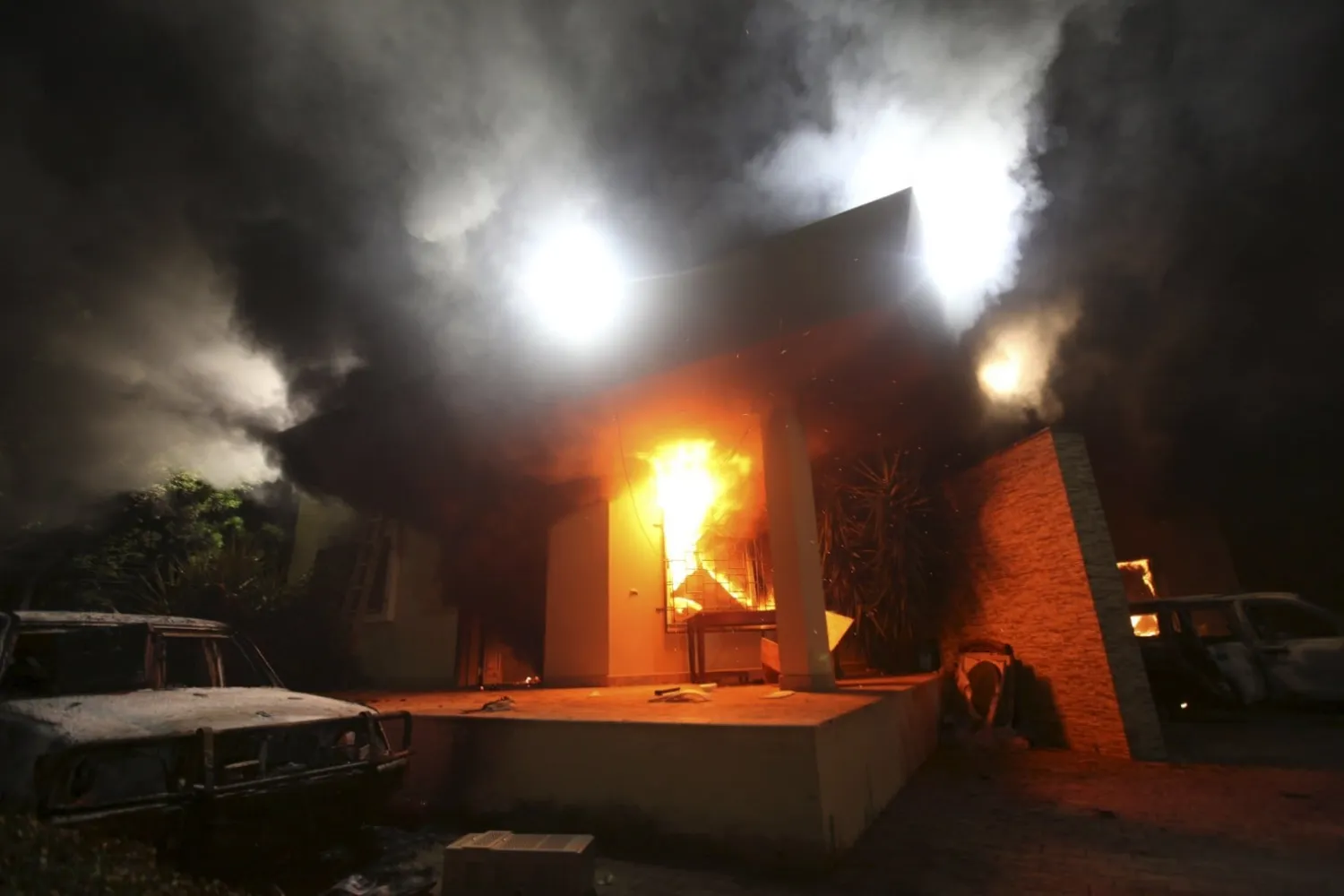

CIA Officers Detail Part of Benghazi Attack at Abu Khattala’s Trial

The US Consulate in Benghazi is seen in flames in the 2012 attack. (Esam Al-Fetori/Reuters)
TT

CIA Officers Detail Part of Benghazi Attack at Abu Khattala’s Trial

The US Consulate in Benghazi is seen in flames in the 2012 attack. (Esam Al-Fetori/Reuters)

A CIA witness testified Tuesday that the body of US Ambassador J. Christopher Stevens was returned after the September 2012 attacks on US facilities in Benghazi, Libya, only after he overheard Libyan fighters discussing whether to tell Americans about a dead compatriot at a hospital.

Appearing under false names and in wigs or a mustache because their identities remain classified, two active CIA employees gave gripping accounts at the trial of the accused mastermind of the attacks about the chaotic, at times haphazard US response to the bloody assault on Sept. 11 and 12, 2012, that killed Stevens and three other Americans at a US special diplomatic mission and nearby CIA Annex.

The two witnesses said they used $30,000 in cash to arrange a one-hour, midnight flight for six US security operatives to go from Tripoli to reinforce Benghazi in the immediate aftermath of the attacks. There, they waited — futilely — for an armed escort of Libyan special forces personnel who were supposed to take them from the Benghazi airport to the CIA annex. In the end, one testified, he offered $1,000 to Libyan ambulance drivers for a litter to carry Stevens’s body aboard a Libyan Air Force C-130 aircraft evacuating the American dead and surviving security officers.

The drivers offered the litter — and declined to accept payment for the courtesy.

The testimony by “Alexander Charles” and “Roy Edwards,” an Arabic-speaking CIA operations support manager and the CIA’s team leader for security in Libya, respectively, continued several days of emotionally powerful appearances by witnesses put on by federal prosecutors in Washington with the US attorney’s office of the District.

The testimony in the case has yet to lay out for jurors the strong evidence prosecutors have asserted in filings and in opening statements that they have tying Ahmed Abu Khattala, 46, to the attacks.

Abu Khattala is a Libyan national who led a brigade of the Ansar al-Sharia militia that the United States designated a terrorist organization and holds responsible for the Benghazi attacks. He was captured in a June 2014 raid by US Special Operations forces and faces life in prison if convicted in a trial that began Oct. 2.

Abu Khattala has pleaded not guilty to 18 charges including conspiracy to support terrorism, murder, attempted murder and damaging US acilities.

The courtroom was closed for security reasons during the CIA officers’ testimony Tuesday, and images from the witness stand were blacked out on video streamed to an observation room for journalists. Live audio of their testimony was streamed into ancillary rooms where journalists and other observers could listen.

Charles and Edwards, disguised in what the judge called light disguises, testified that US forces on the ground could scarcely tell friend from foe among rival militia groups, and were delayed by conflicting aims of keeping a low profile while still moving in force to avoid being ambushed and needing rescuing themselves.

After the CIA’s chief of station in Tripoli tried in vain to get help from the Libyan ministries of defense and interior and the intelligence service for a flight to Benghazi after the attack began at 9:40 p.m. on Sept. 11, 2012, Charles reached out to a Libyan charter flight provider he had met earlier that same day.

Edwards, who worked for the CIA’s secret contract security force called the Global Response Staff, said the team of four GRS officers, Charles, and two US military operatives arrived at the Benghazi airport before 1 a.m., shortly after the assault on the annex had started, but was stranded because the Libyan military unit they expected to be waiting to drive them to the annex did not show, triggering hours of negotiations and phone calls.

“Obviously nothing worked, because we were on the ground for approximately three hours,” said Charles, who said he worked 30 years with the US government or with the CIA.

Edwards said the CIA team was directed to retrieve a wounded Westerner reportedly at a Benghazi hospital who possibly could be Stevens.

Later, however, the team received a report that the person was dead, and the CIA station chief in Tripoli told the team to move on the annex, which had already repelled two ground attacks, Edwards testified.

A leader of a Benghazi-based militia at the airport had refused to take the CIA team members to the hospital, possibly for their own safety, but agreed to take them to the annex, Edwards told jurors.

Within minutes of arriving at the annex, about 5 a.m., “All hell broke loose,” Charles said.

Edwards had asked a key member from Tripoli, a former Navy SEAL commando and medic named Glen “Bub” A. Doherty, to assist other GRS officers on watch on the roof. Doherty wanted to join a GRS friend there, his SEAL school classmate Tyrone S. Woods, Charles said.

Suddenly, a mortar round exploded nearby. Another landed closer, then several hit the roof.

Voice breaking with emotion, Edwards said he raced to the roof, but wearing night-vision goggles, he could not recognize one of the victims until a colleague said, “Bub is dead. Move to other medic.”

The other, Woods, was alive, Edwards testified, but as Edwards pulled him to a ladder to get off the roof, “he expired in that time.” GRS officer Mark Geist and State Department security agent David Ubben were wounded.

Expecting a “final assault to wipe us out,” Edwards said, the Americans evacuated to the airport.

Fate then seemingly stepped in, according to an account from Charles, who said he decided to walk near Libyan revolutionary militiamen guarding them at the airport.

“I don’t know why, maybe it was divine intervention,” Charles said, “I heard two Libyans talking to each other. They said, ‘Should we tell them about this dead American at the hospital?’ ”

Charles said he offered all the money in his backpack for the body, to which the men’s commander said, “ ‘I don’t want your money.’ He said, ‘I’ll see what I can do.’ About 15 minutes later, the body of the ambassador was delivered to the airport.”

The Washington Post


Italy Arrests 7 Accused of Raising Millions for Hamas

Palestinian Hamas members secure the area as Egyptian workers accompanied by members of the International Committee of the Red Cross (ICRC) search for the remains of the last Israeli hostage in the Zeitoun neighborhood of Gaza City on December 8, 2025. (Photo by Omar AL-QATTAA / AFP)
TT

Italy Arrests 7 Accused of Raising Millions for Hamas

Palestinian Hamas members secure the area as Egyptian workers accompanied by members of the International Committee of the Red Cross (ICRC) search for the remains of the last Israeli hostage in the Zeitoun neighborhood of Gaza City on December 8, 2025. (Photo by Omar AL-QATTAA / AFP)

Italian police said Saturday that they have arrested seven people suspected of raising millions of euros for Palestinian group Hamas.

Police also issued international arrests for two others outside the country, said AFP.

Three associations, officially supporting Palestinian civilians but allegedly serving as a front for funding Hamas, are implicated in the investigation, said a police statement.

The nine individuals are accused of having financed approximately seven million euros ($8 million) to "associations based in Gaza, the Palestinian territories, or Israel, owned, controlled, or linked to Hamas."

While the official objective of the three associations was to collect donations "for humanitarian purposes for the Palestinian people," more than 71 percent was earmarked for the direct financing of Hamas" or entities affiliated with the movement, according to police.

Some of the money went to "family members implicated in terrorist attacks," the statement said.

Among those arrested was Mohammad Hannoun, president of the Palestinian Association in Italy, according to media reports.

Interior Minister Matteo Piantedosi posted on X that the operation "lifted the veil on behavior and activities which, pretending to be initiatives in favor of the Palestinian population, concealed support for and participation in terrorist organizations."


Türkiye Holds Military Funeral for Libyan Officers Killed in Plane Crash

The Libyan national flag flies at half-mast in Tripoli on December 24, 2025, after the head of Libya's armed forces and his four aides died in a plane crash in Türkiye. (AFP)
TT

Türkiye Holds Military Funeral for Libyan Officers Killed in Plane Crash

The Libyan national flag flies at half-mast in Tripoli on December 24, 2025, after the head of Libya's armed forces and his four aides died in a plane crash in Türkiye. (AFP)

Türkiye held a military funeral ceremony Saturday morning for five Libyan officers, including western Libya’s military chief, who died in a plane crash earlier this week.

The private jet with Gen. Muhammad Ali Ahmad al-Haddad, four other military officers and three crew members crashed on Tuesday after taking off from Ankara, Türkiye’s capital, killing everyone on board. Libyan officials said the cause of the crash was a technical malfunction on the plane.

Al-Hadad was the top military commander in western Libya and played a crucial role in the ongoing, UN-brokered efforts to unify Libya’s military.

The high-level Libyan delegation was on its way back to Tripoli, Libya’s capital, after holding defense talks in Ankara aimed at boosting military cooperation between the two countries.

Saturday's ceremony was held at 8:00 a.m. local time at the Murted Airfield base, near Ankara, and attended by the Turkish military chief and the defense minister. The five caskets, each wrapped in a Libyan national flag, were then loaded onto a plane to be returned to their home country.

Türkiye’s military chief, Selcuk Bayraktaroglu, was also on the plane headed to Libya, state-run news agency TRT reported.

The bodies recovered from the crash site were kept at the Ankara Forensic Medicine Institute for identification. Justice Minister Yilmaz Tunc told reporters their DNA was compared to family members who joined a 22-person delegation that arrived from Libya after the crash.

Tunc also said Germany was asked to help examine the jet's black boxes as an impartial third party.


Syrian Foreign Ministry: Talks with SDF Have Not Yielded Tangible Results

SDF fighters are seen at a military parade in Qamishli. (Reuters file)
TT

Syrian Foreign Ministry: Talks with SDF Have Not Yielded Tangible Results

SDF fighters are seen at a military parade in Qamishli. (Reuters file)

A source from the Syrian Foreign Ministry said on Friday that the talks with the Kurdish Syrian Democratic Forces (SDF) over their integration into state institutions “have not yielded tangible results.”

Discussions about merging the northeastern institutions into the state remain “hypothetical statements without execution,” it told Syria’s state news agency SANA.

Repeated assertions over Syria’s unity are being contradicted by the reality on the ground in the northeast, where the Kurds hold sway and where administrative, security and military institutions continue to be run separately from the state, it added.

The situation “consolidates the division” instead of addressing it, it warned.

It noted that despite the SDF’s continued highlighting of its dialogue with the Syrian state, these discussions have not led to tangible results.

It seems that the SDF is using this approach to absorb the political pressure on it, said the source. The truth is that there is little actual will to move from discussion to application of the March 10 agreement.

This raises doubts over the SDF’s commitment to the deal, it stressed.

Talk about rapprochement between the state and SDF remains meaningless if the agreement is not implemented on the ground within a specific timeframe, the source remarked.

Furthermore, the continued deployment of armed formations on the ground that are not affiliated with the Syrian army are evidence that progress is not being made.

The persistence of the situation undermines Syria’s sovereignty and hampers efforts to restore stability, it warned.
