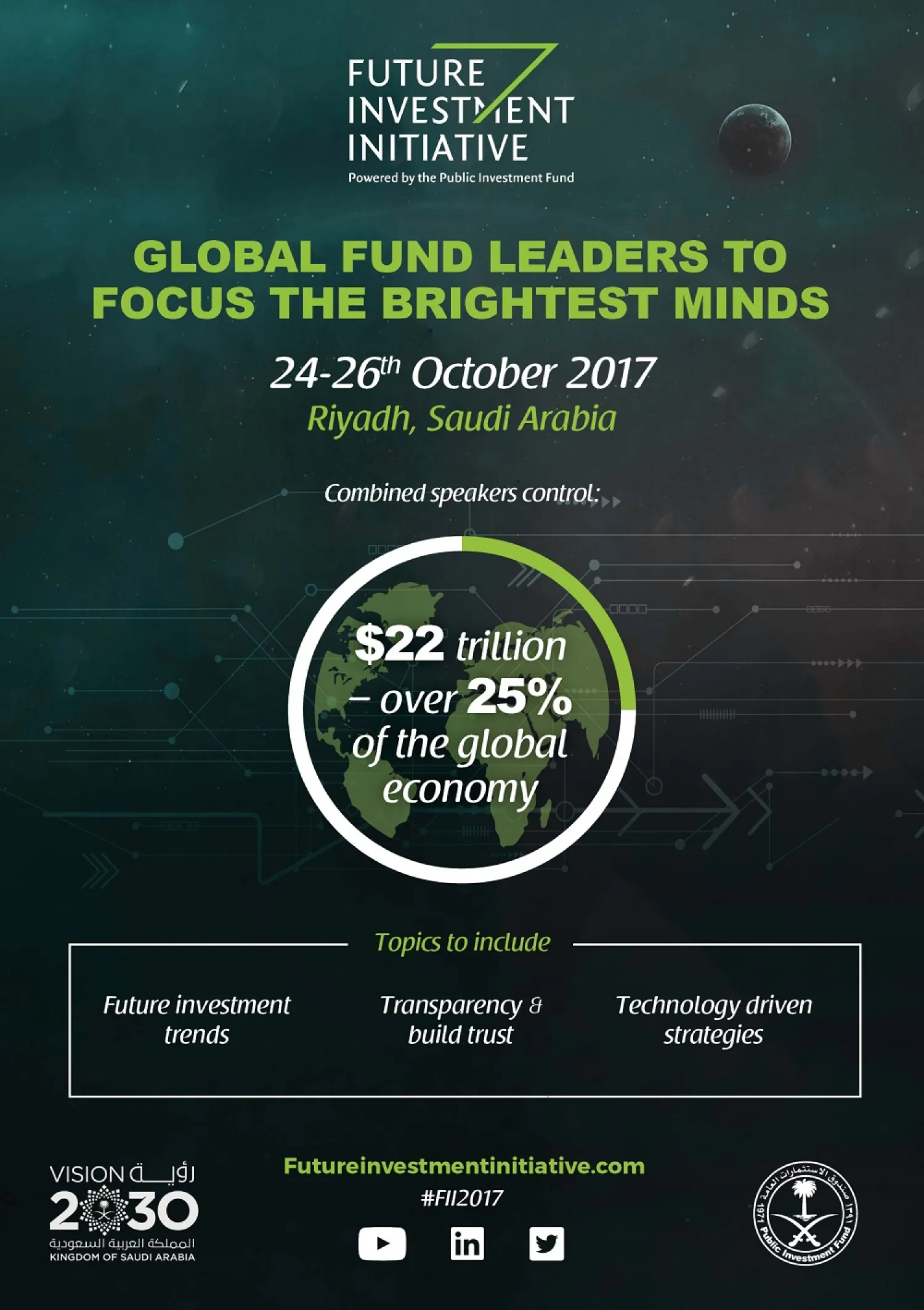
Speakers Controlling $22 Trillion in Asset Value Expected at Saudi Future Investment Initiative

Future Investment Initiative announcement poster.
TT

Speakers Controlling $22 Trillion in Asset Value Expected at Saudi Future Investment Initiative

Future Investment Initiative announcement poster.

Saudi Arabia’s Public Investment Fund (PIF), one of the world’s most important sovereign wealth funds, said that prominent speakers from the investment sector have confirmed tat they will be attending the "Future Investment Initiative.”

Held in Riyadh, throughout October 24-26, the PIF-organized Future Investment Initiative is a pioneering new global investment event that will connect the world’s most powerful investors, business leaders, thought leaders and public officials with groundbreaking innovations defining the future.

According to a Future Investment Initiative press release, major asset managers such as Colony NorthStar Executive Chairman Thomas Barrack, Apollo Global Management Chairman and CEO Leon Black, First Eastern Investment Group Chairman and CEO Victor Chu, and BlackRock Chairman and CEO Larry Fink were among the confirmed speakers.

It is estimated that the speakers at Future Investment Initiative control a combined asset value of $22 trillion.

Over the past five years, sovereign wealth funds have significantly increased their exposure to emerging markets, while at the same time moving away from investment in foreign government bonds. While this partly reflects geopolitical instability, it is also a recognition that high yield returns are more readily available in the private sector.

Alternatively, unlisted and private investment portfolios, often in emerging technologies, are becoming increasingly popular with managers. The growth of funds in the Middle East and Asia enables managers from these regions to increasingly drive the global investment agenda.

The highly collaborative and interactive program has been carefully structured to allow investment leaders to discuss a range of topics pertinent to the current and future trends.

The program will also explore how investors can reconcile the demands to consider the environmental, social and governance benefits alongside the traditional returns drivers. Another key focus area will be how to meet transparency requirements and actively build trust with public constituents. Participants will also gain insights directly from global sovereign wealth fund leaders on how they can adapt to new technology driven strategies.

The investment themes have been developed through three key content pillars: Shifting centers of power; the new investment paradigm; and innovation for a better world.

The Future Investment Initiative will be hosted under the patronage of Custodian of the Two Holy Mosques King Salman bin Abdulaziz, and under the leadership of Crown Prince Mohammed bin Salman, who is also the Chairman of PIF’s board.

Asset managers speaking at the Future Investment Initiative will be joined by speakers represent a range of sovereign wealth funds and pension funds including: Russian Direct Investment Fund CEO Kirill Dmitriev and Khazanah Nasional Berhad Malaysia Director and CEO Azman Mokhtar.

Leading GCC sovereign wealth funds will also be represented.


Lucid Gets Crucial $1.75 Billion Liquidity Boost From PIF

A Lucid Air Grand Touring electric car is displayed during the New York International Auto Show in New York City, US, April 1, 2026. REUTERS/Jeenah Moon/File Photo 
TT

Lucid Gets Crucial $1.75 Billion Liquidity Boost From PIF

A Lucid Air Grand Touring electric car is displayed during the New York International Auto Show in New York City, US, April 1, 2026. REUTERS/Jeenah Moon/File Photo 

Lucid Group, an American electric vehicle (EV) manufacturer, said on Monday a $1.75 billion increase in a loan facility from Saudi Arabia's Public Investment Fund (PIF), its largest investor, would help fund the ‌electric-vehicle maker into the fourth quarter of 2027, according to Reuters.

The larger delayed-draw term loan lifts the company’s pro forma liquidity to $3.75 billion, strengthening new CEO Silvio Napoli's hand as he seeks to turn around the company facing an industry-wide demand weakness following the expiry of a federal ⁠tax credit last year.

Lucid said it expects its liquidity to fund operations until production of its midsize vehicle begins in the second half of 2027.

The company’s shares were down about 5% in extended trading.

Lucid cut its third-quarter cash outflow to $1.04 billion from $1.48 billion in the previous quarter by cutting production, including eliminating a second shift at its Arizona factory and reducing inventory and operating costs.

“These actions are already showing through in Q3, ‌with ⁠free cash flow consumption 30% lower sequentially,” CFO Alexander De Bock said.

Lucid said it would provide 2027 guidance and a mid-term plan with its year-end results. It had withdrawn its annual production forecast earlier this year amid a sweeping operational ⁠review by its newly appointed CEO.

The company said headcount fell about 28% between the first and third quarters. It said it had achieved $800 million of a targeted $1.4 ⁠billion cash flow improvement this year through lower inventory, operating costs and capital spending.

New chief technology, finance, customer and transformation officers joined early in ⁠the third quarter, the company said. Lucid is also cutting management layers and tying incentives to four priority projects.


Saudi Real Estate Market Maintains Investment Momentum Despite War Fallout

Residential developments in Saudi Arabia (Ministry of Municipalities and Housing)
TT

Saudi Real Estate Market Maintains Investment Momentum Despite War Fallout

Residential developments in Saudi Arabia (Ministry of Municipalities and Housing)

Saudi Arabia's real estate market continues to attract investment despite geopolitical challenges weighing on economic activity worldwide, supported by new housing developments and efforts to expand residential supply.

The Ministry of Municipalities and Housing announced that more than 15,000 residential land plots had been made available through the Sakani platform across the Kingdom between the beginning of 2026 and the end of October, alongside additional projects launched by private-sector developers.

The developments underscore the sector's continued momentum and its importance to the Saudi economy.

Government initiatives and private-sector projects aim to expand housing supply and meet growing demand, reinforcing real estate's position as a key driver of economic growth and diversification.

Strong domestic demand and ongoing urban development projects continue to underpin the market's appeal, attracting investment from both Saudi and international investors.

Against a backdrop of geopolitical uncertainty and war-related disruptions to trade, supply chains, financing costs and construction expenses, the real estate sector has gained importance as an industry driven largely by domestic demand and capable of sustaining economic activity.

Private-Sector Investment

Despite mounting global economic volatility and geopolitical tensions, Saudi Arabia's real estate market continues to attract international investment, supported by clear economic policies, expanding development opportunities and strong housing demand.

Real estate developer Arada recently announced its entry into the Saudi market through a partnership with local company XTOPIA, backed by a SAR 50 billion ($13.3 billion) portfolio of land and development opportunities.

The partnership's first project is a SAR 14 billion residential development in Riyadh's Al Rimal district.

Riyadh Region Municipality, the Ministry of Municipalities and Housing, and the National Center for Privatization & PPP also recently announced the launch of the expression of interest, prequalification and proposal submission stages for a joint land investment project.

The initiative involves developing a municipal land plot in northern Riyadh through a 50-year partnership with the private sector, marking the municipality's first project under the joint investment model.

Real estate specialists described the initiative as an important step toward enabling private investors to develop property assets into sustainable projects with significant economic value.

They said the extended investment period would encourage developers to improve construction quality and services, strengthen project feasibility, diversify real estate offerings and increase supply in one of the capital's most expensive neighborhoods.

Balancing the Real Estate Market

The importance of releasing more residential land lies in achieving greater balance in the property market, a government objective outlined by Crown Prince and Prime Minister Mohammed bin Salman.

The strategy seeks to increase housing supply by making more land available, broadening the options accessible to Saudi citizens and enabling more households to move from searching for a home to building and owning one.

Increasing the availability of residential land, particularly in cities and governorates experiencing rising demand, could ease pressure on land prices over the medium term, provided that plot locations and sizes correspond to actual market needs.

The release of additional land also creates opportunities for real estate developers, contractors, engineering firms and building materials suppliers to benefit from anticipated demand for construction projects.

As a result, businesses across the real estate and construction supply chain could see stronger activity despite the impact of the geopolitical crisis on other economic sectors in the region.

The initiative also expands housing choices, supports efforts to increase homeownership rates and improve quality of life, and encourages urban development beyond major metropolitan centers.

Lowering Prices

Real estate developer Ahmed Omar Basoudan believes the main challenge facing Saudi Arabia's property market in the coming period will not simply be increasing the number of land plots and housing units available.

Rather, he said, the priority must be ensuring that homes reach buyers at prices they can afford, while providing adequate infrastructure and services and keeping development and construction costs under control.

Speaking to Asharq Al-Awsat, Basoudan explained that genuine balance in the real estate market depends on the availability of housing that meets buyers' needs in terms of price, location and quality, rather than simply increasing overall supply.

He said the release of more than 15,000 residential land plots during the first 10 months of the year, together with recently announced private-sector projects, reflected the government's continued commitment to expanding housing supply and providing more residential options.

Basoudan stressed that the latest real estate developments represent an important step toward addressing one of the market's most pressing challenges: achieving a sustainable balance between supply and demand, particularly amid the Kingdom's population growth and continued urban expansion.


Saudi Stocks Rebound 0.9%, Recouping Previous Session's Losses

An investor monitors stock market data on a screen at the Saudi Exchange (Tadawul) in Riyadh (Reuters)
TT

Saudi Stocks Rebound 0.9%, Recouping Previous Session's Losses

An investor monitors stock market data on a screen at the Saudi Exchange (Tadawul) in Riyadh (Reuters)

Saudi stocks closed higher on Monday, recovering some of the losses sustained in the previous session as heavyweight shares strengthened and the banking sector advanced.

The benchmark Tadawul All Share Index (TASI) rose 0.90% to close at 10,106 points, gaining 90 points. Total trading value reached approximately SAR 3.5 billion ($933 million).

The index had fallen 0.8% on Sunday amid selling pressure on heavyweight stocks.

Anaam International Holding Group, Fitaihi Holding Group and Raoom were among the session's top gainers, rising between 7% and 9% to close at SAR 11.93, SAR 2.11 and SAR 72.30, respectively.

On the losing side, Almunajem Foods led the declines, shedding 9.20% to SAR 49.94, followed by Saudi Paper Manufacturing Co., which fell 6.18% to SAR 48.88, and Alamar Foods, which dropped 4.63% to SAR 44.06.

At the sector level, banks led the gains, advancing 1.60%, supported by a 2.06% rise in Bank AlJazira shares, which closed at SAR 10.89.