Putin Outlines his Vision for Syria Solution

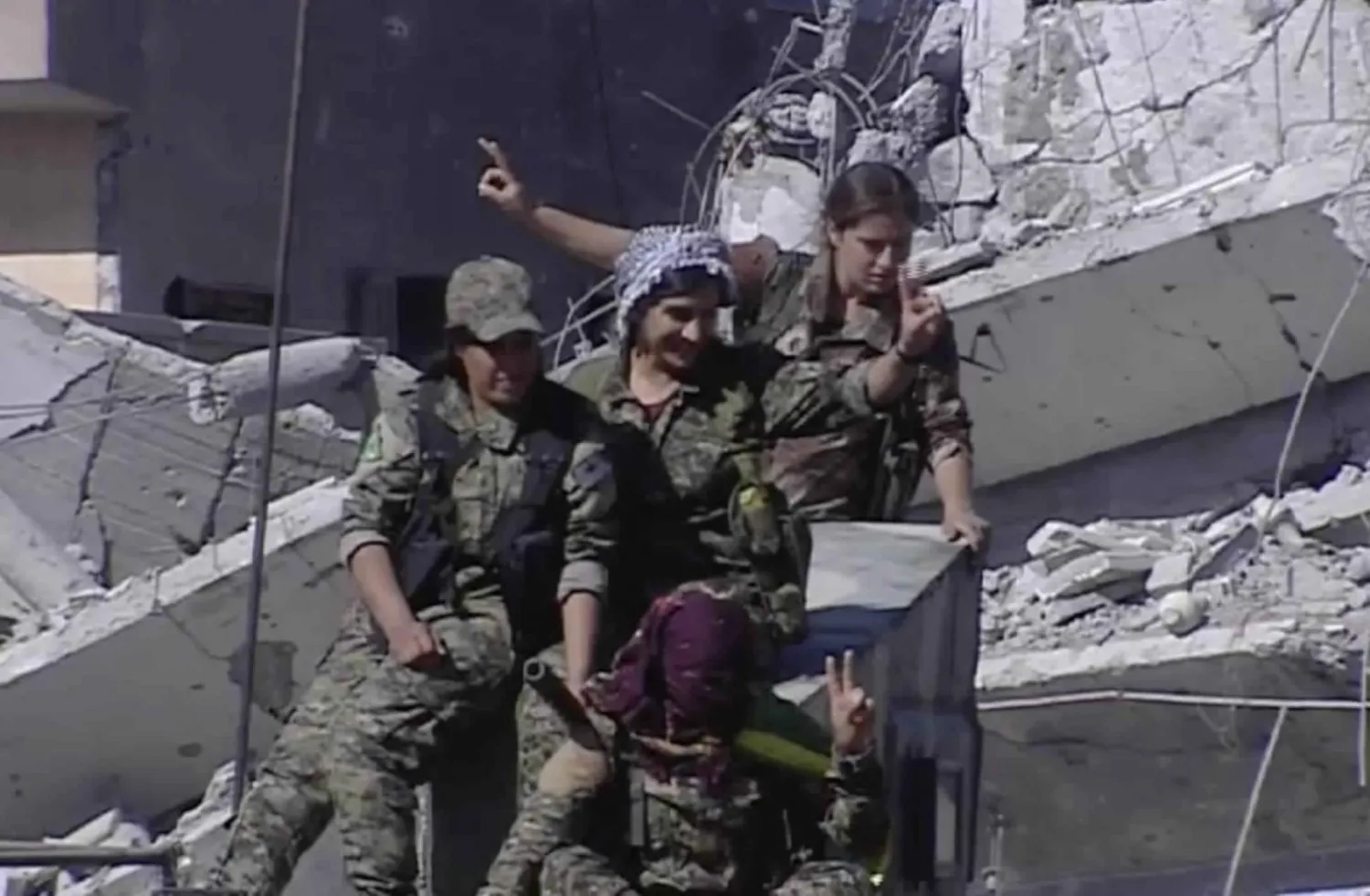
This frame grab from a video released on Thursday, Oct. 19, 2017 provided by Ronahi TV, shows members of the Women’s Protection Units, flashing victory signs as they celebrate the victory against ISIS, in Raqqa, Syria. (Ronahi TV, via AP) (Associated Press)
TT

Putin Outlines his Vision for Syria Solution

This frame grab from a video released on Thursday, Oct. 19, 2017 provided by Ronahi TV, shows members of the Women’s Protection Units, flashing victory signs as they celebrate the victory against ISIS, in Raqqa, Syria. (Ronahi TV, via AP) (Associated Press)

Russian President Vladimir Putin uncovered on Thursday his vision regarding a political solution in Syria, proposing a congress bringing together representatives of all ethnic groups in Syria following the establishment of de-escalation zones.

Speaking at the Valdai Discussion Club held in Sochi Thursday, Putin said: “There is an initiative to set up a congress of the Syrian peoples, involving all the ethnic and religious groups, as well as the government and opposition.”

“If this is done with the support of the guarantor countries, such as Saudi Arabia and Egypt, it would mark the next step on the way to finding a political solution and drawing up a new constitution, but it is too early to talk about that,” the president added.

Putin also expressed concern that the setup of de-escalation zones may lead to Syria’s division, hoping that cooperation between all forces in the country would prevent it.

The Russian president said he was also concerned of the complicated dialogue between the Syrian regime and opposition.

“There are grounds to expect, and I’d be cautious, that we will soon finish off the terrorists in Syria, but this is not the reason yet to be glad and think that they have been eliminated once and for all," he added.

Meanwhile, the Syrian Democratic Forces (SDF) retained on Thursday full control over the city of Raqqa.

The Women’s Protection Units, which is affiliated to the People's Protection Units (YPG), organized on Thursday a military parade in Raqqa’s Al-Naim Square, where they raised a portrait of Abdullah Ocalan, leader of the Kurdistan Workers' Party (PKK), considered a terrorist organization by Turkey.

Meanwhile, Raqqa is getting prepared to be handed over to a civilian authority.

Separately, the Israeli Army shelled on Thursday Syrian regime positions in Quneitra in the Golan Heights.


Israel’s Zamir: Lebanon is the Main Combat Arena

First responders gather at the site of an Israeli airstrike in the village of Habbouch, southern Lebanon on April 10, 2026. (Photo by Abbas FAKIH / AFP)
TT

Israel’s Zamir: Lebanon is the Main Combat Arena

First responders gather at the site of an Israeli airstrike in the village of Habbouch, southern Lebanon on April 10, 2026. (Photo by Abbas FAKIH / AFP)

The head of Israel’s military, Lt. Gen. Eyal Zamir, has said that the “main combat arena is in Lebanon.”

The mission is to keep weakening Hezbollah, Zamir said.

He was speaking on Thursday to Israeli troops inside Lebanon, on the outskirts of the town of Bint Jbeil.

“Our main combat arena is here in Lebanon,” he stated.

Zamir said the army’s mission is to “continue deepening the damage and to continue weakening Hezbollah.”

He added that the objective is to remove the direct threat to residents of northern Israel.

Israeli Prime Minister Benjamin Netanyahu has offered a potential boost to ceasefire efforts in the region when saying he had approved direct talks with Lebanon.

The announcement came after Israel’s pounding of Beirut Wednesday killed more than 300 people. The negotiations are expected next week in Washington.


Macron Meets Pope Leo to Talk Lebanon, Middle East War

 French President Emmanuel Macron and his wife Brigitte Macron are welcomed as they arrive at the San Damaso courtyard to meet Pope Leo XIV at the Vatican, April 10, 2026. (Reuters)
French President Emmanuel Macron and his wife Brigitte Macron are welcomed as they arrive at the San Damaso courtyard to meet Pope Leo XIV at the Vatican, April 10, 2026. (Reuters)
TT

Macron Meets Pope Leo to Talk Lebanon, Middle East War

 French President Emmanuel Macron and his wife Brigitte Macron are welcomed as they arrive at the San Damaso courtyard to meet Pope Leo XIV at the Vatican, April 10, 2026. (Reuters)
French President Emmanuel Macron and his wife Brigitte Macron are welcomed as they arrive at the San Damaso courtyard to meet Pope Leo XIV at the Vatican, April 10, 2026. (Reuters)

French President Emmanuel Macron arrived Friday at the Vatican for his first meeting with Pope Leo XIV, a private audience expected to be dominated by the Iran war.

The French leader, who arrived with his wife Brigitte after flying to Rome on Thursday, will meet the US pontiff and the Vatican's secretary of state, Pietro Parolin.

Macron and the leader of the world's 1.4 billion Catholics were due above all to discuss "the resolution of the crisis in the Middle East", a spokesman for Macron's office told reporters.

They are particularly focused on Lebanon, where deadly Israeli strikes threatened this week's temporary truce between the US and Iran.

Leo XIV visited Lebanon late last year as part of his first trip abroad, which also included Türkiye, and has repeatedly prayed for the victims of conflict there.

Macron has also made numerous appeals for Lebanon to be included in the ceasefire.

He discussed the conflict on Thursday evening with representatives of the Catholic community of Sant'Egidio, an informal diplomatic channel of the Holy See that is very active on Middle Eastern and humanitarian issues.

"Macron is a man of peace," and "can do a lot" to "support" the Lebanese authorities, the community's founder, Andrea Riccardi, told reporters, adding that Lebanon "must not be left alone".

In recent days, both Macron and the Chicago-born pontiff have spoken out against US President Donald Trump over the war, which began with Israel-US attacks on Iran.

Leo condemned as "unacceptable" threats to civilian targets -- while not citing Trump by name -- while Macron said there was "too much talk, and it's all over the place".

Both welcomed the truce and have urged a diplomatic solution to the war, which has expanded across the Middle East and roiled the global economy.

The US government on Thursday denied a report that the Vatican's US envoy was summoned in January for a "bitter" dressing down over a speech by the pope condemning "diplomacy based on force", in remarks widely viewed as aimed at the Trump administration.

Macron is expected to invite Leo, a more reserved character than his predecessor, to visit France soon.

Friday's meeting at the Vatican comes three days before the pope's visit to the former French colony of Algeria, the first ever by a pontiff.


World Food Program Warns Lebanon Facing Food Security Crisis Due to Iran War

Volunteers carry World Food Program (WFP) boxes of aid supplies in a school-turned-shelter in Beirut, following an escalation between Hezbollah and Israel amid the US-Israeli conflict with Iran, Lebanon, March 12, 2026. REUTERS/Mohamed Azakir
TT

World Food Program Warns Lebanon Facing Food Security Crisis Due to Iran War

Volunteers carry World Food Program (WFP) boxes of aid supplies in a school-turned-shelter in Beirut, following an escalation between Hezbollah and Israel amid the US-Israeli conflict with Iran, Lebanon, March 12, 2026. REUTERS/Mohamed Azakir

Lebanon is facing a food security crisis as the Iran war disrupts supplies of goods inside the country, the United Nations World Food Program said on Friday. 

A fragile two-day-old ceasefire has halted the campaign of US and Israeli airstrikes on Iran, but it has not so far calmed a parallel war waged by Israel against Iran's Hezbollah allies in Lebanon. 

"What we're witnessing is not just a displacement crisis, it is rapidly becoming a ‌food security ‌crisis," said World Food Program country director Allison ‌Oman, ⁠speaking via video ⁠link from Beirut. 

She warned that food was becoming increasingly unaffordable due to rising prices and demand among displaced families. 

PRICE OF VEGETABLES HAS SOARD 

The price of vegetables has soared by more than 20% and bread prices have increased by 17% since March 2, the WFP said. 

"What we're now seeing is ⁠a very worrying combination: prices are rising, incomes ‌are disrupted and demand is increasing ‌as displacement continues for many families," Oman stated. 

Lebanon faces a two-layered ‌crisis, in which some markets have fully collapsed - especially in ‌the south, where more than 80% of markets are no longer functioning - while those in Beirut are under increasing strain, Oman said. 

Many traders in conflict-affected areas in southern parts of Lebanon are reporting ‌less than one week of essential food stocks remaining, she added. 

The ability to deliver food ⁠aid into ⁠hard-to-reach areas in the south, which has faced heavy bombardment by Israeli airstrikes since March 2, was becoming increasingly difficult. 

While the Qasmiyeh bridge, which was previously struck, is now operational, movement remains difficult. Ten WFP convoys have reached the south to provide aid to some of the estimate 50,000 to 150,000 in need of humanitarian support in that part of the country. 

"This escalation is pushing vulnerable communities even closer to the edge," said Oman, adding that, due to this latest escalation, about 900,000 people across Lebanon were facing food insecurity - a number that was set to rise.