


The Decline of Holland's Football Team: Doomed by Total Obsession with Past

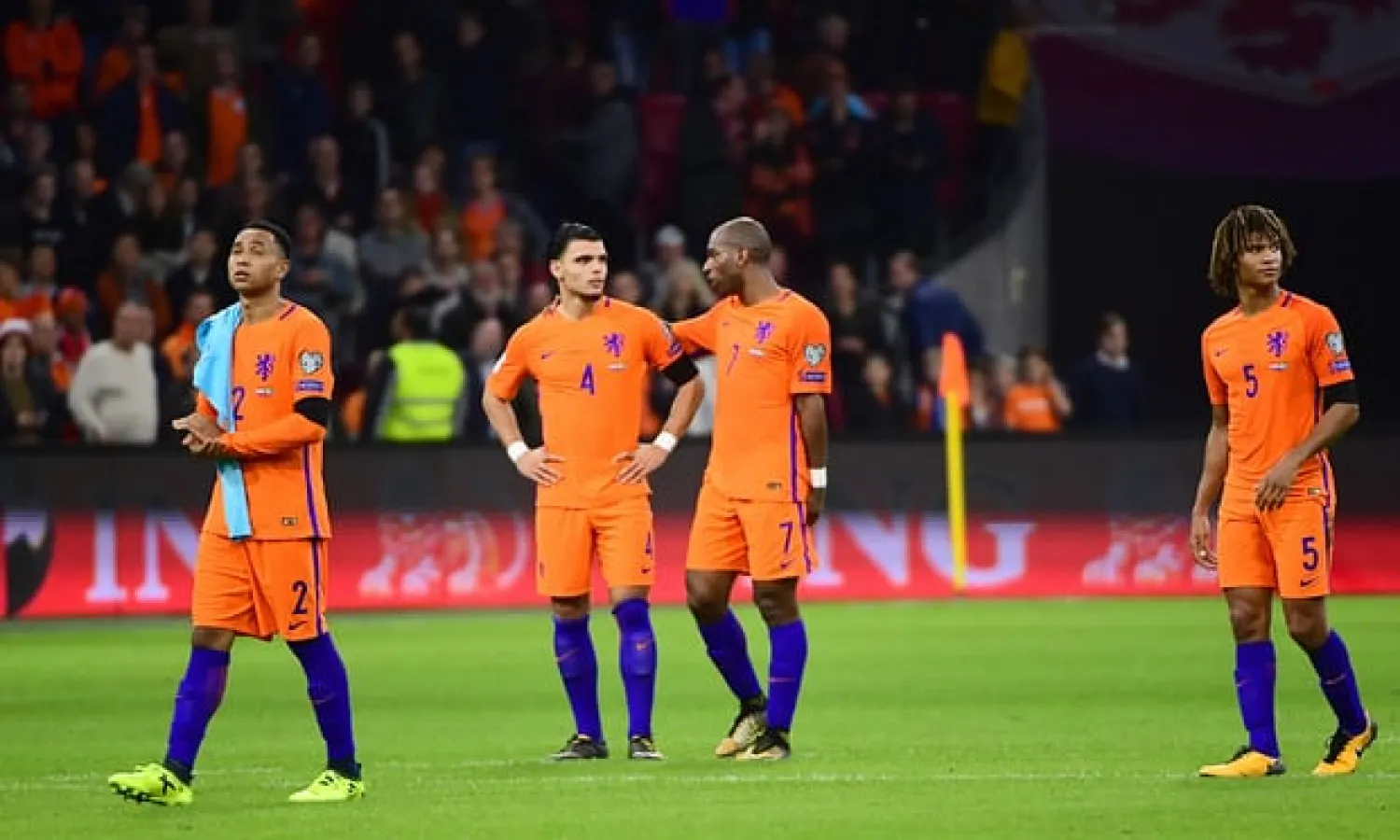
 The Holland players react to the disappointment of failing to qualify for their second major football tournament in a row. Photograph: Emmanuel Dunand/AFP/Getty Images
The Holland players react to the disappointment of failing to qualify for their second major football tournament in a row. Photograph: Emmanuel Dunand/AFP/Getty Images
TT

The Decline of Holland's Football Team: Doomed by Total Obsession with Past

 The Holland players react to the disappointment of failing to qualify for their second major football tournament in a row. Photograph: Emmanuel Dunand/AFP/Getty Images
The Holland players react to the disappointment of failing to qualify for their second major football tournament in a row. Photograph: Emmanuel Dunand/AFP/Getty Images

In Graham Swift’s novel Waterland his narrator, a history teacher going through a mid-life crisis, says: “And where history does not undermine and set traps for itself in such an openly perverse way, it creates this insidious longing to revert. It begets this bastard but pampered child, Nostalgia. How we yearn to return to that time before history claimed us, before things went wrong.”

At some point analysis of decline becomes an ordeal, particularly when the causative factors seem numerous and varied and not independent of one another. Nostalgia lends itself to convenient explanations of why things are not as good as they were, which may overshadow the fact it is perhaps more important that one looks back to move forward and not vice versa. Dutch football has seen four talented generations of players, right from Cruyff and Van Hanegem’s cohort in the 70s, Gullit, Rijkaard, Van Basten and Koeman in the 80s, Bergkamp’s batch in the 90s and the 1983-84-born class of the 00s led by Arjen Robben and Wesley Sneijder.

In the wake of failing to qualify for next year’s World Cup finals in Russia Dutch footballers are now criticised for a lack of “winning mentality”. Marcel Brands of PSV, in a discussion in 2014 with his fellow technical directors of the so-called big three, Marc Overmars of Ajax and Feyenoord’s Martin van Geel, remarked: “We develop many intelligent, tactically strong players. We just need to improve substantially in the winning factor. I went to Portugal recently: Sporting, Benfica and Porto. There it is completely different. There it is all about winning. With us, it’s the exact opposite: ‘80% possession, played well, yes but we lose 1-0.’

“That’s not how it should be. If you look at Germany, they have taken a step. There was always physical football, a lot of running. Now, there is a lot more [technical] football than 10 years ago. They also observed us [the Dutch] a lot.”

Tellingly, nearly all of the successful recent exports from the Eredivisie have been players who were scouted between the ages of 16 and 19 – Uruguay’s Luis Suárez, Denmark’s Christian Eriksen and Belgium’s Toby Alderweireld found the Netherlands a prime location to hone their talent, having developed initially elsewhere. But even if the current Holland side lacked extraordinary talents, there was sufficient quality for them at least to make the qualification play-offs. That suggests there are deeper structural problems with the national team. It is clearly more complicated than just Memphis Depay’s preference for wearing hats.

In 2014 all the big three’s technical directors agreed that the KNVB, the Dutch FA, needed a strong technical director. Jelle Goes had functioned as “technical manager” since 2013 and played a big role in drafting the Winnaars van Morgen, “Winners of Tomorrow”, plan for reviving Dutch football; and, when Hans van Breukelen was made technical director in 2016, Goes’ focus shifted to youth.

However, this summer both Goes and Van Breukelen left their roles, with the latter resigning, having made a mess of the national coach situation after Danny Blind’s departure and saying he had not been able to make “his – and the KNVB’s — ambitions come true”.

The KNVB’s lack of a clear long-term vision seemed evident as they let Hakim Ziyech slip through their fingers. The 24-year-old, who played for Dutch youth teams up to the under-21s and was the outstanding Dutch midfielder of his generation, was injured on his first call-up in May 2015 and could not play, but then seemed to be overlooked. He then elected to represent Morocco, making his debut in October 2015.

In March 2016 Blind was asked why there had not been more of an effort to tie down Ziyech. The then Holland manager responded with the specious excuse that Ziyech was not playing as a “true No10” at Twente at the time but as more of a second striker. Immediately his then-assistant coach, Marco van Basten, sitting at the back of the room, turned to the reporter who had suggested the KNVB had failed in this regard and said: “Why? He has gone with the choice with his heart? Then, in my opinion, you should ask him.”

In May 2016 Van Basten called Ziyech and the St-Etienne winger Oussama Tannane “stupid boys” for not having the patience to wait for their chance: “How stupid can you be to choose Morocco if you are in contention for the Dutch national team?”

This, beyond the disrespect, suggests some delusions of grandeur and superiority persist despite Holland’s shortcomings on the pitch. Nearly two years later another young talent – Sofyan Amrabat –is set to follow Ziyech. He still has a chance of playing at the World Cup finals with Morocco, while the Dutch must watch a second consecutive international tournament on their TV screens, still lacking direction in their long-term planning as well as a player worthy of building a new side around.

The way in which Van Basten expressed his view is indicative of the way dynamics can shift when there are many big personalities vying for influence. For the Dutch this is not a new phenomenon. In 1981, as Ajax trailed Twente 2-3 at De Meer, Johan Cruyff, then in a vague directorial role, made his way from the stands to the bench and propped himself beside the coach, Leo Beenhakker, shouting instructions and making tactical changes. In 2004, when Ronald Koeman was manager of Ajax, Louis van Gaal, then technical director, used to sit on the sidelines and commentate on training sessions.

Recently Ruud Gullit, assistant coach to Dick Advocaat, recorded a video for his Twitter feed in the Holland dressing room. Advocaat was unaware of and unhappy with the breach of protocol, yet Gullit was excused. Less than a month later Advocaat suggested Gullit would be his ideal successor because of the way the France players seemed to approach him in reverence at full-time, after they had easily defeated Holland 4-0 in September. “The Netherlands really forgets what a great Gullit is,” said Advocaat. There is bias in choosing to remember the great player – but not the fairly mediocre manager.

Robert Maaskant, who has managed NAC Breda and Willem II, pertinently told De Volkskrant in August: “When I started as a trainer, I thought: ‘I did not have a great career as a player, so I need to get into [management] early. Because between the ages of 42 and 50, all those former internationals [Frank de Boer, Phillip Cocu, Giovanni van Bronckhorst] will start to get involved, and they will get the best jobs first.’ But the lead I had, ultimately led to nothing more. Because experience is no longer as important.

“It started with Marco van Basten’s appointment as Holland coach, without any experience. Since then you do not ‘build’ a career in Dutch football any more: it will ‘happen’ to you.”

Peter Bosz, now at Borussia Dortmund, is a Dutch rarity in breaking that ceiling in recent years but seemed to be swiftly pushed out by the powers that be at Ajax. So a picture emerges of an insular, constricted group of coaches who are granted opportunities with little or no coaching experience. Most share a common idea of possession-based 4‑3‑3 football, which makes Dutch teams predictable while other nations have either bettered 4-3-3 or moved on.

The most successful exponents of the “Dutch” style are no longer Dutch, and given there is little to lose now, perhaps a step in the right direction would be to experiment with appointing a foreign coach. The last one – the Austrian Ernst Happel – did not fare too badly.

Dutch football has always been a battleground of “philosophy” and winning football matches in the somewhat arbitrary “right” way over just winning. That there was still pride in losing the 1974 World Cup final to West Germany – when Cruyff’s talented side squandered a one-goal lead to their greatest rivals in Munich – seemed to set forth the belief that results were, to an extent, expendable in the pursuit of the ideal of total football.

Now, in the friction between the nostalgia for their great footballing innovations of the past and the reality of being surpassed in tactical relevance today, the Dutch seem to have lost their standing and ended up compromising on both the style for which they were renowned and the results they fail to achieve.

In retrospect their shock 5-1 drubbing of Spain at the 2014 World Cup finals in Brazil signified a strange fork-in-the-road of a game, in which the defending champions had fallen into a predictable rhythm and the team who had lost the 2010 final seemed to be one step ahead. But Spain have recovered while the Dutch have regressed because that is where the insidiousness of nostalgia can lead – to regression, in the assumption that to achieve glory in the future we need to “go back” and recreate a past that has long been lost. Clearly Holland and Dutch football must now look to the future instead.

The Guardian Sport


Salah Steers Egypt into Africa Cup Knockout Stages After VAR Denies South Africa Late Penalty

 Egypt's forward #10 Mohamed Salah shoots from the penalty spot to score the team's first goal during the Africa Cup of Nations (CAN) Group B football match between Egypt and South Africa at Adrar Stadium in Agadir on December 26, 2025. (AFP)
Egypt's forward #10 Mohamed Salah shoots from the penalty spot to score the team's first goal during the Africa Cup of Nations (CAN) Group B football match between Egypt and South Africa at Adrar Stadium in Agadir on December 26, 2025. (AFP)
TT

Salah Steers Egypt into Africa Cup Knockout Stages After VAR Denies South Africa Late Penalty

 Egypt's forward #10 Mohamed Salah shoots from the penalty spot to score the team's first goal during the Africa Cup of Nations (CAN) Group B football match between Egypt and South Africa at Adrar Stadium in Agadir on December 26, 2025. (AFP)
Egypt's forward #10 Mohamed Salah shoots from the penalty spot to score the team's first goal during the Africa Cup of Nations (CAN) Group B football match between Egypt and South Africa at Adrar Stadium in Agadir on December 26, 2025. (AFP)

Mohamed Salah scored again on Friday as Egypt's 10 men held on to beat South Africa 1-0 to reach the knockout stages of the Africa Cup of Nations.

Salah, who secured the Pharaohs’ opening win with a stoppage-time strike against Zimbabwe on Monday, did it again in Agadir and his penalty before the break secured progression from Group B.

But South Africa should arguably have been given a penalty in stoppage time when Yasser Ibrahim blocked a shot with his arm. After a long delay, the referee decided against awarding the spot kick after consulting video replays and Ibrahim sank to the ground in relief.

“We didn’t have much luck. We also had several refereeing decisions go against us,” South Africa coach Hugo Broos said.

Salah converted his penalty after he was struck in the face by the hand of the retreating South Africa forward Lyle Foster. Salah showed no ill effects from the blow and sent his shot straight down the middle while goalkeeper Ronwen Williams dived to his right.

There was still time before the break for Egypt defender Mohamed Hany to get sent off, after receiving a second yellow card for a foul on Teboho Mokoena.

Goalkeeper Mohamed El Shenawy was Egypt’s key player in the second half.

“We gave our all in this match right until the end, and we also hope for the best for what comes next,” the 37-year-old El Shenawy said.

Earlier, Angola and Zimbabwe drew 1-1 in the other group game, a result that suited neither side after opening losses.

Egypt leads with 6 points from two games followed by South Africa on 3. Angola and Zimbabwe have a point each. The top two progress from each group, along with the best third-place finishers.

Zambia drew 1-1 with Comoros in the early Group A fixture after both lost their opening games, meaning the winner of the late match could be sure of progressing.


Draper to Miss Australian Open Due to Injury

 Jack Draper, of Great Britain, reacts after defeating Federico Agustin Gomez, of Argentina, during the first round of the US Open tennis championships, Aug. 25, 2025, in New York. (AP)
Jack Draper, of Great Britain, reacts after defeating Federico Agustin Gomez, of Argentina, during the first round of the US Open tennis championships, Aug. 25, 2025, in New York. (AP)
TT

Draper to Miss Australian Open Due to Injury

 Jack Draper, of Great Britain, reacts after defeating Federico Agustin Gomez, of Argentina, during the first round of the US Open tennis championships, Aug. 25, 2025, in New York. (AP)
Jack Draper, of Great Britain, reacts after defeating Federico Agustin Gomez, of Argentina, during the first round of the US Open tennis championships, Aug. 25, 2025, in New York. (AP)

Briton Jack Draper said on Friday he will not compete in next month's Australian Open, citing ongoing recovery from an injury.

Draper, 10th in the world rankings, was forced to withdraw from the second round of ‌the US Open ‌in August ‌due ⁠to bone ‌bruising in his left arm.

"Unfortunately, me and my team have decided not to head out to Australia this year. It's a really, ⁠really tough decision," the British ‌number one said in ‍a video ‍posted on X.

The 24-year-old ‍is targeting a February return alongside preparation for the defense of his Indian Wells title in March.

"This injury has been the most difficult ⁠and complex of my career," Draper added. "It's weird, it always seems to make me more resilient. I'm looking forward to getting back out there in 2026 and competing."

The Australian Open begins on January 18 in ‌Melbourne.


Morocco Forced to Wait for AFCON Knockout Place After Mali Draw

Football - CAF Africa Cup of Nations - Morocco 2025 - Group A - Morocco v Mali - Prince Moulay Abdellah Stadium, Rabat, Morocco - December 26, 2025 Morocco's Ismael Saibari reacts after Mali's Lassine Sinayoko scored their first goal. (Reuters)
TT

Morocco Forced to Wait for AFCON Knockout Place After Mali Draw

Football - CAF Africa Cup of Nations - Morocco 2025 - Group A - Morocco v Mali - Prince Moulay Abdellah Stadium, Rabat, Morocco - December 26, 2025 Morocco's Ismael Saibari reacts after Mali's Lassine Sinayoko scored their first goal. (Reuters)

Morocco missed the chance to guarantee their spot in the last 16 of the Africa Cup of Nations after Lassine Sinayoko's second-half penalty earned Mali a 1-1 draw with the hosts on Friday.

The match was a tale of two spot-kicks, with Brahim Diaz giving Morocco the lead from a penalty deep in first-half injury time and Sinayoko replying on 64 minutes.

The stalemate at the Prince Moulay Abdellah Stadium in the capital Rabat ended Morocco's world record winning run which had been taken to 19 matches with their 2-0 victory over Comoros in the tournament's opening game.

It also means Morocco have not yet confirmed their place in the knockout phase, although they are on top of Group A with four points from two games.

Mali come next on two points alongside Zambia, who drew 0-0 with minnows Comoros earlier in Casablanca.

Morocco next face Zambia on Monday and a victory in that match against the 2012 champions will ensure that the hosts go through as group winners.

"We'll look back at the second half and see what the problem was but we didn't play the way we did in the first half. We didn't impose our game and had to drop off. The penalty changed the game a bit," Morocco midfielder Azzedine Ounahi told broadcaster beIN Sports.

"We go into the third game with the same approach, to win the game and finish top of the group."

Morocco captain Achraf Hakimi, the African player of the year, was again an unused substitute as he continues his recovery from an ankle injury suffered playing for Paris Saint-Germain at the start of November.

- Mbappe watches on -

His former PSG teammate Kylian Mbappe, the current Real Madrid superstar and France skipper, was among the spectators in the crowd of 63,844 and appeared to be wearing a Morocco shirt with Hakimi's number two on it.

With Hakimi on the sidelines, Mbappe's Real Madrid teammate Diaz was the main attraction on the pitch -- the little number 10 forced a good save from Mali goalkeeper Djigui Diarra on 17 minutes and then played a key part in the penalty which led to the opening goal just before the interval.

Mali defender Nathan Gassama brushed the ball with his hand as he tried to stop Diaz dribbling past him inside the box, and the referee eventually awarded a spot-kick following a lengthy look at the pitchside VAR monitor.

Morocco's Soufiane Rahimi had a spot-kick saved against Comoros but this time Diaz sent the goalkeeper the wrong way for his second goal of the tournament.

However, Walid Regragui's side, the best team in Africa according to the FIFA rankings, could not build on that as Mali won a penalty of their own just after the hour mark.

Sinayoko went down under a clumsy challenge by Jawad El Yamiq and 29-year-old Cameroonian referee Abdoul Abdel Mefire awarded the penalty after eventually being called over to check his screen.

Auxerre striker Sinayoko, having been booked apparently for something he said to the referee, kept his cool to stroke in the reward and restore parity.

Morocco substitute Youssef En-Nesyri was denied by a good Diarra save and Mali then held on through 10 minutes of stoppage time for a point, as the final whistle was greeted with jeers from the home fans.
