


The Decline of Holland's Football Team: Doomed by Total Obsession with Past

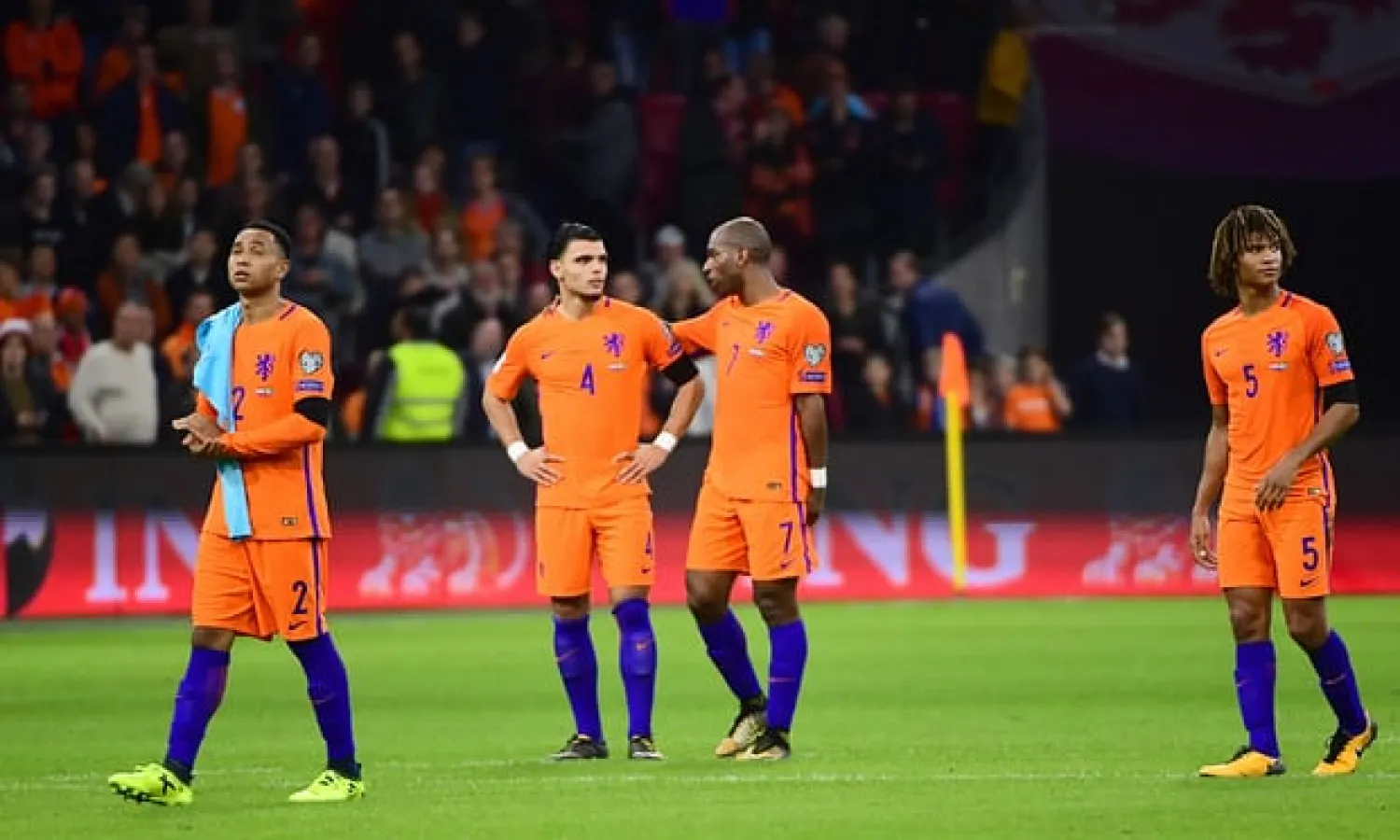
 The Holland players react to the disappointment of failing to qualify for their second major football tournament in a row. Photograph: Emmanuel Dunand/AFP/Getty Images
The Holland players react to the disappointment of failing to qualify for their second major football tournament in a row. Photograph: Emmanuel Dunand/AFP/Getty Images
TT

The Decline of Holland's Football Team: Doomed by Total Obsession with Past

 The Holland players react to the disappointment of failing to qualify for their second major football tournament in a row. Photograph: Emmanuel Dunand/AFP/Getty Images
The Holland players react to the disappointment of failing to qualify for their second major football tournament in a row. Photograph: Emmanuel Dunand/AFP/Getty Images

In Graham Swift’s novel Waterland his narrator, a history teacher going through a mid-life crisis, says: “And where history does not undermine and set traps for itself in such an openly perverse way, it creates this insidious longing to revert. It begets this bastard but pampered child, Nostalgia. How we yearn to return to that time before history claimed us, before things went wrong.”

At some point analysis of decline becomes an ordeal, particularly when the causative factors seem numerous and varied and not independent of one another. Nostalgia lends itself to convenient explanations of why things are not as good as they were, which may overshadow the fact it is perhaps more important that one looks back to move forward and not vice versa. Dutch football has seen four talented generations of players, right from Cruyff and Van Hanegem’s cohort in the 70s, Gullit, Rijkaard, Van Basten and Koeman in the 80s, Bergkamp’s batch in the 90s and the 1983-84-born class of the 00s led by Arjen Robben and Wesley Sneijder.

In the wake of failing to qualify for next year’s World Cup finals in Russia Dutch footballers are now criticised for a lack of “winning mentality”. Marcel Brands of PSV, in a discussion in 2014 with his fellow technical directors of the so-called big three, Marc Overmars of Ajax and Feyenoord’s Martin van Geel, remarked: “We develop many intelligent, tactically strong players. We just need to improve substantially in the winning factor. I went to Portugal recently: Sporting, Benfica and Porto. There it is completely different. There it is all about winning. With us, it’s the exact opposite: ‘80% possession, played well, yes but we lose 1-0.’

“That’s not how it should be. If you look at Germany, they have taken a step. There was always physical football, a lot of running. Now, there is a lot more [technical] football than 10 years ago. They also observed us [the Dutch] a lot.”

Tellingly, nearly all of the successful recent exports from the Eredivisie have been players who were scouted between the ages of 16 and 19 – Uruguay’s Luis Suárez, Denmark’s Christian Eriksen and Belgium’s Toby Alderweireld found the Netherlands a prime location to hone their talent, having developed initially elsewhere. But even if the current Holland side lacked extraordinary talents, there was sufficient quality for them at least to make the qualification play-offs. That suggests there are deeper structural problems with the national team. It is clearly more complicated than just Memphis Depay’s preference for wearing hats.

In 2014 all the big three’s technical directors agreed that the KNVB, the Dutch FA, needed a strong technical director. Jelle Goes had functioned as “technical manager” since 2013 and played a big role in drafting the Winnaars van Morgen, “Winners of Tomorrow”, plan for reviving Dutch football; and, when Hans van Breukelen was made technical director in 2016, Goes’ focus shifted to youth.

However, this summer both Goes and Van Breukelen left their roles, with the latter resigning, having made a mess of the national coach situation after Danny Blind’s departure and saying he had not been able to make “his – and the KNVB’s — ambitions come true”.

The KNVB’s lack of a clear long-term vision seemed evident as they let Hakim Ziyech slip through their fingers. The 24-year-old, who played for Dutch youth teams up to the under-21s and was the outstanding Dutch midfielder of his generation, was injured on his first call-up in May 2015 and could not play, but then seemed to be overlooked. He then elected to represent Morocco, making his debut in October 2015.

In March 2016 Blind was asked why there had not been more of an effort to tie down Ziyech. The then Holland manager responded with the specious excuse that Ziyech was not playing as a “true No10” at Twente at the time but as more of a second striker. Immediately his then-assistant coach, Marco van Basten, sitting at the back of the room, turned to the reporter who had suggested the KNVB had failed in this regard and said: “Why? He has gone with the choice with his heart? Then, in my opinion, you should ask him.”

In May 2016 Van Basten called Ziyech and the St-Etienne winger Oussama Tannane “stupid boys” for not having the patience to wait for their chance: “How stupid can you be to choose Morocco if you are in contention for the Dutch national team?”

This, beyond the disrespect, suggests some delusions of grandeur and superiority persist despite Holland’s shortcomings on the pitch. Nearly two years later another young talent – Sofyan Amrabat –is set to follow Ziyech. He still has a chance of playing at the World Cup finals with Morocco, while the Dutch must watch a second consecutive international tournament on their TV screens, still lacking direction in their long-term planning as well as a player worthy of building a new side around.

The way in which Van Basten expressed his view is indicative of the way dynamics can shift when there are many big personalities vying for influence. For the Dutch this is not a new phenomenon. In 1981, as Ajax trailed Twente 2-3 at De Meer, Johan Cruyff, then in a vague directorial role, made his way from the stands to the bench and propped himself beside the coach, Leo Beenhakker, shouting instructions and making tactical changes. In 2004, when Ronald Koeman was manager of Ajax, Louis van Gaal, then technical director, used to sit on the sidelines and commentate on training sessions.

Recently Ruud Gullit, assistant coach to Dick Advocaat, recorded a video for his Twitter feed in the Holland dressing room. Advocaat was unaware of and unhappy with the breach of protocol, yet Gullit was excused. Less than a month later Advocaat suggested Gullit would be his ideal successor because of the way the France players seemed to approach him in reverence at full-time, after they had easily defeated Holland 4-0 in September. “The Netherlands really forgets what a great Gullit is,” said Advocaat. There is bias in choosing to remember the great player – but not the fairly mediocre manager.

Robert Maaskant, who has managed NAC Breda and Willem II, pertinently told De Volkskrant in August: “When I started as a trainer, I thought: ‘I did not have a great career as a player, so I need to get into [management] early. Because between the ages of 42 and 50, all those former internationals [Frank de Boer, Phillip Cocu, Giovanni van Bronckhorst] will start to get involved, and they will get the best jobs first.’ But the lead I had, ultimately led to nothing more. Because experience is no longer as important.

“It started with Marco van Basten’s appointment as Holland coach, without any experience. Since then you do not ‘build’ a career in Dutch football any more: it will ‘happen’ to you.”

Peter Bosz, now at Borussia Dortmund, is a Dutch rarity in breaking that ceiling in recent years but seemed to be swiftly pushed out by the powers that be at Ajax. So a picture emerges of an insular, constricted group of coaches who are granted opportunities with little or no coaching experience. Most share a common idea of possession-based 4‑3‑3 football, which makes Dutch teams predictable while other nations have either bettered 4-3-3 or moved on.

The most successful exponents of the “Dutch” style are no longer Dutch, and given there is little to lose now, perhaps a step in the right direction would be to experiment with appointing a foreign coach. The last one – the Austrian Ernst Happel – did not fare too badly.

Dutch football has always been a battleground of “philosophy” and winning football matches in the somewhat arbitrary “right” way over just winning. That there was still pride in losing the 1974 World Cup final to West Germany – when Cruyff’s talented side squandered a one-goal lead to their greatest rivals in Munich – seemed to set forth the belief that results were, to an extent, expendable in the pursuit of the ideal of total football.

Now, in the friction between the nostalgia for their great footballing innovations of the past and the reality of being surpassed in tactical relevance today, the Dutch seem to have lost their standing and ended up compromising on both the style for which they were renowned and the results they fail to achieve.

In retrospect their shock 5-1 drubbing of Spain at the 2014 World Cup finals in Brazil signified a strange fork-in-the-road of a game, in which the defending champions had fallen into a predictable rhythm and the team who had lost the 2010 final seemed to be one step ahead. But Spain have recovered while the Dutch have regressed because that is where the insidiousness of nostalgia can lead – to regression, in the assumption that to achieve glory in the future we need to “go back” and recreate a past that has long been lost. Clearly Holland and Dutch football must now look to the future instead.

The Guardian Sport


Liverpool Boss Slot Says Isak in 'Final Stages of Rehab'

Soccer Football -  FA Cup - Fourth Round - Liverpool v Brighton & Hove Albion - Anfield, Liverpool, Britain - February 14, 2026 Liverpool manager Arne Slot celebrates after the match REUTERS/Phil Noble
Soccer Football - FA Cup - Fourth Round - Liverpool v Brighton & Hove Albion - Anfield, Liverpool, Britain - February 14, 2026 Liverpool manager Arne Slot celebrates after the match REUTERS/Phil Noble
TT

Liverpool Boss Slot Says Isak in 'Final Stages of Rehab'

Soccer Football -  FA Cup - Fourth Round - Liverpool v Brighton & Hove Albion - Anfield, Liverpool, Britain - February 14, 2026 Liverpool manager Arne Slot celebrates after the match REUTERS/Phil Noble
Soccer Football - FA Cup - Fourth Round - Liverpool v Brighton & Hove Albion - Anfield, Liverpool, Britain - February 14, 2026 Liverpool manager Arne Slot celebrates after the match REUTERS/Phil Noble

Liverpool manager Arne Slot said on Thursday he believes striker Alexander Isak is in the "final stages of rehab" and could return by the end of next month to bolster the Reds' push for Champions League qualification.

The British record signing has been sidelined since mid-December when he fractured a bone in his lower leg and needed ankle surgery following a sliding tackle from Tottenham's Micky van de Ven.

His injury came just as 26-year-old Sweden international Isak, who joined Premier League champions Liverpool for £125 million ($169 million) from top-flight rivals Newcastle in September, was finding his form at Anfield with two goals in six matches.

"Alex has been on the pitch, not with his football boots but with his running shoes for the first time this week," Slot told reporters, according to AFP.

"The next step is doing work with the ball, which every player likes most, then the next step is to come into the group and then it takes a while before you're ready to play.

"It will be some time around there, end of March, start of April, where he is hopefully back with the group. That is not to say you are ready to play, let alone start a game.

"But it's nice that rehab goes well; that's a compliment to him and our medical staff.

"I think we all know the moment you go on the pitch it doesn't take three months but these final stages of rehab can also make it change."

Isak is one of five Liverpool first-team players currently sidelined, with only Jeremie Frimpong close to a return.

The right-back has been out since the end of last month with a hamstring injury but is expected to be available for next weekend's visit of West Ham.

Liverpool have had a rare week without a match ahead of Sunday's trip to Nottingham Forest.

"It is nice and useful as the players we are having, nine out of 10 go to the national team so for seven, eight, nine months they hardly have a time off," said Dutch boss Slot, who insisted he had no need of a rest himself.

"It was nice but I did not really need it. Last season I felt I needed it more in this period of time. I am enjoying the work I do here."

Liverpool, after a slow start to their title defense -- are now sixth and within three points of the top four with 12 games to go.

They next play three of the bottom four clubs as they look to get themselves into a Champions League position.

Premier League leaders Arsenal were left just five points clear of second-placed Manchester City after blowing a two-goal lead in a shock 2-2 draw away to rock-bottom Wolves on Wednesday.

Slot, however, said: "We didn't need yesterday to know how difficult it is to win a Premier League game. What has made the Premier League nicer this season than three, four, five, six years ago is it's more competitive."


Familiar Face Returns to Marseille where Habib Beye Takes Charge

(FILES) Rennes' French-Senegalese head coach Habib Beye looks on before the French L1 football match between Le Havre AC (HAC) and Rennes at the Oceane Stadium in Le Havre, Northwestern France, on April 13, 2025. (Photo by Lou BENOIST / AFP)
TT

Familiar Face Returns to Marseille where Habib Beye Takes Charge

(FILES) Rennes' French-Senegalese head coach Habib Beye looks on before the French L1 football match between Le Havre AC (HAC) and Rennes at the Oceane Stadium in Le Havre, Northwestern France, on April 13, 2025. (Photo by Lou BENOIST / AFP)

Marseille is looking to reignite its season with a new coach on board.

The nine-time French champion appointed Habib Beye to replace Roberto De Zerbi following a bad patch of form that saw the club exit the Champions League and drop 12 points behind Ligue 1 leader Lens.

Beye, a former Senegal international who played for Marseille, will be in charge of Friday's trip to Brest.

After leading Red Star to promotion to Ligue 2, Beye spent the last year and a half as the Rennes coach. The club sacked Beye this month.

Key matchups Marseille has failed to win its past three league games, badly damaging its title hopes. The results including a 5-0 mauling at PSG have left fans fuming. The club hopes Beye, a disciplinarian advocating ball possession and a strong attacking identity, will produce a jolt.

Beye's hiring "refocuses us on the challenges we still need to tackle between now and the end of the season,” The Associated Press quoted Marseille owner Frank McCourt as saying.

Since McCourt bought Marseille in 2016, the former powerhouse has failed to find any form of stability in a succession of coaches and crises. It hasn’t won the league title since 2010.

PSG abandoned the top spot to Lens after losing to Rennes 3-1 last week. Luis Enrique's team bounced back with a 3-2 win at Monaco in the first leg of their Champions League playoff and hosts last-placed Metz on Saturday. Lens welcomes Monaco the same day.

Third-placed Lyon, on a stunning 13-match winning run, plays at Strasbourg on Sunday.
Players to watch With the World Cup in his country looming, former Arsenal striker Folarin Balogun is hitting form at the right time. The American forward scored twice inside 18 minutes against PSG and has 10 goals and four assists this season.

At PSG, the man in form is Désiré Doué.

After his team quickly fell behind by two goals against Monaco midweek, Doué came to the rescue to turn things around. The France international was relentless and left his mark on the match after coming on as a replacement for Ousmane Dembélé. He first reduced the deficit, played a role in Achraf Hakimi’s equalizer then netted the winner.
Out of action Dembélé is expected to miss PSG's match against Metz because of an injured left calf.

Off the field PSG was sanctioned with the partial closure of the Auteuil stand for two matches and a 10,000 euros ($11,800) fine by the disciplinary committee of the French league following banners displayed and insults directed by supporters during the match against Marseille on Feb. 8. at the Parc des Princes. There were brief discriminatory chants about Marseille at the start of the game and the referee stopped play for about one minute around the 70th.


Verona Prepares its Ancient Arena for the Olympics Closing Ceremony on Sunday

A view of the Arena ahead of the closing ceremony at the 2026 Winter Olympics, in Verona, Italy, Tuesday, Feb. 17, 2026. (AP Photo/Antonio Calanni)
TT

Verona Prepares its Ancient Arena for the Olympics Closing Ceremony on Sunday

A view of the Arena ahead of the closing ceremony at the 2026 Winter Olympics, in Verona, Italy, Tuesday, Feb. 17, 2026. (AP Photo/Antonio Calanni)

A city forever associated with Romeo and Juliet, Verona will host the final act of the Milan Cortina Winter Olympics on Sunday inside the ancient Roman Arena, where some 1,500 athletes will celebrate their feats against a backdrop of Italian music and dance.

Acclaimed ballet dancer Roberto Bolle has been rehearsing for the closing ceremony inside the Arena di Verona this week under a veil of secrecy, along with some 350 volunteers, for a spectacle titled “Beauty in Motion," which frames beauty as something inherently dynamic.

“Beauty cannot be fixed in time. This ancient monument is beautiful if it is alive, if it continues to change,” said the ceremony's producer, Alfredo Accatino. “This is what we want to narrate: An Italy that is changing, and also the beauty of movement, the beauty of sport and the beauty of nature."

Other headlining Italian artists include singer Achille Lauro and DJ Gabry Ponte, whose hits could be heard blasting from the Arena during rehearsals this week.

Inside a tent serving as a dressing room, seamstresses put the finishing touches on costumes inspired by the opera world as volunteers prepped for the stage, The Associated Press reported.

“It’s really special to be inside the Arena,” said Matilde Ricchiuto, a student from a local dance school. "Usually, I am there as a spectator and now I get to be a star, I would say. I feel super special.”

The Arena has been a venue for popular entertainment since it was first built in 1 A.D., predating the larger Roman Colosseum by decades. Accatino said the ancient monument will produce some surprises from within its vast tunnels.

“Under the Arena there is a mysterious world that hides everything that has happened. At a certain point, this world will come out," Accatino said, promising “something very beautiful."

The ceremony will open with athletes parading triumphantly through Piazza Bra into the Arena, which once served as a stage for gladiator fights and hunts for exotic beasts.

The closing ceremony stage was inspired by a drop of water, meant to symbolically unite the Olympic mountain venues with the Po River Valley, where Milan and Verona are located, while serving as a reminder that the Winter Games are being reshaped by climate change.

While the opening ceremony was held in Milan, the other host city, Cortina d’Ampezzo, nestled in the Dolomite mountains, was considered too small and remote to host the closing ceremony. Verona, in the same Veneto region as Cortina, was chosen for its unique venue and relatively central location, said Maria Laura Iascone, the local organizing committee's head of ceremonies.

“Only Italians can use such monuments to do special events, so this is very unique, very rare," Iascone said of the Arena.

She promised a more intimate evening than the opening ceremony in Milan's San Siro soccer stadium, with about 12,000 people attending the closing compared with more than 60,000 for the opening.

Iascone said about 1,500 of the nearly 3,000 athletes participating in the most spread-out Winter Games in Olympic history are expected to drive a little over an hour from Milan and between two and four hours from the six mountain venues.

The ceremony will close with the Olympic flame being extinguished. A light show will substitute fireworks, which are not allowed in Verona to protect animals from being disturbed.

The Verona Arena will also be the venue for the Paralympic opening ceremony on March 6. For the ceremonies, the ancient Arena has been retrofitted with new wheelchair ramps and accessible restrooms along with other safety upgrades. The six Paralympic events will be held in Milan and Cortina until March 15.
