


Macron Stresses Security with Egyptian Leader Sisi

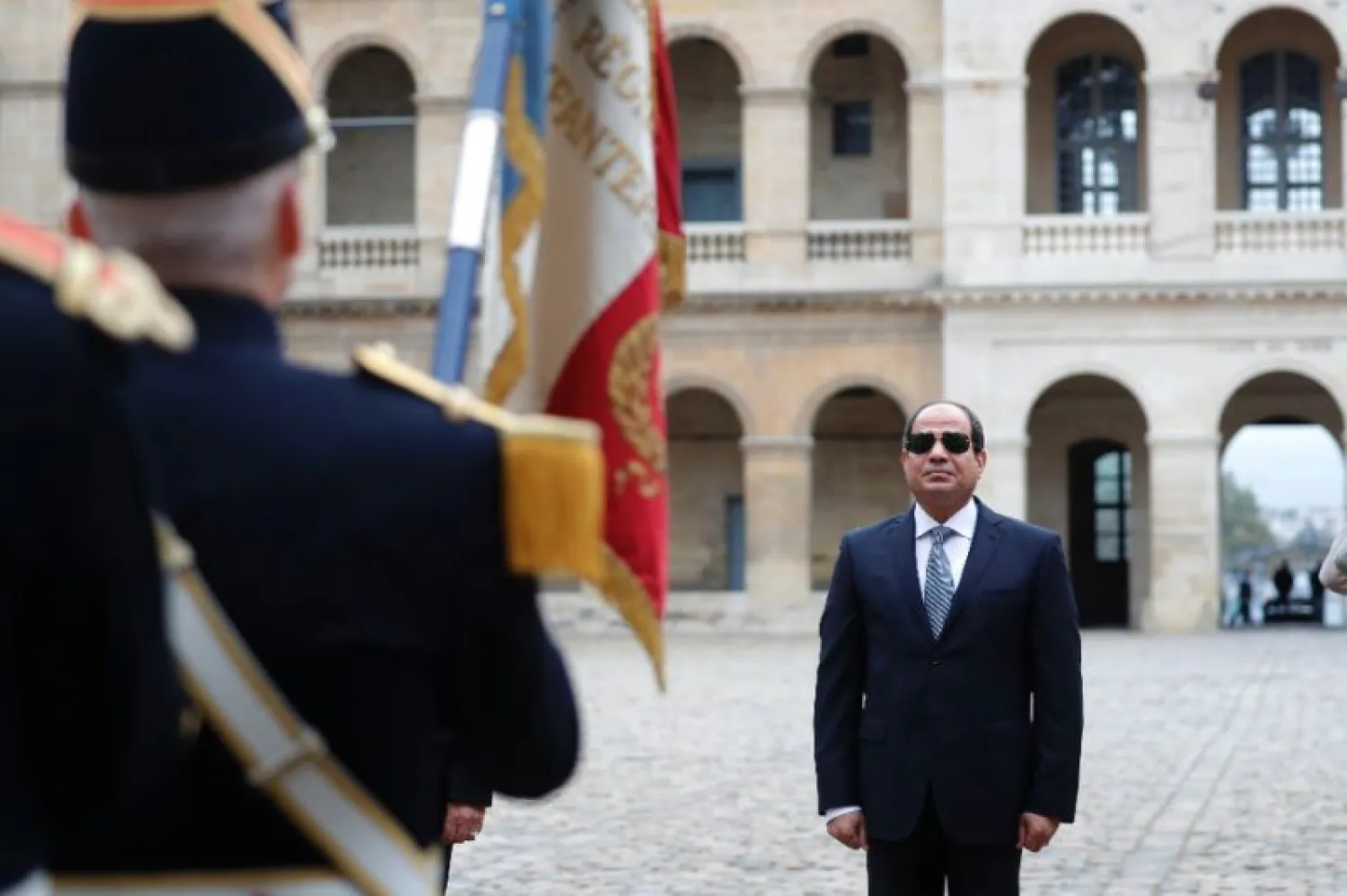
Egyptian President Abdel Fattah al-Sisi attends a military ceremony at the Hotel des Invalides in Paris on October 24, 2017 (AFP Photo/CHARLES PLATIAU)
TT

Macron Stresses Security with Egyptian Leader Sisi

Egyptian President Abdel Fattah al-Sisi attends a military ceremony at the Hotel des Invalides in Paris on October 24, 2017 (AFP Photo/CHARLES PLATIAU)

French President Emmanuel Macron backed visiting Egyptian leader Abdel Fattah al-Sisi in his country's fight against terrorism on Tuesday.

According to AFP, Macron stressed how Egypt was a vital partner in the fight against Islamist extremism in the Middle East and Europe, as well as key in the search for lasting political solutions in war-wracked Libya and Syria.

Responding to claims of rights groups, Macron said he would not "give lessons" to a sovereign state.

"The first battle that we have in common is the fight against terrorism," Macron said during a joint press conference which underlined their common purpose against extremists that have claimed hundreds of victims in both countries.

Macron said he had stated that combating extremism "should be carried out with respect for the rule of law and human rights."

As French president Macron said, "I would not accept that another leader gave me lessons about how to govern my country... I believe in the sovereignty of states and I am not here to give lessons without taking account of the context."

Egypt is a major buyer of French military equipment with orders worth more than 5.0 billion euros ($5.8 billion) since 2015.

They include an order for 24 fighter jets from the Rafale series for which France had long struggled to find a buyer.

French Economy Minister Bruno Le Maire said Tuesday that Macron and Sisi would discuss the possibility of further Rafale orders.

"If there can be new contracts, all the better," he told Europe 1 radio.

Macron's backing for Egypt's tough stance on security is in line with that of other Western leaders, who see Sisi as a source of stability.

US President Donald Trump memorably praised the Egyptian for doing a "fantastic job" in April.

The most populous country in the Middle East is fighting the Egyptian branch of the ISIS group in the north of the Sinai peninsula and has faced a series of attacks that has affected its vital tourism industry.

At least 16 Egyptian police officers were killed at the weekend in an ambush by fighters in the country's Western Desert in a rare flare-up outside the Sinai.

Macron and Sisi both stressed the need to step up the fight against terrorism in Egypt's lawless neighbor Libya, where ISIS ultrahardliners have gained a foothold.



Italy Arrests 7 Accused of Raising Millions for Hamas

Palestinian Hamas members secure the area as Egyptian workers accompanied by members of the International Committee of the Red Cross (ICRC) search for the remains of the last Israeli hostage in the Zeitoun neighborhood of Gaza City on December 8, 2025. (Photo by Omar AL-QATTAA / AFP)
TT

Italy Arrests 7 Accused of Raising Millions for Hamas

Palestinian Hamas members secure the area as Egyptian workers accompanied by members of the International Committee of the Red Cross (ICRC) search for the remains of the last Israeli hostage in the Zeitoun neighborhood of Gaza City on December 8, 2025. (Photo by Omar AL-QATTAA / AFP)

Italian police said Saturday that they have arrested seven people suspected of raising millions of euros for Palestinian group Hamas.

Police also issued international arrests for two others outside the country, said AFP.

Three associations, officially supporting Palestinian civilians but allegedly serving as a front for funding Hamas, are implicated in the investigation, said a police statement.

The nine individuals are accused of having financed approximately seven million euros ($8 million) to "associations based in Gaza, the Palestinian territories, or Israel, owned, controlled, or linked to Hamas."

While the official objective of the three associations was to collect donations "for humanitarian purposes for the Palestinian people," more than 71 percent was earmarked for the direct financing of Hamas" or entities affiliated with the movement, according to police.

Some of the money went to "family members implicated in terrorist attacks," the statement said.

Among those arrested was Mohammad Hannoun, president of the Palestinian Association in Italy, according to media reports.

Interior Minister Matteo Piantedosi posted on X that the operation "lifted the veil on behavior and activities which, pretending to be initiatives in favor of the Palestinian population, concealed support for and participation in terrorist organizations."


Army Chief Says Switzerland Can’t Defend Itself from Full-Scale Attack

Lieutenant General Thomas Suessli, Chief of the Armed Forces of the Swiss Army, attends a news conference on the outbreak of the coronavirus disease (COVID-19) in Bern, Switzerland, March 16, 2020. Picture taken March 16, 2020. (Reuters)
TT

Army Chief Says Switzerland Can’t Defend Itself from Full-Scale Attack

Lieutenant General Thomas Suessli, Chief of the Armed Forces of the Swiss Army, attends a news conference on the outbreak of the coronavirus disease (COVID-19) in Bern, Switzerland, March 16, 2020. Picture taken March 16, 2020. (Reuters)

Switzerland cannot defend itself against a full-scale attack and must boost military spending given rising risks from Russia, the head of its armed forces said.

The country is prepared for attacks by "non-state actors" on critical infrastructure and for cyber attacks, but its military still faces major equipment gaps, Thomas Suessli told the NZZ newspaper.

"What we cannot do is defend against threats from a distance or even a full-scale ‌attack on ‌our country," said Suessli, who is ‌stepping ⁠down at ‌the end of the year.

"It's burdensome to know that in a real emergency, only a third of all soldiers would be fully equipped," he said in an interview published on Saturday.

Switzerland is increasing defense spending, modernizing artillery and ground systems ⁠and replacing ageing fighter jets with Lockheed Martin F-35As.

But the ‌plan faces cost overruns, while ‍critics question spending on artillery ‍and munitions amid tight federal finances.

Suessli said ‍attitudes towards the military had not shifted despite the war in Ukraine and Russian efforts to destabilize Europe.

He blamed Switzerland's distance from the conflict, its lack of recent war experience and the false belief that neutrality offered protection.

"But that's historically ⁠inaccurate. There are several neutral countries that were unarmed and were drawn into war. Neutrality only has value if it can be defended with weapons," he said.

Switzerland has pledged to gradually raise defense spending to about 1% of GDP by around 2032, up from roughly 0.7% now – far below the 5% level agreed by NATO countries.

At that pace, the Swiss military would only be ‌fully ready by around 2050.

"That is too long given the threat," Suessli said.


What Lies Ahead for Ukraine’s Contested Zaporizhzhia Nuclear Power Plant?

A Russian service member stands guard at a checkpoint near the Zaporizhzhia Nuclear Power Plant before the arrival of the International Atomic Energy Agency (IAEA) expert mission in the course of Russia-Ukraine conflict outside Enerhodar in the Zaporizhzhia region, Russian-controlled Ukraine, June 15, 2023. (Reuters)
TT

What Lies Ahead for Ukraine’s Contested Zaporizhzhia Nuclear Power Plant?

A Russian service member stands guard at a checkpoint near the Zaporizhzhia Nuclear Power Plant before the arrival of the International Atomic Energy Agency (IAEA) expert mission in the course of Russia-Ukraine conflict outside Enerhodar in the Zaporizhzhia region, Russian-controlled Ukraine, June 15, 2023. (Reuters)

The Zaporizhzhia nuclear power plant, Europe's largest, is one of the main sticking points in US President Donald Trump's peace plan to end the nearly four-year war between Russia and Ukraine. The issue is one of 20 points laid out by Ukrainian President Volodymyr Zelenskiy in a framework peace proposal.

Here are some of the issues regarding the facility:

WHAT ROLE MAY THE US PLAY?

Russia took control of the plant in March 2022 and announced plans to connect it to its power grid. Almost all countries consider that it belongs to Ukraine but Russia says it is owned by Russia and a unit of Russia's state-owned Rosatom nuclear corporation runs the plant.

Zelenskiy stated at the end of December that the US side had proposed joint trilateral operation of the nuclear power plant with an American chief manager.

Zelenskiy said the Ukrainian proposal envisages Ukrainian-American use of the plant, with the US itself determining how to use 50% of the energy produced.

Russia has considered joint Russian-US use of the plant, according to the Kommersant newspaper.

WHAT IS ITS CURRENT STATUS?

The plant is located in Enerhodar on the banks ‌of the Dnipro River and ‌the Kakhovka Reservoir, 550 km (342 miles) southeast of the capital Kyiv.

The Zaporizhzhia nuclear power plant has ‌six ⁠Soviet-designed reactors. They were ‌all built in the 1980s, although the sixth only came online in the mid-1990s after the collapse of the Soviet Union. It has a total capacity of 5.7 gigawatts, according to an International Atomic Energy Agency (IAEA) database.

Four of the six reactors no longer use Russian nuclear fuel, having switched to fuel produced by then-US nuclear equipment supplier Westinghouse.

After Russia took control of the station, it shut down five of its six reactors and the last reactor ceased to produce electricity in September 2022. Rosatom said in 2025 that it was ready to return the US fuel to the United States.

According to the Russian management of the plant, all six reactors are in "cold shutdown."

Both Russia and Ukraine have accused each other of striking the nuclear plant and of severing power lines to the plant.

The plant's equipment is powered by ⁠electricity supplied from Ukraine. Over the past four years these supplies have been interrupted at least eleven times due to breaks in power lines, forcing the plant to switch to emergency diesel generators.

Emergency generators ‌on site can supply electricity to keep the reactors cool if external power lines are cut.

IAEA ‍Director General Rafael Grossi says that fighting a war around a nuclear ‍plant has put nuclear safety and security in constant jeopardy.

WHY DOES RUSSIA WANT ZAPORIZHZHIA PLANT?

Russia has been preparing to restart the station but ‍says that doing so will depend on the situation in the area. Rosatom chief Alexei Likhachev has not ruled out the supply of electricity produced there to parts of Ukraine.

Oleksandr Kharchenko, director of the Energy Research Center in Kyiv, said Moscow intended to use the plant to cover a significant energy deficit in Russia's south.

"That's why they are fighting so hard for this station," he said.

In December 2025, Russia's Federal Service for Environmental, Technological and Nuclear Supervision issued a license for the operation of reactor No. 1, a key step towards restarting the reactor.

Ukraine's energy ministry called the move illegal and irresponsible, risking a nuclear accident.

WHY DOES UKRAINE NEED THE PLANT?

Russia has been pummeling Ukraine's energy infrastructure for months and some areas have had blackouts during winter.

In recent ⁠months, Russia has sharply increased both the scale and intensity of its attacks on Ukraine's energy sector, plunging entire regions into darkness.

Analysts say Ukraine's generation capacity deficit is about 4 gigawatts, or the equivalent of four Zaporizhzhia reactors.

Kharchenko says it would take Ukraine five to seven years to build the generating capacity to compensate for the loss of the Zaporizhzhia plant.

Kharchenko said that if Kyiv regained control of the plant, it would take at least two to three years to understand what condition it was in and another three years to restore the equipment and return it to full operations.

Both Ukrainian state nuclear operator Energoatom and Kharchenko said that Ukraine did not know the real condition of the nuclear power plant today.

WHAT ABOUT COOLING FUEL AT THE PLANT?

In the long term, there is the unresolved problem of the lack of water resources to cool the reactors after the vast Kakhovka hydro-electric dam was blown up in 2023, destroying the reservoir that supplied water to the plant.

Besides the reactors, there are also spent fuel pools at each reactor site used to cool down used nuclear fuel. Without water supply to the pools, the water evaporates and the temperatures increase, risking fire.

An emission of hydrogen from a spent fuel pool caused an explosion in Japan's Fukushima nuclear disaster in ‌2011.

Energoatom said the level of the Zaporizhzhia power plant cooling pond had dropped by more than 15%, or 3 meters, since the destruction of the dam, and continued to fall.

Ukrainian officials previously said the available water reserves may be sufficient to operate one or, at most, two nuclear reactors.