


Violence is So Bad in Kabul that Red Cross Clinics are Shutting their Doors

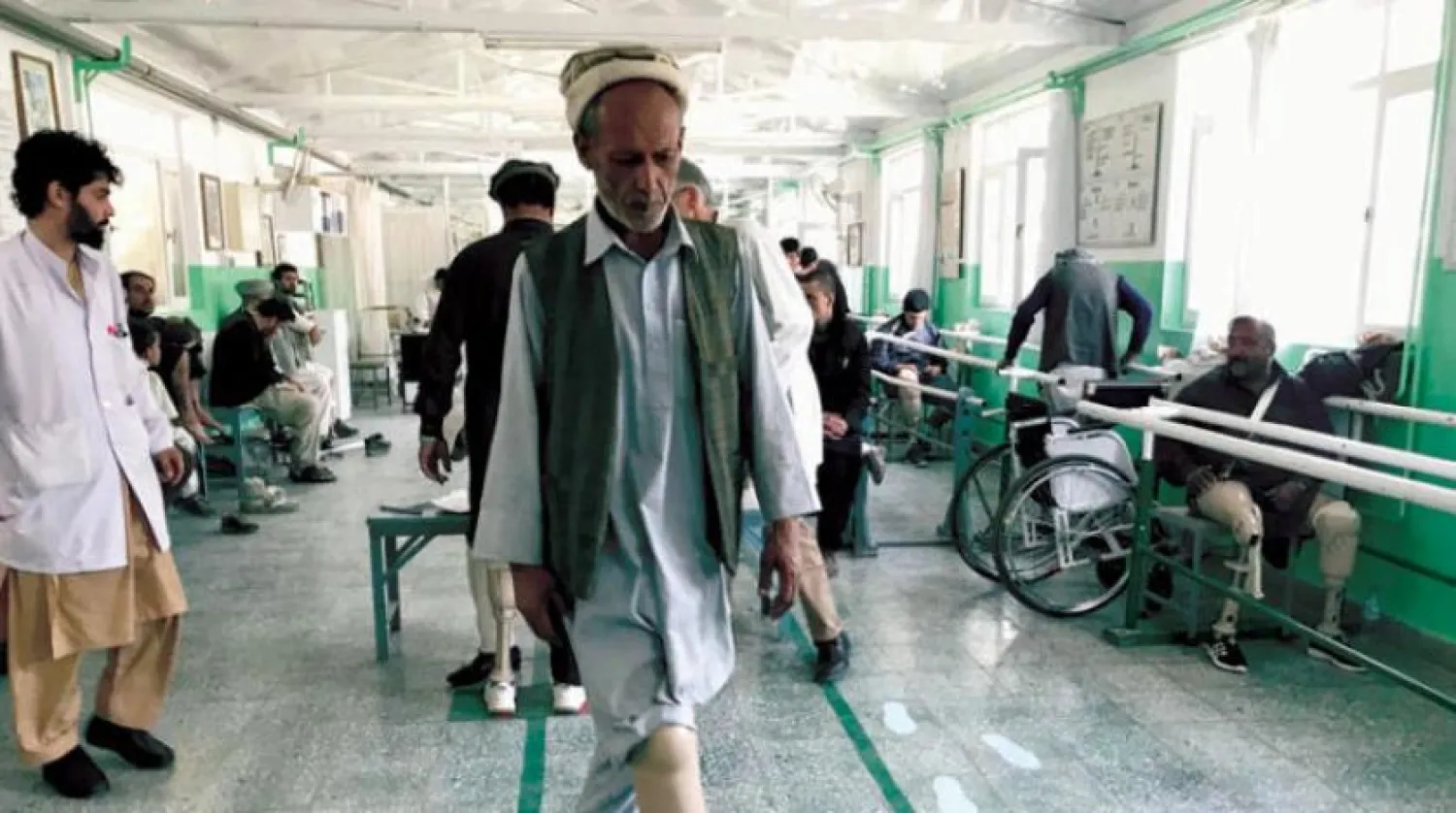
An Afghan man who lost his leg to a landmine tries out his new prosthetic leg inside a Red Cross orthopedic center in Kabul. (Antonio Olivo/The Washington Post)
TT

Violence is So Bad in Kabul that Red Cross Clinics are Shutting their Doors

An Afghan man who lost his leg to a landmine tries out his new prosthetic leg inside a Red Cross orthopedic center in Kabul. (Antonio Olivo/The Washington Post)

A smiling physiotherapist beams in a framed photo inside the Red Cross ­center here, hinting at the radiant personality that charmed her orthopedic patients before a man with polio took out a gun hidden in his wheelchair and killed her.

The slaying of Lorena Enebral Perez at a clinic in the northern city of Mazar-e Sharif followed the roadside killing of six Afghans working for the International Committee of the Red Cross (ICRC) and three abductions in the past year, part of a spike in violence by smaller militias and by the terror group Taliban that has led to more than 200 deaths in the past week.

That violence has prompted the international aid agency to shut down two of its offices in the northern part of the country and to scale down operations in Mazar-e Sharif — a decision that will affect hundreds of thousands of Afghans who receive aid from the organization in seven northern provinces.

“The places where you have war and insecurity are the places where your help is needed,” said Alberto Cairo, a doctor who during the early 1990s spearheaded the creation of the ICRC’s orthopedic program, which treats 160,000 people annually across the country. “At the same time, you cannot deliver it. If we cannot guarantee the security of our staff, how can we work?”

So far this year, there have been 107 attacks on health facilities, up from 41 last year, according to the UN Office for the Coordination of Humanitarian Affairs. Fifteen aid workers have been killed in attacks, and an additional 43 have been abducted this year, down from 121 kidnappings the year before.

The orthopedic center’s roughly 8,500 patients who have lost legs to war or stray land mines, plus an additional 17,500 who have problems walking because of cerebral palsy, polio and other ailments, will still be able to receive treatment at the Mazar-e Sharif clinic. But the approximately 675,000 other Afghans who rely on the ICRC for food, water or medical aid in
the north will be left without options until the Afghan government or a different aid group fills the gap.

With US Secretary of State Rex Tillerson calling on Pakistan to help force the Taliban into peace negotiations amid a surge of 4,000 more U.S. troops, the militant group is fighting for a stronger presence outside its southern strongholds.

In that setting, more aid workers in areas once considered relatively safe have become targets for attacks or abductions. Meanwhile, more people need help.

In the past 12 months, 8,000 civilians have either died or been injured by military operations, down slightly from a peak of 8,500 in the previous year, according to the United Nations.

UN officials say humanitarian aid groups are trying to strike a balance by limiting their operations in some areas or prioritizing services to meet only the most urgent demands.

“We have to put the oxygen mask on ourselves before we can help others,” said Toby Lanzer, the UN humanitarian coordinator in Afghanistan. “I think, for the time being, you will see a reduction of aid in some of the areas where aid agencies have been hit.”

The erosion of security in the north has multiple causes, security analysts say.

In the hostile province of Kunduz, fighting between the Taliban and government forces has led to instability all around, making it harder for aid groups to know who is in charge. Elsewhere, smaller renegade groups — some of whom claim affiliation with ISIS — have taken hold in areas not under firm control of the government or the Taliban.

Those groups are behind many of the aid worker abductions and the attacks on medical facilities, said Obaid Ali, a director with the Afghan Analysts Network, who focuses on security issues in the north.

“They are small groups who work under their own flag, and in many cases, they refuse to obey Taliban rule and honor local culture,” Ali said. In the case of abductions, “it’s really hard, and it’s really dangerous to approach these people and discuss terms with them.

The increased instability revealed itself to the ICRC in December when a Spanish member of the staff was abducted by a group of gunmen while traveling from Kunduz to Mazar-e Sharif. The man was held for a month before the ICRC negotiated his release.

The Washington Post

Exclusive for Asharq Al-Awsat


South Korea’s Ex-President Yoon Apologizes After Life Sentence Over Martial Law 

South Korean President Yoon Suk Yeol  delivers a speech to declare martial law in Seoul, South Korea, December 3, 2024. (The Presidential Office/Handout via Reuters/File Photo)
South Korean President Yoon Suk Yeol delivers a speech to declare martial law in Seoul, South Korea, December 3, 2024. (The Presidential Office/Handout via Reuters/File Photo)
TT

South Korea’s Ex-President Yoon Apologizes After Life Sentence Over Martial Law 

South Korean President Yoon Suk Yeol  delivers a speech to declare martial law in Seoul, South Korea, December 3, 2024. (The Presidential Office/Handout via Reuters/File Photo)
South Korean President Yoon Suk Yeol delivers a speech to declare martial law in Seoul, South Korea, December 3, 2024. (The Presidential Office/Handout via Reuters/File Photo)

Former ‌South Korean President Yoon Suk Yeol apologized on Friday for his short-lived declaration of martial law in December 2024, a day after a Seoul court sentenced him to life in prison for masterminding an insurrection.

In a statement released by his lawyers, Yoon said that while he was sorry for the "frustration and hardship" brought upon the people by his martial law decree, he stood behind the "sincerity and purpose" behind his actions.

The Seoul Central District Court's decision ‌to hand him ‌a life sentence on Thursday was "predetermined," he ‌said, ⁠adding that the verdict ⁠against him was political retaliation.

"Forces that seek to smear a decision made to save the nation as an 'insurrection' and to use it beyond political attacks as an opportunity to purge and eliminate their opponents will only grow more rampant going forward," he said.

Yoon also questioned ⁠whether an appeal would have meaning ‌in what he described as an ‌environment where judicial independence could not be guaranteed, while telling ‌supporters to "unite and rise."

His lawyers separately said the statement ‌did not amount to an intention to forgo an appeal.

Yoon's martial law declaration lasted around six hours before being voted down by parliament, but it sent shockwaves through the country and ‌sparked street protests.

The court found Yoon guilty of subverting constitutional order by deploying troops ⁠to storm ⁠parliament and move to detain opponents, capping a dramatic fall that saw him stripped of office and end up behind bars.

Yoon, a former career prosecutor, denied the charges, arguing he had presidential authority to declare martial law and his action was aimed at sounding the alarm over opposition parties' obstruction of government.

A special prosecutor had sought the death penalty for Yoon, though South Korea has not carried out an execution since 1997.

A prosecutor said on Thursday the team had some "regret" over the sentencing, but declined to say whether they planned to appeal.


Police Continue to Search Mountbatten-Windsor's Former Stately Home, a Day after His Arrest

(FILES) Britain's Prince Andrew, Duke of York leaves after attending for the Royal Family's traditional Christmas Day service at St Mary Magdalene Church in Sandringham in eastern England, on December 25, 2023. (Photo by Adrian DENNIS / AFP)
TT

Police Continue to Search Mountbatten-Windsor's Former Stately Home, a Day after His Arrest

(FILES) Britain's Prince Andrew, Duke of York leaves after attending for the Royal Family's traditional Christmas Day service at St Mary Magdalene Church in Sandringham in eastern England, on December 25, 2023. (Photo by Adrian DENNIS / AFP)

Police continued on Friday to search the former home of Andrew Mountbatten-Windsor, a day after the former prince was held in custody for the best part of 11 hours on suspicion of misconduct in public office linked to his friendship with the late convicted sex offender Jeffrey Epstein.
Following one of the most tumultuous days in the modern history of Britain's royal family, the former Prince Andrew is back at his new home on the Sandringham estate, King Charles III 's private retreat, which is around 115 miles (185 kilometers) north of London.
Police have concluded their search there but are still searching Royal Lodge, his 30-room former home in the grounds of Windsor Castle, just west of the capital.
Mountbatten-Windsor, who was pictured slouched in the back of his chauffeur-driven car following his release Thursday evening, remains under investigation, which means he has neither been charged nor exonerated by Thames Valley Police, the force responsible for areas west of London.
Arrest was years in the making
His arrest follows years of allegations over his links with Epstein, who took his own life in a New York prison in 2019. The accusation at the heart of his arrest is that Mountbatten-Windsor — who was known as Prince Andrew until October when his brother stripped him of his titles and honors — shared confidential trade information with the disgraced financier when he was a trade envoy for the UK.
Specifically, emails released last month by the US Department of Justice appeared to show Mountbatten-Windsor sharing reports of official visits to Hong Kong, Vietnam and Singapore.
One, dated November 2010, appeared to be forwarded by Andrew five minutes after he had received it. Another a few weeks later appeared to show him sending Epstein a confidential brief on investment opportunities in the reconstruction of Helmand Province, Afghanistan.
Other police forces in the UK are also conducting their own investigations into Mountbatten-Windsor’s Epstein-related links.
Mountbatten-Windsor has consistently denied any wrongdoing in his association with Epstein but has not commented on the most recent allegations that have emerged with the release of the so-called Epstein files.
Arrest was sudden, investigation will take time
Police swept into the grounds of Mountbatten-Windsor's home to arrest him at 8 a.m. Thursday — his 66th birthday — before taking him to a nearby police station for questioning.
It's not known what he told them. He may have said nothing, or “no comment,” as is his right.
Experts said that misconduct in a public office is notoriously difficult to prove.
“Firstly, it must be determined if Andrew Mountbatten-Windsor was in a role within government that constitutes the title of public officer,” said Sean Caulfield, a criminal defense lawyer at Hodge Jones & Allen. “There is no standard definition to clearly draw on.”
The Crown Prosecution Service will ultimately make a decision about charging him.
Andrew Gilmore, a partner at Grosvenor Law, said that prosecutors will apply the two-stage test known as the “Code for Crown Prosecutors.”
“That test is to determine whether there is a more realistic prospect of a conviction than not based on the evidence and whether the matter is in the public interest,” he said. “If these two tests are met, then the matter will be charged and proceed to court.”
Arrest is not just unusual, it's historic
Mountbatten-Windsor was the first royal since King Charles I nearly four centuries ago to be placed under arrest. That turned into a seismic moment in British history, leading to civil war, Charles’ beheading and the temporary abolition of the monarchy.
His arrest is undoubtedly one of the gravest crises to affect the House of Windsor since its establishment more than 100 years ago. Arguably, only the abdication of King Edward VIII in 1936 and the death of Diana, Princess of Wales, in 1997 have been as grave for the institution of the British monarchy in modern times.
For the king, it's business as usual
Though the king and the royal family will carry out their normal duties as normal, the questions surrounding Mountbatten-Windsor will continue, not least because the investigations are likely to take time.
In a statement Thursday, the king said the “law must take its course,’’ but that as ”this process continues, it would not be right for me to comment further on this matter.’’
The allegations are not related to Epstein's sex trafficking
The allegations being investigated Thursday are separate from those made by Virginia Giuffre, who claimed she was trafficked to Britain to have sex with the prince in 2001, when she was just 17. Giuffre died by suicide last year.
Still, Giuffre’s sister-in-law Amanda Roberts said that she was overjoyed when she got a phone call at 3 a.m. telling her the news of the arrest. But those feelings of elation were quickly complicated by the realization that she couldn't share the feelings of "vindication" with Giuffre.
“We can’t tell her how much we love her, and that everything that she was doing is not in vain,” Roberts added tearfully.


Russia Hits Ukraine's Oil, Gas Infrastructure in Poltava Region, Naftogaz Says

FILE PHOTO: A Ukrainian service member of the 14th Unmanned Aerial Systems Regiment prepares a deep strike unmanned aerial vehicle before its launch toward Russian territory, amid Russia's attack on Ukraine, in an undisclosed location in Ukraine, undisclosed date, 2025. REUTERS/Valentyn Ogirenko/File Photo
TT

Russia Hits Ukraine's Oil, Gas Infrastructure in Poltava Region, Naftogaz Says

FILE PHOTO: A Ukrainian service member of the 14th Unmanned Aerial Systems Regiment prepares a deep strike unmanned aerial vehicle before its launch toward Russian territory, amid Russia's attack on Ukraine, in an undisclosed location in Ukraine, undisclosed date, 2025. REUTERS/Valentyn Ogirenko/File Photo

Russian drones hit Ukraine's oil and gas infrastructure in the central Poltava region, causing ‌damage ‌and a ‌fire, ⁠the state energy company ⁠Naftogaz said on Friday.

"This is yet another targeted ⁠attack on ‌our ‌oil and ‌gas infrastructure. ‌Since the beginning of the year, the ‌enemy has attacked Naftogaz Group facilities ⁠more ⁠than 20 times," Sergii Koretskyi, Naftogaz CEO said in a post on Facebook.
