


Dele Alli...Tottenham's Total Footballer

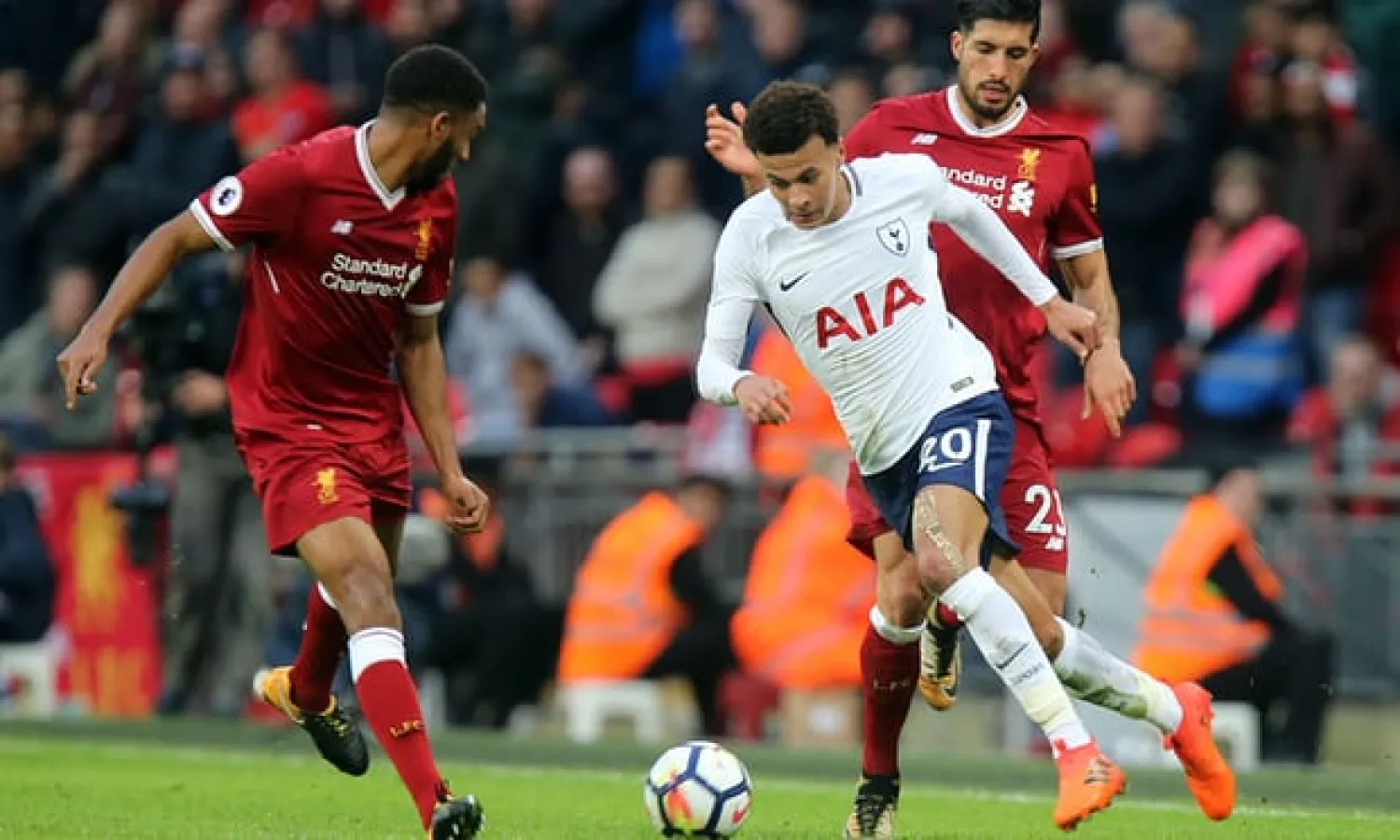
 Dele Alli gets the better of Emre Can, as Spurs swept Liverpool aside at Wembley. Photograph: TGSPhoto/REX/Shutterstock
Dele Alli gets the better of Emre Can, as Spurs swept Liverpool aside at Wembley. Photograph: TGSPhoto/REX/Shutterstock
TT

Dele Alli...Tottenham's Total Footballer

 Dele Alli gets the better of Emre Can, as Spurs swept Liverpool aside at Wembley. Photograph: TGSPhoto/REX/Shutterstock
Dele Alli gets the better of Emre Can, as Spurs swept Liverpool aside at Wembley. Photograph: TGSPhoto/REX/Shutterstock

There was a fascinating moment during Tottenham Hotspur’s 4-1 shellacking of Liverpool at Wembley on Sunday; a moment made all the more so by the fact it didn’t involve Harry Kane gorging himself, flesh‑eating zombie-style, on some poor dawdling defender, Son Heung-min leading another brutal counterattack or any of the other stuff that took up most of the highlights reel.

Midway through the second half Emre Can came chugging through the centre circle with time to look up and pick a pass. Except, something else happened. Dele Alli had been caught upfield chasing a break. As he sprinted back he skirted around Can’s left side, stretched out a leg and removed the ball from Can’s stride with surgical precision. In the same movement Alli spun through a full circle and began to dribble back the other way.

Nothing much came of it. Tottenham were 4-1 up in any case but it was a stunning little moment of total midfield play. Probably not the kind of last-ditch positional band-aid you’d want your central midfielder pulling off in every game but as a piece of athleticism, skill and basic talent-arrogance – the conviction that yeah, Germany international, whatever, you’ve got this bloke – it sounded its own elite footballer klaxon.

Some sports people can do this. Watching a certain kind of cricketer there are times where suddenly the boundaries just seem too small, the opposition too human-scale, an entire contest thrown out of shape by one player’s skill and power. Alli is not finished yet, is still working out how best to apply his own wonderful talent but when he plays as a central midfielder – as he did when he first broke into the Spurs team and has too seldom for England – it is hard to avoid these glimpses of a potent future.

This may or may not be Mauricio Pochettino’s broader plan. The deeper role against Liverpool was brought about by the needs of the team. Pochettino had chosen to stick with the fast-breaking style that seems to suit more possession‑based opponents and the topography of Wembley. In this system it makes sense to have the speed of Son ahead of Alli. A corollary of which is that Alli’s craft and power are seen in that deeper position, often to great effect.

Alli had a good game on his return to the team. He scored a spanking goal. He covered a lot of ground, effortlessly, and passed well. He even had time to produce that party piece “flip-flap” close to the touchline, pirouetting with flypaper control away from Can, who had a tough match. More significantly perhaps, Alli also made more interceptions, blocks and tackles than any other midfielder on the pitch.

This will come as no great surprise to Spurs fans. Alli often played in central midfield when he first came into the team, the more progressive half of the double pivot in a 4-2-3-1 alongside Eric Dier or Moussa Dembélé. The switch to 3-4-2-1 moved Alli up the pitch more regularly, to brilliant effect. Last season he scored an astonishing 22 goals.

Again, no surprise here. Alli is a wonderful footballer, a player who can basically do anything on a football pitch, but he has other gears too. As Paul Pogba’s price tag shows, in modern football there is a rarity value to a player of his gifts operating in that all‑purpose midfielder role, and it is here Alli looks a thrilling prospect at times.

English football does have a history of pushing its better players forward, in search always of more tangible impact. Two England matches spring to mind in this regard, also two of the most impressive performances of the past 20 years. In Munich in 2001 England beat Germany 5-1 with Steven Gerrard playing as a supremely athletic, telescopically aggressive deep midfielder alongside Paul Scholes. England never started a game with that same central midfield again.

In March last year England also beat Germany, this time 3-2 in a friendly in Berlin. On that occasion Alli played as a supremely athletic, telescopically aggressive deep midfielder. He hasn’t started in the middle since for England, who went to Euro 2016 three months after Berlin and fell to pieces, lacking most obviously a ballsy, driving high-class central midfielder.

No doubt this tendency is in part to do with a lack of confidence in the talent available, the assumption that greater defensive “insurance” – an inferior, less ambitious player – is required in central midfield. Gerrard was plonked back into deep central midfield but only when the necessary snap and speed and agility had gone, and found himself exposed at times by its demands.

Pochettino can hardly be accused of a lack of boldness, just as the evidence of Wembley is that Alli will still score goals from deep, and may even prefer to attack with space in front of him rather than with his back to goal. Either way he looked refreshed. It has been a tricky third season for Alli as a first‑team regular, with a few snags to be untangled, some adolescent gripes to be overcome. Before Sunday he had not scored in the league since the end of August and had one assist this season.

Again this is no great surprise. Alli has taken a different road to this point. A sporting adolescence spent outside the clone army of Premier League academy products is one of his strengths, but it will come with a little rawness. Pochettino’s management has been the perfect balm to this, a combination of bristly paternalism and an invigorating faith in his players’ talent.

There are only pluses here for Tottenham. The one element Pochettino wanted to add to that hard-pressing team of the past two years was tactical variation. That he should find it by drawing greater depth and range out of the best young English player in the league is another intriguing subplot.

The Guardian Sport


Shakhtar Boss Pays Ukrainian Racer $200,000 After Games Disqualification

Ukrainian President Volodymyr Zelenskiy holds helmet as he meets with a Ukrainian skeleton racer Vladyslav Heraskevych , who was disqualified from the Olympic skeleton competition over his "helmet of remembrance" depicting athletes killed since Russia's invasion and his father and coach, Mykhailo Heraskevych, amid Russia's attack on Ukraine, in Munich, Germany February 13, 2026. (Ukrainian Presidential Press Service/Handout via Reuters)
TT

Shakhtar Boss Pays Ukrainian Racer $200,000 After Games Disqualification

Ukrainian President Volodymyr Zelenskiy holds helmet as he meets with a Ukrainian skeleton racer Vladyslav Heraskevych , who was disqualified from the Olympic skeleton competition over his "helmet of remembrance" depicting athletes killed since Russia's invasion and his father and coach, Mykhailo Heraskevych, amid Russia's attack on Ukraine, in Munich, Germany February 13, 2026. (Ukrainian Presidential Press Service/Handout via Reuters)

The owner of ‌Ukrainian football club Shakhtar Donetsk has donated more than $200,000 to skeleton racer Vladyslav Heraskevych after the athlete was disqualified from the Milano Cortina Winter Games before competing over the use of a helmet depicting Ukrainian athletes killed in the war with Russia, the club said on Tuesday.

The 27-year-old Heraskevych was disqualified last week when the International Bobsleigh and Skeleton Federation jury ruled that imagery on the helmet — depicting athletes killed since Russia invaded Ukraine in 2022 — breached rules on athletes' expression at ‌the Games.

He ‌then lost an appeal at the Court ‌of ⁠Arbitration for Sport hours ⁠before the final two runs of his competition, having missed the first two runs due to his disqualification.

Heraskevych had been allowed to train with the helmet that displayed the faces of 24 dead Ukrainian athletes for several days in Cortina d'Ampezzo where the sliding center is, but the International Olympic Committee then ⁠warned him a day before his competition ‌started that he could not wear ‌it there.

“Vlad Heraskevych was denied the opportunity to compete for victory ‌at the Olympic Games, yet he returns to Ukraine a ‌true winner," Shakhtar President Rinat Akhmetov said in a club statement.

"The respect and pride he has earned among Ukrainians through his actions are the highest reward. At the same time, I want him to ‌have enough energy and resources to continue his sporting career, as well as to fight ⁠for truth, freedom ⁠and the remembrance of those who gave their lives for Ukraine," he said.

The amount is equal to the prize money Ukraine pays athletes who win a gold medal at the Games.

The case dominated headlines early on at the Olympics, with IOC President Kirsty Coventry meeting Heraskevych on Thursday morning at the sliding venue in a failed last-minute attempt to broker a compromise.

The IOC suggested he wear a black armband and display the helmet before and after the race, but said using it in competition breached rules on keeping politics off fields of play. Heraskevych also earned praise from Ukraine President Volodymyr Zelenskiy.


Speed Skating-Italy Clinch Shock Men’s Team Pursuit Gold, Canada Successfully Defend Women’s Title

 Team Italy with Davide Ghiotto, Andrea Giovannini, Michele Malfatti, celebrate winning the gold medal on the podium of the men's team pursuit speed skating race at the 2026 Winter Olympics, in Milan, Italy, Tuesday, Feb. 17, 2026. (AP)
Team Italy with Davide Ghiotto, Andrea Giovannini, Michele Malfatti, celebrate winning the gold medal on the podium of the men's team pursuit speed skating race at the 2026 Winter Olympics, in Milan, Italy, Tuesday, Feb. 17, 2026. (AP)
TT

Speed Skating-Italy Clinch Shock Men’s Team Pursuit Gold, Canada Successfully Defend Women’s Title

 Team Italy with Davide Ghiotto, Andrea Giovannini, Michele Malfatti, celebrate winning the gold medal on the podium of the men's team pursuit speed skating race at the 2026 Winter Olympics, in Milan, Italy, Tuesday, Feb. 17, 2026. (AP)
Team Italy with Davide Ghiotto, Andrea Giovannini, Michele Malfatti, celebrate winning the gold medal on the podium of the men's team pursuit speed skating race at the 2026 Winter Olympics, in Milan, Italy, Tuesday, Feb. 17, 2026. (AP)

An inspired Italy delighted the home crowd with a stunning victory in the Olympic men's team pursuit final as

Canada's Ivanie Blondin, Valerie Maltais and Isabelle Weidemann delivered another seamless performance to beat the Netherlands in the women's event and retain their title ‌on Tuesday.

Italy's ‌men upset the US who ‌arrived ⁠at the Games ⁠as world champions and gold medal favorites.

Spurred on by double Olympic champion Francesca Lollobrigida, the Italian team of Davide Ghiotto, Andrea Giovannini and Michele Malfatti electrified a frenzied arena as they stormed ⁠to a time of three ‌minutes 39.20 seconds - ‌a commanding 4.51 seconds clear of the ‌Americans with China taking bronze.

The roar inside ‌the venue as Italy powered home was thunderous as the crowd rose to their feet, cheering the host nation to one ‌of their most special golds of a highly successful Games.

Canada's women ⁠crossed ⁠the line 0.96 seconds ahead of the Netherlands, stopping the clock at two minutes 55.81 seconds, and

Japan rounded out the women's podium by beating the US in the Final B.

It was only Canada's third gold medal of the Games, following Mikael Kingsbury's win in men's dual moguls and Megan Oldham's victory in women's freeski big air.


Lindsey Vonn Back in US Following Crash in Olympic Downhill 

Milano Cortina 2026 Olympics - Alpine Skiing - Women's Downhill 3rd Official Training - Tofane Alpine Skiing Centre, Belluno, Italy - February 07, 2026. Lindsey Vonn of United States in action during training. (Reuters)
TT

Lindsey Vonn Back in US Following Crash in Olympic Downhill 

Milano Cortina 2026 Olympics - Alpine Skiing - Women's Downhill 3rd Official Training - Tofane Alpine Skiing Centre, Belluno, Italy - February 07, 2026. Lindsey Vonn of United States in action during training. (Reuters)

Lindsey Vonn is back home in the US following a week of treatment at a hospital in Italy after breaking her left leg in the Olympic downhill at the Milan Cortina Games.

“Haven’t stood on my feet in over a week... been in a hospital bed immobile since my race. And although I’m not yet able to stand, being back on home soil feels amazing,” Vonn posted on X with an American flag emoji. “Huge thank you to everyone in Italy for taking good care of me.”

The 41-year-old Vonn suffered a complex tibia fracture that has already been operated on multiple times following her Feb. 8 crash. She has said she'll need more surgery in the US.

Nine days before her fall in Cortina d'Ampezzo, Italy, Vonn ruptured the ACL in her left knee in another crash in Switzerland.

Even before then, all eyes had been on her as the feel-good story heading into the Olympics for her comeback after nearly six years of retirement.
