Tottenham’s Defeat of Real Madrid is a Warning to Europe’s Super-Clubs

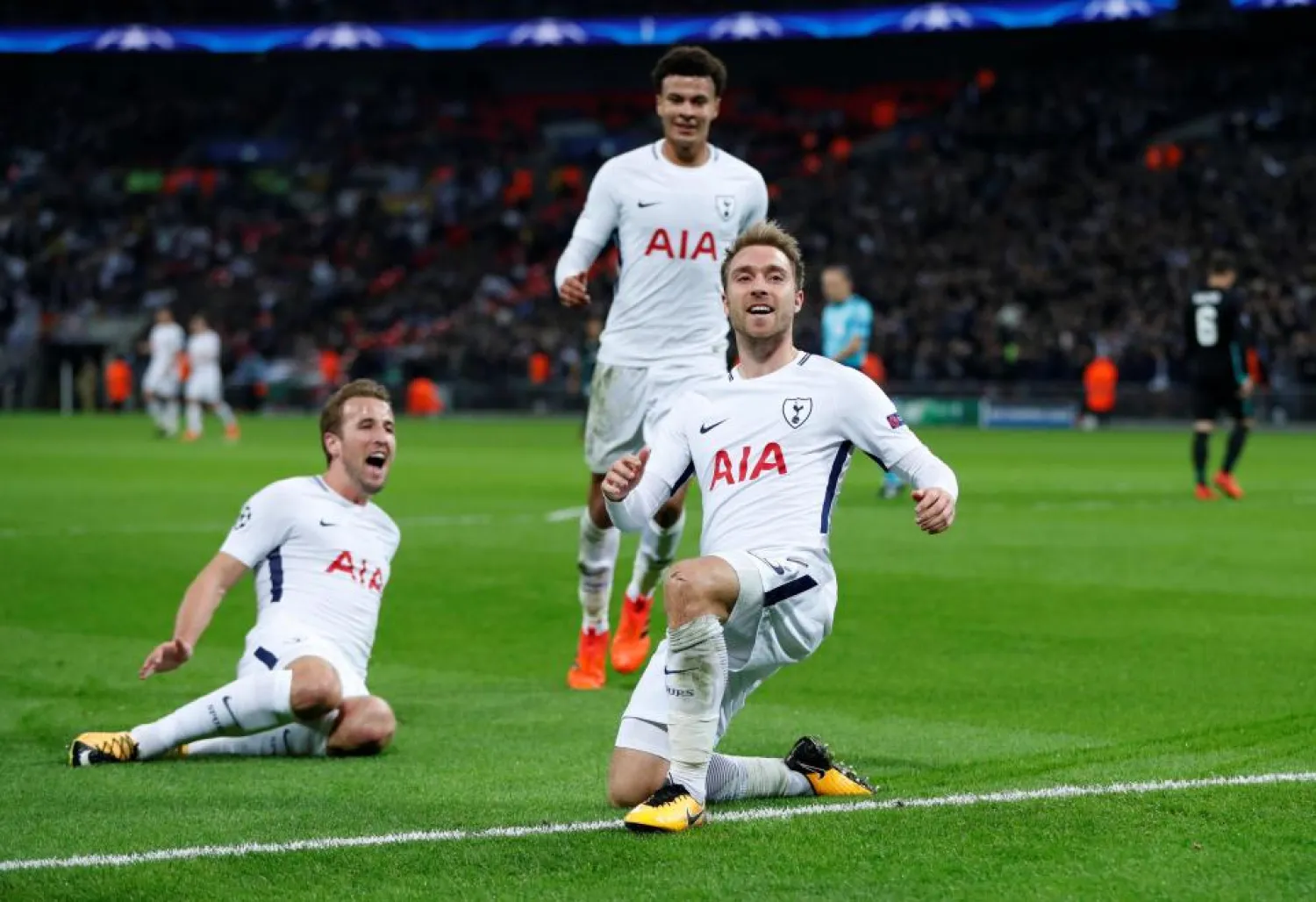
Christian Eriksen celebrates after helping Tottenham produce an historic win over Real Madrid. (Reuters)
TT

Tottenham’s Defeat of Real Madrid is a Warning to Europe’s Super-Clubs

Christian Eriksen celebrates after helping Tottenham produce an historic win over Real Madrid. (Reuters)

It was one of the greatest nights in Tottenham’s history. It was better than beating Internazionale 3-1, probably the equal of those fraught nights in 1983-84 when Bayern Munich, Austria Vienna, Hajduk Split and Anderlecht were overcome on the way to the Uefa Cup. Almost whatever happens over the next three decades, it is safe to assume that in 2050 Christian Eriksen’s goal will still be included in the pre-match White Hart Lane montage as Danny Blanchflower’s voice, the crackle of time even more pronounced, explains once again that the game is about glory.

And this was glorious. The European champions were humbled. As Eriksen pointed out, if Spurs had shown a little more composure, they would have had more. If Harry Kane had been fully fit, perhaps, they would have had more. If Spurs had been able to believe quite what was happening, they would have had more. Dele Alli admitted he was astonished by the amount of space Madrid had allowed them.

That hints at a wider point, which is that Madrid were weirdly terrible. That is not to diminish Tottenham’s performance, and it is hugely to their credit that they have adapted their game this season to such an extent their best three performances – against Borussia Dortmund, Liverpool and Madrid – have come when they had only around a third of possession, but it is to ask questions about Zinedine Zidane and, perhaps, the nature of elite football in general.

Nine years ago the former Liverpool midfielder Igor Biscan spoke about the problem clubs such as Dinamo Zagreb have, explaining how they dominated to such an extent domestically that they wilted as soon as they meet a side of even vaguely comparable quality in Europe. They had forgotten how to defend and they had forgotten how to fight.

Football became for their players an exhibition, the sense that you might have to struggle before you could express yourself was gone.

Since then, the economics of football have meant more and more teams have found themselves succumbing to the Biscan Principle. Bayern are now laughably dominant in the Bundesliga. Juventus may be facing more of a challenge this season than in recent years but they have won Serie A six times in a row. PSG were so upset when their run of four successive French league titles came to an end last season that they went and arranged the two most expensive transfers in history; their only rival, meanwhile, lost four key players. Barcelona and Real Madrid dwarf the rest in Spain.

The result is a decadence among many of the leading sides, a focus on only one part of the game. As Tony Evans pointed out on the Second Captains podcast this week, fans have come to expect and demand entertainment and for some that has become a surrogate for winning. In practical terms, on the pitch, what it means is that elite sides have softer underbellies than they have ever had before. Genuine opposition is such a rarity that when they meet it they have no idea how to react.

That is why so many games between ostensibly well-matched elite sides end up with a surprisingly large margin of victory. The Barcelona-PSG last-16 tie last season – 4-0 to PSG in the first leg; 6-1 to Barça in the second – was the perfect example of that. It was thrilling but it was essentially two big men taking it in turns to hit a blancmange with an ax. Barcelona, it will be remembered, rapidly succumbed to a better-balanced Juventus in the following round.

In the past eight seasons, 21 games at the quarter-final stage or later of the Champions League have been won by a three-goal margin; in the eight seasons before that, there were only eight. Top sides, the elite who reach those stages of the competition, may be better than their forebears at attacking but the art of defending is being forgotten. There is too much attention on the glitter of glory and not enough on the guts.

The one major league that is not – yet – subject to the Biscan Principle, is the Premier League. It is not just that six sides began this season with at least vaguely realistic title ambitions, it is that the bottom sides are still wealthy enough to compete – which is why the attempts of the Big Six to hive off more of the overseas television rights must continue to be resisted.

For the past few years, English under-performance in Europe has been blamed on that competitiveness, on, as Louis van Gaal had it, the “rat race” of the English game. This season, although it is still early, the signs are that Premier League sides may be benefiting. Premier League sides have lost only one of 20 Champions League games this season, have collected 40 percent more coefficient points than any other league and, perhaps most impressively, have shown an intelligence and a tactical flexibility perhaps lacking in the past.

Mauricio Pochettino tweaked again, shifting from the 3-5-2 he had used in the Bernabéu to a 3-4-2-1. Madrid’s 4-3-1-2 shape demands the full-backs get forward to offer attacking width; Tottenham were merciless in exposing that, leading directly to the opening goal.

Madrid were limp, lazy and disorganized, still a threat going forward but a rabble at the back. Perhaps they were infected by the realization they will almost certainly qualify anyway and that they won the competition after going through in second last season. But after their sluggish start to the domestic season there is reason for serious concern.

After successive defeats, Tottenham sides of the past might have wilted but not this one. Mentally they were tougher than Madrid and tactically they were smarter. Wednesday was a night that will live always in Tottenham’s history but it should also be a warning to Madrid and perhaps also the other super-clubs.

The Guardian Sport


Irish Boxer Lee Reeves Dies at Age 31, Three Months after Dublin Title Fight Injury

Irish boxer Lee Reeves. Reuters
TT

Irish Boxer Lee Reeves Dies at Age 31, Three Months after Dublin Title Fight Injury

Irish boxer Lee Reeves. Reuters

Irish boxer Lee Reeves has died more than three months after being injured during a fight in Dublin, promoter Queensberry said Tuesday. He was 31.

"Everyone at Queensberry is devastated to learn of the passing of Lee Reeves," Queensberry Promotions said in a statement.

Reeves was hospitalized after being knocked out by compatriot Gary Cully in the 10th and final round of their Boxing Union of Ireland Celtic super-lightweight title fight on Aug. 1.

Reeves was carried from the ring on a stretcher after receiving initial treatment.

Queensberry had said after the fight that his condition was critical but stable.

“Lee was an immensely talented boxer, as well as a true role model and inspiration to his community,” the statement added Tuesday, according to The Associated Press. “Our deepest condolences go to Lee’s family, friends and all those who loved him. We ask that their privacy be respected at this incredibly difficult time. Rest in peace, Lee.”


Alonso to Enter Dakar Rally with Loeb and Aston Martin Team

November 5, 2026 Aston Martin's Fernando Alonso during a press conference ahead of the F1 Sao Paulo Grand Prix. (Reuters)
TT

Alonso to Enter Dakar Rally with Loeb and Aston Martin Team

November 5, 2026 Aston Martin's Fernando Alonso during a press conference ahead of the F1 Sao Paulo Grand Prix. (Reuters)

Double Formula One champion Fernando Alonso will compete in next January's Dakar Rally in an Aston Martin Dreadnought entry run by engineering partner Prodrive.

The 45-year-old Spaniard, a 32-time Grand Prix winner and two-time Le Mans 24 Hours winner, will be racing in the annual event for the second time after competing with Toyota in 2020, finishing 13th.

France's nine-time world rally champion Sebastien Loeb and Brazil's reigning world rally-raid champion Lucas Moraes will be his teammates in a three-car entry.

The 49th edition of the Dakar Rally will ‌be held in ‌Morocco from January 9 to 23, with a prologue and first ‌stage ⁠in Portugal, after ⁠being moved from Saudi Arabia due to security concerns.

The 24-round Formula One season is due to start in Bahrain in March after testing in late February.

Alonso, who will again have compatriot and five-time motorcycle Dakar winner Marc Coma as co-driver, is racing in the Las Vegas Grand Prix this weekend. He said he had turned his thoughts to Dakar after deciding to continue in Formula One with Aston Martin.

“In the end, the decision became simple. I wanted to embrace ⁠the challenge completely and take on both Formula One and the ‌Dakar Rally in the same year," he explained in ‌a statement.

"In 2020, Dakar was one of the most challenging and enjoyable experiences of my career. ‌I have enormous respect for this race and the specialists who have mastered it.

"Formula One ‌remains my priority. But I am a racing driver, and challenges like this are why I love competing. I’m looking forward to seeing what we can achieve."

LOEB CHASES FIRST DAKAR WIN

In October, Alonso told reporters at the Singapore Grand Prix that he felt the desert endurance race would be physically ‌incompatible with his Formula One commitments.

Loeb, 52, will also be chasing a first Dakar win after 10 previous attempts that have brought ⁠him 28 stage ⁠wins to date.

“Winning the Dakar is very important to me,” said the Frenchman, who will be partnered by Belgian Fabian Lurquin. “We have come close several times, and the motivation is there to keep working until we achieve it."

The Dreadnought is a digital-only tactical SUV created exclusively for gamers playing "Call of Duty: Modern Warfare 4" that will now be brought into the real world by Prodrive, Aston Martin's partners in endurance GT racing.

The Dakar will be Aston Martin Racing’s debut in the world rally-raid championship.

"Aston Martin's ambition for this program has been clear from the outset: to create a car capable of competing at the front of the world's toughest motorsport event," said Prodrive Chairman David Richards.

"By combining Aston Martin's vision with Prodrive's experience in rallying, endurance racing and Dakar competition, we have built a strong foundation. With an exceptional driver line-up and a highly capable engineering team, we look forward to seeing Dreadnought take on this remarkable challenge."


Owono Does Not Deserve 12-Match Ban Over De Miguel Death, Says Andorra Owner Pique

Equatorial Guinea's goalkeeper #01 Jesus Owono leaves the pitch at half time during the Africa Cup of Nations (CAN) Group E football match between Equatorial Guinea and Algeria at Moulay Hassan Stadium in Rabat on December 31, 2025. (AFP)
TT

Owono Does Not Deserve 12-Match Ban Over De Miguel Death, Says Andorra Owner Pique

Equatorial Guinea's goalkeeper #01 Jesus Owono leaves the pitch at half time during the Africa Cup of Nations (CAN) Group E football match between Equatorial Guinea and Algeria at Moulay Hassan Stadium in Rabat on December 31, 2025. (AFP)

FC Andorra owner Gerard ‌Pique said goalkeeper Jesus Owono did not deserve the 12-match suspension he received following the challenge that led to the death of Tenerife forward Jesus de Miguel.

Owono and De Miguel collided during a Spanish second-tier match on November 2. De Miguel was taken to intensive care and died the following day.

The disciplinary committee of the Spanish football federation (RFEF) banned Owono for violent conduct which resulted in serious ‌injury last week.

"Players, ‌former players, coaches, goalkeepers, everyone has ‌called ⁠it an accident," ⁠Pique said in a video posted on social media late on Monday.

"I truly believe that imposing the maximum sanction on Jesus for this action puts him in a situation he does not deserve, because he is not to blame for all of ⁠this having happened."

Former Barcelona player Pique ‌pointed to the three-match ‌ban handed to Albacete's Jose Corpas for accidentally kicking Sabadell ‌player Quadri Liameed in the head during a ‌recent match in Spain.

"Fortunately Quadri is fine, the consequences in this case were not fatal, and the committee decided to sanction Corpas with three matches," Pique added.

"With ‌all this, my reflection is: what is being sanctioned, the action or the ⁠consequences?"

The RFEF ⁠did not immediately respond to a request for comment outside regular business hours in Spain.

Owono, 25, has withdrawn from Equatorial Guinea's squad for Africa Cup of Nations qualifiers against Zimbabwe this month and Pique said it was unlikely the goalkeeper would return to action as soon as his suspension is up.

"Jesus is going to need far more than 12 matches before he is available and able to compete," he added. "No sanction is going to bring Demi (De Miguel) back to us."