


Moscow Opposes Extending Mandate of UN Chemical Arms Inquest in Syria

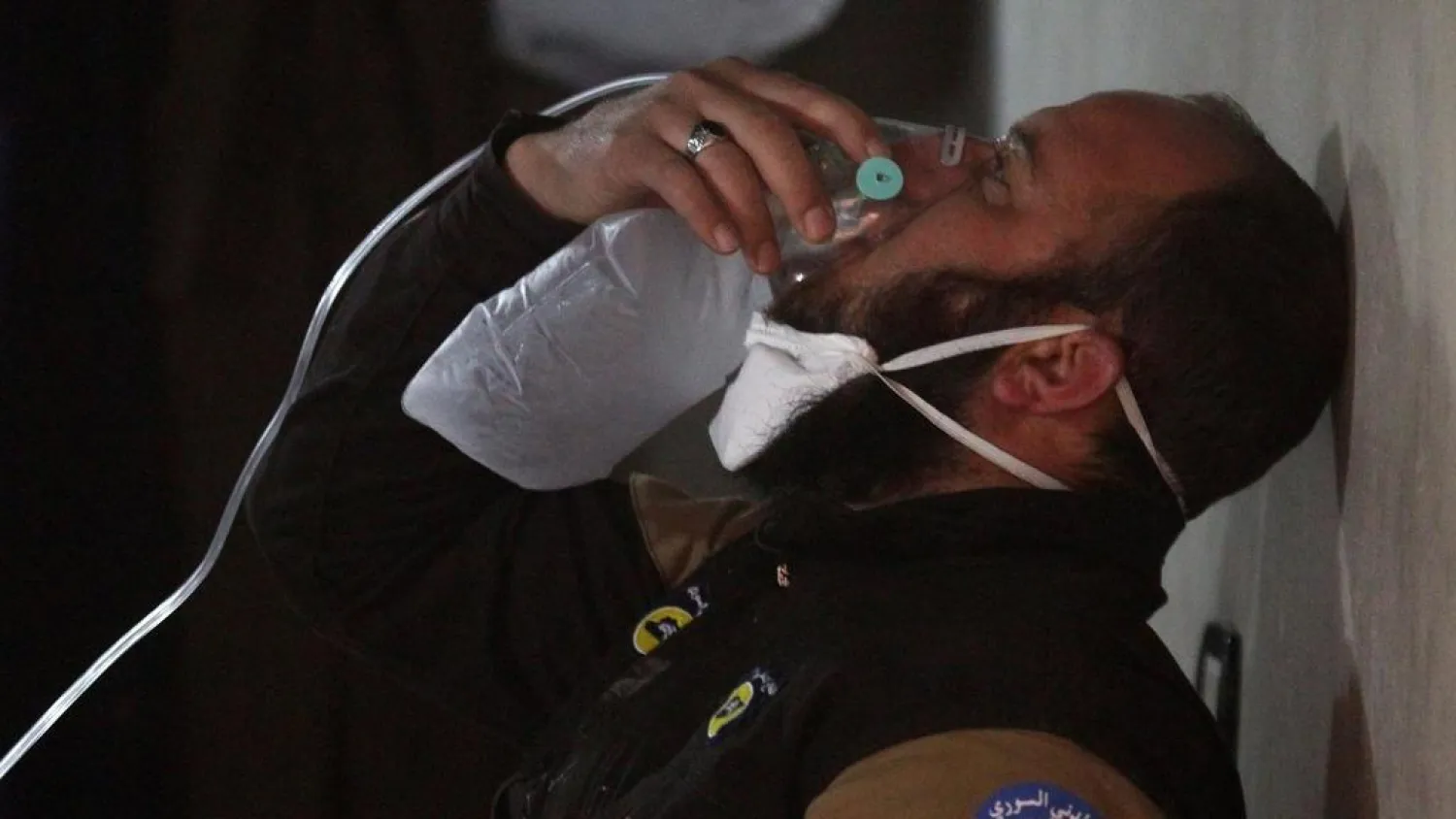
A Syrian civil defense member breathes through an oxygen mask, after a chemical attack on the town of Khan Sheikhoun, Idlib province, on April 4, 2017. (Reuters)
TT

Moscow Opposes Extending Mandate of UN Chemical Arms Inquest in Syria

A Syrian civil defense member breathes through an oxygen mask, after a chemical attack on the town of Khan Sheikhoun, Idlib province, on April 4, 2017. (Reuters)

Russia announced on Wednesday that it opposes a draft United Nations resolution on extending the mandate of the international inquiry into chemical weapons attacks in Syria, Deputy Foreign Minister Sergei Ryabkov said.

His comments came hours after Russia rejected a report by the international inquiry blaming the Syrian government for a deadly toxic gas attack, casting doubt on the UN Security Council’s ability to extend the investigation’s mandate before it expires next week.

Russia and the United States have circulated rival resolutions to extend the experts' body, known as the Joint Investigative Mechanism, or JIM. Its mandate expires November 14.

“I stress that we are in no way raising the question of ending this structure’s activities,” Ryabkov stated.

“We are in favor of its maintenance, but on a different basis,” he added.

The draft UN resolution by the United States says Syria must not develop or produce chemical weapons, and it calls on all parties in Syria to provide full cooperation with the international probe.

The investigation found that Syrian President Bashar al-Assad’s regime was to blame for a chemical attack on the opposition-held town of Khan Sheikhoun that killed dozens of people in April, according to a report sent to the Security Council on October 26.

Russia, whose air force and special forces have bolstered the Syrian regime forces, has said there is no evidence to show Damascus was responsible for the attack. Moscow maintains that the chemicals that killed civilians belonged to rebels, not Assad’s government.

Russia last month cast a veto at the United Nations Security Council against renewing the investigation’s mandate.

US Ambassador Nikki Haley told the Security Council that a revised US draft circulated Tuesday included some points from the Russian draft, including the importance of high standards and sound evidence.

But she said Russia continues "to push unacceptable language only meant to undermine the investigators and divide this council."

Assistant Secretary General Edmond Mulet, who heads the JIM, told the council how experts reached their conclusions, including finding that the chemistry of the sarin used in Khan Sheikhoun was very likely to have been made from the same precursor, called DF, as the sarin in Syria's original stockpile.

Mulet said the Security Council has "a unique responsibility" to deter all those using chemical weapons and "end the use of such weapons forever."

"I understand the political issues surrounding the situation in the Syrian Arab Republic," he said. "However, this is not a political issue about the lives of innocent civilians. Impunity must not prevail."

Russia's deputy UN ambassador, Vladimir Safronkov, was sharply critical of the JIM and the report, especially the experts' failure to visit Khan Sheikhoun, which Mulet said was for security reasons.

Safronkov derided the JIM for not pinpointing specific responsibility, asking: Is "an entire state is responsible?"

He also complained that "while some continue to try to find this mythical or invented chemical weapons in Damascus, the region is seeing an increasing threat of chemical terrorism" that isn't being addressed.

Deputy British Ambassador Jonathan Allen said Russia has advanced multiple theories about the Khan Sheikhoun attack, and when one gets debunked Moscow goes with something else.

"It's one of the great tragedies that Russia is a country with hugely respected and impressive scientists, but also a country of great fiction writers," he told several reporters. "And unfortunately the scientists of Russia are being ignored and the fiction writers are being indulged."

Allen called Russia's draft resolution to renew the JIM mandate "a cynical ploy to discredit a professional, independent and impartial body."



UN Says It Risks Halting Somalia Aid Due to Funding Cuts 

A Somali trader marks watermelons for sale at an open-air grocery market as Muslims start the fasting month of Ramadan, the holiest month in the Islamic calendar, within Bakara market in Mogadishu, Somalia, February 18, 2026. (Reuters)
TT

UN Says It Risks Halting Somalia Aid Due to Funding Cuts 

A Somali trader marks watermelons for sale at an open-air grocery market as Muslims start the fasting month of Ramadan, the holiest month in the Islamic calendar, within Bakara market in Mogadishu, Somalia, February 18, 2026. (Reuters)

The UN's World Food Program (WFP) warned Friday it would have to stop humanitarian assistance in Somalia by April if it did not receive new funding.

The Rome-based agency said it had already been forced to reduce the number of people receiving emergency food assistance from 2.2 million in early 2025 to just over 600,000 today.

"Without immediate funding, WFP will be forced to halt humanitarian assistance by April," it said in a statement.

In early January, the United States suspended aid to Somalia over reports of theft and government interference, following the destruction of a US-funded WFP warehouse in the capital Mogadishu's port.

The US announced a resumption of WFP food distribution on January 29.

However, all UN agencies have warned of serious funding shortfalls since Washington began slashing aid across the world following President Donald Trump's return to the White House last year.

"The situation is deteriorating at an alarming rate," said Ross Smith, WFP Director of Emergency Preparedness and Response, in Friday's statement.

"Families have lost everything, and many are already being pushed to the brink. Without immediate emergency food support, conditions will worsen quickly.

"We are at the cusp of a decisive moment; without urgent action, we may be unable to reach the most vulnerable in time, most of them women and children."

Some 4.4 million people in Somalia are facing crisis-levels of food insecurity, according to the WFP, the largest humanitarian agency in the country.

The Horn of Africa country has been plagued by conflict and also suffered two consecutive failed rainy seasons.


Hamas Says Path for Gaza Must Begin with End to ‘Aggression’ 

Makeshift tents of displaced Palestinian families among the ruins of their homes at sunset during the holy month of Ramadan in Jabaliya northern Gaza Strip on, 19 February 2026. (EPA)
TT

Hamas Says Path for Gaza Must Begin with End to ‘Aggression’ 

Makeshift tents of displaced Palestinian families among the ruins of their homes at sunset during the holy month of Ramadan in Jabaliya northern Gaza Strip on, 19 February 2026. (EPA)

Discussions on Gaza's future must begin with a total halt to Israeli "aggression", the Palestinian movement Hamas said after US President Donald Trump's Board of Peace met for the first time.

"Any political process or any arrangement under discussion concerning the Gaza Strip and the future of our Palestinian people must start with the total halt of aggression, the lifting of the blockade, and the guarantee of our people's legitimate national rights, first and foremost their right to freedom and self-determination," Hamas said in a statement Thursday.

Trump's board met for its inaugural session in Washington on Thursday, with a number of countries pledging money and personnel to rebuild the Palestinian territory, more than four months into a fragile ceasefire between Israel and Hamas.

Israeli Prime Minister Benjamin Netanyahu has insisted however that Hamas must disarm before any reconstruction begins.

"We agreed with our ally the US that there will be no reconstruction of Gaza before the demilitarization of Gaza," Netanyahu said.

The Israeli leader did not attend the Washington meeting but was represented by his foreign minister Gideon Saar.

Trump said several countries had pledged more than seven billion dollars to rebuild the territory.

Muslim-majority Indonesia will take a deputy commander role in a nascent International Stabilization Force, the unit's American chief Major General Jasper Jeffers said.

Trump, whose plan for Gaza was endorsed by the UN Security Council in November, also said five countries had committed to providing troops, including Morocco, Kazakhstan, Kosovo and Albania.


Official Contacts Aim to Keep Lebanon out of War on Iran as Israel Raises Readiness on Northern Front 

This photograph shows a memorial for slain Lebanese Hezbollah longtime leader Hassan Nasrallah at the entrance of the southern village of Qannarit on February 16, 2026. (AFP)
TT

Official Contacts Aim to Keep Lebanon out of War on Iran as Israel Raises Readiness on Northern Front 

This photograph shows a memorial for slain Lebanese Hezbollah longtime leader Hassan Nasrallah at the entrance of the southern village of Qannarit on February 16, 2026. (AFP)

Israel has raised the alert level of its military along the border with Lebanon, raising questions that Lebanon’s south may again be involved in a regional confrontation should the US attack Iran.

Given the heightened tensions between the US and Iran, questions have been asked over whether Hezbollah will become involved in a new war. Its Secretary-General Sheikh Naim Qassem had recently announced that the party will not remain on the side if Iran is attacked.

On the ground, Israel blew up houses in southern Lebanon border towns and carried out air strikes in the south. Israeli military spokesman Avichay Adraee said the raids targeted “Hezbollah infrastructure,” including arms caches and rocket launchers.

Their presence in the south is a violation of current agreements, he added.

Amid the high regional tensions, Israel’s Maariv quoted a military source as saying that the army has come up with plans, including a preemptive strike against Hezbollah, which would drag the south and the whole of Lebanon into a new war.

Ministerial sources told Asharq Al-Awsat that the presidency has been carrying out internal and foreign contacts since Thursday morning to keep Lebanon out of any escalation.

Hezbollah had launched a “support front” war against Israel a day after Hamas’ October 7, 2023 attack. In 2024, the war spiraled into an all-out conflict, with Israel decimating the Hezbollah leadership and severely weakening the party.

Israel believes that Hezbollah has been rebuilding its capabilities since the ceasefire that was struck in November 2024.

Kassim Kassir, a political analyst who is close to Hezbollah, told Asharq Al-Awsat: “No one knows what Hezbollah will do because the situation is tied the extent of the attack, should it happen.”

He noted that Qassem was ambiguous when he said the party will decide what to do when the time is right, but at any rate, he stressed that the party will not remain on the sidelines or abandon Iran.

“No one knows what Hezbollah’s abilities are, so everything is possible,” Kassir said.

Riad Kahwaji, a security and defense affairs expert, said he does not rule out the possibility that Hezbollah would join the war should the US attack Iran.

Speaking to Asharq Al-Awsat, he stressed that Iran is now the United States’ main target, when previously it used to confront its proxies.

It has now taken the fight directly to the heart of the problem, which is the Iranian regime, he remarked.

The extent of the military mobilization in the region and the frequent American statements about regime change all indicate that a major military operation may be imminent, he added.

Israel’s military also favors preemptive operations, so it is watching Hezbollah, which remains Iran’s most powerful regional proxy despite the blows it received in 2024 war, Kahwaji said.

Hezbollah still possesses a rocket arsenal that can threaten Israel, he remarked.

Israel’s high level of alert on the border with Lebanon could be in readiness for any development. Should Tel Aviv receive word from Washington that it intends to attack Iran, then it could launch operations against Hezbollah as part of preemptive strikes aimed at preventing the party from launching attacks against it, Kahwaji said.

“As long as Hezbollah possesses heavy weapons, such as rockets, and drones, that it has not handed over to the army, then Lebanon will continue to be vulnerable to attacks in the next confrontation. It will be exposed to Israeli strikes as long as this issue remains unresolved,” he added.