
Louvre Abu Dhabi Director: We Brought Together All the Riches of French Museums

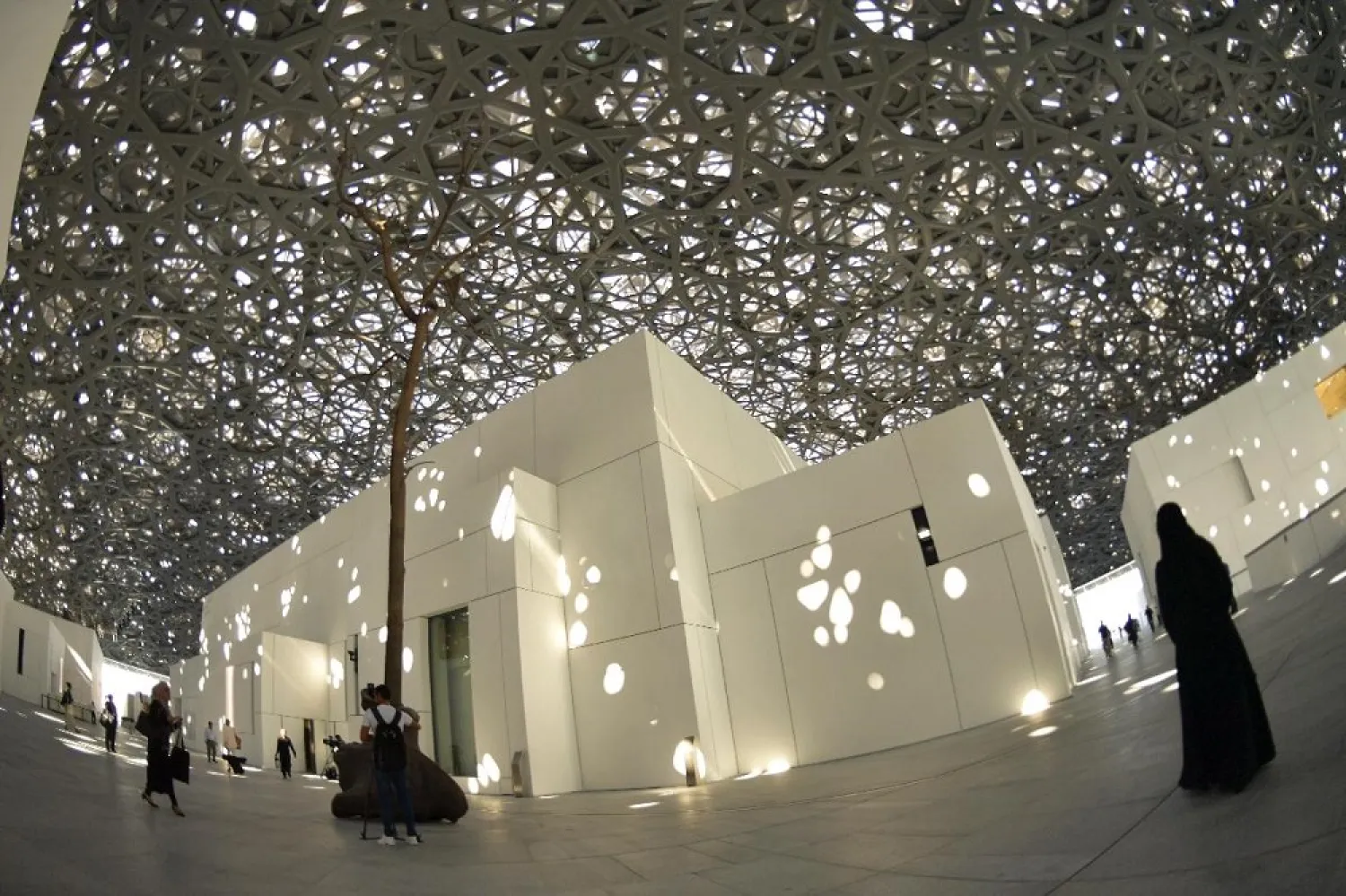
A general view shows part of the Louvre Abu Dhabi Museum designed by French architect Jean Nouvel in Abu Dhabi. (AFP)
TT

Louvre Abu Dhabi Director: We Brought Together All the Riches of French Museums

A general view shows part of the Louvre Abu Dhabi Museum designed by French architect Jean Nouvel in Abu Dhabi. (AFP)

Louvre Abu Dhabi director Manuel Rabaté said that the museum brings together the riches of all the French museums.

Speaking to Asharq Al-Awsat, he stated that the Paris Louvre spirit in its vastness and international inclusiveness is very well represented at the Abu Dhabi edition.

Paris’ Louvre is organized by departments, disciplines and culture.

But when Louvre Abu Dhabi was in the making, it was designed to resonate with the modern 21st century.

Rabaté explained that the new architectural design and exhibitions layout have not only successfully contained international culture, but also managed to span all eras.

"From the idea of ​​containing the world, we have kept the story of the world and history, but had it extend to contain all civilizations in all times,” he said.

In France, after visiting the Louvre your quest for art will need you to make a few more stops. For more modern works, you will go to the Musée d'Orsay. To check out contemporary works, you will go to The Centre Pompidou. For books, maps and documents, you should visit the National Library of France.

All the richness that French museums have to offer has been made available at one location, the Louvre Abu Dhabi.

Its uniqueness is based on an overarching vision of artistic creation. Museums traditionally organize their collections by school, technique and materials, and while this approach does highlight the unique characteristics of a series, it does nothing to show the influences, exchanges and circulation of ideas and know-how.

The Louvre Abu Dhabi’s unique exhibition design explores the connections between civilizations and cultures that may, at first, appear to be far separated by time and geography.

Visitors will be guided through a chronological and theme-based display, traversing different periods and civilizations. The display picks out universal themes and common influences to illustrate the similarities that grow out of a shared human experience, beyond any geographical, historical or cultural boundaries. The result is a truly universal museum.

The Louvre Abu Dhabi is the result of an unprecedented initiative that laid the groundwork for a new type of cultural collaboration of unparalleled scope between two countries, centered on the creation of a national institution.

Born out of an intergovernmental agreement signed on March 6, 2007, between the United Arab Emirates and France, the Louvre Abu Dhabi is the first universal museum in the Arab world. It brings the Louvre name to Abu Dhabi and presents both ancient and contemporary works of historic, cultural and sociological interest from around the world.

The agreement involves twelve French public cultural establishments.

Commenting on architect Jean Nouvel's remarkable creation, Rabaté said that there is a philosophical aspect to the building.

The dome welcomes the visitor and extends a worldwide invitation, he added.


Austria Turns Hitler’s Home into a Police Station

Workers are finishing works at the birth house of former German dictator Adolf Hitler that is turned into a police station, pictured on February 17, 2026 in Braunau am Inn, Austria. (AFP)
TT

Austria Turns Hitler’s Home into a Police Station

Workers are finishing works at the birth house of former German dictator Adolf Hitler that is turned into a police station, pictured on February 17, 2026 in Braunau am Inn, Austria. (AFP)

Turning the house where Adolf Hitler was born into a police station has raised mixed emotions in his Austrian hometown.

"It's a double-edged sword," said Sibylle Treiblmaier, outside the house in the town of Braunau am Inn on the border with Germany.

While it might discourage far-right extremists from gathering at the site, it could have "been used better or differently", the 53-year-old office assistant told AFP.

The government wants to "neutralize" the site and passed a law in 2016 to take control of the dilapidated building from its private owner.

Austria -- which was annexed by Hitler's Germany in 1938 -- has repeatedly been criticized in the past for not fully acknowledging its responsibility in the Holocaust.

The far-right Freedom Party, founded by former Nazis, is ahead in the polls after getting the most votes in a national election for the first time in 2024, though it failed to form a government.

Last year, two streets in Braunau am Inn commemorating Nazis were renamed after years of complaints by activists.

- 'Problematic' -

The house where Hitler was born on April 20, 1889, and lived for a short period of his early life, is right in the center of town on a narrow shop-lined street.

A memorial stone in front reads: "For Peace, Freedom and Democracy. Never Again Fascism. Millions of Dead Warn."

When AFP visited this week, workers were putting the finishing touches to the renovated facade.

Officers are scheduled to move in during "the second quarter of 2026", the interior ministry said.

But for author Ludwig Laher, a member of the Mauthausen Committee Austria that represents Holocaust victims, "a police station is problematic, as the police... are obliged, in every political system, to protect what the state wants".

An earlier idea to turn the house into a place where people would come together to discuss peace-building had "received a lot of support", he told AFP.

Jasmin Stadler, a 34-year-old shop owner and Braunau native, said it would have been interesting to put Hitler's birth in the house in a "historic context", explaining more about the house.

She also slammed the 20-million-euro ($24-million) cost of the rebuild.

- 'Bit of calm' -

But others are in favor of the redesign of the house, which many years ago was rented by the interior ministry and housed a center for people with disabilities before it fell into disrepair.

Wolfgang Leithner, a 57-year-old electrical engineer, said turning it into a police station would "hopefully bring a bit of calm", avoiding it becoming a shrine for far-right extremists.

"It makes sense to use the building and give it to the police, to the public authorities," he said.

The office of Braunau's conservative mayor declined an AFP request for comment.

Throughout Austria, debate on how to address the country's Holocaust history has repeatedly flared.

Some 65,000 Austrian Jews were killed and 130,000 forced into exile during Nazi rule.


Virus Kills Dozens of Tigers in Thailand Park

Animal rights group PETA Asia says tigers live in 'misery', urging tourists to stay away from private parks. Mladen ANTONOV / AFP/File
TT

Virus Kills Dozens of Tigers in Thailand Park

Animal rights group PETA Asia says tigers live in 'misery', urging tourists to stay away from private parks. Mladen ANTONOV / AFP/File

A deadly virus and bacterial infection have killed at least 72 tigers at a private animal park in Thailand's north in recent weeks, authorities said.

The provincial livestock office in Chiang Mai said in a statement on Friday that testing detected the highly infectious canine distemper virus as well as bacteria affecting the respiratory system, said AFP.

"When tigers fall ill, it is more difficult to detect than in animals like cats or dogs. By the time we realized they were sick, it was already too late," Somchuan Ratanamungklanon, director of the national livestock department, told local media.

The park where the deaths occurred, Tiger Kingdom, could not be reached for comment on Saturday.

Its website advertises a chance for visitors to touch and take photos with the big cats.

"These tigers died the way they lived -- in misery, confinement and fear," animal rights organization PETA Asia told AFP.

"If tourists stayed away, these places would quickly become unprofitable, and tragedies like this would be far less likely to happen," the group added.


What Is ALS, the Disease That Killed Actor Eric Dane?

US actor Eric Dane speaks about his ALS diagnosis during a news conference to discuss health insurance at the Department of Health and Human Services Headquarters in Washington, DC, on June 23, 2025. (AFP)
TT

What Is ALS, the Disease That Killed Actor Eric Dane?

US actor Eric Dane speaks about his ALS diagnosis during a news conference to discuss health insurance at the Department of Health and Human Services Headquarters in Washington, DC, on June 23, 2025. (AFP)

Eric Dane, known for his roles on "Grey’s Anatomy" and "Euphoria," died this week from amyotrophic lateral sclerosis at age 53.

The fatal nervous system disease, also known as Lou Gehrig’s disease, killed Dane less than a year after he announced his diagnosis.

According to the Centers for Disease Control and Prevention, ALS is rare. In 2022, there were nearly 33,000 estimated cases, say researchers, who project that cases will rise to more than 36,000 by 2030.

The disease is slightly more common in men than in women and tends to strike in midlife, between the ages of 40 and 60.

Here’s what to know.

What is ALS? It affects nerve cells in the brain and spinal cord, causing loss of muscle control and getting worse over time.

ALS causes nerve cells in the upper and lower parts of the body to stop working and die. Nerves no longer trigger specific muscles, eventually leading to paralysis. People with ALS may develop problems with mobility, speaking, swallowing and breathing.

The exact cause of the disease is unknown, and Mayo Clinic experts said a small number of cases are inherited.

It’s called Lou Gehrig’s disease after the Hall of Fame New York Yankees player. Gehrig was diagnosed with ALS in 1939 on his 36th birthday, died in 1941 and was the face of ALS for decades.

What are some signs of ALS? Experts say the first symptoms are often subtle. The disease may begin with muscle twitching and weakness in an arm or leg.

Over time, muscles stop acting and reacting correctly, said experts at University of California San Francisco Health. People may lose strength and coordination in their arms and legs; feet and ankles may become weak; and muscles in the arms, shoulders and tongue may cramp or twitch. Swallowing and speaking may become difficult and fatigue may set in.

The ability to think, see, hear, smell, taste and touch are usually not affected, UCSF experts said.

Eventually, muscles used for breathing may become paralyzed. Patients may be unable to swallow and inhale food or saliva. Most people with ALS die of respiratory failure.

How is ALS diagnosed and treated? The disease is difficult to diagnose because there’s no test or procedure to confirm it. Generally, doctors will perform a physical exam, lab tests and imaging of the brain and spinal cord.

A doctor may interpret certain things as signs of ALS, including an unusual flexing of the toes, diminished fine motor coordination, painful muscle cramps, twitching and spasticity, a type of stiffness causing jerky movements.

There’s no known cure for ALS, but the drug riluzole has been approved for treatment. According to the Mayo Clinic, it may extend survival in the early stages of the disease or extend the time until a breathing tube is needed.

Another much-debated drug, Relyvrio, was pulled from the US market by Amylyx Pharmaceuticals in 2024. Its development had been financed, in part, by the ALS Association, the major beneficiary of the 2014 " ice bucket challenge " viral phenomenon.

Other medications are sometimes prescribed to help control symptoms.

Choking is common as ALS progresses, so patients may need feeding tubes. People may also use braces, wheelchairs, speech synthesizers or computer-based communication systems.

After the onset of the disease, experts say patients may survive from two years to a decade. Most people live from two to five years after symptoms develop, and about a fifth live more than five years after they are diagnosed.