

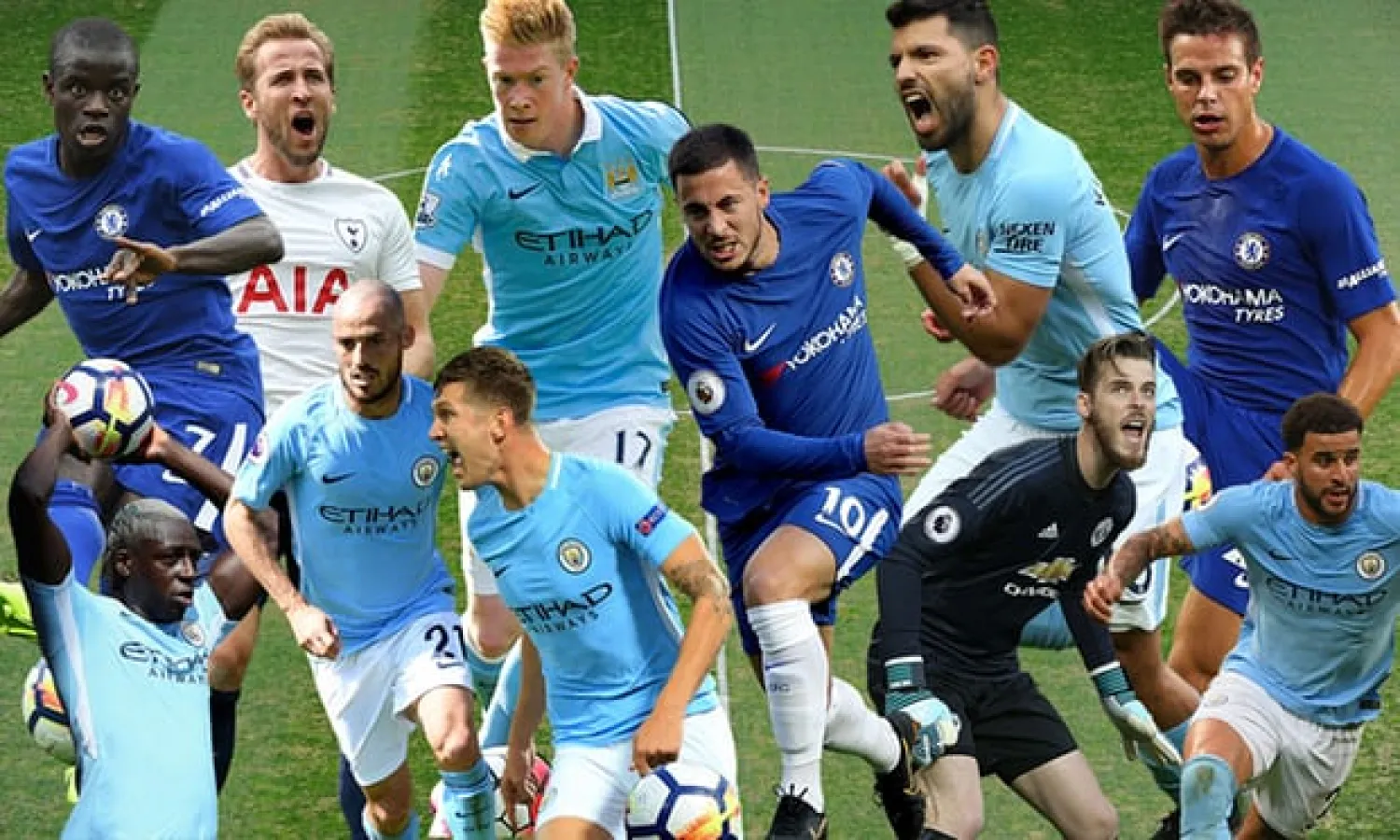

A Premier League All-Star Xi: Young, Energetic, Upwardly Mobile

 Clockwise from top left: Kanté, Kane, De Bruyne, Hazard, Agüero, Azpilicueta, Walker, De Gea, Stones, Silva and Mendy. Photograph: Getty Images Sport
Clockwise from top left: Kanté, Kane, De Bruyne, Hazard, Agüero, Azpilicueta, Walker, De Gea, Stones, Silva and Mendy. Photograph: Getty Images Sport
TT

A Premier League All-Star Xi: Young, Energetic, Upwardly Mobile

 Clockwise from top left: Kanté, Kane, De Bruyne, Hazard, Agüero, Azpilicueta, Walker, De Gea, Stones, Silva and Mendy. Photograph: Getty Images Sport
Clockwise from top left: Kanté, Kane, De Bruyne, Hazard, Agüero, Azpilicueta, Walker, De Gea, Stones, Silva and Mendy. Photograph: Getty Images Sport

When Andy Warhol was asked his opinion on photography he replied: “My idea of a good picture is one that’s in focus and of a famous person.” No doubt Warhol would have found a lot to like about Fifa’s The Best awards, which took place in London last month, and featured a swarm of very famous footballers looking glossed and styled and engaged as ever in an unofficial competition to source and procure the most appalling plum-coloured velveteen triple-sequinned dinner jacket available to mankind.

This year The Best also featured a famous football photograph. In its own way it is a defining image of a certain era, the selfie taken by the host, Idris Elba, that managed to cram all 11 members of Fifa’s team of the year in front of the same camera lens.

Looking at that picture various thoughts occur immediately. Firstly, from Neymar to Gianluigi Buffon this is clearly a very decent era for top level footballers. Secondly nobody puts Cristiano in the corner (he’ll smile for now, but there will be consequences and this isn’t over). Thirdly none of them play in the Premier League or are likely to in the near future. And finally quite a few of those bedded-in megastars are pretty old these days.

The last two of these, taken together, are significant. As the league season takes its final autumn break there is the usual rush to divvy up and take stock of the state of the footballing nation. Teams of the season so far have been drawn up, new arrivals ranked, early player of the year contenders flagged.

In England we have become used to the fact the wider awards process, the best of The Best, no longer touches our league, a feeling the real star presences are located elsewhere. Only one solely Premier League-based player (Wayne Rooney) has been in the Fifa team of the year in the past eight seasons. Luis Suárez didn’t get a spot until he left for Barcelona. Even when Chelsea won the Champions League in 2012 Ashley Cole, who was brilliant that year, lost out to the immovable Marcelo.

It is hard to argue with this. The Fifa team is voted on by footballers around the world. This isn’t a stitch-up or a fix. It is a measure of star wattage, of established pedigree, of the disorientating brilliance of the Messi-Ronaldo godhead, and the footballing success of La Liga.

And yet there is a chance we might be about to enter a new cycle this season. Given the Premier League’s riches it was always likely the balance might alter a little. What is interesting is the way this has begun to happen.

There are two things here. Firstly, after a fallow few years there really is a rising tide of quality in the Premier League. Kevin De Bruyne, player of the season so far, is as good as any playmaker in Europe right now. Harry Kane is an elite centre-forward, fit for any club side anywhere. The level has risen, the gap closed, to the extent that a Premier League XI could at least hold its own a little against Fifa’s best efforts.

So, let’s have a go then. A Premier League best XI from the calendar year might look a bit like this: David De Gea; Kyle Walker, John Stones, César Azpilicueta, Benjamin Mendy; N’Golo Kanté, David Silva, Kevin De Bruyne; Eden Hazard, Harry Kane, Sergio Agüero.

Again this is not an attempt at a definitive, forensic ranking. It is instead an all-star team, the kind of XI the FIFPro process would spew out, selected to the same standards of gloss and prestige and sustained success. There will be the usual outrage at absences, slights, the focus on “the big six”. Plenty of other players would be in the reckoning for a genuine best XI: Sead Kolasinac, James Tarkowski, Sadio Mané, Leroy Sané, Dele Alli, Gabriel Jesus, Christian Eriksen, Raheem Sterling, Marcus Rashford, Mo Salah, Philippe Coutinho, Wilfred Zaha, Marcus Rashford, Ederson and Paul Pogba if he gets going again.

But this is the other thing about the Premier League’s rising tide of talent. The best players are almost exclusively younger players, certainly compared to the Elba selfie crew, whose average age is 32. By contrast only David Silva of all the Premier League players listed above has hit 30.

Some disclaimers here. There are obviously stellar young players in every other league around Europe. Borussia Dortmund bow to no man when it comes to processing elite youth footballers. Spain continues to produce exhilarating talent. France has a frightening depth of young players. Plus of course the Premier League still does not produce its own, but buys pretty much everything in from outside

But the league is providing a stage and a finishing school. That buying power has been applied to this demographic, and to good effect. Seven of the 25 current Golden Boy nominees are signed to English clubs, more than any other league. Liverpool, Tottenham and Manchester United have three of the four youngest squads in the division, with Chelsea and Manchester City also in the top nine, making it the only league in Europe where youth corresponds to points.

There are probably some textural reasons for this. The Premier League is a draining, bruising place. It makes sense that younger players should thrive there. This is a sensible buyer’s policy, not least when elsewhere the aristocrats of the European game are ageing together, kept aloft by their own star power, by the fact sports science and extreme financial rewards will allow careers to be extended at the very top.

Real Madrid have benefited from stability in recent years, the fact there is nowhere for their best players to be lured away to, while elsewhere in Europe every other promising clique of players is raided and picked off every summer.

But this might just have passed into something else now. The midfield was overrun by Tottenham at Wembley last week. Their best players have aged together, as have those at Barcelona. Bayern Munich are still rebuilding. For the first time in some time there are no unassailable superstar XIs in the Champions League. Perhaps come the next all-star Fifa selfie – give it another Ballon D’Or, one more lionising of the La Liga supremacy – we might just see a few Premier League-based faces gleaming in the glow of the old giants.

The Guardian Sport


Mexico City Suspends Classes, Shifts to Remote Work for World Cup Kickoff

 Souvenirs shaped like the FIFA World Cup trophy are displayed for sale on a street in Mexico City on June 8, 2026. (AFP)
Souvenirs shaped like the FIFA World Cup trophy are displayed for sale on a street in Mexico City on June 8, 2026. (AFP)
TT

Mexico City Suspends Classes, Shifts to Remote Work for World Cup Kickoff

 Souvenirs shaped like the FIFA World Cup trophy are displayed for sale on a street in Mexico City on June 8, 2026. (AFP)
Souvenirs shaped like the FIFA World Cup trophy are displayed for sale on a street in Mexico City on June 8, 2026. (AFP)

Mexico's President Claudia Sheinbaum on Tuesday issued a decree ordering federal workers in the capital to work from home on June 11 and suspending school classes to ease traffic ‌during FIFA World ‌Cup opening ‌events.

The decree aims ⁠to improve urban mobility and road safety as Mexico City hosts the World Cup opening match and accompanying ⁠events on June 11.

The ‌opening events are expected ‌to draw significant numbers of ‌visitors.

Federal agencies must implement remote work schemes for Mexico City-based staff, with ‌exceptions for essential services including healthcare, security, critical ⁠infrastructure ⁠and World Cup operations.

Schools from preschool through university, both public and private, will close for the day under the decree.

The government also urged private companies to adopt similar remote work arrangements.


Iran Football Body Claims Fans’ Tickets for World Cup Games in the US Have Been Revoked

 Reza Mansoori (R) and Mostafa Pourmanda, Iranian supporters living in San Diego and staying at the same hotel as Iran's national football team, cheer for their team in Tijuana, Mexico, on June 8, 2026, ahead of the FIFA 2026 World Cup football tournament. (AFP)
Reza Mansoori (R) and Mostafa Pourmanda, Iranian supporters living in San Diego and staying at the same hotel as Iran's national football team, cheer for their team in Tijuana, Mexico, on June 8, 2026, ahead of the FIFA 2026 World Cup football tournament. (AFP)
TT

Iran Football Body Claims Fans’ Tickets for World Cup Games in the US Have Been Revoked

 Reza Mansoori (R) and Mostafa Pourmanda, Iranian supporters living in San Diego and staying at the same hotel as Iran's national football team, cheer for their team in Tijuana, Mexico, on June 8, 2026, ahead of the FIFA 2026 World Cup football tournament. (AFP)
Reza Mansoori (R) and Mostafa Pourmanda, Iranian supporters living in San Diego and staying at the same hotel as Iran's national football team, cheer for their team in Tijuana, Mexico, on June 8, 2026, ahead of the FIFA 2026 World Cup football tournament. (AFP)

FIFA has revoked the ticket allocation for Iran fans at the team’s three World Cup games in the United States, the national soccer federation claimed Tuesday.

Each federation for the 48 teams taking part is entitled to receive and distribute 8% of stadium capacity at the World Cup, adding up to several thousands of tickets for each game.

Just days before Iran opens its World Cup — on June 15 at the Los Angeles Rams’ stadium in Inglewood against New Zealand — the federation claimed in a statement reported by semi-official state media that it was now unable to provide any tickets to its supporters.

FIFA was approached for comment.

The claim adds to the turmoil between Iranian soccer, FIFA and tournament co-host the US, which began military attacks on Iran on Feb. 28.

Iran’s team is now based in the Mexican border city of Tijuana instead of its pre-war plan to train in Tucson, Arizona.

Some federation officials also have been denied visas to enter the US, where Iran also plays Belgium in Inglewood on June 21 and then Egypt in Seattle on June 26.

Federations of World Cup teams typically sell their ticket allocation to the most loyal fans who attend games at home and away.

Iran residents were subject to a travel ban by the US government since last year and were unlikely to get entry visas for the World Cup. It was unclear how many tickets in Iran’s allocation were sold since the tournament draw was made in December to the country's diaspora including in the US.

Still, FIFA president Gianni Infantino stated in 2017 — when US football officials were preparing a co-hosting bid with Canada and Mexico they won the following year — that fans must have access to the tournament.

“It’s obvious when it comes to FIFA competitions as well (that) any team, including the supporters and the officials of that team, who would qualify for a World Cup need to have access to the country, otherwise there is no World Cup,” Infantino said nine years ago. “That is obvious.”

A FIFA-appointed match referee from Somalia was denied entry to the US in Miami at the weekend and on Monday he was ruled out of taking part in the 104-game tournament that starts on Thursday.


World Cup Nears Kickoff after Pre-tournament Turbulence

The World Cup will kick off in the Estadio Azteca in Mexico City. Carl DE SOUZA / AFP
TT

World Cup Nears Kickoff after Pre-tournament Turbulence

The World Cup will kick off in the Estadio Azteca in Mexico City. Carl DE SOUZA / AFP

The World Cup kicks off on Thursday with FIFA betting that the enduring appeal of the greatest footballing show on earth can rise above anger at soaring ticket prices, an uneasy political climate in Donald Trump's America and the shadow of conflict in the Middle East.

A record 48 teams and millions of fans are set to descend on the United States, Canada and Mexico for the first ever World Cup co-hosted by three nations, the largest and most logistically complex edition of the tournament ever staged.

The action gets under way at Mexico City's iconic Estadio Azteca on Thursday, with co-hosts Mexico taking on South Africa at 3:00 pm local time (1900 GMT), launching a sprawling, nearly six-week-long spectacle that will culminate in the final at New Jersey's 82,500-seat MetLife Stadium on July 19.

Can Lionel Messi, at the age of 38, settle any lingering debate about his status as the greatest player of all time by leading Argentina to a second consecutive World Cup title?

Or can Messi's great rival, the 41-year-old Cristiano Ronaldo, defy father time by inspiring a talented Portugal team to its maiden World Cup win?

Or will England, led by Harry Kane, finally end the country's 60-year wait for a second major international championship following their lone 1966 World Cup victory?

Those questions and more will be answered over the course of a tournament that Gianni Infantino, the president of world football's governing FIFA, has bullishly hyped as "the greatest show that the planet has ever seen."

- Ticket fury -

Yet Infantino's breezy optimism has run into hurricane-force headwinds of skepticism during a build-up dogged by concerns over affordability, politics and conflict.

The skyrocketing cost of tickets to the tournament has triggered a global backlash which has left FIFA and Infantino struggling to mount a convincing public relations defense.

The most expensive ticket for the 2022 World Cup final cost around $1,600 at face value; in 2026 the most expensive face value ticket being sold by FIFA is an eye-watering $32,970.

That kind of inflation has been prevalent across the tournament's 104 matches, where seats for many games remain available on secondary re-sale markets despite huge demand.

Even Infantino's staunch ally, Donald Trump, has balked at the cost, reacting with surprise when told of the $1,000 price tag for tickets to the USA's opening game with Paraguay in Los Angeles on Friday -- the first game on US soil.

"I wouldn't pay it either, to be honest with you," the US president told the New York Post.

While fans absorb the expense of travel to the tournament, other critics have questioned whether the World Cup party will be soured by the political climate in the United States.

Human Rights Watch says Trump's crackdowns on immigration, demonstrations and press freedom could lead to a World Cup defined by "exclusion and fear."

Those fears were fueled Monday when FIFA dropped a Somali referee from the World Cup after he was denied entry to the United States.

Omar Artan was set to be the first match official from Somalia to referee at a global finals, but he was turned back when he arrived at Miami International Airport on Saturday.

FIFA said it was powerless to influence the decision and announced it had omitted Artan from its 52-strong referees roster.

The US-Israel military strikes launched against Iran in February have also loomed large over the tournament, where Iran are due to play three group games in the United States, starting with their opener against New Zealand on June 15.

Trump initially suggested Iran should withdraw from the tournament for their own "life and safety" before walking back his rhetoric.

Iran meanwhile have switched their base camp from Tucson, Arizona to the Mexican city of Tijuana, where they touched down early Sunday.

While Iran's players are free to travel in and out of the United States, some 15 administrative and management staff have been denied visas by US authorities in a move Iranian authorities have condemned as "deliberate and discriminatory treatment."

- Expanded field -

On the field, the decision to expand the tournament to 48 teams -- up from 32 in 2022 -- is likely to strip the group stage of any sense of jeopardy.

A total of 72 first-round matches will be needed to eliminate just 12 teams, with 32 advancing to the knockout rounds -- the top two finishers in each of the 12 first ground groups along with the eight best third-place finishers.

The tournament will see a range of other innovations.

For the first time in World Cup history, every game will feature cooling breaks in the middle of each half, a measure designed to mitigate the effects of searing heat and humidity expected at many of the tournament's 16 venues.

Players and referees will need to adjust to several new rules being rolled out at the World Cup, including teams being required to make substitutions inside 10 seconds to prevent time-wasting.

A crackdown on racist abuse will see players risk a red card for covering their mouth with a hand, arm or shirt during a confrontation with an opponent.

Next month's final, meanwhile, could well be the longest on record due to the decision to stage a Super Bowl-style halftime show, headlined by Madonna, Shakira and BTS.

The show means the half-time interval will be stretched from the traditional 15 minutes to around 25 minutes.
