

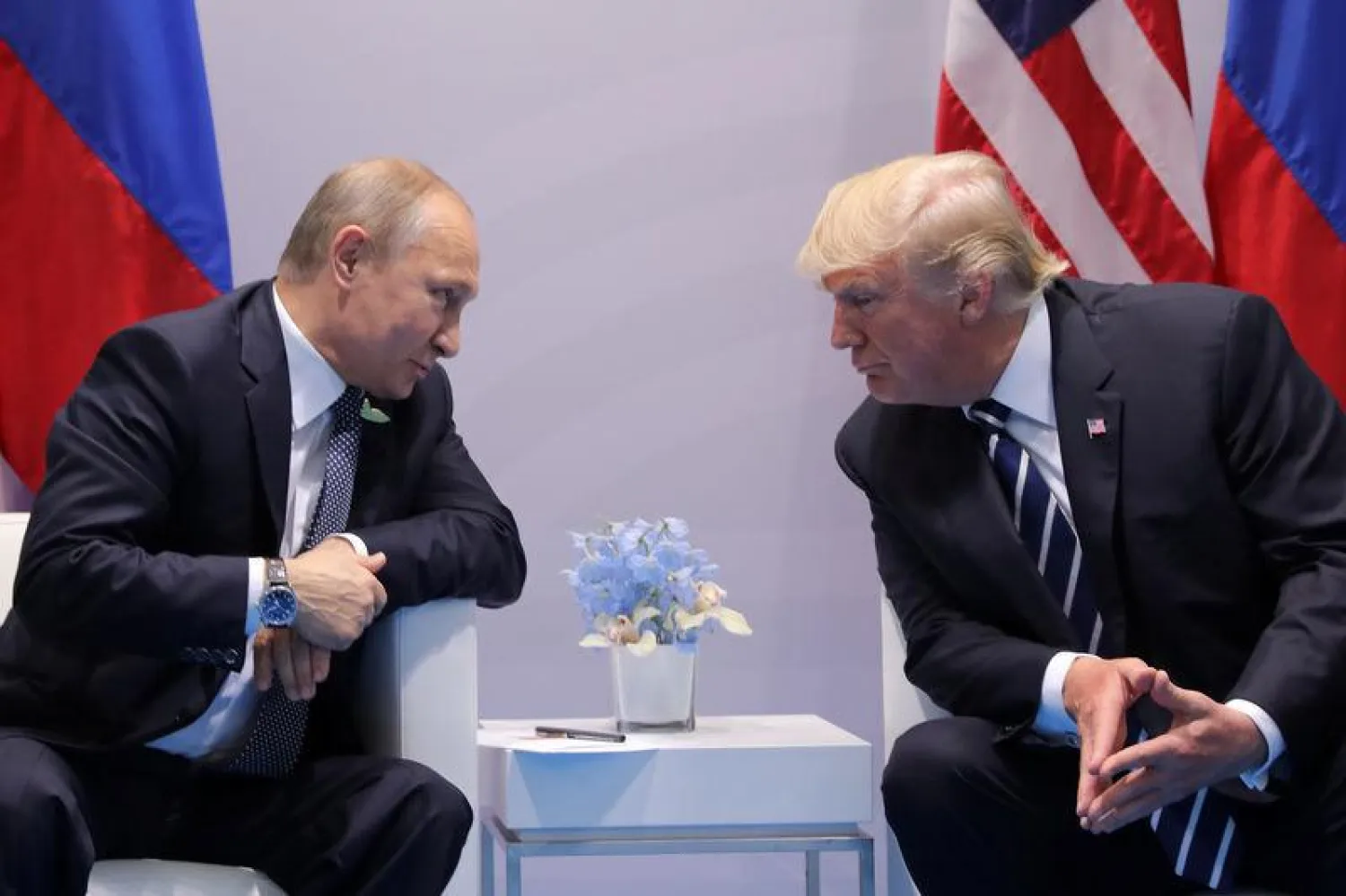

8 Remarks on Trump-Putin Agreement: US Flexibility to Ensure Military Presence

U.S. President Donald Trump speaks with Russian President Vladimir Putin during their bilateral meeting. REUTERS/Carlos Barria
TT

8 Remarks on Trump-Putin Agreement: US Flexibility to Ensure Military Presence

U.S. President Donald Trump speaks with Russian President Vladimir Putin during their bilateral meeting. REUTERS/Carlos Barria

With Russia’s blessing, US will extend the US forces’ presence in east Syria after ISIS has been defeated. In return, it will facilitate the Russian political solution announced days before.

The joint statement announced in Washington and Moscow between US President Donald Trump and Russian President Vladimir Putin following their meeting on the margins of the Asia-Pacific Economic Cooperation (APEC) in Da Nang, Vietnam, showed US flexibility and joint understanding on a new reference for the solution of Syrian crisis is within constitutional reforms and not a new constitution.

According to Western officials, there are right remarks on the Trump-Putin joint statement which included:

First: De-confliction and dividing powers: Putin and Trump agreed to maintain open military channels of communication between military professionals to help ensure the safety of both US and Russian forces and de-confliction of partnered forces engaged in the fight against ISIS.

Both leaders confirmed these efforts will be continued until ISIS is defeated.

The agreement, coordinated between a center in Amman and Hmaymeem base, succeeded in preventing any collusion between the two armies and air forces during the battles east of Syria. It also ensured the control of Arab-Kurdish Syrian Democratic Forces on Raqqa and east of Euphrates River, and regime forces and their allies in Der Ezzor and west of Euphrates.

However, Washington is worried about the destiny of its forces in Syria after ISIS is defeated, something the Moscow is beginning to consider an illegal presence.

This could be considered a Russian –US political admittance of division of power: east of Euphrates for US’ allies, west of Euphrates for Russia’s allies. Noticeably, the statement affirmed the leaders’ commitment to Syria’s sovereignty, unity, independence, territorial integrity, and non-sectarian character, as defined in UNSCR 2254.

Two: No Military Solution:

The statement stated that there is no military solution to the conflict in Syria, and both presidents confirmed that the “ultimate political solution to the conflict must be forged through the Geneva process pursuant to UNSCR 2254.”

This affirms Trump administration’s decision to end CIA’s secret program to train opposition factions in Jordan and Turkey which ends this year. This comes as a part of the US’ plan to drop its plan to “change the regime”, which was reported previously by the former US Secretary of State John Kerry during his meetings with Russian officials.

The US succeeded, according to reports, in adding the statement that ensures the Geneva process and Resolution 2253.

Thirdly, the statement didn’t mention the Syrian National Dialogue that was expected to be held in Sochi, Russia this month. It did however, state that the solution will be in the final stage of Geneva Convention according to Resolution 2254.

Fourth, the statement “also took note of President Assad’s recent commitment to the Geneva process and constitutional reform and elections as called for under UNSCR 2254.”

Based on information, US insisted on adding Geneva process and UNSR 2254 to the Russian draft of the statement.

“The two Presidents affirmed that these steps must include full implementation of UNSCR 2254, including constitutional reform and free and fair elections under UN supervision, held to the highest international standards of transparency, with all Syrians, including members of the diaspora, eligible to participate,” added the statement.

US Secretary of State Rex Tillerson said following his talks with UN Special Envoy for Syria Staffan de Mistura, President Bashar al-Assad and his family have no role in the future of Syria.

“It is our view and I have said this many times as well that we do not believe that there is a future for the Assad regime and Assad family. The reign of the Assad family is coming to an end. The only issue is how that should that be brought about,” Tillerson told reporters.

Five, Political Transition: the statement didn’t refer to political transition or 2012 Geneva statement, but it didn’t include two things: the clause on forming a non-sectarian system, and establishing a new constitution.

Six: Syrian Diaspora: the statement only referred to right of “all Syrians, including members of the diaspora, eligible to participate” in the elections.

“During the 2015 Vienna process, Russia suggested that Syrian refugees could participate in the elections under the UN supervision,” said a diplomat. However, Moscow succeeded in convincing Washington in accepting the suggestions.

Seven: US interest in Iran’s militias and Hezbollah: “President Trump and President Putin confirmed the importance of de-escalation areas as an interim step to reduce violence in Syria, enforce ceasefire agreements, facilitate unhindered humanitarian access, and set the conditions for the ultimate political solution to the conflict,” read the statement.

The two presidents reviewed the progress on the ceasefire in southwest Syria that was finalized the last time the two Presidents met in Hamburg, Germany on July 8, and welcomed the Memorandum of Principles concluded in Amman, Jordan, on November 8.

The memorandum reinforces the success of the ceasefire initiative, to include: “reduction and ultimate elimination of foreign forces and foreign fighters from the area to ensure a more sustainable peace.”

The statement is referring here to the Nujaba Movement and Hezbollah between Damscus, Jordanian border, and Golan Heights.

Finally, the statement unveiled Washington’s bet on Russia’s attempt to reduce Iran’s influence in Syria and withdrawal of its forces from south of the Country.

Some Western officials welcomed the joint statement considering it a political agreement between two countries to support the political process in Geneva, while others doubted its necessity saying that the upcoming negotiations will not discuss political transition but rather focus on: how to amend the constitution? Will the elections be parliamentary or presidential? Will the elections be done soon or in 2021? Will Assad participate? What is the role of the international monitoring? Who are Syrians in diaspora who will participate in the elections?



UN Says It Risks Halting Somalia Aid Due to Funding Cuts 

A Somali trader marks watermelons for sale at an open-air grocery market as Muslims start the fasting month of Ramadan, the holiest month in the Islamic calendar, within Bakara market in Mogadishu, Somalia, February 18, 2026. (Reuters)
TT

UN Says It Risks Halting Somalia Aid Due to Funding Cuts 

A Somali trader marks watermelons for sale at an open-air grocery market as Muslims start the fasting month of Ramadan, the holiest month in the Islamic calendar, within Bakara market in Mogadishu, Somalia, February 18, 2026. (Reuters)

The UN's World Food Program (WFP) warned Friday it would have to stop humanitarian assistance in Somalia by April if it did not receive new funding.

The Rome-based agency said it had already been forced to reduce the number of people receiving emergency food assistance from 2.2 million in early 2025 to just over 600,000 today.

"Without immediate funding, WFP will be forced to halt humanitarian assistance by April," it said in a statement.

In early January, the United States suspended aid to Somalia over reports of theft and government interference, following the destruction of a US-funded WFP warehouse in the capital Mogadishu's port.

The US announced a resumption of WFP food distribution on January 29.

However, all UN agencies have warned of serious funding shortfalls since Washington began slashing aid across the world following President Donald Trump's return to the White House last year.

"The situation is deteriorating at an alarming rate," said Ross Smith, WFP Director of Emergency Preparedness and Response, in Friday's statement.

"Families have lost everything, and many are already being pushed to the brink. Without immediate emergency food support, conditions will worsen quickly.

"We are at the cusp of a decisive moment; without urgent action, we may be unable to reach the most vulnerable in time, most of them women and children."

Some 4.4 million people in Somalia are facing crisis-levels of food insecurity, according to the WFP, the largest humanitarian agency in the country.

The Horn of Africa country has been plagued by conflict and also suffered two consecutive failed rainy seasons.


Hamas Says Path for Gaza Must Begin with End to ‘Aggression’ 

Makeshift tents of displaced Palestinian families among the ruins of their homes at sunset during the holy month of Ramadan in Jabaliya northern Gaza Strip on, 19 February 2026. (EPA)
TT

Hamas Says Path for Gaza Must Begin with End to ‘Aggression’ 

Makeshift tents of displaced Palestinian families among the ruins of their homes at sunset during the holy month of Ramadan in Jabaliya northern Gaza Strip on, 19 February 2026. (EPA)

Discussions on Gaza's future must begin with a total halt to Israeli "aggression", the Palestinian movement Hamas said after US President Donald Trump's Board of Peace met for the first time.

"Any political process or any arrangement under discussion concerning the Gaza Strip and the future of our Palestinian people must start with the total halt of aggression, the lifting of the blockade, and the guarantee of our people's legitimate national rights, first and foremost their right to freedom and self-determination," Hamas said in a statement Thursday.

Trump's board met for its inaugural session in Washington on Thursday, with a number of countries pledging money and personnel to rebuild the Palestinian territory, more than four months into a fragile ceasefire between Israel and Hamas.

Israeli Prime Minister Benjamin Netanyahu has insisted however that Hamas must disarm before any reconstruction begins.

"We agreed with our ally the US that there will be no reconstruction of Gaza before the demilitarization of Gaza," Netanyahu said.

The Israeli leader did not attend the Washington meeting but was represented by his foreign minister Gideon Saar.

Trump said several countries had pledged more than seven billion dollars to rebuild the territory.

Muslim-majority Indonesia will take a deputy commander role in a nascent International Stabilization Force, the unit's American chief Major General Jasper Jeffers said.

Trump, whose plan for Gaza was endorsed by the UN Security Council in November, also said five countries had committed to providing troops, including Morocco, Kazakhstan, Kosovo and Albania.


Official Contacts Aim to Keep Lebanon out of War on Iran as Israel Raises Readiness on Northern Front 

This photograph shows a memorial for slain Lebanese Hezbollah longtime leader Hassan Nasrallah at the entrance of the southern village of Qannarit on February 16, 2026. (AFP)
TT

Official Contacts Aim to Keep Lebanon out of War on Iran as Israel Raises Readiness on Northern Front 

This photograph shows a memorial for slain Lebanese Hezbollah longtime leader Hassan Nasrallah at the entrance of the southern village of Qannarit on February 16, 2026. (AFP)

Israel has raised the alert level of its military along the border with Lebanon, raising questions that Lebanon’s south may again be involved in a regional confrontation should the US attack Iran.

Given the heightened tensions between the US and Iran, questions have been asked over whether Hezbollah will become involved in a new war. Its Secretary-General Sheikh Naim Qassem had recently announced that the party will not remain on the side if Iran is attacked.

On the ground, Israel blew up houses in southern Lebanon border towns and carried out air strikes in the south. Israeli military spokesman Avichay Adraee said the raids targeted “Hezbollah infrastructure,” including arms caches and rocket launchers.

Their presence in the south is a violation of current agreements, he added.

Amid the high regional tensions, Israel’s Maariv quoted a military source as saying that the army has come up with plans, including a preemptive strike against Hezbollah, which would drag the south and the whole of Lebanon into a new war.

Ministerial sources told Asharq Al-Awsat that the presidency has been carrying out internal and foreign contacts since Thursday morning to keep Lebanon out of any escalation.

Hezbollah had launched a “support front” war against Israel a day after Hamas’ October 7, 2023 attack. In 2024, the war spiraled into an all-out conflict, with Israel decimating the Hezbollah leadership and severely weakening the party.

Israel believes that Hezbollah has been rebuilding its capabilities since the ceasefire that was struck in November 2024.

Kassim Kassir, a political analyst who is close to Hezbollah, told Asharq Al-Awsat: “No one knows what Hezbollah will do because the situation is tied the extent of the attack, should it happen.”

He noted that Qassem was ambiguous when he said the party will decide what to do when the time is right, but at any rate, he stressed that the party will not remain on the sidelines or abandon Iran.

“No one knows what Hezbollah’s abilities are, so everything is possible,” Kassir said.

Riad Kahwaji, a security and defense affairs expert, said he does not rule out the possibility that Hezbollah would join the war should the US attack Iran.

Speaking to Asharq Al-Awsat, he stressed that Iran is now the United States’ main target, when previously it used to confront its proxies.

It has now taken the fight directly to the heart of the problem, which is the Iranian regime, he remarked.

The extent of the military mobilization in the region and the frequent American statements about regime change all indicate that a major military operation may be imminent, he added.

Israel’s military also favors preemptive operations, so it is watching Hezbollah, which remains Iran’s most powerful regional proxy despite the blows it received in 2024 war, Kahwaji said.

Hezbollah still possesses a rocket arsenal that can threaten Israel, he remarked.

Israel’s high level of alert on the border with Lebanon could be in readiness for any development. Should Tel Aviv receive word from Washington that it intends to attack Iran, then it could launch operations against Hezbollah as part of preemptive strikes aimed at preventing the party from launching attacks against it, Kahwaji said.

“As long as Hezbollah possesses heavy weapons, such as rockets, and drones, that it has not handed over to the army, then Lebanon will continue to be vulnerable to attacks in the next confrontation. It will be exposed to Israeli strikes as long as this issue remains unresolved,” he added.