

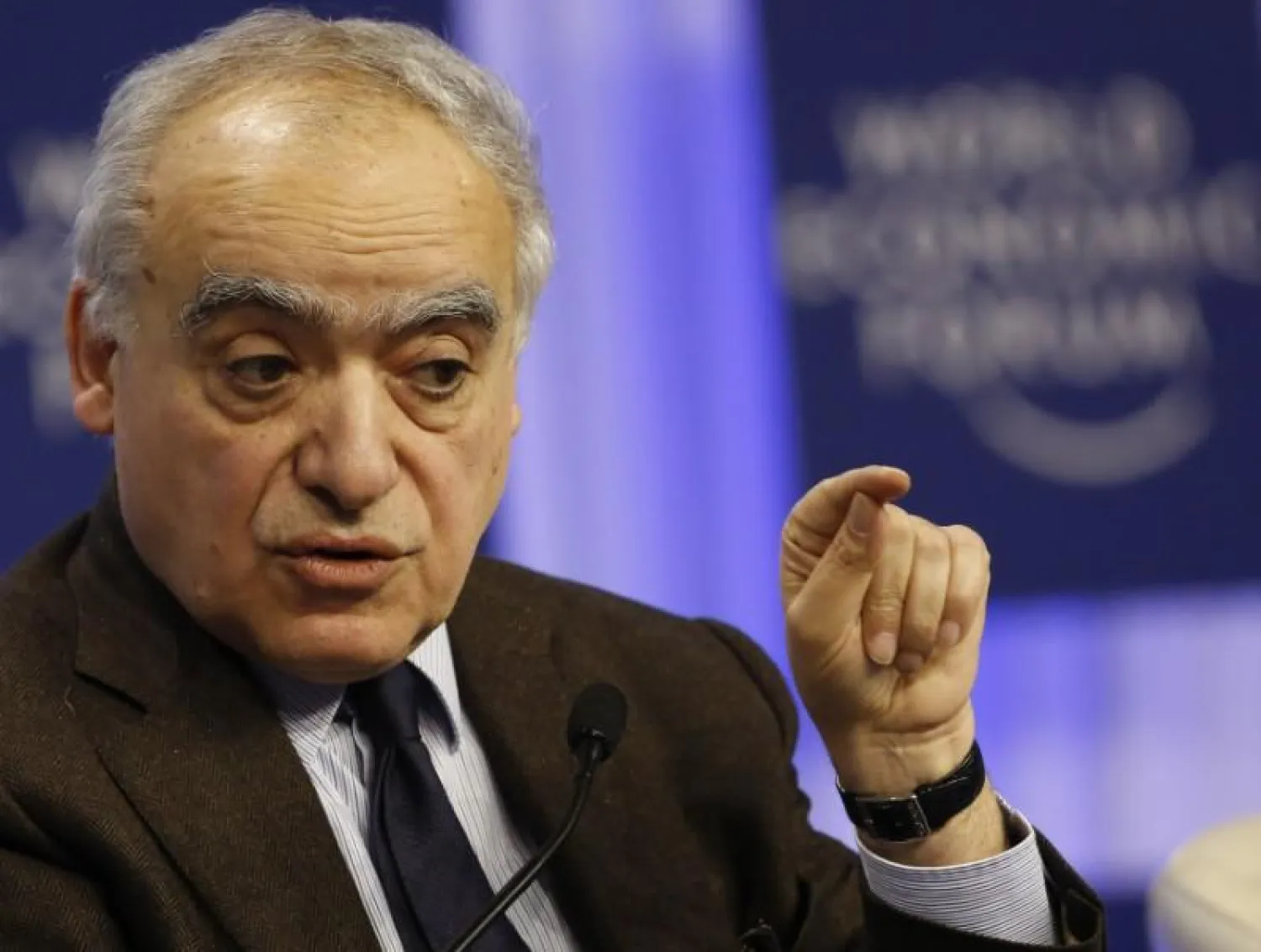

UN Envoy Salameh: Libya Not Ready to Hold Elections at the Moment

UN envoy to Libya Ghassan Salemeh attends a session at the annual meeting of the World Economic Forum. (Reuters)
TT

UN Envoy Salameh: Libya Not Ready to Hold Elections at the Moment

UN envoy to Libya Ghassan Salemeh attends a session at the annual meeting of the World Economic Forum. (Reuters)

United Nations envoy to Libya Ghassan Salameh said that the country’s future is determined by its own institutions, adding that the preconditions for holding legislative and presidential elections are not currently available.

The 66-year-old Lebanese-born academic told AFP in an interview that if state institutions can begin to work, Libya will finally change course after years of chaos since the fall of Muammar Gadhafi in 2011.

“The key to my approach is institutions,” Salameh said. “If in a year or two, we can began to reunite, revive and liberate institutions, then the country will be on a different path.”

A UN-mediated political deal in 2015 was supposed to unite Libya, but the country remains divided between a government in Tripoli that enjoys UN support and a rival authority based in Tobruk in the east.

Salameh said shoring up Libya’s institutions means stepping away from “the basic competition between individuals, who tell you they represent big tribes until you discover that they represent very little.”

Under Gadhafi, Libya was devoid of functioning state institutions as the leader “cemented his power by systematically destroying institutions.”

In his action plan, the UN envoy hopes to set a course to elections, by beginning voter registration in December and convening a national conference in February to draw a consensus about elections.

It remains unclear whether Libya will hold presidential, legislative and local elections at the same time and no timetable has been set for the polls.

“I haven’t decided yet,” said Salameh. “The country is not ready for any election. For elections to be held, there are technical, political and security conditions that have to be met. None of these are currently there.”

A referendum on a new constitution is also planned, said the former Lebanese culture minister.

Salameh insists that elections in Libya must not deepen divisions.

“The thing that leaves me panicked is the idea that we could hold elections that would create a third parliament and the same result for the government,” he said.

On the other hand, the evacuation of foreign employees from southern Libya after four of their colleagues were kidnapped has stalled work to complete a power station in the city of Ubari.

Extra electricity supply is badly needed in Libya, where there have been frequent power cuts in recent years because of rising demand and the degradation of infrastructure linked to political and economic turmoil in the oil-rich nation.

Three Turks and one South African working at the plant were abducted while traveling by road from Ubari airport on November 3. It is not clear who carried out the kidnapping.

Before the evacuation of the workers, the 600MW plant had been due for completion at the end of the year.

A delay in completion of the Ubari plant would defer the diversion of oil from Libya’s giant Sharara field to power it.

The plant was due to initially consume 30,000 bpd of crude oil, before ramping up to around 50,000 bpd, according to a Libyan oil source.



Egypt’s Prime Minister and FM Head to Washington for Trump Peace Council Meeting

Egyptian Foreign Minister Badr Abdelatty speaks during a joint press conference with Kenyan Prime Cabinet Secretary/Cabinet Secretary for Foreign Diaspora Affairs Musalia Mudavadi in Nairobi, Kenya, Monday, Feb. 16, 2026. (AP)
TT

Egypt’s Prime Minister and FM Head to Washington for Trump Peace Council Meeting

Egyptian Foreign Minister Badr Abdelatty speaks during a joint press conference with Kenyan Prime Cabinet Secretary/Cabinet Secretary for Foreign Diaspora Affairs Musalia Mudavadi in Nairobi, Kenya, Monday, Feb. 16, 2026. (AP)

Egypt's Prime Minister Mostafa Madbouly headed to Washington on Tuesday ‌to ‌participate in ‌the inaugural ⁠meeting of a "Board of Peace" established by US President Donald ⁠Trump, the ‌cabinet ‌said.

Madbouly is ‌attending ‌on behalf of President Abdel ‌Fattah al-Sisi and is accompanied by ⁠Foreign ⁠Minister Badr Abdelatty.

Foreign Minister Gideon Saar will represent Israel at the inaugural meeting, his office said on Tuesday.

Hamas, meanwhile, called on the newly-formed board to pressure Israel to halt what it described as ongoing violations of the ceasefire in Gaza.

The Board of Peace, of which Trump is the chairman, was initially designed to oversee the Gaza truce and the territory's reconstruction after the war between Hamas and Israel.

But its purpose has since morphed into resolving all sorts of international conflicts, triggering fears the US president wants to create a rival to the United Nations.

Saar will first attend a ministerial level UN Security Council meeting in New York on Wednesday, and on Thursday he "will represent Israel at the inaugural session of the board, chaired by Trump in Washington DC, where he will present Israel's position", his office said in a statement.

It was initially reported that Prime Minister Benjamin Netanyahu might attend the gathering, but his office said last week that he would not.

Ahead of the meeting, Hamas spokesman Hazem Qassem told AFP that the Palestinian movement urged the board's members "to take serious action to compel the Israeli occupation to stop its violations in Gaza".

"The war of genocide against the Strip is still ongoing -- through killing, displacement, siege, and starvation -- which have not stopped until this very moment," he added.

He also called for the board to work to support the newly formed Palestinian technocratic committee meant to oversee the day-to-day governance of post-war Gaza "so that relief and reconstruction efforts in Gaza can commence".

Announcing the creation of the board in January, Trump also unveiled plans to establish a "Gaza Executive Board" operating under the body.

The executive board would include Turkish Foreign Minister Hakan Fidan and Qatari diplomat Ali Al-Thawadi.

Netanyahu has strongly objected to their inclusion.

Since Trump launched his "Board of Peace" at the World Economic Forum in Davos in January, at least 19 countries have signed its founding charter.


Palestinian Child Dies After Stepping on Mine in West Bank

Israeli troops conduct a military raid in the village of Al-Yamoun, west of Jenin, West Bank, 17 February 2026. (EPA)
TT

Palestinian Child Dies After Stepping on Mine in West Bank

Israeli troops conduct a military raid in the village of Al-Yamoun, west of Jenin, West Bank, 17 February 2026. (EPA)

A Palestinian child died after stepping on a mine near an Israeli military camp in the occupied West Bank on Tuesday, the Palestinian Red Crescent said, with an Israeli defense ministry source confirming the death.

"Our crews received the body of a 13-year-old child who was killed after a mine exploded in one of the old camps in Jiftlik in the northern Jordan Valley," the Red Crescent said in a statement.

A source at COGAT, the Israeli defense ministry's agency in charge of civilian matters in the Palestinian territories, confirmed the death to AFP and identified the boy as Mohammed Abu Dalah, from the village of Jiftlik.

Israel's military had previously said in a statement that three Palestinians were injured "as a result of playing with unexploded ordnance", without specifying their ages.

It added that the area of the incident, Tirzah, is "a military camp in the area of the Jordan Valley", near Jiftlik and close to the Jordanian border.

"This area is a live-fire zone and entry into it is prohibited," the military said.

Jiftlik village council head Ahmad Ghawanmeh told AFP that three children, the oldest of whom was 16, were collecting herbs near the military base when they detonated a mine.

Jiftlik as well as the nearby Tirzah base are located in the Palestinian territory's Area C, which falls under direct Israeli control.

Israel has occupied the West Bank since 1967.

Much of the area near the border with Jordan -- which Israel signed a peace deal with in 1994 -- remains mined.

In January, Israel's defense ministry said it had begun demining the border area as part of construction works for a new barrier it says aims to stem weapons smuggling.


Hezbollah Rejects Disarmament Plan and Government’s Four-Month Timeline

29 July 2024, Iran, Tehran: Then Hezbollah deputy leader Sheikh Naim Qassem is pictured during a meeting in Tehran. (Iranian Presidency/dpa)
TT

Hezbollah Rejects Disarmament Plan and Government’s Four-Month Timeline

29 July 2024, Iran, Tehran: Then Hezbollah deputy leader Sheikh Naim Qassem is pictured during a meeting in Tehran. (Iranian Presidency/dpa)

Hezbollah rejected on Tuesday the Lebanese government's decision to grant the army at least four months to advance the second phase of a nationwide disarmament plan, saying it would not accept what it sees as a move serving Israel.

Lebanon's cabinet tasked the army in August 2025 with drawing up and beginning to implement a plan to bring all armed groups' weapons under state control, a bid aimed primarily at disarming Hezbollah after its devastating ‌war with ‌Israel in 2024.

In September 2025 the cabinet formally ‌welcomed ⁠the army's plan to ⁠disarm the Iran-backed Shiite party, although it did not set a clear timeframe and cautioned that the military's limited capabilities and ongoing Israeli strikes could hinder progress.

Hezbollah Secretary-General Sheikh Naim Qassem said in a speech on Monday that "what the Lebanese government is doing by focusing on disarmament is a major mistake because this issue serves the goals of Israeli ⁠aggression".

Lebanon's Information Minister Paul Morcos said during a press ‌conference late on Monday after ‌a cabinet meeting that the government had taken note of the army's monthly ‌report on its arms control plan that includes restricting weapons in ‌areas north of the Litani River up to the Awali River in Sidon, and granted it four months.

"The required time frame is four months, renewable depending on available capabilities, Israeli attacks and field obstacles,” he said.

Hezbollah lawmaker Hassan ‌Fadlallah said, "we cannot be lenient," signaling the group's rejection of the timeline and the broader approach to ⁠the issue of ⁠its weapons.

Hezbollah has rejected the disarmament effort as a misstep while Israel continues to target Lebanon, and Shiite ministers walked out of the cabinet session in protest.

Israel has said Hezbollah's disarmament is a security priority, arguing that the group's weapons outside Lebanese state control pose a direct threat to its security.

Israeli officials say any disarmament plan must be fully and effectively implemented, especially in areas close to the border, and that continued Hezbollah military activity constitutes a violation of relevant international resolutions.

Israel has also said it will continue what it describes as action to prevent the entrenchment or arming of hostile actors in Lebanon until cross-border threats are eliminated.