Granit Xhaka: ‘My Dad’s First Few Months In Jail Were Ok, Then The Beatings Started’

 Arsenal’s Granit Xhaka pictured in Camden, north London. ‘People probably don’t expect an Arsenal player to come to Camden Lock and, basically, be a normal guy.’ Photograph: Tom Jenkins for the Guardian
Arsenal’s Granit Xhaka pictured in Camden, north London. ‘People probably don’t expect an Arsenal player to come to Camden Lock and, basically, be a normal guy.’ Photograph: Tom Jenkins for the Guardian
TT

Granit Xhaka: ‘My Dad’s First Few Months In Jail Were Ok, Then The Beatings Started’

 Arsenal’s Granit Xhaka pictured in Camden, north London. ‘People probably don’t expect an Arsenal player to come to Camden Lock and, basically, be a normal guy.’ Photograph: Tom Jenkins for the Guardian
Arsenal’s Granit Xhaka pictured in Camden, north London. ‘People probably don’t expect an Arsenal player to come to Camden Lock and, basically, be a normal guy.’ Photograph: Tom Jenkins for the Guardian

It is the story that has shaped Granit Xhaka and fuelled the fires that rage inside him. The details are savage, barely comprehensible, and it is a wonder that the Arsenal midfielder can articulate them. Then again, like his father, Ragip – who spent three and a half years as a political prisoner in Yugoslavia – Xhaka is not a man who runs or hides.

“As far as I know, his first few months in jail were OK,” Xhaka says. “But then the beatings started.”

Xhaka Sr’s crime had been to take part in demonstrations against the communist central government in Belgrade. It was 1986 and he was a 22-year-old student at the university of Pristina in Kosovo, which was then an autonomous province in Yugoslavia. He would be arrested and summarily given a six-year sentence. Xhaka Sr shared a cell with four other men and he would be let out once every day – for 10 minutes.

“As his son, the story is something that touches me very deeply – it is really, really in my heart,” Xhaka says. “To describe my dad properly, you have to appreciate the full depth of it. It’s so tragic. I sometimes ask him: ‘Tell it to me again,’ but I still don’t think he has revealed all of it. There have always been silent moments where I’ve felt he has swallowed something and not spilled out the truth. Maybe it was just too much and he wanted to spare his kids all the grief.

“He was a proud Kosovarian and he thought they had a right to exist. He was standing up for their rights and they were basic democratic rights –necessities, such as being able to vote. It was not only him. There were other people arrested, including his uncle, who had been jailed a number of years earlier. He got 15 years. It was strictly political. My dad was asking: ‘Why aren’t we democrats here? We deserve to be democrats. We deserve to be heard.’”

To understand Xhaka is to understand his family; how they have suffered, how they have pulled together and worked tirelessly in order to overcome.

His guiding principles are loyalty and respect. When he commits to something or someone, he does so with body and soul – just like his father and just like his mother, Eli.

“One of the most revealing details about my parents is that they only got together three months before my dad’s arrest,” Xhaka says. “I have such an incredible respect for my mother. I have never heard of a woman being together with a man for three months – at that young age – and then waiting for him for three and a half years. My mother is just an incredible person.

“One of the strange things is we don’t know why my dad was released early from his sentence but he was let go at the same time as his uncle. None of the family knew about it until they turned up on the doorstep. My feeling is that they took a pact to go along with the prison rules, keeping their mouths shut and never causing any problems. This is why they released them because they thought: ‘There’s no problem with them any more.’ But I’m not sure about that.”

Xhaka’s parents knew that they needed a fresh start and, in 1990, they emigrated to Switzerland. Their first son, Taulant, would be born in Basel in 1991, with Granit following 18 months later. Taulant is now the key midfielder for the Swiss side Basel.

“My dad showed an incredible strength and Taulant and I have grown up with his mental strength,” Xhaka says. “We had this idol, this role model, who taught us that you have to be strong to achieve things. So we grew up very strong. It’s why on the pitch, we have this mental strength to get over things and really go for it.”

Xhaka owes everything to Switzerland, and the opportunities he was afforded there, but he cannot and will not forget his Kosovo-Albanian roots, which continue to touch him in London. During the photoshoot for this interview in Camden Town, an Albanian passer-by almost walks into the canal after he recognises Xhaka. He is thrilled when Xhaka acknowledges him in Albanian.

“I’ve found a few really nice Albanian people here,” Xhaka says. “Some of them run a car-wash and I take mine in there. We chat and, of course, it’s mainly about football. Some of them support Liverpool, some Manchester United and there are a lot of Arsenal fans. There is a lot of joking and competition.”

Xhaka lives in Barnet with his wife, Leonita, but they have found their home-from-home in Camden – one of the capital’s more eclectic neighbourhoods. They go there a couple of times each week – to browse the market, shop, eat and just chill out.

“I feel a connection to Camden that takes me back to my childhood,” Xhaka says. “When Taulant and I were kids, we had our first trip on a bus from Basel to Pristina so that we could visit our grandparents for the first time. My mum and dad had full-time jobs and, on top of that, they worked at night as office cleaners, and they saved up the money for our tickets. The bus stopped in various places and I saw all of these markets, which Camden now reminds me of. There was also the market in Basel.

“I am a very simple man, I love normality and I love normal people. I love to eat normal food. It’s how I grew up. In Camden, it’s just the atmosphere that gets me. It’s simple, it’s nice, it’s real. And it’s the people, too. I like to interact with them because they are normal and I am normal. People probably don’t expect an Arsenal player to come to Camden Lock and, basically, be a normal guy.”

Xhaka is stopped by Charles, a Nigeria-born, Arsenal-supporting Londoner and, it has to be said, his opening gambit does not sound overly friendly.

“You’re a good player, but …” Charles starts. Here we go. He goes on to argue that what Xhaka needs is a more skilful player in front of him, ideally Eden Hazard from Chelsea. “I’d much rather have him than Alexis Sánchez,” Charles adds.

In his fourth language – behind German, Albanian and French – Xhaka does not quite catch everything that Charles says and he later asks for clarification. But Xhaka is interested and engaging. He knows that everybody is a critic and there is no escaping the fact that, right now, Arsenal have plenty of them.

They lie sixth in the Premier League table, three places and four points below Tottenham Hotspur, whom they entertain in the derby at Emirates Stadium on Saturday lunchtime. Their local rivals are flying but that is not the only reason why everything has come to feel so fraught at Arsenal.

Many Arsenal fans cannot see how the club can win the title again under Arsène Wenger and with the current squad, and their misgivings erupt whenever there is a defeat. It adds up to a climate of negativity, in which the principal upside of a victory appears to be that crisis is kept at bay. How can the players perform to their maximum in such circumstances?

“We deserved to be criticised after we failed to qualify for the Champions League last season,” Xhaka says. “Normally – and certainly for me – the critics make you stronger but I believe that, for some Arsenal players, these critics are not good. They are not helping them.

“Personally, I can handle criticism, especially when it is deserved, and it’s because my dad never, ever said ‘well done’ to me. He did it on purpose so that I kept my feet on the ground. With us, it’s been a lot of little things; it’s never a big thing [that goes wrong]. After the 0-0 draw at Chelsea in September, I thought: ‘OK. We can build up from here.’ But then we see the 2-1 defeat at Watford and you start doubting yourself.”

At Vicarage Road, Xhaka was criticised for switching off for Tom Cleverley’s stoppage-time winner and, afterwards, the Watford striker Troy Deeney accused the Arsenal players of having no cojones. “I don’t know Troy Deeney personally but this has to do with respect,” Xhaka says. “If he believes we don’t have cojones, he can come to our locker room and see for himself.”

Xhaka hates to lose. When it happens, it is no exaggeration to say that he is overtaken by self-loathing. According to Leonita, it is impossible to speak to him for up to an hour after the final whistle. Do others in the Arsenal dressing room take it as personally?

“Sometimes, it’s difficult for me to come down,” Xhaka says. “I focus a lot of our defeats on myself. What did I do wrong? I never criticise my team-mates before I’ve looked at myself. I’ve been that way since I was a kid. Do I put too much pressure on myself? Definitely. And it’s getting worse as I get older. When I was younger, I never put as much thought into a defeat as I do now.”

Xhaka has polarised opinion since his arrival from Borussia Mönchengladbach in the summer of last year. His champions laud his anticipation and the way that he reads the game, together with the range and vision of his passing. No Premier League midfielder made more successful passes than Xhaka last season and he sits third on the Opta list this time out. He was outstanding in Arsenal’s FA Cup final win over Chelsea last May, showing what can happen when he and the team click but, on the other hand, he has been criticised for reckless tackling and defensive errors.

Xhaka was sent off twice for Arsenal last season, the first for a trip on Swansea City’s Mo Barrow, when he clearly intended to take a yellow card before regrouping; the second for a lunge at Burnley’s Steven Defour. “I thought football in England was supposed to be a lot tougher,” Xhaka says.

“I accept the Burnley decision but not Swansea. I was more surprised than angry at first. I’ve always watched the Premier League and I think a lot of fouls that are whistled for today were not given in the past.”

Xhaka is a ball-playing No8 rather than a destructive No6 but the lines have sometimes been blurred with him; partly because of his full-blooded commitment and chequered disciplinary record, partly because of how the Arsenal support have yearned for a defensive midfield general. Xhaka needs to be cherished for what he is rather than lamented for what he is not.

“I’d actually describe myself as a fake No10 – in other words, a No10 that plays further back,” Xhaka says. “But I do think I’m a two-sided player. I am very confident that I have certain skills in world football but I am also a dedicated fighter.”

Xhaka can look forward to the World Cup finals at the end of the season, after Switzerland qualified with their play-off victory over Northern Ireland. The principal talking point was the terrible penalty decision that gave Switzerland the only goal of the two-leg tie and it was put to Xhaka that the controversy had taken some of the shine off the qualification.

“Who cares about that?” he says. “We were the better team over the two games. Obviously, it wasn’t a penalty but we created enough chances. When we played Manchester City before the international break, they scored with an offside goal but nobody went on about it like this. It was a mistake but you must accept it.”

Xhaka’s pragmatism extends to the visit of Tottenham. “No one has to tell us to be motivated,” he says. “It’s the game of the year and you have to win it. It’s not about beautiful football and there can be no excuses. You simply have to win.”

The Guardian Sport


Ukraine's Officials to Boycott Paralympics over Russian Flag Decision

Milano Cortina 2026 Winter Olympics - Skeleton - Interview with Ukraine Youth and Sports minister Matvii Bidnyi - N H Hotel, Milan, Italy - February 12, 2026 Ukraine Youth and Sports Minister Matvii Bidnyi speaks after the disqualification of Ukrainian skeleton racer Vladyslav Heraskevych from the Winter Games. REUTERS/Kevin Coombs
TT

Ukraine's Officials to Boycott Paralympics over Russian Flag Decision

Milano Cortina 2026 Winter Olympics - Skeleton - Interview with Ukraine Youth and Sports minister Matvii Bidnyi - N H Hotel, Milan, Italy - February 12, 2026 Ukraine Youth and Sports Minister Matvii Bidnyi speaks after the disqualification of Ukrainian skeleton racer Vladyslav Heraskevych from the Winter Games. REUTERS/Kevin Coombs

Ukrainian officials will boycott the Paralympic Winter Games, Kyiv said Wednesday, after the International Paralympic Committee allowed Russian athletes to compete under their national flag.

Ukraine also urged other countries to shun next month's Opening Ceremony in Verona on March 6, in part of a growing standoff between Kyiv and international sporting federations four years after Russia invaded.

Six Russians and four Belarusians will be allowed to take part under their own flags at the Milan-Cortina Paralympics rather than as neutral athletes, the Games' governing body confirmed to AFP on Tuesday.

Russia has been mostly banned from international sport since Moscow invaded Ukraine. The IPC's decision triggered fury in Ukraine.

Ukraine's sports minister Matviy Bidny called the decision "outrageous", and accused Russia and Belarus of turning "sport into a tool of war, lies, and contempt."

"Ukrainian public officials will not attend the Paralympic Games. We will not be present at the opening ceremony," he said on social media.

"We will not take part in any other official Paralympic events," he added.

Ukrainian Foreign Minister Andriy Sybiga said he had instructed Kyiv's ambassadors to urge other countries to also shun the opening ceremony.

"Allowing the flags of aggressor states to be raised at the Paralympic Games while Russia's war against Ukraine rages on is wrong -- morally and politically," Sybiga said on social media.

The EU's sports commissioner Glenn Micallef said he would also skip the opening ceremony.

- Kyiv demands apology -

The IPC's decision comes amid already heightened tensions between Ukraine and the International Olympic Committee, overseeing the Winter Olympics currently underway.

The IOC banned Ukrainian skeleton racer Vladyslav Heraskevych for refusing to ditch a helmet depicting victims of the war with Russia.

Ukraine was further angered that the woman chosen to carry the "Ukraine" name card and lead its team out during the Opening Ceremony of the Games was revealed to be Russian.

Media reports called the woman an anti-Kremlin Russian woman living in Milan for years.

"Picking a Russian person to carry the nameplate is despicable," Kyiv's foreign ministry spokesman Georgiy Tykhy said at a briefing in response to a question by AFP.

He called it a "severe violation of the Olympic Charter" and demanded an apology.

And Kyiv also riled earlier this month at FIFA boss Gianni Infantino saying he believed it was time to reinstate Russia in international football.

- 'War, lies and contempt' -

Valeriy Sushkevych, president of the Ukrainian Paralympic Committee told AFP on Tuesday that Kyiv's athletes would not boycott the Paralympics.

Ukraine traditionally performs strongly at the Winter Paralympics, coming second in the medals table four years ago in Beijing.

"If we do not go, it would mean allowing Putin to claim a victory over Ukrainian Paralympians and over Ukraine by excluding us from the Games," said the 71-year-old in an interview.

"That will not happen!"

Russia was awarded two slots in alpine skiing, two in cross-country skiing and two in snowboarding. The four Belarusian slots are all in cross-country skiing.

The International Paralympic Committee (IPC) said earlier those athletes would be "treated like (those from) any other country".

The IPC unexpectedly lifted its suspension on Russian and Belarusian athletes at the organisation's general assembly in September.


'Not Here for Medals', Nakai Says after Leading Japanese Charge at Olympics

Ami Nakai of Japan competes during the women's short program figure skating at the 2026 Winter Olympics, in Milan, Italy, Tuesday, Feb. 17, 2026. (AP Photo/Ashley Landis)
TT

'Not Here for Medals', Nakai Says after Leading Japanese Charge at Olympics

Ami Nakai of Japan competes during the women's short program figure skating at the 2026 Winter Olympics, in Milan, Italy, Tuesday, Feb. 17, 2026. (AP Photo/Ashley Landis)

Ami Nakai entered her first Olympics insisting she was not here for medals — but after the short program at the Milano Cortina Games, the 17-year-old figure skater found herself at the top, ahead of national icon Kaori Sakamoto and rising star Mone Chiba.

Japan finished first, second, and fourth on Tuesday, cementing a formidable presence heading into the free skate on Thursday. American Alysa Liu finished third.

Nakai's clean, confident skate was anchored by a soaring triple Axel. She approached the moment with an ease unusual for an Olympic debut.

"I'm not here at this Olympics with the goal of achieving a high result, I'm really looking forward to enjoying this Olympics as much as I can, till the very last moment," she said.

"Since this is my first Olympics, I had nothing to lose, and that mindset definitely translated into my results," she said.

Her carefree confidence has unexpectedly put her in medal contention, though she cannot imagine herself surpassing Sakamoto, the three-time world champion who is skating the final chapter of her competitive career. Nakai scored 78.71 points in the short program, ahead of Sakamoto's 77.23.

"There's no way I stand a chance against Kaori right now," Nakai said. "I'm just enjoying these Olympics and trying my best."

Sakamoto, 25, who has said she will retire after these Games, is chasing the one accolade missing from her resume: Olympic gold.

Having already secured a bronze in Beijing in 2022 and team silvers in both Beijing and Milan, she now aims to cap her career with an individual title.

She delivered a polished short program to "Time to Say Goodbye," earning a standing ovation.

Sakamoto later said she managed her nerves well and felt satisfied, adding that having three Japanese skaters in the top four spots "really proves that Japan is getting stronger". She did not feel unnerved about finishing behind Nakai, who also bested her at the Grand Prix de France in October.

"I expected to be surpassed after she landed a triple Axel ... but the most important thing is how much I can concentrate on my own performance, do my best, stay focused for the free skate," she said.

Chiba placed fourth and said she felt energised heading into the free skate, especially after choosing to perform to music from the soundtrack of "Romeo and Juliet" in Italy.

"The rankings are really decided in the free program, so I'll just try to stay calm and focused in the free program and perform my own style without any mistakes," said the 20-year-old, widely regarded as the rising all-rounder whose steady ascent has made her one of Japan's most promising skaters.

All three skaters mentioned how seeing Japanese pair Riku Miura and Ryuichi Kihara deliver a stunning comeback, storming from fifth place after a shaky short program to capture Japan's first Olympic figure skating pairs gold medal, inspired them.

"I was really moved by Riku and Ryuichi last night," Chiba said. "The three of us girls talked about trying to live up to that standard."


PSG’s Mental Strength Hailed as they Come from Behind to Win at Monaco

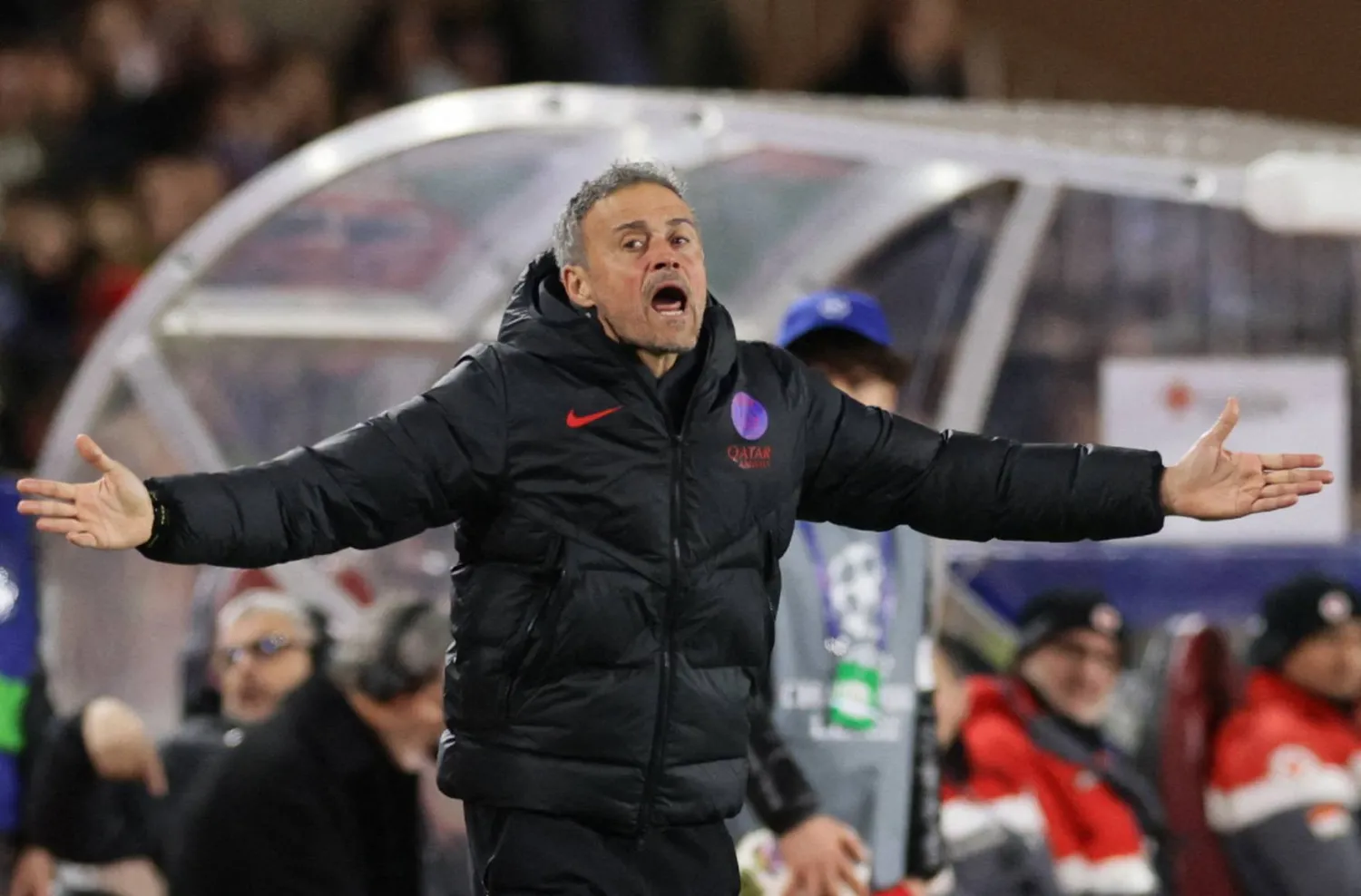
Soccer Football - UEFA Champions League - Play Off - First Leg - AS Monaco v Paris St Germain - Stade Louis II, Monaco - February 17, 2026 Paris St Germain coach Luis Enrique reacts REUTERS/Manon Cruz
TT

PSG’s Mental Strength Hailed as they Come from Behind to Win at Monaco

Soccer Football - UEFA Champions League - Play Off - First Leg - AS Monaco v Paris St Germain - Stade Louis II, Monaco - February 17, 2026 Paris St Germain coach Luis Enrique reacts REUTERS/Manon Cruz

Paris Saint-Germain coach Luis ‌Enrique hailed the mental strength of his side in coming from two goals down to win 3-2 away at Monaco in the Champions League on Tuesday, but warned the knockout round tie was far from finished.

The first leg clash between the two Ligue 1 clubs saw Folarin Balogun score twice for the hosts in the opening 18 minutes before Vitinha had his penalty saved to compound matters.

But after Desire Doue came on for injured Ousmane Dembele, the ‌match turned ‌and defending champions PSG went on to ‌secure ⁠a one-goal advantage ⁠for the return leg.

"Normally, when a team starts a match like that, the most likely outcome is a loss,” Reuters quoted Luis Enrique as saying.

“It was catastrophic. It's impossible to start a match like that. The first two times they overcame our pressure and entered our half, they scored. They ⁠made some very good plays.

“After that, it's difficult ‌to have confidence, but we ‌showed our mental strength. Plus, we missed a penalty, so ‌it was a chance to regain confidence. In the ‌last six times we've played here, this is only the second time we've won, which shows how difficult it is.”

The 20-year-old Doue scored twice and provided a third for Achraf Hakimi, just ‌days after he had turned in a poor performance against Stade Rennais last Friday ⁠and was ⁠dropped for the Monaco clash.

“I'm happy for him because this past week, everyone criticized and tore Doue apart, but he was sensational, he showed his character. He helped the team at the best possible time.”

Dembele’s injury would be assessed, the coach added. “He took a knock in the first 15 minutes, then he couldn't run.”

The return leg at the Parc des Princes will be next Wednesday. “Considering how the match started, I'm happy with the result. But the match in Paris will be difficult, it will be a different story,” Luis Enrique warned.