


Kuwait Minister: We are not Dissatisfied with the Representation Reduction

Sheikh Mohammed Abdullah Al Mubarak, the minister of state for cabinet affairs and acting information minister.(October 24, 2017. KUNA)
TT

Kuwait Minister: We are not Dissatisfied with the Representation Reduction

Sheikh Mohammed Abdullah Al Mubarak, the minister of state for cabinet affairs and acting information minister.(October 24, 2017. KUNA)

Kuwait's Minister of State for Cabinet Affairs and Acting Minister Information Sheikh Mohammad al-Abdullah al-Sabah said Wednesday that his country is not dissatisfied with the reduction of the level of representation of Gulf delegations to the GCC Kuwait summit.

Sheikh Mohammad said Kuwait has had the honor of welcoming the representatives of any leader of a GCC member country, adding: "we are dealing with each delegate as the representative of his country's leadership and people."

Speaking at a meeting with the media covering the 38th GCC summit that concluded on Tuesday, the minister said that none of the GCC countries imposed preconditions to participate in the summit, especially with regard to the current crisis with Qatar.

When asked by Asharq Al-Awsat about the crisis and Kuwait's mediation, Sheikh Mohammad said the mediation derives its credibility from the impartiality of the mediator, adding: "our role as mediator requires us to be neutral in this crisis." He indicated that Kuwait's role is very important and vital and it will continue its efforts to reach a solution.

With regard to the Yemen crisis, the Kuwaiti minister said all GCC delegations agreed in the closed session on the importance of maintaining stability and unity of Yemen, adding that they all support efforts of political solution to this crisis.

During the meeting, the minister also addressed foreign challenges, including Iran's interventions in the region, calling on Iran to abide by international law and good-neighborliness with its Gulf region.

"We are keen to avoid any issue that could create a disagreement between GCC states, but the issue of foreign interventions is not a controversial issue," he concluded.


Mohammed bin Salman, Zelenskyy Meet in Jeddah

Prince Mohammed bin Salman, Saudi Crown Prince and Prime Minister, and Ukraine’s President Volodymyr Zelenskyy meet in Jeddah on Friday. (SPA)
TT

Mohammed bin Salman, Zelenskyy Meet in Jeddah

Prince Mohammed bin Salman, Saudi Crown Prince and Prime Minister, and Ukraine’s President Volodymyr Zelenskyy meet in Jeddah on Friday. (SPA)

Prince Mohammed bin Salman, Saudi Crown Prince and Prime Minister, received in Jeddah on Friday Ukraine’s President Volodymyr Zelenskyy. 

Zelenskyy had arrived in the Kingdom earlier on Friday. He was welcomed by Deputy Governor of the Makkah Region Prince Saud bin Mishaal bin Abdulaziz and other senior officials upon his arrival at King Abdulaziz International Airport. 

Separately, Crown Prince Mohammed received a written message from Czech Prime Minister Andrej Babis on bilateral ties between their countries. 


Kuwait Announces New Attack Launched from Iraq

File photo of smoke rising from a building in Kuwait following recent Iranian attacks (AFP)
TT

Kuwait Announces New Attack Launched from Iraq

File photo of smoke rising from a building in Kuwait following recent Iranian attacks (AFP)

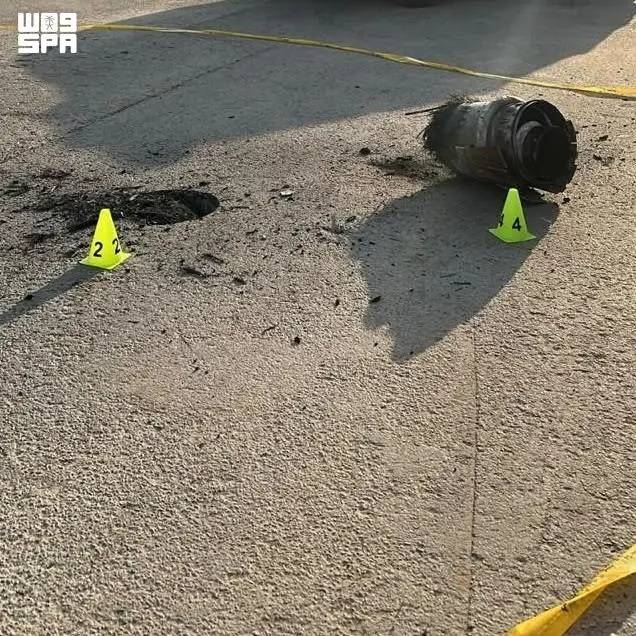
Kuwait said a new attack targeted its territory from Iraq, in a repeat of similar incidents reported in recent weeks during the Iran war.

The official spokesman of the Kuwaiti Ministry of Defense, Colonel Staff Saud Abdulaziz Al-Atwan, said in Statement No. 60 that two sites belonging to Kuwait’s northern land border posts were targeted this morning in a “criminal act of aggression involving two explosive-laden drones guided by fibre-optic cables, originating from the Republic of Iraq,” resulting in material damage without any human casualties.

The statement added that the Ministry of Defense confirms the competent authorities immediately began taking the necessary measures to deal with the incident.

No immediate Iraqi comment was issued regarding the Kuwaiti announcement, noting that Kuwait and several Gulf states have complained in recent weeks of attacks launched from Iraqi territory.

On April 14, the Saudi Cabinet stressed its categorical rejection of violations of state sovereignty and attempts to threaten regional security and stability, reiterating its strongest condemnation of blatant attacks targeting the country and Gulf states using drones launched from Iraqi territory, and underscoring the importance of the Iraqi government acting responsibly in addressing these threats.

The UAE Ministry of Foreign Affairs also summoned the chargé d’affaires of the Iraqi embassy in the country, Omar Al-Obaidi, handing him a strongly worded protest note expressing condemnation and denunciation of terrorist attacks launched from Iraqi territory targeting vital facilities in Gulf Cooperation Council states, despite the announcement of a ceasefire between Iran and the United States.

In the note, delivered by the Director of the Arab Affairs Department at the ministry, Ahmed Al-Marashda, the UAE affirmed its absolute rejection of these attacks, stating they were carried out by armed factions and groups loyal to Iran, constituting a violation of the sovereignty and airspace of the targeted states and a clear breach of international law and the United Nations Charter.


Foreign Ministers of Arab, Islamic Countries Condemn Israeli Violations in Jerusalem

FILED - 05 May 2022, ---, Jerusalem: Israeli security officers patrol in front of the Dome of the Rock mosque at the Al-Aqsa mosque compound in the Old City of Jerusalem. Photo: Ilia Yefimovich/dpa
TT

Foreign Ministers of Arab, Islamic Countries Condemn Israeli Violations in Jerusalem

FILED - 05 May 2022, ---, Jerusalem: Israeli security officers patrol in front of the Dome of the Rock mosque at the Al-Aqsa mosque compound in the Old City of Jerusalem. Photo: Ilia Yefimovich/dpa

The foreign ministers of several Arab and Muslim countries have condemned the repeated Israeli violations of the historic and legal status quo in Jerusalem’s Islamic and Christian holy sites, particularly the continued incursions by settlers and extremist ministers into Al-Aqsa Mosque compound under Israeli police protection, as well as the raising of the Israeli flag within its courtyards.

The foreign ministers of Saudi Arabia, Jordan, the United Arab Emirates, Qatar, Indonesia, Pakistan, Egypt, and Türkiye reiterated that these provocative actions at Al-Aqsa Mosque constitute a flagrant violation of international law and international humanitarian law, and represent an unacceptable provocation to Muslims around the world, and a flagrant violation of the sanctity of the holy city.

They reaffirmed their categorical rejection of any attempts to alter the historic and legal status quo in Jerusalem and its Islamic and Christian holy sites, and stressed its preservation while recognizing the special role of the historic Hashemite custodianship in this regard.

The ministers reiterated that the entire area of Al-Aqsa Mosque, which amounts to 144 dunams, is a place of worship exclusively for Muslims, and that the Jerusalem Endowments and Al-Aqsa Mosque Affairs Department, affiliated with the Jordanian Ministry of Awqaf and Islamic Affairs, is the legal entity with exclusive jurisdiction to administer the affairs of the blessed Al-Aqsa Mosque and to regulate entry thereto.

The ministers further condemned the accelerating illegal settlement activity, including Israel’s decision to approve over 30 new settlements, which constitutes a flagrant violation of international law, including United Nations Security Council resolutions and the 2024 advisory opinion of the International Court of Justice.

They also condemned the continued and escalating settler violence against Palestinians in the occupied West Bank, including recent attacks on Palestinian schools and children, and called for those responsible to be held accountable.

They emphasized that Israel has no sovereignty over the Occupied Palestinian Territory.

The ministers stressed that such actions constitute a deliberate and direct attack on the viability of the Palestinian State and on the implementation of the two-state solution, increase tensions, undermine peace efforts, and hinder ongoing initiatives aimed at de-escalation and the restoration of stability.

They called on Israel to assume full responsibility, condemn these hostile acts, and hold perpetrators accountable.

The ministers reiterated their call for the international community to uphold its legal and moral responsibilities and compel Israel to halt its dangerous escalation in the occupied West Bank, and to put an end to its illegal practices.

They also called on the international community to intensify all efforts to advance a political solution that achieves a comprehensive peace based on the two-state solution.

The ministers reiterated their unwavering support for the legitimate rights of the Palestinian people, particularly their right to self-determination and to establish a state along the June 4, 1967 lines, with East Jerusalem as its capital.
