


Welcome to China’s Florida: Sun, Sand and Retired Snowbirds

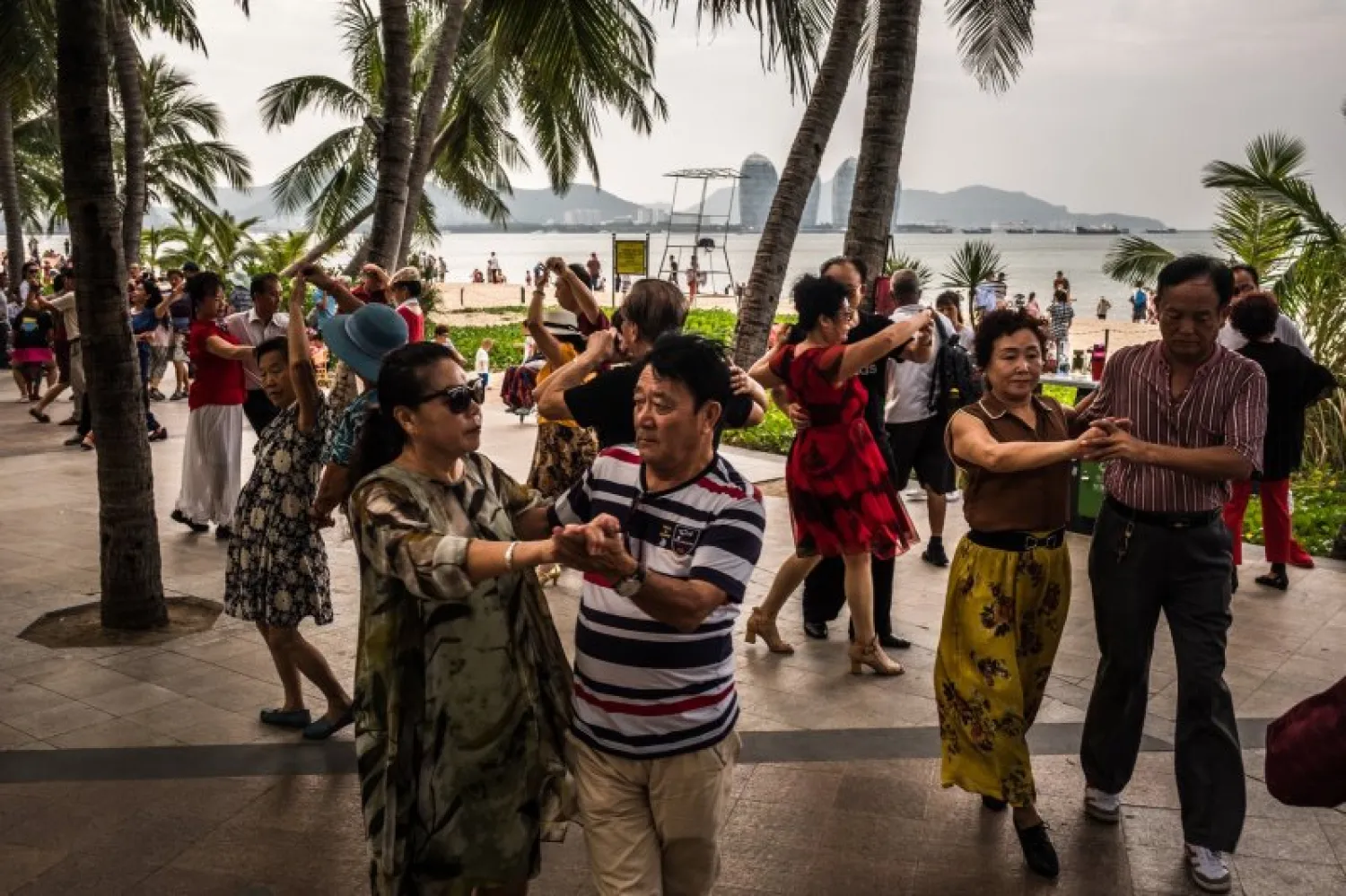
A Latin dance gathering. Credit Bryan Denton for The New York Times
TT

Welcome to China’s Florida: Sun, Sand and Retired Snowbirds

A Latin dance gathering. Credit Bryan Denton for The New York Times

While the white-sand beaches and five-star international resorts are meant to be the main attraction, for the hundreds of thousands of Chinese retirees who descend upon this tropical city every winter, dancing on the seaside promenade is often the real draw.

On a recent, balmy morning, palm trees swayed along the beachfront promenade as gray-haired dancers twirled and sashayed about. Retired men in head-to-toe Hawaiian print and women in floppy hats and flowery skirts sat on wheelchairs and folding stools, exchanging gossip over card games. Nearby, singers took turns belting out Mao-era favorites on an outdoor karaoke machine.

Nearly every corner of the promenade was occupied by older snowbirds looking to escape the dreary, bone-chilling winter of the north. And here, in this seaside city on Hainan island, the southernmost edge of China, was their wintertime paradise.

Welcome to China’s Florida.

“Oh, we absolutely love it here,” said Xu Yan, 70, sporting a dyed perm and big sunglasses as she sat beneath a palm tree near a gaggle of ballroom dancers.

Splayed out on a pink towel next to Ms. Xu was her companion, a toothless white Chihuahua named Maomao, who was burying his snout into a mound of torn-up hot dog pieces. Every winter for the past 13 years, Ms. Xu, a retired airline worker, and Maomao have left their home in the frigid northeastern city of Harbin to stay in Sanya.

Like Ms. Xu and Maomao, more than half of the nearly 400,000 retired snowbirds who flock to Sanya every year are said to hail from China’s northeast.

China’s population is rapidly aging; experts predict that by 2055, 400 million Chinese — or about a quarter of the country’s population — will be over age 65. And dramatically improved life expectancy and rising incomes have afforded these older people a freedom to enjoy life post-retirement in a way that would have been unthinkable for their parents’ generation.

“Retired life is better than we could have ever imagined,” said Sheng Shengmin, 67, a retired building contractor from Beijing.

Last year, Mr. Sheng joined the wave of snowbirds who have laid down roots here, buying an apartment in the city for the equivalent of $272,000. After years of living in Beijing, Mr. Sheng said, “the pollution, the migrant workers, and the cold” had made the capital city uninhabitable.

“Once you retire and you’ve saved up enough money, you don’t want to go back to living in the big cities,” Mr. Sheng said as he took a sip from his tea thermos, a common accessory for many older Chinese.

That so many Chinese retirees would leave behind their homes to live in an unfamiliar city is all the more remarkable given China’s tradition of filial piety. For generations, children in China have grown up with the expectation that they would one day care for their aging parents.

But there are growing concerns that responsibility may be too much for the generation of only children produced by the “one-child” policy to handle on their own. As a result, more empty nesters in China are adopting the snowbird lifestyle with the aim of easing the burden on their children.

“Right now, it’s fine because we’re healthy,” said Zhao Kaile, 62, a retired railway bureau administrator and a native of Mudanjiang in northeastern China. “But twenty years from now, will we be able to take care of ourselves without our children? Everybody is thinking about this problem now.”

As the head of the migrants association in a suburban community all but taken over by snowbirds, Mr. Zhao spends much of his time coordinating meetings and music rehearsals.

On a recent morning, more than 60 retirees gathered together in the community recreation room to rehearse sentimental favorites like “Onwards, Chinese Communist Party” and more recent hits like “Together Build the Chinese Dream.” Accompanying the chorus was a boisterous band of graying musicians, including a piccoloist and an electric guitarist.

“Before, we thought retired life would be very dull, just sitting on little stools in the sun and shriveling up and growing old,” said Mr. Zhao. “But our lives have transformed. We had no idea that after coming here we would be so happy and have so many friends.”

Not everyone is happy with the presence of Sanya’s snowbirds. The annual influx, which began in the early 2000s, has created tensions with local residents, who are increasingly outnumbered by their seasonal visitors. Locals complain that the retirees have driven up the cost of housing and food while simultaneously taking advantage of public services like transportation and hospitals.

They find peace only in the off-season summer months, when the snowbirds retreat to their homes up north to escape the sweltering temperatures and monsoon rains.

Several years ago, the local government began razing large tracts of housing in the city, in what many see as an ongoing effort to drive out the often frugal snowbirds by denying them places to rent. Others say the goal is instead to attract high-spending vacationers to boost local tourism, already one of the city’s main industries in addition to agriculture.

“Sanya wants to be known as an international tourism destination, not as an elderly retirement community,” said Huang Cheng, a lecturer at the University of Sanya who has studied the local snowbird phenomenon.

Several months ago, Wen Zhiguo, manager of a local hotel that caters to aging snowbirds, was forced to move to the outskirts of the city after the local government tore down his seaside facilities. Despite the change in location, Mr. Wen continues to run a brisk business renting out rooms to retirees who pay about $350 a month in exchange for simple accommodation and three meals a day.

On a recent afternoon, the lobby of Mr. Wen’s hotel began to stir as guests rose from their lunchtime naps. The choice of activities was plentiful — calligraphy, mah-jongg, cards and table tennis — and the faint scent of medicinal ointment infused the sunlit room.

A stately looking man with a snow-white coif sat quietly at a table playing a game of mah-jongg solitaire. A retired soldier in the People’s Liberation Army, Wang Xingeng, 89, remembered the first time he visited Sanya more than a half-century ago, just after the Communist Party’s 1949 takeover.

“Back then, the island was all shabby little huts, there were no buildings,” Mr. Wang said. “It was the poorest place I’d ever seen. It’s where they sent criminals.”

“I never thought I’d be back here,” he added, looking around pensively at his fellow snowbirds. “But now I’ve come full circle.”

The New York Times


Coffee Regions Hit by Extra Days of Extreme Heat, Say Scientists 

17 April 2012, North Rhine-Westphalia, Vluyn: A general view of Arabica Coffee beans. (dpa)
TT

Coffee Regions Hit by Extra Days of Extreme Heat, Say Scientists 

17 April 2012, North Rhine-Westphalia, Vluyn: A general view of Arabica Coffee beans. (dpa)

The world's main coffee-growing regions are roasting under additional days of climate change-driven heat every year, threatening harvests and contributing to higher prices, researchers said Wednesday.

An analysis found that there were 47 extra days of harmful heat per year on average in 25 countries representing nearly all global coffee production between 2021 and 2025, according to independent research group Climate Central.

Brazil, Vietnam, Colombia, Ethiopia and Indonesia -- which supply 75 percent of the world's coffee -- experienced on average 57 additional days of temperatures exceeding the threshold of 30C.

"Climate change is coming for our coffee. Nearly every major coffee-producing country is now experiencing more days of extreme heat that can harm coffee plants, reduce yields, and affect quality," said Kristina Dahl, Climate Central's vice president for science.

"In time, these impacts may ripple outward from farms to consumers, right into the quality and cost of your daily brew," Dahl said in a statement.

US tariffs on imports from Brazil, which supplies a third of coffee consumed in the United States, contributed to higher prices this past year, Climate Central said.

But extreme weather in the world's coffee-growing regions is "at least partly to blame" for the recent surge in prices, it added.

Coffee cultivation needs optimal temperatures and rainfall to thrive.

Temperatures above 30C are "extremely harmful" to arabica coffee plants and "suboptimal" for the robusta variety, Climate Central said. Those two plant species produce the majority of the global coffee supply.

For its analysis, Climate Central estimated how many days each year would have stayed below 30C in a world without carbon pollution but instead exceeded that level in reality -- revealing the number of hot days added by climate change.

The last three years have been the hottest on record, according to climate monitors.


Dog Gives Olympics Organizers Paws for Thought

A dog wanders on the ski trail during the women's team cross country free sprint qualification event of the Milano Cortina 2026 Winter Olympic Games at Tesero Cross-Country Skiing Stadium in Lago di Tesero (Val di Fiemme), on February 18, 2026. (Photo by Anne-Christine POUJOULAT / AFP)
TT

Dog Gives Olympics Organizers Paws for Thought

A dog wanders on the ski trail during the women's team cross country free sprint qualification event of the Milano Cortina 2026 Winter Olympic Games at Tesero Cross-Country Skiing Stadium in Lago di Tesero (Val di Fiemme), on February 18, 2026. (Photo by Anne-Christine POUJOULAT / AFP)

A dog decided he would bid for an unlikely Olympic medal on Wednesday as he joined the women's cross country team free sprint in the Milan-Cortina Games.

The dog ran onto the piste in Tesero in northern Italy and gamely, even without skis, ran behind two of the competitors, Greece's Konstantina Charalampidou and Tena Hadzic of Croatia.

He crossed the finishing line, his moment of glory curtailed as he was collared by the organizers and led away -- his owner no doubt will have a bone to pick with him when they are reunited.


Olives, Opera and a Climate-Neutral Goal: How a Mural in Greece Won ‘Best in the World’ 

A building with the mural entitled “Kalamata” depicting opera legend Maria Callas by artist Kleomenis Kostopoulos is seen in Kalamata town, about 240 kilometers (150 miles) southwest of Athens, Monday, Feb. 9, 2026. (AP) 
TT

Olives, Opera and a Climate-Neutral Goal: How a Mural in Greece Won ‘Best in the World’ 

A building with the mural entitled “Kalamata” depicting opera legend Maria Callas by artist Kleomenis Kostopoulos is seen in Kalamata town, about 240 kilometers (150 miles) southwest of Athens, Monday, Feb. 9, 2026. (AP) 

Long known for its olives and seaside charm, the southern Greek city of Kalamata has found itself in the spotlight thanks to a towering mural that reimagines legendary soprano Maria Callas as an allegory for the city itself.

The massive artwork on the side of a prominent building in the city center has been named 2025’s “Best Mural of the World” by Street Art Cities, a global platform celebrating street art.

Residents of Kalamata, approximately 240 kilometers (150 miles) southwest of Athens, cultivate the world-renowned olives, figs and grapes that feature prominently on the mural.

That was precisely the point.

Vassilis Papaefstathiou, deputy mayor of strategic planning and climate neutrality, explained Kalamata is one of the few Greek cities with the ambitious goal of becoming climate-neutral by 2030. He and other city leaders wanted a way to make abstract concepts, including sustainable development, agri-food initiatives, and local economic growth, more tangible for the city’s nearly 73,000 residents.

That’s how the idea of a massive mural in a public space was born.

“We wanted it to reflect a very clear and distinct message of what sustainable development means for a regional city such as Kalamata,” Papaefstathiou said. “We wanted to create an image that combines the humble products of the land, such as olives and olive oil — which, let’s be honest, are famous all over the world and have put Kalamata on the map — with the high-level art.”

“By bringing together what is very elevated with ... the humbleness of the land, our aim was to empower the people and, in doing so, strengthen their identity. We want them to be proud to be Kalamatians.”

Southern Greece has faced heatwaves, droughts and wildfires in recent years, all of which affect the olive groves on which the region’s economy is hugely dependent.

The image chosen to represent the city was Maria Callas, widely hailed as one of the greatest opera singers of the 20th century and revered in Greece as a national cultural symbol. She may have been born in New York to Greek immigrant parents, but her father came from a village south of Kalamata. For locals, she is one of their own.

This connection is also reflected in practice: the alumni association at Kalamata’s music school is named for Callas, and the cultural center houses an exhibition dedicated to her, which includes letters from her personal archive.

Artist Kleomenis Kostopoulos, 52, said the mural “is not actually called ‘Maria Callas,’ but ‘Kalamata’ and my attempt was to paint Kalamata (the city) allegorically.”

Rather than portraying a stylized image of the diva, Kostopoulos said he aimed for a more grounded and human depiction. He incorporated elements that connect the people to their land: tree branches — which he considers the above-ground extension of roots — birds native to the area, and the well-known agricultural products.

“The dress I create on Maria Callas in ‘Kalamata’ is essentially all of this, all of this bloom, all of this fruition,” he said. “The blessed land that Kalamata itself has ... is where all of these elements of nature come from.”

Creating the mural was no small feat. Kostopoulos said it took around two weeks of actual work spread over a month due to bad weather. He primarily used brushes but also incorporated spray paint and a cherry-picker to reach all edges of the massive wall.

Papaefstathiou, the deputy mayor, said the mural has become a focal point.

“We believe this mural has helped us significantly in many ways, including in strengthening the city’s promotion as a tourist destination,” he said.

Beyond tourism, the mural has sparked conversations about art in public spaces. More building owners in Kalamata have already expressed interest in hosting murals.

“All of us — residents, and I personally — feel immense pride,” said tourism educator Dimitra Kourmouli.

Kostopoulos said he hopes the award will have a wider impact on the art community and make public art more visible in Greece.

“We see that such modern interventions in public space bring tremendous cultural, social, educational and economic benefits to a place,” he said. “These are good springboards to start nice conversations that I hope someday will happen in our country, as well.”
