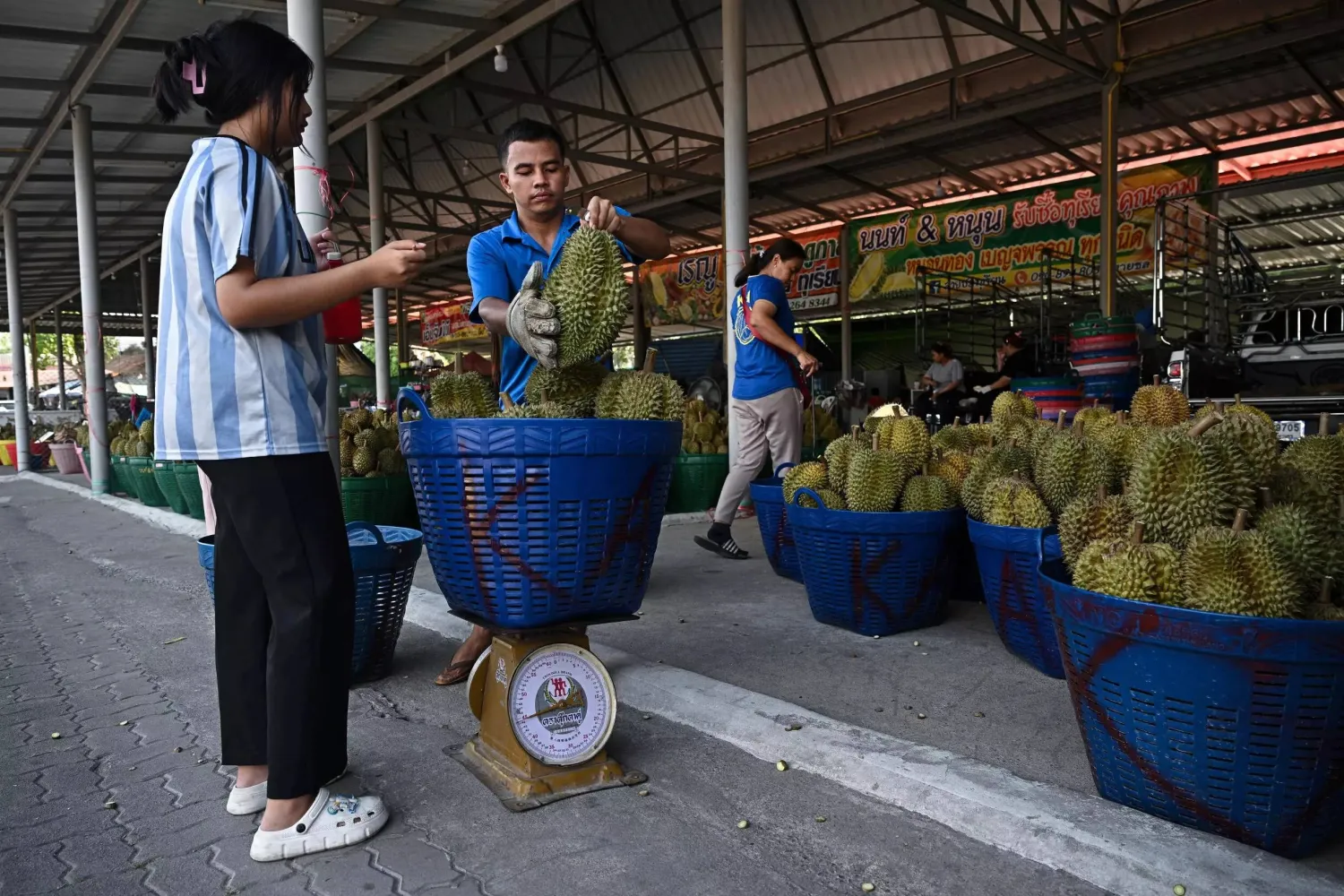
Heatwave Hammers Thailand's Stinky but Lucrative Durian Farms

The heat causes the durian to ripen faster so it does not grow to its fullest -- and most valuable -- size. Lillian SUWANRUMPHA / AFP
TT

Heatwave Hammers Thailand's Stinky but Lucrative Durian Farms

The heat causes the durian to ripen faster so it does not grow to its fullest -- and most valuable -- size. Lillian SUWANRUMPHA / AFP

Clambering hand-over-hand, sweat dripping into his eyes, a durian laborer expertly slices a cumbersome fruit from a tree before tossing it down to land with a soft thump in his colleague's waiting arms some 15 meters (50 feet) below.
Among Thailand's most famous and lucrative exports, the pungent "king of fruits" is as distinctive in its smell as its spiky green-brown carapace, and has been farmed in the kingdom for hundreds of years, AFP said.
But a vicious heat wave engulfing Southeast Asia has resulted in smaller yields and spiraling costs, with growers and sellers increasingly panicked as global warming damages the industry.
"This year is a crisis," durian farmer Busaba Nakpipat told AFP bluntly.
The weather-beaten 54-year-old took over her parents' farm in eastern Chanthaburi province -- Thailand's durian heartland -- three decades ago.
"If the hot weather continues to rise in the future, it'll be over," she said. "Farmers wouldn't be able to produce durian anymore."
Durian season usually lasts from March until June, but the soaring temperatures -- which in her province have hovered around 40 degrees Celsius (104 degrees Fahrenheit) for weeks -- and subsequent drought have shortened the harvest.
Busaba said the heat causes the durian, which is graduated by weight and size, to ripen faster so it does not grow to its fullest -- and most valuable -- size.
"The quality of the durian won't meet the standard," she said.
And not only is she getting less money for the crop, Busaba's operational costs have risen.
Since March a drought has sucked water from the wells, so to keep her precious durian trees alive Busaba is forced to bring in thousands of liters by truck.
"We have to buy 10 water trucks for 120,000 liters of water for one-time watering the whole 10-rai (1.6 hectares) of our farm," she said, repeating the process every other day, at a cost of thousands of dollars.
"We have prayed for rain," she said. "But there was no rain."
This year, less
Thailand's durian exports are worth billions and are the kingdom's third most valuable agricultural product -- behind rice and rubber.
But in the nearby durian market, anxiety is running high among stall-holders, many of them with family businesses going back generations.
Siriwan Roopkaew, manning her mother's stall, said the lack of water has impacted the size of the fruit, but for now prices remain high thanks to demand from China.
Around 95 percent of Thaliand's durian exports are to China, which shipped nearly $4.6 billion worth of the love-it-or-hate-it fruit from the kingdom in 2023, according to data from Beijing's commerce ministry.
But the weather is threatening Thailand's dominance.
In May Chinese state media reported an almost 50 percent rise in durian imported from Vietnam, citing heat and drought in Thailand.
"Hot weather means there will be less durian. Even this year, there is less durian," Siriwan, 26, said.
"Normally, my stall would be full of durian by now."
While farmers worried about water, she said, sellers like her family were more concerned about the knock-on economics.
"Less durian means our earnings are less," she said, "so it'd be hard for us to live the whole year."
Meanwhile, back at the farm, Busaba sighed as she considered the months ahead.
"The future of durian, it's over if there's no water," she said.


UK Endures Second Big Storm of the Weekend, with the North Bearing the Brunt This Time

People walk through heavy rain in Liverpool, Britain, 24 October 2026. (EPA)
TT

UK Endures Second Big Storm of the Weekend, with the North Bearing the Brunt This Time

People walk through heavy rain in Liverpool, Britain, 24 October 2026. (EPA)

The second of two storms to hit the UK this weekend brought widespread travel disruptions and power outages to Scotland, Northern Ireland and northern England on Sunday.

The Met Office, the UK's national forecaster, said Storm Boelo will bring a danger to life from flying debris and crashing waves and people should stay indoors as much as possible.

Gusts above 80 mph (128 kph) have already been recorded in Scotland, including on the island of Tiree in the Inner Hebrides. Energy company SSEN had reported a total of 93 unplanned power cuts in Scotland by 10 a.m.

An amber wind warning, the Met Office’s second most severe, is active across Scotland and the north of England until late Sunday. Flood warnings are also in place, while airports, ferries, railways and roads have seen disruptions.

Boelo, pronounced “Boo-Loh”, has followed hard on the heels of Storm Austen, which battered southern England on Friday. The National Grid, which distributes electricity around the UK, said power had been restored to more than 130,000 properties impacted by Austen by 7 p.m. on Saturday.

The Met Office began naming major storms in 2015 as a way to keep the public informed about severe weather. Storms are named in alphabetical order throughout the season, from September to August.


Ensnared Female Orangutan and Her Baby Rescued in Indonesia

A 20-year-old orangutan tries to escape as members of the BKSDA (Natural Resources Conservation Agency), the Borneo Orangutan Survival Foundation (BOSF) and the World Wide Fund for Nature (WWF) Indonesia evacuate it due to forest and land fire, in Hampangen Village, Katingan Regency, Central Kalimantan, on October 17, 2026. (AFP)
TT

Ensnared Female Orangutan and Her Baby Rescued in Indonesia

A 20-year-old orangutan tries to escape as members of the BKSDA (Natural Resources Conservation Agency), the Borneo Orangutan Survival Foundation (BOSF) and the World Wide Fund for Nature (WWF) Indonesia evacuate it due to forest and land fire, in Hampangen Village, Katingan Regency, Central Kalimantan, on October 17, 2026. (AFP)

Indonesian conservation workers rescued an orangutan ensnared in rope and her baby on the island of Borneo where the critically endangered animals are at risk from boar traps and wildfires, an official said Sunday.

The female orangutan named Gadis, about 25 years old, and her son Garis, 10 months, were found snared in a suspected trap early Friday near a village in Central Kalimantan province on the Indonesian part of Borneo.

"Gadis was found with the ropes tied to her upper right arm and lower left arms, and the wounds were bad because the ropes had torn deep into her flesh," local conservation official Muriansyah told AFP by telephone on Sunday.

"It looked like the ropes were set up as a wild boar snare trap," added Muriansyah, who like many Indonesians has one name.

Both were receiving treatment at the Orangutan Foundation International clinic near the village of Pangkalan Bun.

Wild boar hunting using rope snares is legal and common in parts of Indonesia as a pest control measure to protect crops, but illegal inside protected forests or national parks.

Officials have repeatedly cautioned that careless placement of snares near wildlife areas could instead trap endangered sun bears or orangutans.

Dozens of orangutans have also been rescued in recent weeks from rampant wildfires burning across Indonesia that have cloaked the Southeast Asian region in a toxic haze.

Two more were released in Ketapang, West Kalimantan on Saturday after being rescued from an oil palm plantation.

Orangutans are critically endangered and only about 120,000 remain in the wild in Borneo and Sumatra -- about half the number from a century ago, according to conservation group WWF.

Last month, the International Union for Conservation of Nature said fires were burning in habitats containing 52 percent of Borneo's orangutan population.


Cracking a Smile Regularly May be Good Not Just for Your Mood but for Your Health

FILE - A fan attends the performance by American singer Jon Batiste at the Rock in Rio music festival in Rio de Janeiro, Sept. 7, 2026. (AP Photo/Bruna Prado, File)
TT

Cracking a Smile Regularly May be Good Not Just for Your Mood but for Your Health

FILE - A fan attends the performance by American singer Jon Batiste at the Rock in Rio music festival in Rio de Janeiro, Sept. 7, 2026. (AP Photo/Bruna Prado, File)

Reminding yourself to smile often cannot only make more friendships but it can also make you feel better.

And rather than wait for a reason to smile, just making the physical change of literally turning that frown upside down could impact emotions, according to experts.

Research backs up the fact that smiling goes a long way.

Some older research has focused on this “facial feedback hypothesis,” according to Jeanne Tsai, a longtime psychology professor at Stanford University who runs the Culture and Emotion Lab. In one classic study in the late 1980s, researchers would have subjects put a pencil between their lips and adopt a smile or a frown while viewing a positive movie clip like a cartoon. Some subjects who smiled would feel the sensation of the smile more and be more amused.

“When we’ve done that demonstration in classes, it works,” Tsai said. “When you’re doing it in a room by yourself, you’re not doing it in a social interaction, maybe it’s making you remember, or it’s an effect of remembering some good thing that happened and that would put you in a better mood.”

At the Orange County Academy of Sciences and Arts in Southern California, the power of a smile is taken very seriously. An entire section on the charter school group’s website is dedicated to its philosophy that a smile can make a difference.

“Smiling creates a supportive classroom culture that makes students relaxed, active, and motivated,” according to the website. “It increases emotional well-being, lowers stress, and gives students confidence.”

How smiling can benefit health Dr. Judy Ho, a Los Angeles clinical and forensic neuropsychologist who also teaches at Pepperdine University, discusses smiling as a coping strategy with some patients suffering depression or anxiety.

“I'm not suggesting that that's the only way they can fix things,” Ho said. “It's just like another thing that you can add to your toolbox.”

Smiling can affect one's level of cortisol, a hormone the body releases partly to help regulate stress and mood, according to Ho. Smiling can affect brain chemicals that are associated with positive feelings including endorphins, dopamine and serotonin.

“People who smile during stressful tasks generally demonstrated lower heart rates during recovery than those maintaining neutral expressions,” Ho said. “Smiling also reduced aspects of the body's physiological stress response.”

The hope is if you smile enough, you will start feeling it emotionally.

“In some ways it's like a mediating effect,” she added.

The value of a smile varies culture to culture How smiling and even the openness of a smile are perceived are not universal. Tsai, the Stanford professor, has conducted research on how emotion in American culture puts value on trying to always feel positive and minimizing negativity and sadness. In East Asian cultures, emotion is more about balance.

“It’s like the positive and the negative emotions are braided together, and so you don’t want to feel too positive or too negative,” Tsai said. “You want more of a balance between the two.”

Her past studies also examined how European Americans and East Asians — including Taiwanese, South Koreans, Japanese and Hong Kong Chinese — look at a “neutral or a calm” smile versus a full-on grin. Subjects rated the differing facial expressions on warmth and trustworthiness. While some Americans saw the excited smiles as friendlier, some East Asians characterized those facial expressions as “emotionally unstable” or “unreliable."

“What kind of smile matters — whether it’s a calm, closed mouth smile more like the Dalai Lama or a big toothy excited smile like Julia Roberts,” Tsai said. “We’ve done some series of studies in Taiwan and other East Asian contexts. They don’t like the big, toothy, excited smile unless it’s really situationally appropriate.”

In Thailand — known as “The Land of Smiles” — smiling is embedded in the culture. There are nearly 30 Thai words for “smile.” Many teach-abroad programs where people can teach English as a foreign language in Thailand cite that smiling often with children and colleagues is key to showing respect, good manners and calmness.

At the OCASA charter schools, smiling is part of an effort to make children feel seen.

“I’ve always believed in wanting school to be a happy place for kids,” said RaNae Posey, principal of OCASA Capistrano Elementary School. “To actually help them form habits of looking at the bright side of things.”

Mandating smiles may lead to more frowns Women in recent years have smacked down the idea that they have to smile in the workplace while men do not. Smiling can feel like a Catch-22 for some women and sometimes for people of color who may be stereotyped as unapproachable or cold if they don’t smile enough.

Last year, retailer Target was ridiculed across social media for instituting a smiling policy. Workers had to smile and make eye contact if a customer was within 10 feet (3 meters) and personally greet them if they were within 4 feet (1.2 meters).

People do not like feeling like they have no “emotional autonomy,” according to Nicholas Coles, an assistant professor who runs the Social Science Collaboratory at the University of Florida in Gainesville.

“In those scenarios, what we find is that it’s more that you’re smiling your way to misery,” Coles said. “It’s only when it feels authentic and voluntary that I think it’ll have any real effect.”

With the holidays approaching, more people may have to muster smiles with family if sensitive topics like politics and religion come up. Those could be good times to see if smiling helps.

“If we were able to just smile and be like ’Look, this is somebody that historically cares about you and loves you,' maybe that would change the way that we respond to them even in a moment of tough conversation,” Ho said.