

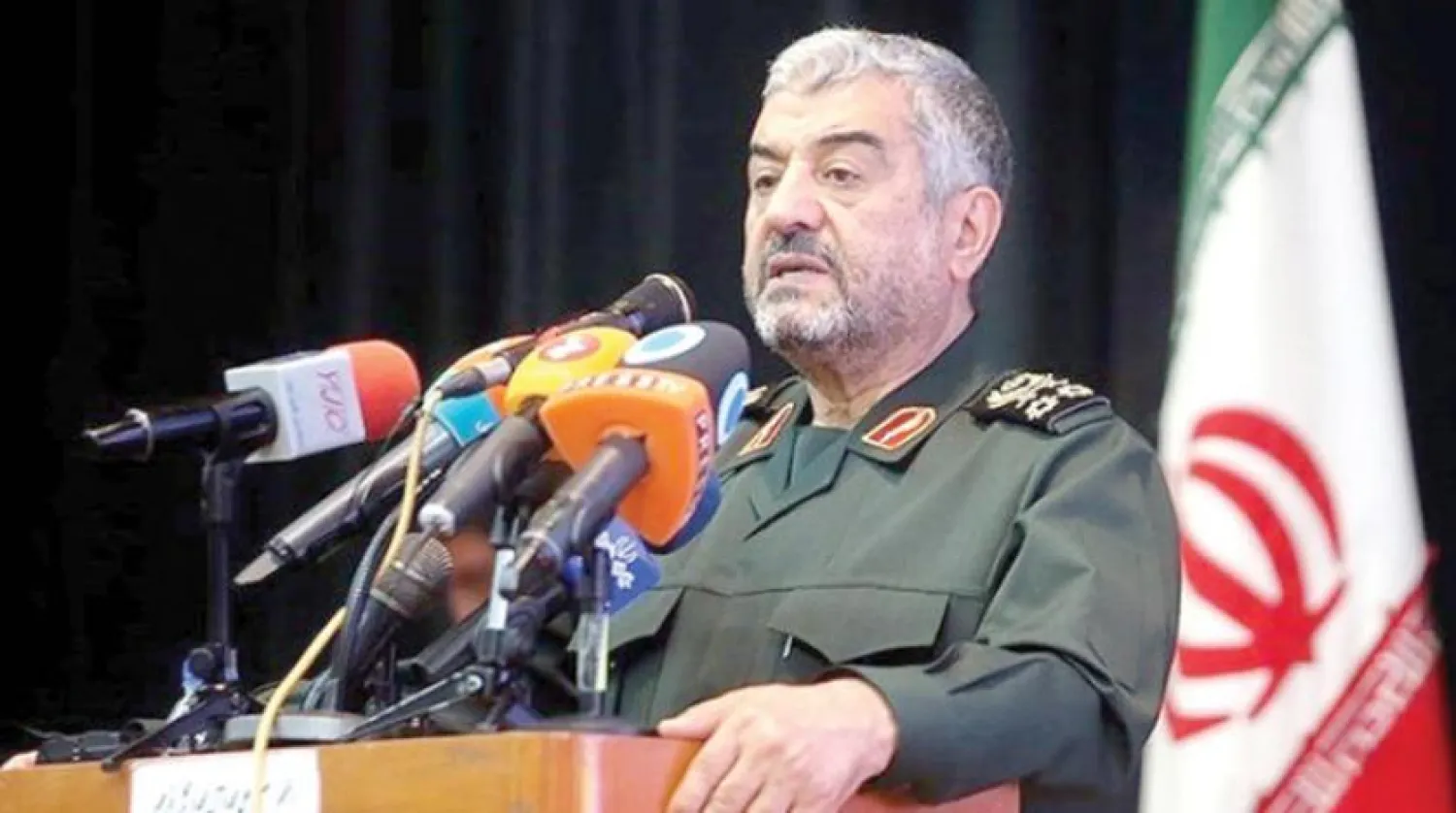

Revolutionary Guards Commander: Coup Militias Play Tehran Regime’s Bidding in Region

Revolutionary Guards Commander Mohammad Ali Jafari addresses a crowd of students at military universities in Tehran. (Tasnim)
TT

Revolutionary Guards Commander: Coup Militias Play Tehran Regime’s Bidding in Region

Revolutionary Guards Commander Mohammad Ali Jafari addresses a crowd of students at military universities in Tehran. (Tasnim)

Iran’s Revolutionary Guards Chief-Commander Major General Mohammad Ali Jafari announced on Thursday the body’s decision to reinforce forces in Iraq and Syria.

Backing the announcement, Supreme Leader representative Ali Saidi said regional developments have weighed in significantly to Tehran’s benefit, especially in shifting its Middle East strategy away from conventional warfare.

However, both leaders denied Iran was taking on a negative role in the region.

Jafari told an audience of students at Revolutionary Guard-affiliated universities that the broad outlines of his forces’ approach, on both external and internal levels, is part of the role played in "guarding the regime".

The military chief also highlighted the role Iran actively plays in five Arab countries: Lebanon, Iraq, Syria, Yemen and Palestine, calling for consolidating the victories of the Iranian axis in the region.

Jafari also said that “victory in Yemen is near," referring to coup forces as an extension of the Iranian revolution, Iran-based ISNA news agency reported.

At the end of November, Jafari revealed Iran's unbound support for Houthi militias in Yemen. However, he said that the support was limited to an "advisory role."

Iran has labeled its presence in each of Syria and Iraq as “advisory” as well.

Jafari implicitly linked regional developments and Iranian internal events, saying that "despite the problems facing Iran, it remains in a good standing abroad."

He said that the Iranian regime is facing threats on cultural, political and economic levels, stressing the need to rehabilitate universities to face “threats”.

"Today we have overcome security and defense threats, but that does not mean there are no threats," he said.

Jafari implicitly referred to the widening rift between the Iranian President Hassan Rouhani’s reformist approach and Tehran conservatives, who look to Iranian Supreme Leader Ali Khamenei for ultimate guidance.

Conservatives in Iran continue to fear Western cultural impact on the public, calling it a “soft” threat in terms of it not being a direct act of war, but still a threat to the Revolutionary Guards’ authority.

He also vaguely criticized Rouhani, pointing out that some officials seek to "appease others, especially when they need votes," describing it as "the reason for not making the right decisions in the country."

In a related context, Supreme Leader Representative Saidi said regional equations changed in favor of Iran after “growing resistance forces spread across the region.”

According to Saidi, the Revolutionary Guards has successfully shifted the status quo from the notion of waging balanced wars to “asymmetric” and proxy wars—tilting the table to its benefit. He said that “Hezbollah’s” war with Israel was a result of this shift.

“Asymmetric” war is a military strategy which capitalizes on the strength gap between warring parties, and highly relies on forming paramilitary gangs and militias to fight organized armies.

Saidi claimed that the region is witnessing a war between the “holy” and the “satanic”—with the "sacred" being a coalition consisting of Iran and pro-Iranian groups, such as “Hezbollah” and Afghan and Fatimid militias, as well as Iraqi and Syrian groups.



Iran, US Race to Find Crew Member of Crashed American Fighter Jet

A US Air Force F-16 Fighting Falcon aircraft refuels from a KC-135 Stratotanker aircraft during a mission supporting Operation Epic Fury during the Iran war at an undisclosed location, April 2, 2026.  US Air Force/Handout via REUTERS
A US Air Force F-16 Fighting Falcon aircraft refuels from a KC-135 Stratotanker aircraft during a mission supporting Operation Epic Fury during the Iran war at an undisclosed location, April 2, 2026. US Air Force/Handout via REUTERS
TT

Iran, US Race to Find Crew Member of Crashed American Fighter Jet

A US Air Force F-16 Fighting Falcon aircraft refuels from a KC-135 Stratotanker aircraft during a mission supporting Operation Epic Fury during the Iran war at an undisclosed location, April 2, 2026.  US Air Force/Handout via REUTERS
A US Air Force F-16 Fighting Falcon aircraft refuels from a KC-135 Stratotanker aircraft during a mission supporting Operation Epic Fury during the Iran war at an undisclosed location, April 2, 2026. US Air Force/Handout via REUTERS

Iranian and American forces raced each other Saturday to recover a crew member from the first US fighter jet to go down inside Iran since the start of the war.

Tehran said it had shot down the F-15 warplane and US media reported United States special forces had rescued one of its two crew members, with the other was still missing.

Iran's military also said it downed a US A-10 ground attack aircraft in the Gulf, with US media saying the pilot of that plane was rescued, reported AFP.

The war erupted more than a month ago with US-Israeli strikes on Iran that killed supreme leader Ali Khamenei, triggering retaliation that spread the conflict throughout the Middle East, convulsing the global economy and impacting millions of people worldwide.

US Central Command did not immediately respond to a request for comment on the loss of the F-15, but White House Press Secretary Karoline Leavitt said: "The president has been briefed."

President Donald Trump told NBC the F-15 loss would not affect negotiations with Iran, saying: "No, not at all. No, it's war."

On Saturday, there were fresh strikes on Israel, Lebanon and Iran, as well as on Gulf states.

An AFP journalist saw a thick haze of grey smoke covering Tehran's skyline after hearing several blasts over the capital. It was not immediately clear what had been targeted.

- 'Valuable reward' -

A spokesperson for the Iranian military's central operational command earlier said "an American hostile fighter jet in central Iranian airspace was struck and destroyed by the IRGC Aerospace Force's advanced air defense system".

"The jet was completely obliterated, and further searches are ongoing."

An Iranian television reporter on a local official channel said anyone who captured a crew member alive would "receive a valuable reward".

Retired US brigadier general Houston Cantwell, who has 400 hours of combat flight experience, said a pilot's training would likely kick in before he or she parachutes to the ground.

"My priority would be, first of all, concealment, because I don't want to be captured," he told AFP.

Mohammad Ghalibaf, the speaker of Iran's parliament, mocked the Trump administration.

He wrote on X: "After defeating Iran 37 times in a row, this brilliant no-strategy war they started has now been downgraded from 'regime change' to 'Hey! Can anyone find our pilots? Please?'

"Wow. What incredible progress. Absolute geniuses."


Explosion Hits Pro-Israel Center in the Netherlands

Rotterdam Police officers. (Getty Images/AFP)
TT

Explosion Hits Pro-Israel Center in the Netherlands

Rotterdam Police officers. (Getty Images/AFP)

A blast hit a pro-Israeli center in the Netherlands, police said Saturday, adding it caused minimal damage and no injuries.

A police spokeswoman told AFP no one was inside the site run by Christians for Israel, a non-profit, in the central city of Nijkerk when the explosion went off outside its gate late on Friday.

An investigation was ongoing.

The incident comes after a string of similar night-time attacks on Jewish sites in the Netherlands and neighboring Belgium in recent weeks that has heightened concerns in the wake of the war in the Middle East.


Iran Says Strike Hit Close to Its Bushehr Nuclear Facility, Killing a Guard and Damaging a Building

Iran's Bushehr nuclear reactor (Reuters)
TT

Iran Says Strike Hit Close to Its Bushehr Nuclear Facility, Killing a Guard and Damaging a Building

Iran's Bushehr nuclear reactor (Reuters)

Iran’s atomic agency says an airstrike has hit near its Bushehr nuclear facility, killing a security guard and damaging a support building. It is the fourth time the facility has been targeted during the war.

The agency announced Saturday’s attack on social media.

The US AP’s military pressed ahead Saturday in a frantic search for a missing pilot after Iran shot down an American warplane, as Iran called on people to turn the pilot in, promising a reward.

The plane, identified by Iran as a US F-15E Strike Eagle, was one of two attacked on Friday, with one service member rescued and at least one missing. It was the first time the United States lost aircraft in Iranian territory during the war, now in its sixth week, and could mark a new turning point in the campaign.

The conflict, launched by the US and Israel on Feb. 28, has rippled across the region. It has so far killed thousands, upended global markets, cut off key shipping routes, spiked fuel prices and shows no signs of slowing as Iran responds to US and Israeli airstrikes with attacks across the region.