
Wolfsburg Hungry for more as Englische Woche Leaves Leipzig Gasping for Break

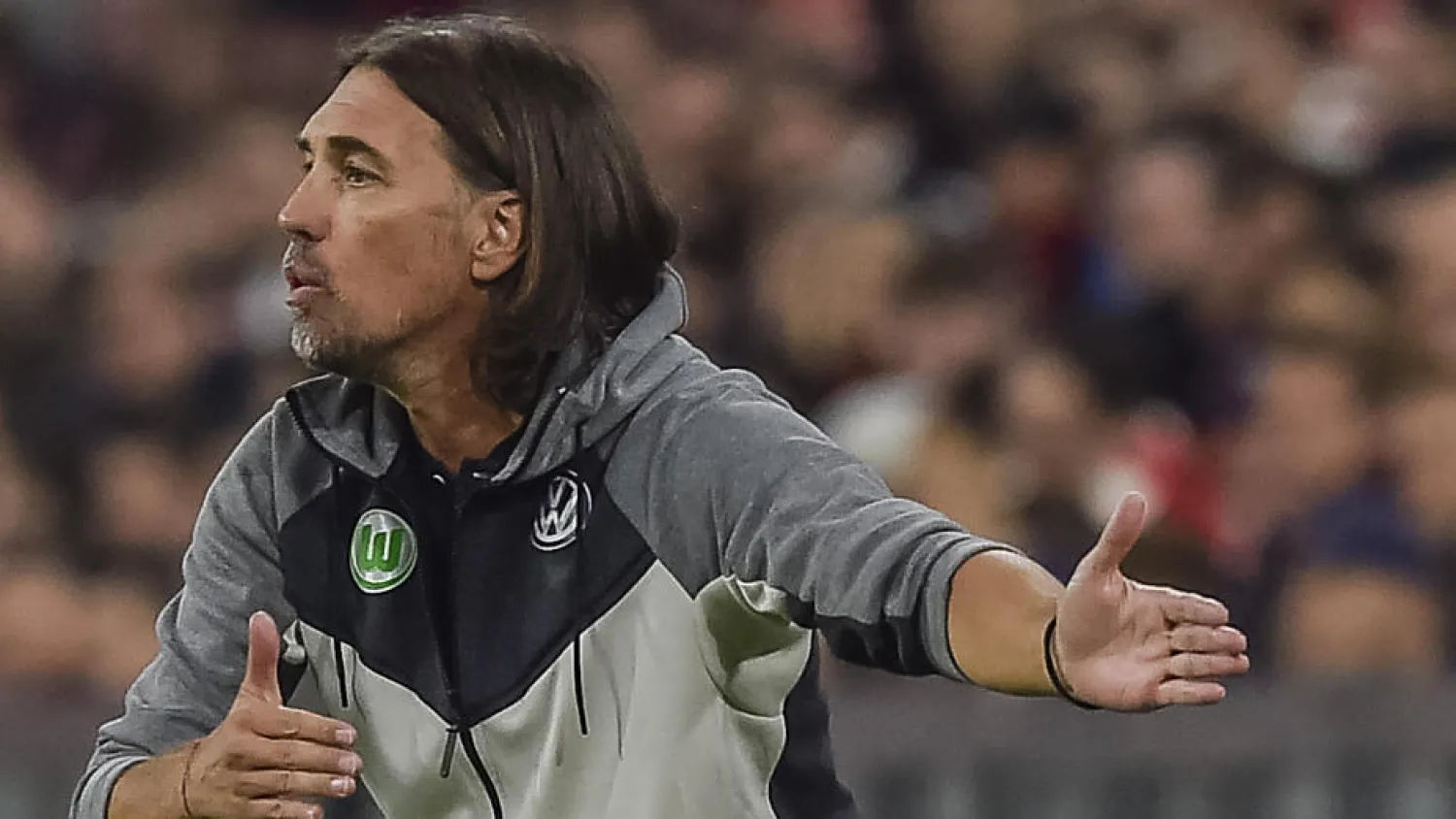
Wolfsburg coach Martin Schmidt. (AFP)
TT

Wolfsburg Hungry for more as Englische Woche Leaves Leipzig Gasping for Break

Wolfsburg coach Martin Schmidt. (AFP)

“I would say it’s something to learn from.” Divock Origi’s summary of his glaring second-half miss that might have given Wolfsburg victory over RB Leipzig might be considered to be erring on the side of circumspection – it was quite simply a sitter, despite his patient and detailed description of the circumstances that conditioned it to TV broadcasters after the game – but then again, his team are getting pretty good at that.

The appointment of Martin Schmidt, removed as Mainz coach after a too-close-for-comfort end to last season, hardly fired the imagination when Wolfsburg decided to end the difficult reign of Andries Jonker. Yet if his new side haven’t yet returned to the heights they were scaling when Kevin De Bruyne was running the show, their new coach has helped them to find stability.

Schmidt has been in charge for 13 games in all competitions and Die Wölfe have lost only one of those – and that defeat, at Augsburg, was heavily influenced by Max Arnold’s contestable early red card. The first seven league games under Schmidt were all draws (a Bundesliga record) and last week’s game was another of strangely mixed emotions: partially pride about what they’ve become, and partly disappointment at failing to quite fulfill what was possible.

Experienced defender Paul Verhaegh, who opened the scoring from the penalty spot early on before Marcel Halstenberg equalized for the visitors at the start of the second half, talked about “two points lost”, which says a lot about rising expectations after facing last season’s runners-up.

Last season, Wolfsburg’s struggles at home set the tone for general dysfunction. Now, they’re beginning to make the Volkswagen Arena a fortress, and are yet to lose there under Schmidt. Maybe he should have been given more credit. He has always had to be adaptable, having had a modest playing career in Switzerland punctuated by no less than seven cruciate knee ligament injuries, suffered playing football, downhill skiing and mountain biking. He has few regrets at being so intrepid. “You’d look back at 50 and say to yourself: ‘I never risked anything,’” he told 11 Freunde in a 2016 interview.

Before he was appointed youth coach as FC Thun – where his path crossed with that of Thomas Tuchel, who later invited him to join him at Mainz on becoming head coach – he was a part-time mechanic too, immersing himself in his workshop before dropping it completely and moving on when the time came. His tenure at Wolfsburg so far has again underlined his chameleon-like tendencies. He once spoke of his typical Mainz player being “a sprinter”. Against Leipzig, his tactics were more rope-a-dope, perhaps wisely in a taxing Englische Woche. Described as “passive” for the first 70 minutes by Leipzig goalkeeper Peter Gulacsi, they certainly came out to play in the final 20.

As well as Origi’s miss, Gulacsi saved from Guilavogui right at the end as Leipzig hung on, after Dayot Upamecano was sent off for a second booking. Guilavogui is a great example of individual improvement, along with Yunus Malli, who was struggling badly last term but spent the morning after the Leipzig game with Wolfsburger Allgemeine, choosing a bespoke name for his inspired pass that set up Daniel Didavi’s goal against Borussia Mönchengladbach. He settled on the Malli-Drop, ahead of Mallifique and Yunusgenuss (“Yunus’ treat”).

Nobody is arguing with the job Schmidt’s counterpart Ralph Hasenhüttl has done at Leipzig, but they look as if they could do with some of that freshness right now. At last week, Sky trailed the statistic that Leipzig were set to have the lowest points total that a second-placed team has had in the Bundesliga at the winter break during the three-point era. It might be something that reflects on the general level of competition for Bayern Munich over the last two months (and with Schalke leapfrogging them with a Wednesday night win), but it underlines their own difficulties too. At the same point last season, despite losing the last of that 16-game sequence 3-0 at Bayern, Hasenhüttl’s side were eight points better off. They are now four games without a win.

Their style is a physically taxing one, with lots of sprints to press the opposition and then to counterattack. It’s hardly surprising, in this context and with a first Champions League involvement behind them, that after a good first half at the Volkswagen Arena, they began to tire badly in the closing stages. It was a thread grasped by Hasenhüttl, who has been dissatisfied with his side’s defensive performance in general but called last week’s effort “decent and alert, except for the last 15 minutes”.

In Lower Saxony they missed the injured Marcel Sabitzer and Emil Forsberg, and have little alternative to Timo Werner and Yussuf Poulsen up top with Jean-Kévin Augustin, who missed this through illness, out of form after a promising start. Gulacsi – who many thought might be replaced last summer, but has matured into one of the side’s most reliable figures – became the fifth different player to wear the captain’s armband on last week. “The other six or seven captains were missing,” he laughed after the match, reflecting on Hasenhüttl’s vote of confidence in him.

Leipzig need their winter break badly while on current form, Wolfsburg will be like caged animals during theirs. Who would have predicted that at the start of the season?

The Guardian Sport


Second Season of ‘Kings League–Middle East' to Kick off in March in Riyadh 

The second season of the Kings League-Middle East will kick off in Riyadh on March 27. (Kings League-Middle East on X)
TT

Second Season of ‘Kings League–Middle East' to Kick off in March in Riyadh 

The second season of the Kings League-Middle East will kick off in Riyadh on March 27. (Kings League-Middle East on X)

The Kings League-Middle East announced that its second season will kick off in Riyadh on March 27.

The season will feature 10 teams, compared to eight in the inaugural edition, under a format that combines sporting competition with digital engagement and includes the participation of several content creators from across the region.

The Kings League-Middle East is organized in partnership with SURJ Sports Investments, a subsidiary of the Public Investment Fund (PIF), as part of efforts to support the development of innovative sports models that integrate football with digital entertainment.

Seven teams will return for the second season: DR7, ABO FC, FWZ, Red Zone, Turbo, Ultra Chmicha, and 3BS. Three additional teams are set to be announced before the start of the competition.

Matches of the second season will be held at Cool Arena in Riyadh under a single round-robin format, with the top-ranked teams advancing to the knockout stages, culminating in the final match.

The inaugural edition recorded strong attendance and wide digital engagement, with approximately a million viewers following the live broadcasts on television and digital platforms.


Shakhtar Boss Pays Ukrainian Racer $200,000 After Games Disqualification

Ukrainian President Volodymyr Zelenskiy holds helmet as he meets with a Ukrainian skeleton racer Vladyslav Heraskevych , who was disqualified from the Olympic skeleton competition over his "helmet of remembrance" depicting athletes killed since Russia's invasion and his father and coach, Mykhailo Heraskevych, amid Russia's attack on Ukraine, in Munich, Germany February 13, 2026. (Ukrainian Presidential Press Service/Handout via Reuters)
TT

Shakhtar Boss Pays Ukrainian Racer $200,000 After Games Disqualification

Ukrainian President Volodymyr Zelenskiy holds helmet as he meets with a Ukrainian skeleton racer Vladyslav Heraskevych , who was disqualified from the Olympic skeleton competition over his "helmet of remembrance" depicting athletes killed since Russia's invasion and his father and coach, Mykhailo Heraskevych, amid Russia's attack on Ukraine, in Munich, Germany February 13, 2026. (Ukrainian Presidential Press Service/Handout via Reuters)

The owner of ‌Ukrainian football club Shakhtar Donetsk has donated more than $200,000 to skeleton racer Vladyslav Heraskevych after the athlete was disqualified from the Milano Cortina Winter Games before competing over the use of a helmet depicting Ukrainian athletes killed in the war with Russia, the club said on Tuesday.

The 27-year-old Heraskevych was disqualified last week when the International Bobsleigh and Skeleton Federation jury ruled that imagery on the helmet — depicting athletes killed since Russia invaded Ukraine in 2022 — breached rules on athletes' expression at ‌the Games.

He ‌then lost an appeal at the Court ‌of ⁠Arbitration for Sport hours ⁠before the final two runs of his competition, having missed the first two runs due to his disqualification.

Heraskevych had been allowed to train with the helmet that displayed the faces of 24 dead Ukrainian athletes for several days in Cortina d'Ampezzo where the sliding center is, but the International Olympic Committee then ⁠warned him a day before his competition ‌started that he could not wear ‌it there.

“Vlad Heraskevych was denied the opportunity to compete for victory ‌at the Olympic Games, yet he returns to Ukraine a ‌true winner," Shakhtar President Rinat Akhmetov said in a club statement.

"The respect and pride he has earned among Ukrainians through his actions are the highest reward. At the same time, I want him to ‌have enough energy and resources to continue his sporting career, as well as to fight ⁠for truth, freedom ⁠and the remembrance of those who gave their lives for Ukraine," he said.

The amount is equal to the prize money Ukraine pays athletes who win a gold medal at the Games.

The case dominated headlines early on at the Olympics, with IOC President Kirsty Coventry meeting Heraskevych on Thursday morning at the sliding venue in a failed last-minute attempt to broker a compromise.

The IOC suggested he wear a black armband and display the helmet before and after the race, but said using it in competition breached rules on keeping politics off fields of play. Heraskevych also earned praise from Ukraine President Volodymyr Zelenskiy.


Speed Skating-Italy Clinch Shock Men’s Team Pursuit Gold, Canada Successfully Defend Women’s Title

 Team Italy with Davide Ghiotto, Andrea Giovannini, Michele Malfatti, celebrate winning the gold medal on the podium of the men's team pursuit speed skating race at the 2026 Winter Olympics, in Milan, Italy, Tuesday, Feb. 17, 2026. (AP)
Team Italy with Davide Ghiotto, Andrea Giovannini, Michele Malfatti, celebrate winning the gold medal on the podium of the men's team pursuit speed skating race at the 2026 Winter Olympics, in Milan, Italy, Tuesday, Feb. 17, 2026. (AP)
TT

Speed Skating-Italy Clinch Shock Men’s Team Pursuit Gold, Canada Successfully Defend Women’s Title

 Team Italy with Davide Ghiotto, Andrea Giovannini, Michele Malfatti, celebrate winning the gold medal on the podium of the men's team pursuit speed skating race at the 2026 Winter Olympics, in Milan, Italy, Tuesday, Feb. 17, 2026. (AP)
Team Italy with Davide Ghiotto, Andrea Giovannini, Michele Malfatti, celebrate winning the gold medal on the podium of the men's team pursuit speed skating race at the 2026 Winter Olympics, in Milan, Italy, Tuesday, Feb. 17, 2026. (AP)

An inspired Italy delighted the home crowd with a stunning victory in the Olympic men's team pursuit final as

Canada's Ivanie Blondin, Valerie Maltais and Isabelle Weidemann delivered another seamless performance to beat the Netherlands in the women's event and retain their title ‌on Tuesday.

Italy's ‌men upset the US who ‌arrived ⁠at the Games ⁠as world champions and gold medal favorites.

Spurred on by double Olympic champion Francesca Lollobrigida, the Italian team of Davide Ghiotto, Andrea Giovannini and Michele Malfatti electrified a frenzied arena as they stormed ⁠to a time of three ‌minutes 39.20 seconds - ‌a commanding 4.51 seconds clear of the ‌Americans with China taking bronze.

The roar inside ‌the venue as Italy powered home was thunderous as the crowd rose to their feet, cheering the host nation to one ‌of their most special golds of a highly successful Games.

Canada's women ⁠crossed ⁠the line 0.96 seconds ahead of the Netherlands, stopping the clock at two minutes 55.81 seconds, and

Japan rounded out the women's podium by beating the US in the Final B.

It was only Canada's third gold medal of the Games, following Mikael Kingsbury's win in men's dual moguls and Megan Oldham's victory in women's freeski big air.