

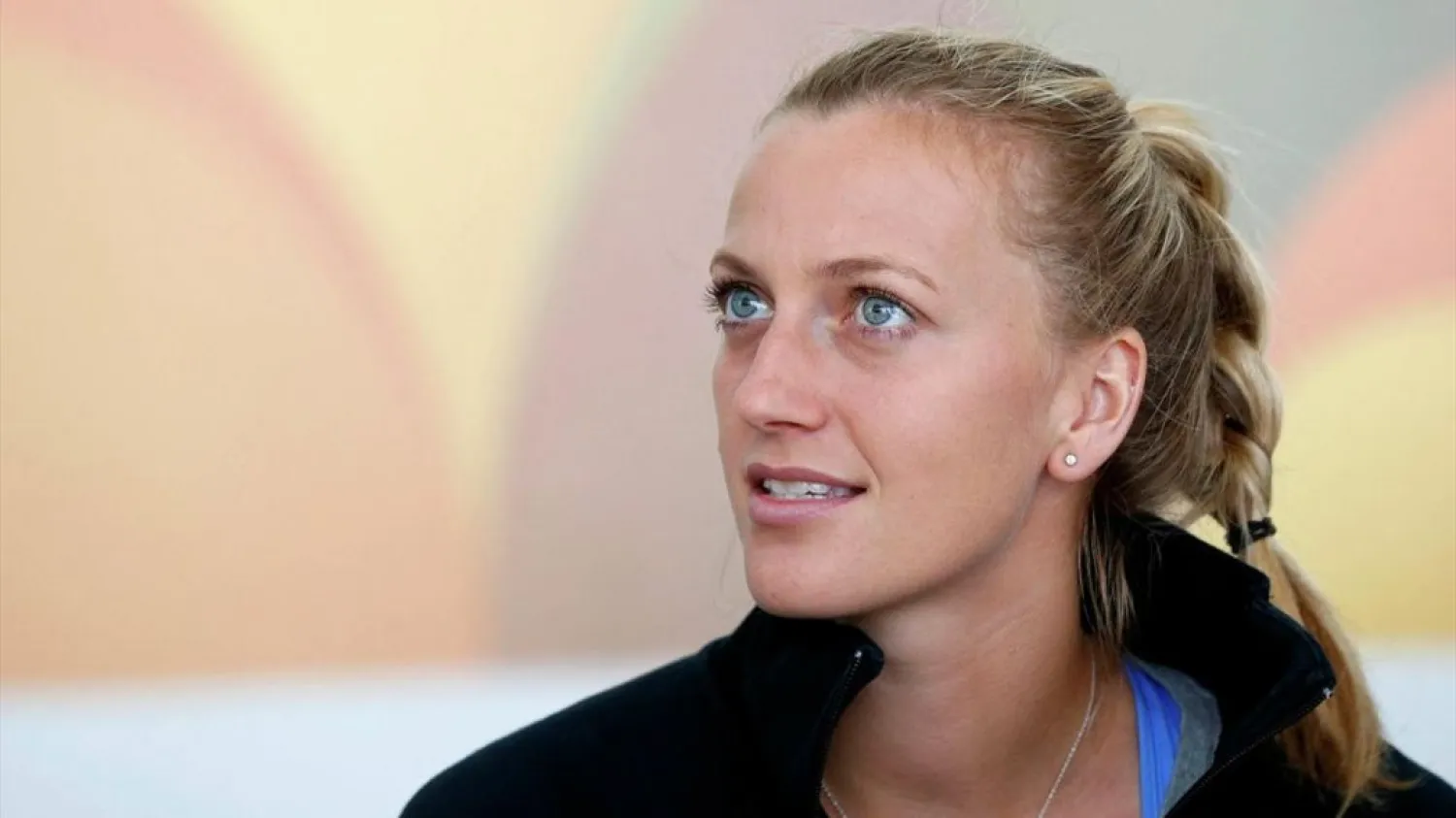

Petra Kvitova: I’ll Never Forget the Attack but I’m Trying to Love my New Hand

Petra Kvitova. (Reuters)
TT

Petra Kvitova: I’ll Never Forget the Attack but I’m Trying to Love my New Hand

Petra Kvitova. (Reuters)

The grisly details of the terrifying knife attack that turned Petra Kvitova’s life upside down almost exactly a year ago are barely comprehensible. Watching her on the practice courts at the Sparta Praha Tennis Club, it is almost impossible to detect the effects from injuries so severe some experts believed the two-times Wimbledon champion would never resume her career; she still suffers from nerve damage to her playing hand and cannot entirely clench her fist or feel two of her fingers.

Kvitova puts down her racket to take a break from back-to-back practice sessions on the indoor courts and makes her way upstairs to a small meeting room with her coach, Jiri Vanek, a kit bag slung over her athletic 6ft frame.

After a brief and cheerful exchange in Czech with Vanek, whom she hired only a few weeks before the attack, she pulls up a chair by the window overlooking the tired and rusty clay courts below. There is an air of confidence about her as she matter-of-factly discusses the next steps in her recovery before revealing the full physical and mental trauma of an attack that left her terrified to hold a racket again after career-saving surgery and a grueling rehabilitation.

“It will probably take more than a year to get full movement back, I’m not sure,” Kvitova says. “For tennis and for life, it’s good. I’ve done everything that I could but there is still some space to improve it. I hope that with more time I will be even stronger. I am happy that [throughout the recovery] I was always looking forward to the better tomorrows.”

The tennis club is some 260km west of Kvitova’s former apartment in Prostejov in the Czech Republic – where the vicious encounter with a knife-wielding intruder posing as a utility worker on 20 December last year took place.

Kvitova has spent a lot of time since then thinking about all of the simple things that she perhaps took for granted. As she begins to unravel the events of the past 12 months, it quickly becomes apparent that she has developed a newfound appreciation for life.

The physical scars that lace her playing hand are healing; the invisible scars have taken somewhat longer. Kvitova pauses briefly, as if to replay the moments when she worked tirelessly on a five-month rehabilitation program, before suggesting: “If I wasn’t playing tennis I don’t think I could be as positive as I am now – but it’s not pleasant to see those flashbacks. It is a time that I try to forget but I know I will never really forget what happened. This experience has shown me how hard I can work if I need to and just how much of a fighter I am on and off the court.”

Kvitova made an emotional return to action in the French Open in May, where she progressed to the second round, confounding the expectations of her surgeon – who had sleepless nights over her recovery – and those who had written off her career. “I did hear the rumors that I would never ever play again but I thought: ‘I will show them,’ she recalls, offering a reminder of the steely determination instilled in her by her father, Jiri.

“I was like: ‘Why are they saying this?’ It was very painful for me, it felt like they didn’t believe me. Of course, at that time, I probably didn’t know how bad it was because nobody told me – and I am happy for that now.

“My doctor [Radek Kebrle] told me that many other experts thought that I would never ever play. He didn’t want to tell me – and that was a good decision for my mental state of mind.

“The week after surgery I asked my doctor: ‘Do you think I could play in Wimbledon this year?’ He didn’t answer for a while and then he said: ‘We are going to work on it and blah, blah, blah.’ I understood then that it wasn’t going to be easy.”

Although the draining physiotherapy sessions are no longer part of Kvitova’s daily routine, she still vividly remembers being gripped by fear when she attempted to hold a racket for the first time only 12 weeks after four hours of emergency surgery.

Any hopes of a comeback took a hit when Kvitova realized she could not feel or grip the racket in a way that she wanted. That familiar sensation of holding a racket firmly in her hand, as she had done since she was four years old, had disappeared almost overnight.

“I had a lot of conversations with my coach [about making adjustments to my racket]. I told him that I didn’t want to change anything because if I was to change some small details I thought it would change everything. I told him: ‘I’m going to try like this, please give me time and we will see how it works out.’

“That’s how he wanted it to be as well. I am glad that we didn’t make any adjustments to my racket. Everything is the same as before … and it’s all good,” Kvitova says – and smiles with a sense of accomplishment.

Having returned to competition, she secured a fairy-tale comeback in only her second tournament back when she won a 20th career title at Birmingham’s Aegon Classic with a 4-6, 6-3, 6-2 triumph over Australia’s Ashleigh Barty. Kvitova lost in the second round at Wimbledon before playing through the hard court season in north America, where she reached the quarter-finals at Flushing Meadows.

“Playing on the grass at Wimbledon and getting a good result in the US Open was very important for me mentally, and for my confidence,” Kvitova adds. “This year has been a rollercoaster. The beginning wasn’t very nice, so I’m really glad that it’s over. Now I can look at everything positively again.”

Even the announcement in November from the Czech police that confirmed the investigation into the attack had been shelved because of a lack of evidence, despite receiving a number of clues from the public, has not fazed her.

Detective Jan Lisicky told reporters they would “immediately start criminal proceedings” should they identify the culprit. Kvitova has shifted her focus from expecting a prosecution to regaining a position in the top 10.

“It was a pretty tough year and I had a lot of emotions during my comeback. But it has been a year [since the attack] already and I can see that I can play tennis – and I can play it well, and for me this is the best outcome I could have hoped for.”

As Kvitova gathers her belongings and prepares to resume pre-season training before her opening tournament in Brisbane in January, she adds: “I have started to live with my new hand. I’ve started to try to like it, to love it and that’s how I am going to take it. It’s my hand and I am just happy that I have all of my fingers.”

The Guardian Sport


Salah Steers Egypt into Africa Cup Knockout Stages After VAR Denies South Africa Late Penalty

 Egypt's forward #10 Mohamed Salah shoots from the penalty spot to score the team's first goal during the Africa Cup of Nations (CAN) Group B football match between Egypt and South Africa at Adrar Stadium in Agadir on December 26, 2025. (AFP)
Egypt's forward #10 Mohamed Salah shoots from the penalty spot to score the team's first goal during the Africa Cup of Nations (CAN) Group B football match between Egypt and South Africa at Adrar Stadium in Agadir on December 26, 2025. (AFP)
TT

Salah Steers Egypt into Africa Cup Knockout Stages After VAR Denies South Africa Late Penalty

 Egypt's forward #10 Mohamed Salah shoots from the penalty spot to score the team's first goal during the Africa Cup of Nations (CAN) Group B football match between Egypt and South Africa at Adrar Stadium in Agadir on December 26, 2025. (AFP)
Egypt's forward #10 Mohamed Salah shoots from the penalty spot to score the team's first goal during the Africa Cup of Nations (CAN) Group B football match between Egypt and South Africa at Adrar Stadium in Agadir on December 26, 2025. (AFP)

Mohamed Salah scored again on Friday as Egypt's 10 men held on to beat South Africa 1-0 to reach the knockout stages of the Africa Cup of Nations.

Salah, who secured the Pharaohs’ opening win with a stoppage-time strike against Zimbabwe on Monday, did it again in Agadir and his penalty before the break secured progression from Group B.

But South Africa should arguably have been given a penalty in stoppage time when Yasser Ibrahim blocked a shot with his arm. After a long delay, the referee decided against awarding the spot kick after consulting video replays and Ibrahim sank to the ground in relief.

“We didn’t have much luck. We also had several refereeing decisions go against us,” South Africa coach Hugo Broos said.

Salah converted his penalty after he was struck in the face by the hand of the retreating South Africa forward Lyle Foster. Salah showed no ill effects from the blow and sent his shot straight down the middle while goalkeeper Ronwen Williams dived to his right.

There was still time before the break for Egypt defender Mohamed Hany to get sent off, after receiving a second yellow card for a foul on Teboho Mokoena.

Goalkeeper Mohamed El Shenawy was Egypt’s key player in the second half.

“We gave our all in this match right until the end, and we also hope for the best for what comes next,” the 37-year-old El Shenawy said.

Earlier, Angola and Zimbabwe drew 1-1 in the other group game, a result that suited neither side after opening losses.

Egypt leads with 6 points from two games followed by South Africa on 3. Angola and Zimbabwe have a point each. The top two progress from each group, along with the best third-place finishers.

Zambia drew 1-1 with Comoros in the early Group A fixture after both lost their opening games, meaning the winner of the late match could be sure of progressing.


Draper to Miss Australian Open Due to Injury

 Jack Draper, of Great Britain, reacts after defeating Federico Agustin Gomez, of Argentina, during the first round of the US Open tennis championships, Aug. 25, 2025, in New York. (AP)
Jack Draper, of Great Britain, reacts after defeating Federico Agustin Gomez, of Argentina, during the first round of the US Open tennis championships, Aug. 25, 2025, in New York. (AP)
TT

Draper to Miss Australian Open Due to Injury

 Jack Draper, of Great Britain, reacts after defeating Federico Agustin Gomez, of Argentina, during the first round of the US Open tennis championships, Aug. 25, 2025, in New York. (AP)
Jack Draper, of Great Britain, reacts after defeating Federico Agustin Gomez, of Argentina, during the first round of the US Open tennis championships, Aug. 25, 2025, in New York. (AP)

Briton Jack Draper said on Friday he will not compete in next month's Australian Open, citing ongoing recovery from an injury.

Draper, 10th in the world rankings, was forced to withdraw from the second round of ‌the US Open ‌in August ‌due ⁠to bone ‌bruising in his left arm.

"Unfortunately, me and my team have decided not to head out to Australia this year. It's a really, ⁠really tough decision," the British ‌number one said in ‍a video ‍posted on X.

The 24-year-old ‍is targeting a February return alongside preparation for the defense of his Indian Wells title in March.

"This injury has been the most difficult ⁠and complex of my career," Draper added. "It's weird, it always seems to make me more resilient. I'm looking forward to getting back out there in 2026 and competing."

The Australian Open begins on January 18 in ‌Melbourne.


Morocco Forced to Wait for AFCON Knockout Place After Mali Draw

Football - CAF Africa Cup of Nations - Morocco 2025 - Group A - Morocco v Mali - Prince Moulay Abdellah Stadium, Rabat, Morocco - December 26, 2025 Morocco's Ismael Saibari reacts after Mali's Lassine Sinayoko scored their first goal. (Reuters)
TT

Morocco Forced to Wait for AFCON Knockout Place After Mali Draw

Football - CAF Africa Cup of Nations - Morocco 2025 - Group A - Morocco v Mali - Prince Moulay Abdellah Stadium, Rabat, Morocco - December 26, 2025 Morocco's Ismael Saibari reacts after Mali's Lassine Sinayoko scored their first goal. (Reuters)

Morocco missed the chance to guarantee their spot in the last 16 of the Africa Cup of Nations after Lassine Sinayoko's second-half penalty earned Mali a 1-1 draw with the hosts on Friday.

The match was a tale of two spot-kicks, with Brahim Diaz giving Morocco the lead from a penalty deep in first-half injury time and Sinayoko replying on 64 minutes.

The stalemate at the Prince Moulay Abdellah Stadium in the capital Rabat ended Morocco's world record winning run which had been taken to 19 matches with their 2-0 victory over Comoros in the tournament's opening game.

It also means Morocco have not yet confirmed their place in the knockout phase, although they are on top of Group A with four points from two games.

Mali come next on two points alongside Zambia, who drew 0-0 with minnows Comoros earlier in Casablanca.

Morocco next face Zambia on Monday and a victory in that match against the 2012 champions will ensure that the hosts go through as group winners.

"We'll look back at the second half and see what the problem was but we didn't play the way we did in the first half. We didn't impose our game and had to drop off. The penalty changed the game a bit," Morocco midfielder Azzedine Ounahi told broadcaster beIN Sports.

"We go into the third game with the same approach, to win the game and finish top of the group."

Morocco captain Achraf Hakimi, the African player of the year, was again an unused substitute as he continues his recovery from an ankle injury suffered playing for Paris Saint-Germain at the start of November.

- Mbappe watches on -

His former PSG teammate Kylian Mbappe, the current Real Madrid superstar and France skipper, was among the spectators in the crowd of 63,844 and appeared to be wearing a Morocco shirt with Hakimi's number two on it.

With Hakimi on the sidelines, Mbappe's Real Madrid teammate Diaz was the main attraction on the pitch -- the little number 10 forced a good save from Mali goalkeeper Djigui Diarra on 17 minutes and then played a key part in the penalty which led to the opening goal just before the interval.

Mali defender Nathan Gassama brushed the ball with his hand as he tried to stop Diaz dribbling past him inside the box, and the referee eventually awarded a spot-kick following a lengthy look at the pitchside VAR monitor.

Morocco's Soufiane Rahimi had a spot-kick saved against Comoros but this time Diaz sent the goalkeeper the wrong way for his second goal of the tournament.

However, Walid Regragui's side, the best team in Africa according to the FIFA rankings, could not build on that as Mali won a penalty of their own just after the hour mark.

Sinayoko went down under a clumsy challenge by Jawad El Yamiq and 29-year-old Cameroonian referee Abdoul Abdel Mefire awarded the penalty after eventually being called over to check his screen.

Auxerre striker Sinayoko, having been booked apparently for something he said to the referee, kept his cool to stroke in the reward and restore parity.

Morocco substitute Youssef En-Nesyri was denied by a good Diarra save and Mali then held on through 10 minutes of stoppage time for a point, as the final whistle was greeted with jeers from the home fans.
