

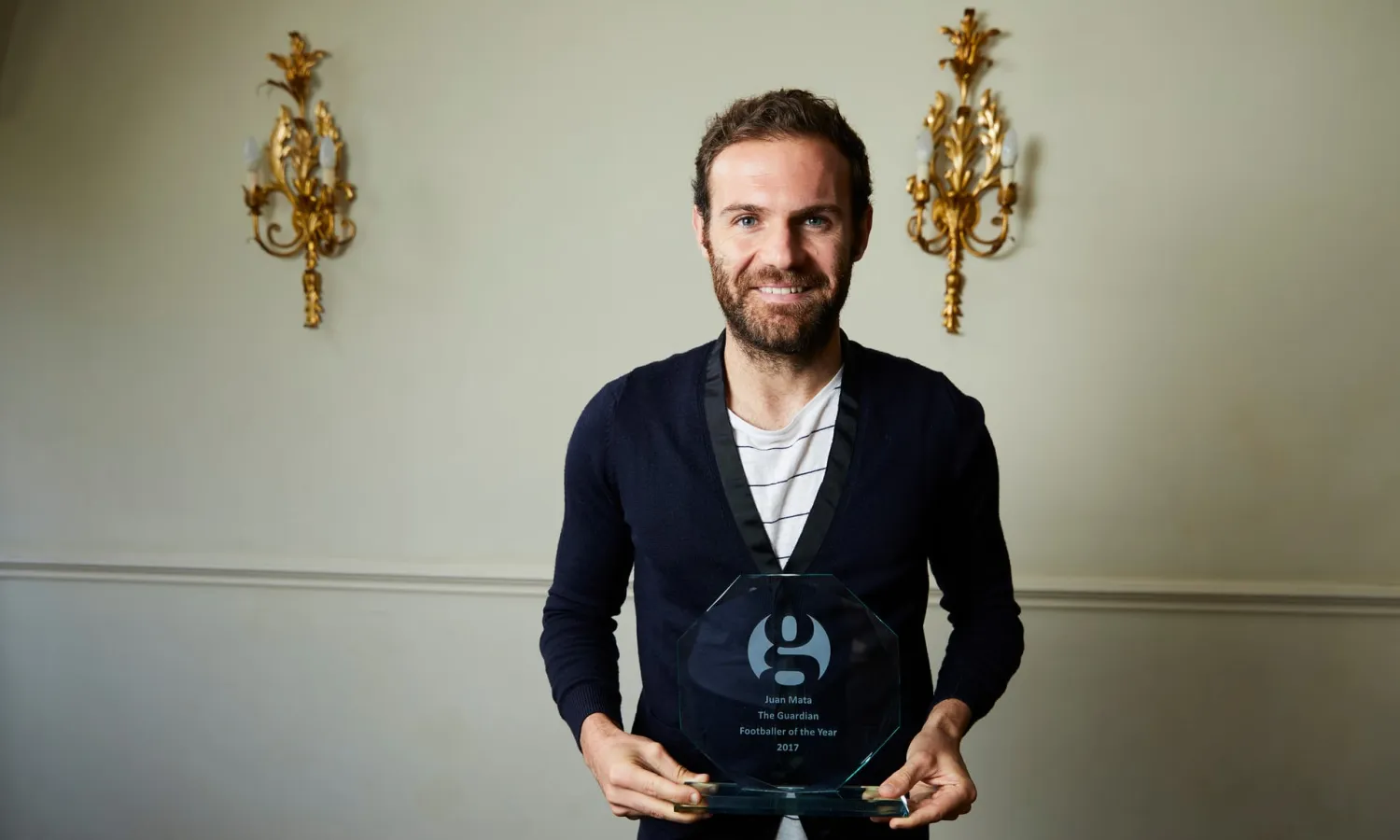

The Guardian footballer of the year 2017: Juan Mata

Juan Mata says sometimes people underestimate footballers ‘and their capacity to have a strong opinion and sympathy for others’. Photograph: Christopher Thomond for the Guardian
TT

The Guardian footballer of the year 2017: Juan Mata

Juan Mata says sometimes people underestimate footballers ‘and their capacity to have a strong opinion and sympathy for others’. Photograph: Christopher Thomond for the Guardian

The Guardian Footballer of the Year is an award given to a player who has done something truly remarkable, whether by overcoming adversity, helping others or setting a sporting example by acting with exceptional honesty. The inaugural winner was Fabio Pisacane in 2016

Each time you meet Juan Mata it’s a surprise how small he appears in person. You never expect a giant of a man to be only 5ft 7in tall, and to cut such a slight figure or to flash a warm smile, but the Guardian’s Footballer of the Year for 2017 has always made a habit of confounding expectations about himself and the game he loves.

This year Mata has done more than anyone to give fresh belief that professional football is not only built on greed and staggering wages for its strutting prima donnas. The Manchester United and Spain midfielder, instead, has broken new ground and begun to use football’s power and wealth to help ordinary people around the world.

“It’s a very simple idea,” Mata says with typical understatement as he describes the remarkable Common Goal initiative he helped to launch in August, so that he and a growing number of his colleagues can donate 1% of their salaries to global charities. “But some of the best ideas are simple ones and, when it comes to football, the power of the game is incredible. Anyone who understands football will know why we are so hopeful and ambitious with Common Goal.”

In less than five months Mata has been joined by 35 other football people from 17 countries in donating 1% of their salaries to Common Goal. All the money raised will be given to football charities where it is needed most – and the project now includes, beyond the players, its first manager, administrator and startup initiative.

The players, of course, are the real drivers of Common Goal and Mata has been joined by high-profile internationals such as Mats Hummels, Giorgio Chiellini, Shinji Kagawa and Kasper Schmeichel – as well as leading women footballers in Alex Morgan and Megan Rapinoe.

Julian Nagelsmann, the 30-year-old who has forged a dynamic reputation at Hoffenheim, became the first head coach to join Common Goal in October while Aleksander Ceferin, the Uefa president, also pledged 1% of his salary to the cause. When announcing his backing last month, Ceferin said: “I call upon everyone in the international football community – players, coaches, clubs and leagues – to show they care about social initiatives and donate to causes they believe in.”

Common Goal’s grand ambition is to reach a position where 1% of football’s entire multibillion dollar industry is donated to charity. It might seem an impossible dream – just as a young boy’s fantasy of becoming a top footballer almost always seems unobtainable. But Mata was one of those who fulfilled his footballing dream.

We have met twice this year and, during our first interview, Mata spoke evocatively when remembering how, having joined Real Oviedo aged 10 in 1998, he was given a previously unimaginable opportunity. Mata sat in a car park in 2003, when he was 14, and watched his father talking to a Real Madrid scout. “My first thought was: ‘Wow, my dad is speaking with a guy from Real Madrid Academy! Is this happening?’ Until that moment I saw myself very far from that. I was in my home town doing good for Real Oviedo and playing with older people but you never realise your level until some of these big clubs speak to your dad.

“You are full of excitement but doubt, too. ‘Am I good enough to play there?’ That was my first thought. I know I’m doing good in Oviedo but if I played against Real Madrid and Barcelona in tournaments I see them with the famous shirts. They look bigger, taller, quicker and stronger – because of the shirt.

“I can’t hear what my dad and the Madrid academy guy are saying but my next thought was: ‘Whoa, let’s see what happens. If they give me a chance let’s try my best.’ But it was still a big surprise when my dad told me the news. Real Madrid wanted me to join their academy. It was a big decision to move when I was 15. It’s a key age for a youngster and you’re close to your friends and family. But I moved to Madrid and my family stayed at home. It made me mature earlier than normal. That was a very big decision and it changed me in a positive way.”

Life is predicated by the decisions and choices we make – and, earlier this year, the personal fused with the professional again as Mata reached the landmark moment when he knew he had to try to harness football’s power for the benefit of people less fortunate than him and his contemporaries. The death of his grandfather, who had done so much to nurture his love of football, moved him profoundly. Mata wanted to turn his feeling of loss into one of hope.

“I had been thinking about doing my own foundation to help others,” Mata says. “But I then met Jürgen Griesbeck [the founder of streetfootballworld, which now runs Common Goal]. He’s been working in football for 15 years and he started in Colombia after the death of Andrés Escobar because he scored an own goal in the [1994] World Cup. We came up with the idea of bringing football together to help others. The idea is that it doesn’t have to be voluntary. We aim to have the 1% donation [embedded] within the structure of football.”

When Common Goal was launched Mata found the right words to explain the pure belief that would drive the project. He began by recalling a lonely moment in the 2012 Champions League final in Munich. Bayern Munich, playing at home, had taken the lead in the 83rd minute when Thomas Müller’s looping header bounced into the Chelsea net.

“A few seconds later,” Mata recalled, “I was standing in the centre circle of the Allianz Arena, waiting for the Bayern players to stop celebrating the goal they thought had just won the match. Didier Drogba, my Chelsea team-mate, walked up to me to restart play. Didier never had his head down – never looked discouraged – but now he did. I couldn’t understand why. We had gone through so much to get to the final. Our manager had been sacked a few months before, then we had come from behind to beat Napoli in the round of 16, then we had survived with 10 men at Camp Nou in the semi-finals. And now … it was over?

“I put my hand on Didier’s shoulder and said: ‘Look around, Didier. Look where we are. Keep believing … just believe.’ For some reason I kept thinking: ‘We are destined to win this thing.’ I’m a pretty quiet person and when Didier saw me encouraging him to keep going, he couldn’t help but smile. He said: ‘OK, Juan. Let’s go.’”

Mata would soon whip in the cross that allowed Drogba to equalise – and Chelsea went on to win the Champions League, beating the German club on penalties, with their talisman from the Ivory Coast making history with the final spot-kick. “As we were celebrating, I looked around at my team-mates and saw the beauty of football. A keeper from the Czech Republic. A defender from Serbia and another from Brazil. Midfielders from Ghana, Nigeria, Portugal, Spain and England. And, of course, one incredible striker from Côte d’Ivoire.

“We came from all over the world, from different circumstances and spoke many different languages. Some had grown up during wartime. Some had grown up in poverty. But there we were, all standing together in Germany as champions of Europe. The way we had come together from all around the world to work for a common goal was more meaningful to me than the trophy. To me, that is something that can change the world for the better.”

The 29-year-old has also won the World Cup and Euro 2012, and played for Valencia, Chelsea and Manchester United. Yet if you spend any sustained time with Mata it is obvious how much he regards football as a game that touches him in the same way that moves billions of people with its capacity for joy and pain. It also generates enduring hope and pleasure, and so, amid the familiar disappointment whenever your team loses, football pulses with more life than any other sport.

“For me,” Mata says, “football is what I love to do most. It is also the thing I’m better doing than anything else. But football is more than a game. Common Goal brings together these two levels of how football is understood. We have professional football but we also have a beautiful game, which, wherever you go, can be used as a social tool for change. Football has an unmatchable power.

“I have such strong memories from South Africa when we won the World Cup with Spain in 2010. We saw the passion for the game among kids there and it was the same when I went to Mumbai this year. Everywhere you go kids are playing football. Even if there is not much grass you have four sweaters which make the two goals. The kids just play.”

I went to the opening of the photographic exhibition Mata and his girlfriend held at the National Football Museum – and surrounded by photographs they had taken in Mumbai it was heartening to see a young Indian football team Mata had invited to Manchester. His face was a picture when he listened to the little footballers sing a team song for him.

“It was a great experience to be in Mumbai. A lot of the kids didn’t know who I was but I loved seeing them play football. I was also emotional when I saw they were trying to teach the kids English in the classrooms – and seeing people trying to feed their children in a proper way. It was a great visit but it was a big shock of reality in terms of how some people around the world do struggle.”

Footballers are often dismissed as arrogant or ignorant but Common Goal provides an alternative view. “Sometimes you look at footballers and think they’re selfish or they don’t bring a good image to society,” Mata admits. “But sometimes people underestimate footballers and their capacity to have a strong opinion and sympathy for others. I believe being a professional footballer means you have some responsibility to think of others who don’t have the same opportunities. It’s a matter of education – but I am positive the more we talk the more young players will have a perception of how lucky we are.”

Football is a game of tumult and glory, of small disappointments and lingering dreams, and Mata has played long enough at the highest level to appreciate these truths. He was player of the year in successive seasons at Chelsea before being sidelined by the returning manager, José Mourinho, and sold to Manchester United in 2014. In 2016 Mata was tested again when Mourinho was appointed United’s manager. Yet there has been no ill-feeling and Mata has become an integral member of Mourinho’s squad – to the extent that, earlier this season, the manager said: “I need Mata’s brain.”

It is a sentiment most of us understand and appreciate. We need Mata’s intelligence and compassion, his wider vision and social conscience in a fractured world. In his own small and noble way he is making a profound difference – which explains why he was such an obvious winner of the Guardian’s Footballer of the Year award in 2017.

He looks down at the trophy and murmurs his thanks. But then Mata stresses his typical belief. “I am proud to accept this award on behalf of everyone at Common Goal. This was never going to be about me. It is about Common Goal – and all of us who share the belief that football can make the world a better place.”

(The Guardian)


Sinner Sees off Popyrin to Reach Doha Quarters

 Italy's Jannik Sinner greets the fans after defeating Australia's Alexei Popyrin in their men's singles match at the Qatar Open tennis tournament in Doha on February 18, 2026. (AFP)
Italy's Jannik Sinner greets the fans after defeating Australia's Alexei Popyrin in their men's singles match at the Qatar Open tennis tournament in Doha on February 18, 2026. (AFP)
TT

Sinner Sees off Popyrin to Reach Doha Quarters

 Italy's Jannik Sinner greets the fans after defeating Australia's Alexei Popyrin in their men's singles match at the Qatar Open tennis tournament in Doha on February 18, 2026. (AFP)
Italy's Jannik Sinner greets the fans after defeating Australia's Alexei Popyrin in their men's singles match at the Qatar Open tennis tournament in Doha on February 18, 2026. (AFP)

Jannik Sinner powered past Alexei Popyrin in straight sets on Wednesday to reach the last eight of the Qatar Open and edge closer to a possible final meeting with Carlos Alcaraz.

The Italian, playing his first tournament since losing to Novak Djokovic in the Australian Open semi-finals last month, eased to a 6-3, 7-5 second-round win in Doha.

Sinner will play Jakub Mensik in Thursday's quarter-finals.

Australian world number 53 Popyrin battled gamely but failed to create a break-point opportunity against his clinical opponent.

Sinner dropped just three points on serve in an excellent first set which he took courtesy of a break in the sixth game.

Popyrin fought hard in the second but could not force a tie-break as Sinner broke to grab a 6-5 lead before confidently serving it out.

World number one Alcaraz takes on Frenchman Valentin Royer in his second-round match later.


Ukraine's Officials to Boycott Paralympics over Russian Flag Decision

Milano Cortina 2026 Winter Olympics - Skeleton - Interview with Ukraine Youth and Sports minister Matvii Bidnyi - N H Hotel, Milan, Italy - February 12, 2026 Ukraine Youth and Sports Minister Matvii Bidnyi speaks after the disqualification of Ukrainian skeleton racer Vladyslav Heraskevych from the Winter Games. REUTERS/Kevin Coombs
TT

Ukraine's Officials to Boycott Paralympics over Russian Flag Decision

Milano Cortina 2026 Winter Olympics - Skeleton - Interview with Ukraine Youth and Sports minister Matvii Bidnyi - N H Hotel, Milan, Italy - February 12, 2026 Ukraine Youth and Sports Minister Matvii Bidnyi speaks after the disqualification of Ukrainian skeleton racer Vladyslav Heraskevych from the Winter Games. REUTERS/Kevin Coombs

Ukrainian officials will boycott the Paralympic Winter Games, Kyiv said Wednesday, after the International Paralympic Committee allowed Russian athletes to compete under their national flag.

Ukraine also urged other countries to shun next month's Opening Ceremony in Verona on March 6, in part of a growing standoff between Kyiv and international sporting federations four years after Russia invaded.

Six Russians and four Belarusians will be allowed to take part under their own flags at the Milan-Cortina Paralympics rather than as neutral athletes, the Games' governing body confirmed to AFP on Tuesday.

Russia has been mostly banned from international sport since Moscow invaded Ukraine. The IPC's decision triggered fury in Ukraine.

Ukraine's sports minister Matviy Bidny called the decision "outrageous", and accused Russia and Belarus of turning "sport into a tool of war, lies, and contempt."

"Ukrainian public officials will not attend the Paralympic Games. We will not be present at the opening ceremony," he said on social media.

"We will not take part in any other official Paralympic events," he added.

Ukrainian Foreign Minister Andriy Sybiga said he had instructed Kyiv's ambassadors to urge other countries to also shun the opening ceremony.

"Allowing the flags of aggressor states to be raised at the Paralympic Games while Russia's war against Ukraine rages on is wrong -- morally and politically," Sybiga said on social media.

The EU's sports commissioner Glenn Micallef said he would also skip the opening ceremony.

- Kyiv demands apology -

The IPC's decision comes amid already heightened tensions between Ukraine and the International Olympic Committee, overseeing the Winter Olympics currently underway.

The IOC banned Ukrainian skeleton racer Vladyslav Heraskevych for refusing to ditch a helmet depicting victims of the war with Russia.

Ukraine was further angered that the woman chosen to carry the "Ukraine" name card and lead its team out during the Opening Ceremony of the Games was revealed to be Russian.

Media reports called the woman an anti-Kremlin Russian woman living in Milan for years.

"Picking a Russian person to carry the nameplate is despicable," Kyiv's foreign ministry spokesman Georgiy Tykhy said at a briefing in response to a question by AFP.

He called it a "severe violation of the Olympic Charter" and demanded an apology.

And Kyiv also riled earlier this month at FIFA boss Gianni Infantino saying he believed it was time to reinstate Russia in international football.

- 'War, lies and contempt' -

Valeriy Sushkevych, president of the Ukrainian Paralympic Committee told AFP on Tuesday that Kyiv's athletes would not boycott the Paralympics.

Ukraine traditionally performs strongly at the Winter Paralympics, coming second in the medals table four years ago in Beijing.

"If we do not go, it would mean allowing Putin to claim a victory over Ukrainian Paralympians and over Ukraine by excluding us from the Games," said the 71-year-old in an interview.

"That will not happen!"

Russia was awarded two slots in alpine skiing, two in cross-country skiing and two in snowboarding. The four Belarusian slots are all in cross-country skiing.

The International Paralympic Committee (IPC) said earlier those athletes would be "treated like (those from) any other country".

The IPC unexpectedly lifted its suspension on Russian and Belarusian athletes at the organisation's general assembly in September.


'Not Here for Medals', Nakai Says after Leading Japanese Charge at Olympics

Ami Nakai of Japan competes during the women's short program figure skating at the 2026 Winter Olympics, in Milan, Italy, Tuesday, Feb. 17, 2026. (AP Photo/Ashley Landis)
TT

'Not Here for Medals', Nakai Says after Leading Japanese Charge at Olympics

Ami Nakai of Japan competes during the women's short program figure skating at the 2026 Winter Olympics, in Milan, Italy, Tuesday, Feb. 17, 2026. (AP Photo/Ashley Landis)

Ami Nakai entered her first Olympics insisting she was not here for medals — but after the short program at the Milano Cortina Games, the 17-year-old figure skater found herself at the top, ahead of national icon Kaori Sakamoto and rising star Mone Chiba.

Japan finished first, second, and fourth on Tuesday, cementing a formidable presence heading into the free skate on Thursday. American Alysa Liu finished third.

Nakai's clean, confident skate was anchored by a soaring triple Axel. She approached the moment with an ease unusual for an Olympic debut.

"I'm not here at this Olympics with the goal of achieving a high result, I'm really looking forward to enjoying this Olympics as much as I can, till the very last moment," she said.

"Since this is my first Olympics, I had nothing to lose, and that mindset definitely translated into my results," she said.

Her carefree confidence has unexpectedly put her in medal contention, though she cannot imagine herself surpassing Sakamoto, the three-time world champion who is skating the final chapter of her competitive career. Nakai scored 78.71 points in the short program, ahead of Sakamoto's 77.23.

"There's no way I stand a chance against Kaori right now," Nakai said. "I'm just enjoying these Olympics and trying my best."

Sakamoto, 25, who has said she will retire after these Games, is chasing the one accolade missing from her resume: Olympic gold.

Having already secured a bronze in Beijing in 2022 and team silvers in both Beijing and Milan, she now aims to cap her career with an individual title.

She delivered a polished short program to "Time to Say Goodbye," earning a standing ovation.

Sakamoto later said she managed her nerves well and felt satisfied, adding that having three Japanese skaters in the top four spots "really proves that Japan is getting stronger". She did not feel unnerved about finishing behind Nakai, who also bested her at the Grand Prix de France in October.

"I expected to be surpassed after she landed a triple Axel ... but the most important thing is how much I can concentrate on my own performance, do my best, stay focused for the free skate," she said.

Chiba placed fourth and said she felt energised heading into the free skate, especially after choosing to perform to music from the soundtrack of "Romeo and Juliet" in Italy.

"The rankings are really decided in the free program, so I'll just try to stay calm and focused in the free program and perform my own style without any mistakes," said the 20-year-old, widely regarded as the rising all-rounder whose steady ascent has made her one of Japan's most promising skaters.

All three skaters mentioned how seeing Japanese pair Riku Miura and Ryuichi Kihara deliver a stunning comeback, storming from fifth place after a shaky short program to capture Japan's first Olympic figure skating pairs gold medal, inspired them.

"I was really moved by Riku and Ryuichi last night," Chiba said. "The three of us girls talked about trying to live up to that standard."
